Wat Sri Suphan: Inside Chiang Mai's Extraordinary Silver Temple
Wat Sri Suphan, known as the Silver Temple, is one of Chiang Mai's most visually striking religious sites. Every surface of the ordination hall is covered in hand-hammered silver and aluminium panels crafted by local artisans, making it a living showcase of Lanna silversmithing traditions that stretches back centuries.
Quick Facts
- Location
- Wualai Road, Hai Ya District, Chiang Mai (approx. 1 km south of the Old City moat)
- Getting There
- Songthaew south along Wualai Road; 10-min walk from Chiang Mai Gate; short tuk-tuk ride from the Old City
- Time Needed
- 45–90 minutes
- Cost
- 50 THB entry for the ordination hall (ubosot); wider temple grounds are generally free to enter, though some areas may request donations
- Best for
- Architecture lovers, photography, cultural history, evening market visits
What Makes the Silver Temple Different
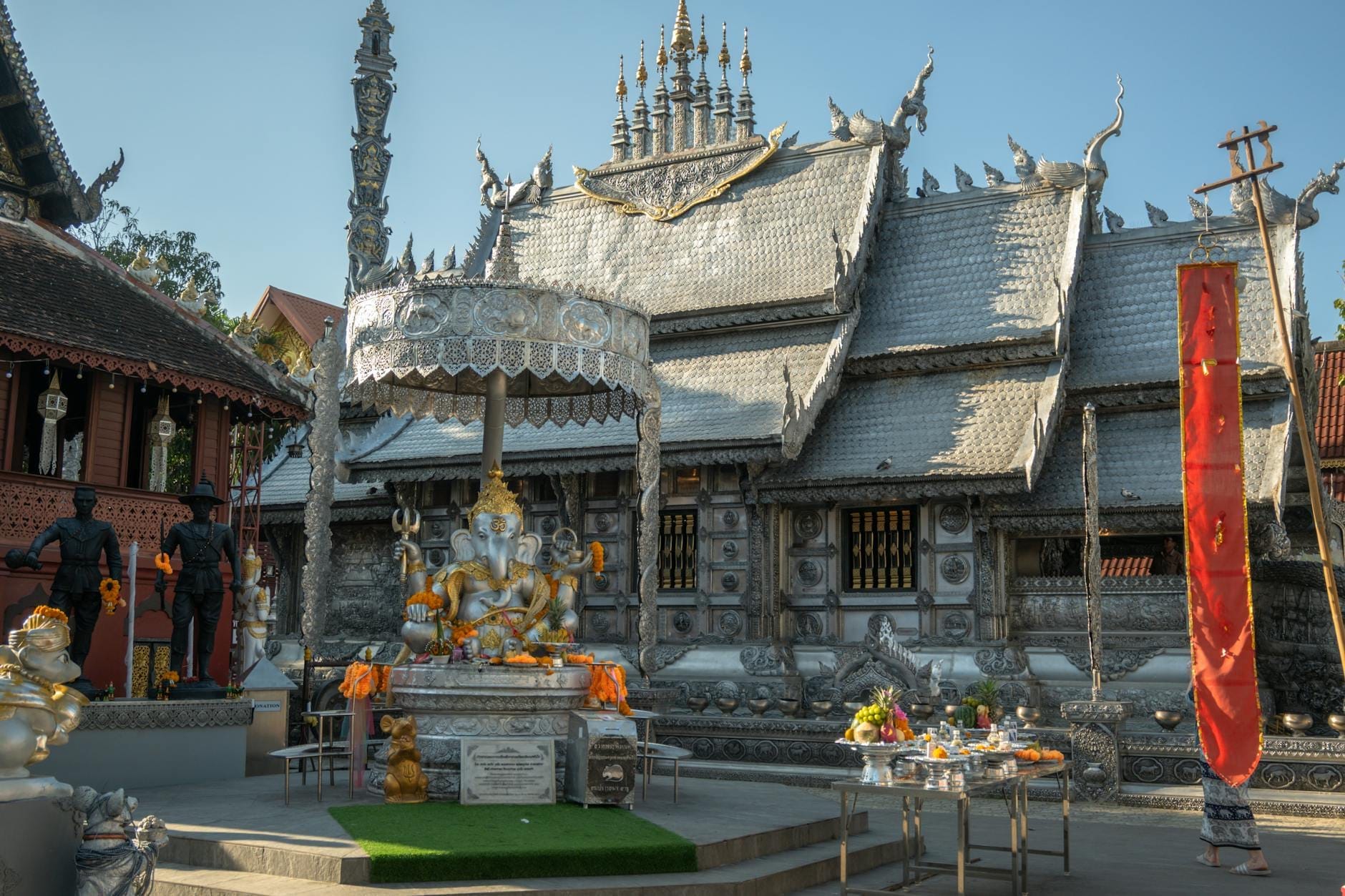
Most visitors to Chiang Mai tick off the same temple circuit: Wat Phra Singh, Wat Chedi Luang, Doi Suthep. Wat Sri Suphan sits just outside that loop, about 600–800 metres south of the Old City moat on Wualai Road, and most first-timers encounter it by accident, spotting the glint of silver through the trees while riding south. That first glimpse is genuinely arresting. The ordination hall (ubosot) looks as if it has been dipped in mercury: the entire exterior is encased in engraved silver and aluminium panels that catch sunlight from every angle, turning the building into something between a temple and a sculpture.
This is not a reconstruction or a novelty project. Wat Sri Suphan was founded in the early 16th century (often cited as around 1501–1502), making it one of the older active temples in Chiang Mai. The silver cladding is the result of continuous community craftsmanship, with local silversmiths from the Wualai silverworking district gradually adding and renewing panels over generations. The tradition is still ongoing: artisans continue to work on the temple today, and if you visit during weekday mornings you may see craftspeople adding new details to the structure. What you are looking at is not a finished monument but an evolving piece of collective art.
ℹ️ Good to know
Women are not permitted inside the ordination hall (ubosot) due to Buddhist tradition. The outer grounds, surrounding buildings, and the adjacent silver workshop areas are open to everyone.
The Architecture Up Close
The ubosot is the centrepiece. Walk slowly around the exterior before going in. The silver panels are not uniform: each section tells a different story through intricate bas-relief carvings. You will find mythological nagas coiling along the roof lines, Lanna-era deity figures framing doorways, and complex geometric lattices that reflect the silverworking vocabulary of northern Thailand. The aluminium panels used on some sections are deliberately chosen to withstand weathering while maintaining visual continuity with the older sterling silver pieces.
Inside, the effect is even more concentrated. The ceiling panels are covered in mirrored glass mosaic work that scatters light in every direction. A large golden Buddha image anchors the far end of the hall, flanked by smaller devotional figures and traditional Lanna offering arrangements. The contrast between the cool metallic exterior and the warm, gold-lit interior is deliberate and effective. This is a working ordination hall used for monk ceremonies, not a museum display, so the incense, candle smoke, and fresh flower offerings you encounter are part of daily religious life.
Photography inside the ubosot requires respect: move quietly, do not point cameras at monks during worship, and avoid flash photography. The exterior is far more photogenic in any case. For the best exterior shots, the north-west corner at mid-morning offers the most complete view with the roof lines fully lit. At noon, harsh overhead light flattens the detail; early morning and late afternoon give the silver its most dimensional appearance.
Tickets & tours
Live prices and dates from our booking partner. If you book, we may earn a commission at no extra cost to you.
Doi Inthanon National Park small group guided tour
From 34 €Instant confirmationFree cancellationHalf-day tour to admire elephants and enjoy Thai nature
From 48 €Instant confirmationFree cancellationChiang Mai - Chiang Dao Cave and 5 Hill Tribe villages
From 42 €Instant confirmationFree cancellationArt in Paradise Chiang Mai 3D Art Museum entrance tickets
From 8 €Instant confirmationFree cancellation
Time of Day and Crowd Patterns
Weekday mornings before 10 am are the quietest period. You may share the grounds with a handful of Thai worshippers, a monk or two tending plants, and occasionally one of the silversmiths working on a panel. The light is soft and raking, which brings out the depth of the engraved detail in a way that midday sun simply does not. This is also when you are most likely to observe the temple in its actual religious function rather than as a tourist spectacle.
Saturday afternoons and evenings draw a much larger crowd, because the temple sits on Wualai Road, which hosts Chiang Mai's Saturday Walking Street market from around 4 pm onwards. The combination of the market and the temple is genuinely worth planning around: you can visit the temple in the late afternoon, then step directly into the market as the stalls open. However, the temple grounds do get noticeably busier after 3 pm on Saturdays, and the mood shifts from contemplative to social. If you are after photographs without crowds, Saturday morning before noon is a better window.
💡 Local tip
Pair a Saturday afternoon temple visit with the Wualai Road Walking Street market immediately outside. Stalls selling handmade silver jewellery and northern Thai street food line the road from late afternoon, making this one of the most cohesive half-day itineraries in the city.
Cultural and Historical Context
Wualai Road has been the centre of Chiang Mai's silverworking community for centuries. The district's craftspeople traditionally supplied the royal courts of the Lanna Kingdom with silver ceremonial objects, jewellery, and decorative ware. Wat Sri Suphan was the neighbourhood temple for these artisans, and the decision to clad it in silver was as much a community statement of identity as it was a religious offering. This relationship between craft district and temple is unusually direct and historically traceable.
The Lanna Kingdom, which controlled northern Thailand from the 13th to 18th centuries, developed a distinct artistic tradition that differed substantially from the art of Bangkok and central Thailand. Lanna silverwork favours dense, layered surface decoration with mythological symbolism drawn from both Theravada Buddhist texts and older animist traditions. The panels at Wat Sri Suphan are a concentrated expression of that tradition, and studying them alongside the exhibits at the Lanna Folklife Museum provides useful comparative context.
For broader temple context in the city, the Chiang Mai temples guide gives a clear overview of how Wat Sri Suphan fits within the wider landscape of Lanna religious architecture. It also helps set expectations: this temple rewards slow attention rather than a quick walk-through.
Getting There and Getting In
Wat Sri Suphan sits on Wualai Road in the Hai Ya district, roughly 600–800 metres south of Chiang Mai Gate and the southern moat of the Old City. It is walkable from Chiang Mai Gate in about 10 minutes on a flat road, though the midday heat makes this uncomfortable between roughly 11 am and 3 pm from March through May. A tuk-tuk from the Old City costs 60–80 THB and takes under 10 minutes.
Entry to the ordination hall is 50 THB per person (men only). The surrounding temple grounds, the smaller chapels, and the areas near the silver workshop are accessible at no charge. Dress code is strictly enforced: shoulders and knees must be covered. Sarongs are sometimes available at the entrance, but bringing appropriate clothing avoids potential awkwardness. Shoes are removed before entering any building.
If you are staying near or exploring the Nimman area, factor in 20–25 minutes of travel time. The temple fits naturally into a morning that also includes the Saturday Walking Street on Wualai Road or a riverside stroll. For a structured route, a three-day Chiang Mai itinerary can help you slot the temple into a logical sequence with other sites.
⚠️ What to skip
Women cannot enter the ubosot (ordination hall). This is a firm religious boundary, not a guideline. The exterior viewing and all other parts of the compound are unrestricted. Plan accordingly if this is the primary draw for your visit.
The Silver Workshop and Craft Experience
Adjacent to the main temple buildings is a silverworking workshop where artisans demonstrate traditional techniques. This is not a performance staged for tourists: the craftspeople are doing actual production work, and visitors are watching over their shoulders. The sound of small hammers on silver sheet is a constant low rhythm across the compound during working hours. Finished pieces, including jewellery, small decorative panels, and ceremonial objects, are available for purchase directly from the workshop.
Buying silver directly here supports the artisans who maintain both the workshop and the temple itself. The quality is traceable and the prices are fair, though not bargain-level. If you are interested in the silverworking tradition more broadly, the stretch of Wualai Road immediately outside the temple gates has additional silver shops, most of them family-run businesses with multi-generational roots in the craft.
If handcraft shopping interests you beyond silver, the broader Chiang Mai shopping guide maps out the artisan districts worth visiting, including Bo Sang and Baan Tawai, which complement the Wualai silverworking tradition.
Who Should Manage Their Expectations
Wat Sri Suphan is genuinely distinctive, but the grounds are compact. Visitors expecting a sprawling complex like Wat Phra Singh or Wat Chedi Luang will find it smaller than anticipated. The main draw is the ubosot itself, plus the workshop, and neither takes long to appreciate in purely logistical terms. The value of the visit scales with how much attention you bring to the craft detail. If temples feel repetitive to you by day two or three of a trip, this one is different enough to justify a visit, but it will not convert someone who has temple fatigue.
The 50 THB entry fee applies only to the ubosot and only to men. Women who are the primary reason for the visit should weigh this carefully: the exterior is remarkable and freely viewable, but if entering the main hall is the goal, this temple will be a partial experience. Families with children will find the grounds pleasant and the workshop engaging, though young children tend to lose interest quickly without something interactive to do.
Insider Tips
- The best exterior photography window is roughly 8–9 am on weekdays: soft directional light, minimal crowds, and no harsh shadows flattening the engraved detail. A polarising filter, if you shoot with a DSLR or mirrorless camera, reduces glare on the silver panels significantly.
- If you visit on a Saturday, time your arrival for 2–3 pm: the market stalls on Wualai Road are just setting up, the temple is not yet at peak crowds, and you get both experiences in a single continuous afternoon without rushing.
- The workshop area sometimes offers short silverworking demonstrations where visitors can try basic hammering technique. Ask at the entrance or at the workshop itself; availability is not guaranteed but worth enquiring about.
- Check the lunar calendar before visiting: on Buddhist holy days (Wan Phra), the temple is significantly more active with Thai worshippers, the atmosphere is more ceremonial, and the grounds smell strongly of incense and jasmine garlands. A more immersive experience, though slightly less convenient for photography.
- Combine the visit with a walk down to the Ping River, about 15 minutes east on foot. The contrast between the dense silverwork of the temple and the open, quiet riverside is a good way to decompress after a concentrated visual experience.
Who Is Wat Sri Suphan (Silver Temple) For?
- Architecture and design enthusiasts who want to understand Lanna craft traditions at source
- Photographers looking for a photogenic temple with genuine structural uniqueness
- Travellers combining a Saturday afternoon with the Wualai Walking Street market
- Anyone with a specific interest in traditional Thai silversmithing and metalwork
- Visitors who have seen the major Old City temples and want something clearly different
Nearby Attractions
Other things to see while in Riverside (Ping River Area):
- Art in Paradise Chiang Mai (3D Art Museum)
Art in Paradise Chiang Mai is a large-format interactive 3D art museum located near the Riverside district. Visitors pose inside trompe-l'oeil paintings to create optical illusion photographs. It suits families, couples, and anyone looking for a lighthearted few hours indoors.
- Chiang Mai Night Bazaar
The Chiang Mai Night Bazaar is a sprawling commercial market district along Chang Khlan Road, drawing both tourists and locals with stalls selling handicrafts, clothing, street food, and souvenirs. It's well-organized and easy to navigate, but knowing what to expect prevents disappointment.
- Mae Ping River Cruises
The Mae Ping River has shaped Chiang Mai since the city's founding in 1296, and a river cruise remains one of the few ways to see the city from a genuinely different angle. Longboat and converted rice-barge tours depart from piers near Nawarat Bridge, passing riverside temples, colonial-era trading houses, and fruit orchards that survive within the city limits.
- Nawarat Bridge
Nawarat Bridge is one of Chiang Mai's most significant bridges across the Ping River, connecting the Old City to the eastern riverfront. More than just infrastructure, it serves as a daily gathering point, a photography landmark, and a quiet window into how the city actually moves.
Planning a trip? Discover personalized activities with the Nomado app.