Sunday Walking Street: Chiang Mai's Best Weekly Market on Ratchadamnoen Road
Every Sunday evening, Ratchadamnoen Road transforms into Chiang Mai's most atmospheric weekly market. From handmade silver jewelry to northern Thai street food and live folk music, the Sunday Walking Street draws both locals and travelers into the heart of the Old City for hours of slow wandering.
Quick Facts
- Location
- Ratchadamnoen Road, Chiang Mai Old City
- Getting There
- Songthaew or tuk-tuk to Tha Phae Gate; market starts just west of the gate
- Time Needed
- 2–4 hours depending on your pace
- Cost
- Free entry; food from 30–80 THB, crafts vary widely
- Best for
- Craft shopping, street food, Old City atmosphere, Sunday evening plans
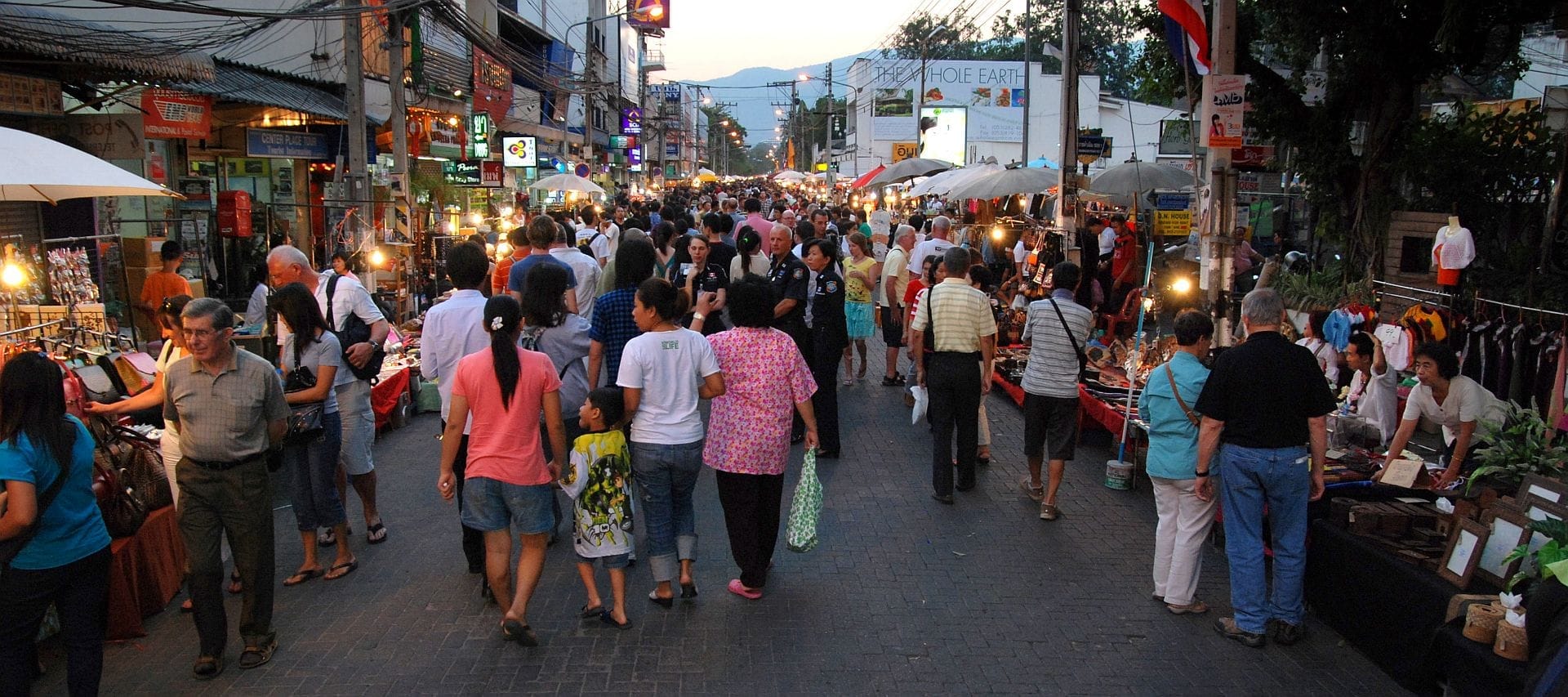
What the Sunday Walking Street Actually Is
Every Sunday from roughly 4:00 PM until around 11:00 PM, Ratchadamnoen Road, the Old City's main ceremonial avenue, closes to traffic and fills with approximately 1.1 kilometers of stalls. The Sunday Walking Street is one of Chiang Mai's longest-running weekly markets and remains one of the most genuinely local experiences in the city center. Unlike some markets that have shifted entirely toward tourist goods, this one still draws a strong Thai crowd, particularly in the hours after 6:00 PM when families and young Thais arrive after dinner.
The market stretches from Tha Phae Gate westward through the Old City, past temples, side street spurs, and food clusters. The full length takes roughly 30–40 minutes to walk at a comfortable pace without stopping, though most visitors take two to three times that once they start browsing.
💡 Local tip
Arrive by 5:00 PM for the best stall selection and cooler temperatures. By 7:00 PM the road is at peak density and navigation becomes slow. If you're there purely for atmosphere and food, 6:30–8:00 PM is ideal.
The Layout: How to Navigate the Market
The market is broadly linear but not uniform. The eastern stretch near Tha Phae Gate tends to concentrate clothing, printed fabrics, and souvenir-style goods. As you move west toward Wat Phra Singh, the stalls shift toward handmade crafts: silverwork, woodcarving, lacquerware, hand-painted ceramics, and woven textiles that reflect Chiang Mai's traditional craft heritage. Prices generally get more negotiable the further west you go, partly because foot traffic is lighter there.
Food stalls are spread throughout but cluster at a few points, particularly around the temple courtyards. Wat Phan Tao and Wat Chedi Luang both sit along the route, and their forecourts become informal seating areas where vendors set up khao soi carts, grilled skewer stands, and dessert stalls. The temple lighting at dusk turns these spots into genuinely beautiful eating areas.
Side streets off Ratchadamnoen Road also open up for the market. These smaller lanes often have lower-priced and more distinctive goods than the main strip. If you're looking for the kind of patient craft shopping that rewards exploration, see our Chiang Mai shopping guide for context on what to prioritize.
Tickets & tours
Live prices and dates from our booking partner. If you book, we may earn a commission at no extra cost to you.
Doi Inthanon National Park small group guided tour
From 34 €Instant confirmationFree cancellationHalf-day tour to admire elephants and enjoy Thai nature
From 48 €Instant confirmationFree cancellationChiang Mai - Chiang Dao Cave and 5 Hill Tribe villages
From 42 €Instant confirmationFree cancellationArt in Paradise Chiang Mai 3D Art Museum entrance tickets
From 8 €Instant confirmationFree cancellation
What to Buy: Crafts and Quality Worth Your Attention
The Sunday Walking Street has a reputation for quality that exceeds most of Chiang Mai's other markets. Northern Thailand has centuries of craft tradition, and a portion of the vendors here are actual makers rather than resellers. Look for: natural-dye cotton scarves and clothing from hill tribe communities, hand-stamped silver jewelry (watch for vendors working at their benches, a strong sign of authenticity), lacquerware bowls with traditional Lanna geometric patterns, and hand-carved wooden items ranging from functional to decorative.
Mass-produced goods are also present, particularly near the Tha Phae Gate end, so a slow walk before committing to purchases helps calibrate your sense of what is handmade and what is imported factory work. When a price seems startlingly low for something that looks hand-finished, it usually is. Vendor tables displaying tools, unfinished pieces, or material scraps tend to be more trustworthy sources.
ℹ️ Good to know
Bargaining is expected but should be moderate. The Sunday market attracts sellers who price with some flexibility in mind, but hard haggling on small items (under 200 THB) is considered poor form. A polite smile and a counter-offer of 10–20% below the asking price is the norm.
Street Food: What to Eat and Where to Find It
The food at the Sunday Walking Street skews heavily northern Thai, which separates it from the more generic pad thai and spring roll circuit found at tourist-facing markets. Look for: khao soi (the coconut curry noodle soup that defines Chiang Mai cuisine), sai ua (northern-style pork sausage grilled over charcoal, with lemongrass and kaffir lime leaf), kanom krok (small coconut pancakes cooked in cast iron molds), and mango sticky rice served with freshly extracted coconut milk.
Temple forecourts along the route are the best spots to eat with a view. Grab something from a nearby vendor and find a spot on the steps or along the low walls around the temple grounds. This is where you'll see local families doing exactly the same thing, which is as good a sign of quality as any.
The Sunday market is a good introduction to northern Thai flavors, but if you want to go deeper into the food scene around the Old City, the Chiang Mai food guide covers regional specialties and where to find the best versions of each dish.
Atmosphere by Time of Day
The market opens in full daylight, which strips some of the atmosphere but allows better visual inspection of goods. Early arrivals (4:00–5:30 PM) get first pick of stalls, cooler air, and easier movement. This window is best for serious shoppers.
After 6:00 PM, as the sun drops and the temperature follows, the energy changes noticeably. String lights, paper lanterns, and the golden glow from temple spotlights give Ratchadamnoen Road a completely different character. The music from folk musicians playing traditional instruments gets louder as the crowd thickens. The smell of charcoal grilling and flower garlands shifts from background to foreground. This is the market's peak sensory hour, and for most visitors, worth experiencing even if it means slower movement.
By 9:00 PM, some stalls begin packing up, and the western end near Wat Phra Singh quiets first. The eastern section near Tha Phae Gate stays active until closing. If you're planning dinner afterward in the Old City, 9:00–9:30 PM is a natural exit point when the market thins but nearby restaurants are still fully operational.
⚠️ What to skip
During the hot season (March–May), the 4:00–6:00 PM stretch can be genuinely uncomfortable, with temperatures above 35°C and little shade on the main road. Carry water, wear light clothing, and consider arriving at 6:00 PM rather than earlier during this period. The burning season (roughly February–April) also affects air quality, which may bother visitors sensitive to smoke.
Historical and Cultural Context
Ratchadamnoen Road was constructed as part of the modernization of Chiang Mai's Old City in the early 20th century, running through the heart of the walled city that dates to around 1296. The road passes directly by some of Chiang Mai's most significant temples, including Wat Chedi Luang and Wat Phra Singh, giving the Sunday market a setting that few street markets anywhere can match.
The walking street format was established in the early 2000s as a managed alternative to unregulated street vending, and it has become a significant economic channel for Chiang Mai's craft community. The market is organized and permits are required, which partially explains the higher average quality compared to informal markets. It also gives the event a consistency: the same vendors appear in roughly the same locations week after week, which builds a kind of local familiarity that you can sense on the ground.
Getting There, Getting Around, and Practical Notes
The most convenient approach is a red songthaew (shared pickup truck taxi) or tuk-tuk to Tha Phae Gate, the market's eastern anchor. Songthaews running through the Old City circuit cost 30–60 THB per person depending on distance and negotiation. Ride-hailing apps (Grab) are reliable for fixed-price trips to the gate from most parts of the city.
Parking is not advisable: streets surrounding the Old City fill completely on Sunday evenings, and the time lost finding a spot defeats any convenience gained. Visitors staying in Old City guesthouses can walk the market end-to-end and back in a relaxed evening without any transport needed.
Accessibility: the road surface is paved and generally flat, making wheelchairs and strollers physically manageable, but the crowd density from 6:30 PM onward makes navigation genuinely difficult for anyone with limited mobility. Early arrival resolves most of this. The market is dog-friendly, and you will encounter leashed pets in the crowd regularly.
💡 Local tip
Cash is essential. While a handful of craft vendors have adopted QR code payments, the majority of the market, especially food stalls, operates on cash only. There are ATMs near Tha Phae Gate and along the road into the Old City.
Insider Tips
- Start from the Wat Phra Singh end (western) rather than Tha Phae Gate if you're arriving after 6:00 PM. The crowd flows predominantly east to west, so walking against the flow gives you clearer views of stalls and easier conversation with vendors.
- The side street spurs off Ratchadamnoen Road often have the most interesting finds and the least foot traffic. Wualai Road (the silver street) is one block south and worth adding to your route if silverwork is a priority.
- Vendors who display a price card without pressure tactics and have consistent pricing tend to be craft makers rather than resellers. Spend a few minutes watching how they interact with other customers before approaching.
- If you want to photograph the market at its most visually compelling, position yourself near one of the lit temple gates just after sunset (around 6:30–7:00 PM) when the light balance between the warm artificial lighting and the remaining blue sky is at its best.
- Many Old City restaurants close their kitchens early on Sunday because staff attend the market. Plan a dinner reservation in advance if you want to eat at a specific restaurant after the market winds down.
Who Is Sunday Walking Street (Ratchadamnoen Road) For?
- Craft and textile shoppers looking for handmade northern Thai goods with real provenance
- Food travelers wanting to sample a wide range of northern Thai street food in one evening
- Photographers working in available light, especially around the temple forecourts after sunset
- First-time visitors to Chiang Mai who want a single evening that captures the city's Old City character
- Couples looking for a slow, atmospheric Sunday evening without a fixed itinerary
Nearby Attractions
Other things to see while in Old City (Chiang Mai Old Town):
- Chang Phuak Night Market (North Gate Food Market)
Chang Phuak Night Market, known to locals as the North Gate Food Market, is a compact open-air street food gathering outside Chiang Mai's ancient city walls. Night after night, it draws a faithful crowd of students, office workers, and savvy travelers in search of authentic northern Thai cooking at prices that haven't caught up with the tourist economy.
- Chiang Mai City Arts and Cultural Centre
Housed in a beautifully restored colonial-era building on the edge of the Old City's Three Kings Monument plaza, the Chiang Mai City Arts and Cultural Centre offers one of the most accessible and well-curated introductions to Lanna history and northern Thai culture. It rewards both first-time visitors and those who want genuine context before exploring the city's temples and neighborhoods.
- Chiang Mai City Walls and Moat
The rectangular moat and surviving brick walls of Chiang Mai's Old City are the physical outline of a 700-year-old Lanna capital. Free to explore at any hour, they offer one of the most atmospheric walks in northern Thailand, framing temples, corner bastions, and four ceremonial gates.
- Chiang Mai National Museum
The Chiang Mai National Museum offers one of the clearest introductions to northern Thailand's Lanna Kingdom, covering 700 years of history through royal artifacts, Buddhist sculpture, ceramics, and ethnographic collections. It's calm, well-organized, and genuinely undervisited compared to the temples nearby.
Planning a trip? Discover personalized activities with the Nomado app.