Chiang Mai City Arts and Cultural Centre: Lanna History in a Colonial Masterpiece
Housed in a beautifully restored colonial-era building on the edge of the Old City's Three Kings Monument plaza, the Chiang Mai City Arts and Cultural Centre offers one of the most accessible and well-curated introductions to Lanna history and northern Thai culture. It rewards both first-time visitors and those who want genuine context before exploring the city's temples and neighborhoods.
Quick Facts
- Location
- Phra Pokklao Road, Old City, Chiang Mai (facing Three Kings Monument)
- Getting There
- 10-minute walk from Tha Phae Gate; accessible by red songthaew along Phra Pokklao Rd
- Time Needed
- 1.5 to 2.5 hours
- Cost
- 90 THB adults / 40 THB children (combined ticket with nearby Lanna Folklife Museum available)
- Best for
- History lovers, architecture admirers, first-time visitors wanting cultural context
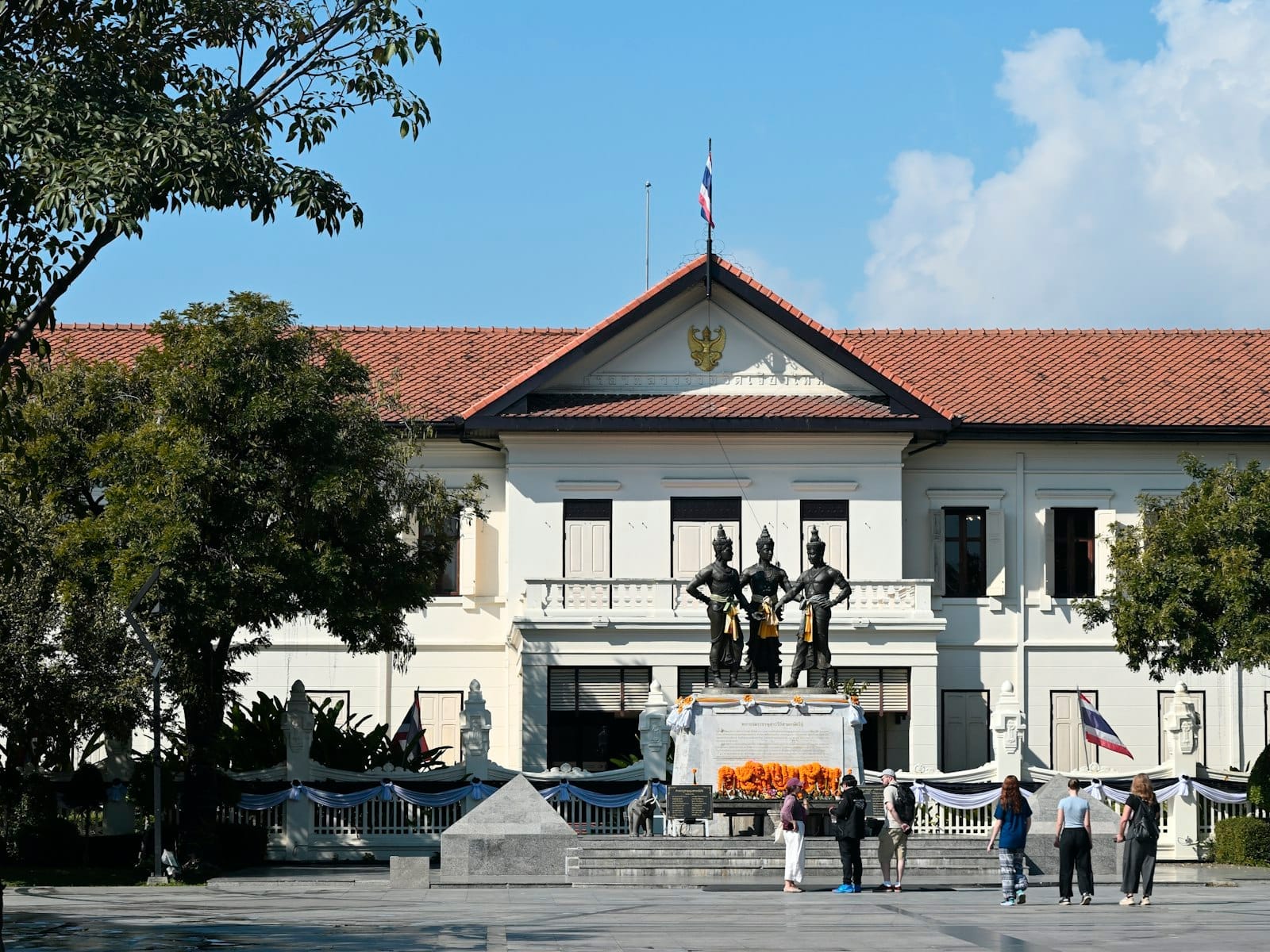
First Impressions: The Building Before You Go Inside
The Chiang Mai City Arts and Cultural Centre announces itself before you reach the entrance. The structure is a pale stucco former provincial hall built in the 1920s during the early decades of Siamese administrative consolidation in the north. It sits on the northern edge of the Three Kings Monument plaza, and its symmetrical European-influenced facade, with arched windows and a wide central portico, stands in deliberate contrast to the Lanna temple architecture surrounding the Old City. The building itself is part of the story on display inside.
Approaching from the plaza, especially in the morning when the light hits the pale walls directly, the scene is genuinely photogenic without requiring a telephoto lens. The manicured grounds and the bronze statue grouping of the Three Kings in the forecourt give the whole ensemble a civic weight that most tourists photograph from the outside but fewer actually enter. That is worth noting: the interior consistently rewards the effort more than the exterior suggests.
💡 Local tip
Buy a combined ticket at the entrance to include the Lanna Folklife Museum next door. The two collections complement each other well and the combined price is significantly better value than purchasing separately.
What the Permanent Collection Actually Shows You
The ground floor is organized chronologically and thematically, walking visitors through the prehistoric origins of settlement in the northern valleys, through the founding of the Lanna Kingdom under King Mengrai in 1296, and into the complex centuries of Burmese rule, Siamese integration, and eventual modernization. The timeline panels are in both Thai and English, with a level of translation quality that is above average for provincial museums in Thailand.
One of the collection's strongest sections covers daily life in traditional Lanna society: agricultural cycles, trade routes connecting Chiang Mai to Yunnan and the Shan States, and the role of Buddhist monasteries as centers of education and manuscript preservation. Scale models, textile displays, and replica household objects make abstract history tangible. The Lanna script panels are worth pausing over even if you cannot read them, because the visual difference from central Thai script is striking and points to how genuinely distinct Lanna culture was.
The upper floor shifts toward more recent history, covering the teak trade era of the late 19th century, the arrival of Christian missionaries, and the 1932 constitutional transition. For visitors who find Thai national history difficult to follow without context, this museum provides exactly the scaffolding needed before wandering through the Old City's streets and temples.
If you plan to spend serious time with Chiang Mai's temple circuit afterward, the material here will significantly change how you read the buildings. The exhibition explains the architectural evolution of Lanna-style chedis and viharns in terms concrete enough to recognize features at places like Wat Chedi Luang or Wat Phra Singh, both a short walk away.
Tickets & tours
Live prices and dates from our booking partner. If you book, we may earn a commission at no extra cost to you.
Cultural experience in Chiang Mai with northern Thai dinner
From 93 €Instant confirmationFree cancellationChiang Mai - Chiang Dao Cave and 5 Hill Tribe villages
From 42 €Instant confirmationFree cancellationArt in Paradise Chiang Mai 3D Art Museum entrance tickets
From 8 €Instant confirmationFree cancellationChiang Mai temples and night market tuk-tuk tour
From 23 €Instant confirmationFree cancellation
How the Experience Changes by Time of Day
The museum opens at 8:30 AM and the first hour is noticeably quieter than midday. Local school groups tend to arrive between 9:00 and 11:00 AM on weekdays, which fills certain rooms with noise but adds a certain energy. If you prefer a contemplative pace, aim for opening time or after 2:00 PM when group tours have typically moved on.
The air conditioning inside is reliable and cool, which makes this one of the more practical midday stops during Chiang Mai's hot season, roughly March through May. If you are planning a full Old City walking day, slotting the museum in at the hottest part of the afternoon gives your legs a rest while keeping the experience genuinely productive. The galleries are well lit with controlled artificial light to protect the textile and manuscript displays, so the difference between morning and afternoon visits is more about crowd volume than visual quality.
⚠️ What to skip
During the March-April burning season, outdoor air quality in Chiang Mai can drop significantly. The museum's interior air conditioning makes it a practical refuge on high-AQI days, but check the AQI forecast before planning any outdoor walking in the Old City area.
The Building as an Artifact: Architecture and Colonial History
The building’s 1920s construction date is significant. Chiang Mai was formally incorporated into the Siamese administrative system in stages following the 1884 treaty that ended the semi-autonomous Lanna state. The provincial hall that became this museum was part of Bangkok's deliberate effort to impose a visible bureaucratic presence on the northern capital. The building's neoclassical vocabulary, unusual in a city of tiered-roof temples, was an architectural statement of central authority.
Walking through its rooms today, with exhibitions celebrating the very Lanna identity the building once represented the suppression of, creates a quiet irony that the curatorial team seems aware of. The introductory panels address this history without excessive delicacy, which is a mark of institutional confidence. The building's long verandas, high ceilings, and thick walls demonstrate colonial-era passive cooling logic that keeps the interior 3 to 4 degrees cooler than the street even without mechanical assistance.
Practical Walkthrough: Navigation and Logistics
The museum is not large by international standards. Two floors of galleries can be covered in 90 minutes at a moderate pace, or stretched to 2.5 hours if you read every panel and examine the object cases closely. There is no audio guide, which is a genuine gap, but the English text is detailed enough to compensate for most visitors. A small gift shop near the entrance sells books on Lanna history and culture, some of which are difficult to find elsewhere.
Accessibility is limited. The ground floor has level entry but the site is not fully accessible by wheelchair. The upper floor is reached by a wide central staircase, and there is a small elevator that staff can unlock on request. The toilets are clean and well-maintained, located near the entrance lobby. Photography is permitted throughout the galleries without flash, and the lighting conditions are good enough for competent smartphone shots of the display cases.
The museum sits on Phra Pokklao Road, making it easy to combine with other Old City sights. The Three Kings Monument is directly in front of the entrance. The Lanna Folklife Museum is immediately to the east, sharing the same civic plaza. The Chiang Mai National Museum offers deeper archaeological coverage if the history exhibitions here leave you wanting more detail.
Who Will Get the Most from This Museum, and Who Might Not
Visitors who invest 10 minutes reading the introductory gallery panels before walking the rest of the collection consistently report a better experience than those who move directly to objects. The museum rewards a reading visitor. If your preference is for sensory or immersive heritage experiences rather than interpretive text and artifact cases, the museum may feel dry. For that profile, the Sunday Walking Street or the craft village at Baan Kang Wat will deliver more atmosphere.
Families with young children under eight may find the text-heavy format challenging, though the scale models and replica environments on the ground floor provide enough visual interest for a 45-minute visit without losing small visitors entirely. For other family-friendly options in the Old City area, the Chiang Mai with kids guide covers alternatives suited to different age groups.
For first-time visitors to northern Thailand, the Cultural Centre functions as the clearest available orientation to what makes Chiang Mai's history distinct from Bangkok's. That context pays dividends across an entire trip, which is why it belongs near the beginning of any Old City itinerary rather than treated as an afterthought.
Insider Tips
- Ask staff at the entrance desk about temporary exhibitions. The museum hosts periodic shows on Lanna textiles, ceramics, and contemporary northern Thai art that are not listed on most travel sites.
- The plaza benches outside the museum face the Three Kings Monument and catch morning shade. They are a practical spot to review your notes or plan the rest of your Old City walk before the midday heat sets in.
- The small bookshop near the entrance stocks academic titles on Lanna history and northern Thai architecture. Several of these are published in limited runs and are genuinely difficult to find online or in Bangkok bookstores.
- The combined museum ticket also covers the Lanna Folklife Museum next door. Start at the Cultural Centre for historical context, then cross to the Folklife Museum for object-focused material on traditional crafts, ceremonies, and rural life.
- If you visit during the Flower Festival in February, the plaza outside hosts additional displays and the museum occasionally adjusts its programming. Check the official Chiang Mai city website for seasonal schedule changes.
Who Is Chiang Mai City Arts and Cultural Centre For?
- First-time visitors wanting a coherent introduction to Chiang Mai's history before exploring temples and neighborhoods
- Architecture enthusiasts interested in the colonial-era built environment of northern Thailand
- History and culture travelers who engage with interpretive text and artifact collections
- Visitors seeking a productive, air-conditioned stop during the hot or smoky season
- Travelers building a full Old City walking day who want a structured anchor point near the Three Kings Monument
Nearby Attractions
Other things to see while in Old City (Chiang Mai Old Town):
- Chang Phuak Night Market (North Gate Food Market)
Chang Phuak Night Market, known to locals as the North Gate Food Market, is a compact open-air street food gathering outside Chiang Mai's ancient city walls. Night after night, it draws a faithful crowd of students, office workers, and savvy travelers in search of authentic northern Thai cooking at prices that haven't caught up with the tourist economy.
- Chiang Mai City Walls and Moat
The rectangular moat and surviving brick walls of Chiang Mai's Old City are the physical outline of a 700-year-old Lanna capital. Free to explore at any hour, they offer one of the most atmospheric walks in northern Thailand, framing temples, corner bastions, and four ceremonial gates.
- Chiang Mai National Museum
The Chiang Mai National Museum offers one of the clearest introductions to northern Thailand's Lanna Kingdom, covering 700 years of history through royal artifacts, Buddhist sculpture, ceramics, and ethnographic collections. It's calm, well-organized, and genuinely undervisited compared to the temples nearby.
- Lanna Folklife Museum
Housed in a beautifully restored colonial-era courthouse in Chiang Mai's Old City, the Lanna Folklife Museum offers one of the clearest windows into northern Thailand's distinct culture, traditions, and belief systems. If you want context before visiting the region's temples and villages, this is where to start.
Planning a trip? Discover personalized activities with the Nomado app.