Chiang Mai City Walls and Moat: Walking the Ancient Boundaries of the Old City
The rectangular moat and surviving brick walls of Chiang Mai's Old City are the physical outline of a 700-year-old Lanna capital. Free to explore at any hour, they offer one of the most atmospheric walks in northern Thailand, framing temples, corner bastions, and four ceremonial gates.
Quick Facts
- Location
- Perimeter of Chiang Mai Old City, Chiang Mai
- Getting There
- Songthaew or tuk-tuk to Tha Phae Gate; walkable from most Old City guesthouses
- Time Needed
- 45 min (one gate) to 3 hours (full perimeter walk)
- Cost
- Free
- Best for
- History lovers, morning walkers, photographers, cyclists
What You're Actually Looking At
The Chiang Mai City Walls and Moat form a near-perfect square roughly 1.6 kilometers on each side, enclosing the heart of what was once the capital of the Lanna Kingdom. King Mangrai founded the city in 1296 CE, and the original earthen ramparts and water channels were constructed as both defensive infrastructure and a cosmological statement: the square layout aligned with cardinal directions and reflected Lanna Buddhist principles of sacred urban planning.
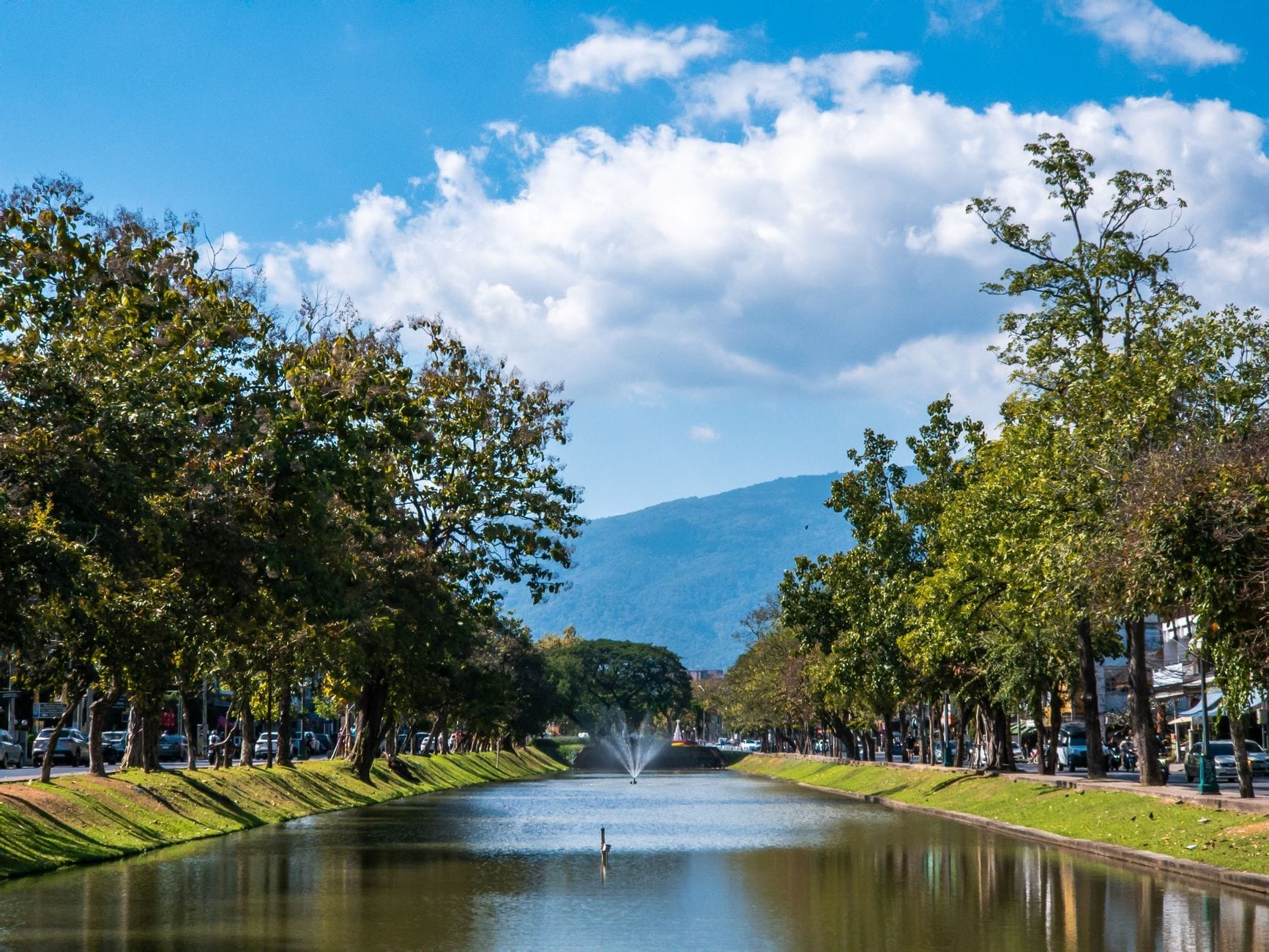
What survives today is a combination of original laterite brick sections and extensive 20th-century restoration work. The moat itself is continuous and easily the most visually commanding element: roughly 20 meters wide, it encircles the Old City and is fed by channels connected to the Ping River. The walls behind it range from heavily reconstructed stretches to short fragments of genuinely aged brick, identifiable by their dark, moss-tinged surface and irregular coursing.
ℹ️ Good to know
Honest context: significant portions of the visible wall are 1980s-era reconstructions, not original 13th-century masonry. Historians and preservation advocates have noted the restorations prioritized appearance over archaeological accuracy. The moat, however, follows its original alignment and is genuinely ancient in its geography.
The Four Gates and the Corner Bastions
Each side of the square features one main gate. Tha Phae Gate on the eastern wall is the most prominent: a broad ceremonial archway reconstructed in 1985 that faces toward the Ping River and the old trading quarter beyond. It is the de facto symbolic entrance to the Old City and the site of Songkran celebrations, markets, and festivals throughout the year. The open plaza in front of it tends to collect food cart vendors in the early evening and becomes a natural gathering spot after dark.
The other three gates, Suan Dok Gate (west), Chang Phuak Gate (north), and Chiang Mai Gate (south), are quieter and less photographed. Chang Phuak Gate sits at the end of the road leading to the famous Chang Phuak Night Market, making it a useful landmark for evening navigation. Chiang Mai Gate anchors the southern side near a small but well-regarded weekend food market that local residents favor over the more tourist-oriented night markets.
At each corner of the square stands a bastion: a raised, square platform that once supported defensive structures. All four survive in some form. The northeast bastion near Tha Phae Gate is the most accessible and gives a slightly elevated view along the moat. The northwest bastion, by contrast, sits on a quieter stretch where morning light reflects cleanly off the water and foot traffic is minimal even at peak hours.
Tickets & tours
Live prices and dates from our booking partner. If you book, we may earn a commission at no extra cost to you.
Chiang Mai - Chiang Dao Cave and 5 Hill Tribe villages
From 42 €Instant confirmationFree cancellationArt in Paradise Chiang Mai 3D Art Museum entrance tickets
From 8 €Instant confirmationFree cancellationChiang Mai temples and night market tuk-tuk tour
From 23 €Instant confirmationFree cancellationGolden Triangle and White Temple guided tour from Chiang Mai
From 79 €Instant confirmationFree cancellation
Walking the Perimeter: What to Expect
The full perimeter is approximately 6 kilometers if you follow the outer moat road continuously. That translates to 75 to 90 minutes of walking at a relaxed pace, or around 30 minutes by bicycle. The pavement varies considerably: the eastern stretch near Tha Phae Gate is wide and well-maintained with good sightlines to the wall; the western and northern stretches narrow in places and share space with slow-moving traffic and parked motorbikes.
Cycling is arguably the most satisfying way to complete the circuit. Bicycle rental shops cluster around Tha Phae Gate and along Nimman Road, offering basic city bikes for around 50 to 80 baht per day. Early morning, between 6:00 and 8:00 AM, the moat road carries almost no vehicle traffic and the light is soft and directional. Monks returning from alms rounds cross the side streets at intervals, and the sound of temple bells from inside the Old City carries clearly through the stillness.
💡 Local tip
Cycling the moat is best done counterclockwise (heading north from Tha Phae Gate) to keep the moat on your left and the wall within easy view throughout the ride. This also puts you against the light in early morning, which is preferable for photography on the east side.
Those on foot are better served by choosing a single stretch rather than attempting the full perimeter in one go. The eastern wall between Tha Phae Gate and the northeast corner bastion is the most concentrated for historic fabric and canal reflections. The southern wall between Chiang Mai Gate and the southeast bastion is less visited and offers a more everyday neighborhood atmosphere, with local coffee shops and small guesthouses spilling out onto the pavement.
How the Experience Changes Through the Day
Sunrise, roughly 6:00 to 6:45 AM depending on season, is the hour when the moat behaves like a mirror. The water is typically still before traffic vibrations and wind disturb it, and the reflections of the wall and the bougainvillea planted along the embankment are at their sharpest. Exercise groups, elderly residents doing tai chi near the corner bastions, and runners using the moat road as a track are the primary company at this hour.
Midday is the least rewarding time. The walls look bleached and flat under overhead sun, the moat water loses its reflective quality, and the heat between March and May can be genuinely punishing on the exposed outer road. If visiting during the burning season (roughly February through April), the sky haze also reduces photographic contrast significantly.
Late afternoon, around 4:30 to 6:00 PM, brings warm side light that restores color and shadow to the brickwork. This is when the moat road sees its most diverse crowd: delivery drivers, students, tourists doing the same circuit walk, and vendors setting up near the gates. It connects naturally to an evening in the Old City, with the Sunday or Saturday walking streets accessible directly from the southern and western gates.
Cultural and Historical Depth
The walls were not just military infrastructure. The gates each carried specific ceremonial functions in Lanna tradition: Tha Phae Gate faced east toward the rising sun and served as the royal entrance for processions from the river, while Suan Dok Gate on the west was historically associated with the exit of royal funerary processions toward Wat Suan Dok temple beyond the walls. This directional symbolism is rooted in Lanna cosmology and distinguishes Chiang Mai's layout from purely utilitarian fortifications.
The moat also played a spiritual role. In the Songkran water festival, the moat water is considered blessed, and water from it is ceremonially used during the New Year celebrations in April. If you are visiting during this period, expect the Tha Phae Gate plaza and moat road to become the center of enormous street celebrations. See the Chiang Mai Songkran guide for crowd and timing details.
Inside the walls, the density of Lanna-era temples is remarkable: Wat Chedi Luang, Wat Phra Singh, and Wat Chiang Man all sit within a short walk of each other and the wall interior. The walls effectively function as the outer frame of one of the highest concentrations of historic Buddhist architecture in Southeast Asia.
Photography Notes and Practical Details
For photography, the northeast corner bastion offers the best composition: the moat curves slightly at the corner, allowing a diagonal line of water framed by the reconstructed wall to appear in the same frame. The lotus pond near Tha Phae Gate is occasionally present depending on seasonal water levels. See the Chiang Mai photography guide for additional location-specific shooting advice.
Accessibility is uneven around the full perimeter. The moat road is flat and continuous, but footpath width and surface quality vary. Sections near Chang Phuak Gate are particularly narrow and shared with motorbike traffic. Wheelchair access is practical only on the wider eastern and southern stretches. There are no formal visitor facilities on the moat road itself, but cafes and convenience stores are within easy reach at each gate.
⚠️ What to skip
Do not enter the moat water. It is not maintained for swimming, the bottom is uneven, and canal debris makes it a health risk. The moat is a visual and cultural feature, not a recreational water body.
Who This Attraction Is and Is Not For
The walls and moat work best as context for a broader Old City visit rather than a standalone destination. Travelers who appreciate layered history and want a frame of reference for the temples inside the walls will find the circuit genuinely rewarding. Photographers, early-morning walkers, and cyclists get particular value from it.
Visitors expecting a well-preserved medieval fortification similar to European city walls will be disappointed. The reconstruction history is significant, and there is no wall-top walkway, no museum embedded in the structure, and no formal interpretive signage along the moat road. If detailed historical context is important to you, combine the moat walk with a visit to the Lanna Folklife Museum or the Chiang Mai City Arts and Cultural Centre, both of which provide the historical depth that the walls themselves cannot.
The walls also hold limited appeal on their own for families with young children, unless combined with a tuk-tuk or bicycle ride that children can participate in. For broader family planning in the city, the Chiang Mai with kids guide covers more targeted options.
Insider Tips
- The northwest corner bastion, near the junction of Mani Nopharat Road and Chotana Road, is almost always empty of tourists and offers the cleanest, least obstructed view of the moat wall with banana and palm trees framing the water.
- Local cycling groups complete the moat circuit as a morning exercise route starting around 6:00 AM on weekends. Joining the loose flow of cyclists gives the ride a community feel that solo tourist exploration usually lacks.
- Chiang Mai Gate's small morning food market (open roughly 6:00 to 10:00 AM) serves some of the most affordable khao tom (rice soup) and northern Thai breakfast dishes in the city. It is primarily patronized by residents, not tourists, and prices reflect that.
- The moat reflects the full moon remarkably well. A late-evening walk on the full moon night, particularly on the eastern stretch, combines the wall's silhouette with the lunar reflection in the still water.
- If you want original, unrestored wall sections, look for the darker, smaller-format laterite bricks with visible age staining and irregular pointing. These occur most frequently on the inner face of the wall, visible from inside the Old City rather than from the moat road.
Who Is Chiang Mai City Walls and Moat For?
- Photographers seeking early morning reflections and atmospheric light on historic structures
- Cyclists who want a flat, scenic loop that doubles as an orientation circuit of the Old City
- History and architecture travelers building context before exploring the temples inside the walls
- Runners and walkers looking for a meaningful morning route with cultural scenery
- Festival visitors during Songkran or Yi Peng, when the gates and moat become ceremonial centerpieces
Nearby Attractions
Other things to see while in Old City (Chiang Mai Old Town):
- Chang Phuak Night Market (North Gate Food Market)
Chang Phuak Night Market, known to locals as the North Gate Food Market, is a compact open-air street food gathering outside Chiang Mai's ancient city walls. Night after night, it draws a faithful crowd of students, office workers, and savvy travelers in search of authentic northern Thai cooking at prices that haven't caught up with the tourist economy.
- Chiang Mai City Arts and Cultural Centre
Housed in a beautifully restored colonial-era building on the edge of the Old City's Three Kings Monument plaza, the Chiang Mai City Arts and Cultural Centre offers one of the most accessible and well-curated introductions to Lanna history and northern Thai culture. It rewards both first-time visitors and those who want genuine context before exploring the city's temples and neighborhoods.
- Chiang Mai National Museum
The Chiang Mai National Museum offers one of the clearest introductions to northern Thailand's Lanna Kingdom, covering 700 years of history through royal artifacts, Buddhist sculpture, ceramics, and ethnographic collections. It's calm, well-organized, and genuinely undervisited compared to the temples nearby.
- Lanna Folklife Museum
Housed in a beautifully restored colonial-era courthouse in Chiang Mai's Old City, the Lanna Folklife Museum offers one of the clearest windows into northern Thailand's distinct culture, traditions, and belief systems. If you want context before visiting the region's temples and villages, this is where to start.
Planning a trip? Discover personalized activities with the Nomado app.