Wat Phan Tao: Chiang Mai's Quiet Teak Temple Worth Finding
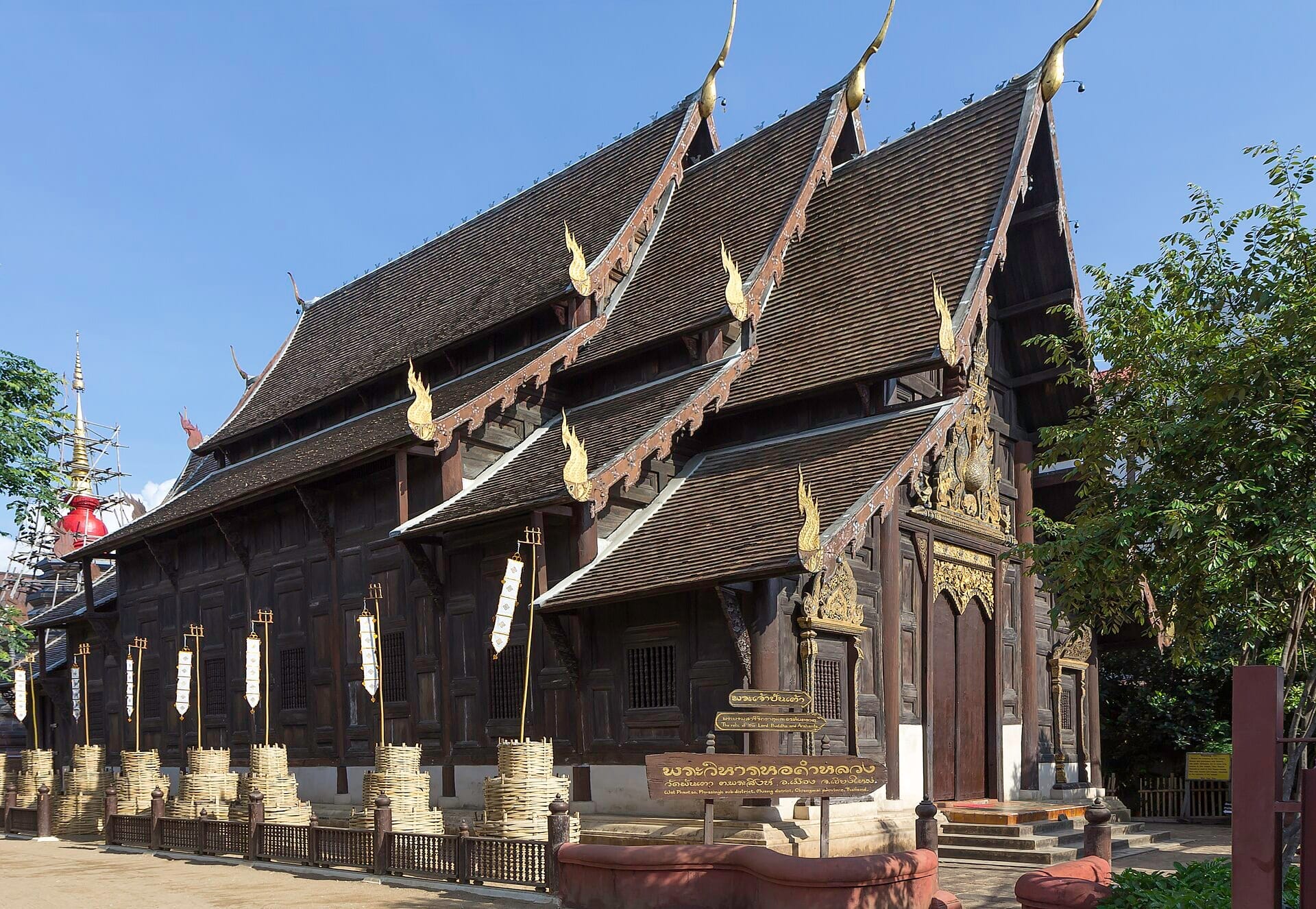
Wat Phan Tao is a 14th-century teak wood temple in Chiang Mai's Old City, famous for its dark, richly carved viharn and golden Lanna-style back-wall decoration. Tucked directly beside the more famous Wat Chedi Luang, it rewards curious visitors with extraordinary craftsmanship and a meditative atmosphere most tourists walk straight past.
Quick Facts
- Location
- Phra Pokklao Road, Old City, Chiang Mai
- Getting There
- 10-min walk from Tha Phae Gate; shared red songthaew along Phra Pokklao Rd
- Time Needed
- 30–50 minutes
- Cost
- Free entry (donations appreciated)
- Best for
- Architecture lovers, photography, quiet reflection
What Wat Phan Tao Actually Is
Wat Phan Tao sits in the heart of Chiang Mai's Old City, sharing a wall with the far more famous Wat Chedi Luang just to its south. The temple's central building, the viharn, is one of the largest surviving teak wood structures in northern Thailand. Its construction used extensive teak panelling — 'phan tao' is widely translated as 'temple of a thousand kilns', likely linked to the site’s historical use for casting Buddha images for nearby temples — and the dark, honey-brown timber absorbs light in a way no concrete temple can replicate.
The structure dates to the 14th century in its origins, though the present viharn was originally constructed in 1846 as a Ho Kham, or royal throne hall, for a king of Chiang Mai, and it was converted into a monastery building in 1876. That history is visible in its proportions: the interior is loftier and more palace-like than a typical monastery hall, with massive teak columns rising to a coffered ceiling stained dark by decades of incense smoke.
💡 Local tip
Modest dress is required: shoulders and knees covered. A sarong is available to borrow at the entrance for a small deposit if you forget.
The Viharn: What to Look for Inside
Step through the carved teak doors and your eyes need a moment to adjust. The interior is deliberately dim, lit mainly by rows of votive candles and a handful of electric lanterns. The centrepiece is a large seated Buddha image in the Lanna style, gilded and positioned at the far end of the hall on an elevated platform, flanked by smaller bronze figures and floral offerings. The entire back wall is covered in a golden mural depicting celestial beings, Lanna motifs, and scenes from the life of the Buddha — the gold leaf glows softly when candlelight catches it, creating an effect no flash photograph can reproduce.
Look up at the ceiling panels. Each carved teak section features decorative motifs, including peacocks that echo royal symbolism and confirm the building’s former palace function. The floor beneath your feet is smooth, worn teak planking. The smell inside is a particular mix: old wood, warm candle wax, and dried floral garlands left at the altar. It is a sensory experience that distinguishes this hall from any tile-and-concrete wat.
Along the outer walls of the viharn, look for the naga balustrades — the mythological serpent figures that line the entrance staircase. They are well-preserved, with scaled bodies and crowned heads that arch outward over the steps. Nagas serve as symbolic guardians of the threshold between the secular world and sacred space in Lanna Buddhist architecture, and the craftsmanship here is noticeably finer than at many Old City temples.
⚠️ What to skip
Photography inside the viharn is permitted, but flash photography is disrespectful and will flatten the moody teak interior completely. Use your camera's lowest ISO or simply put it away and look.
Tickets & tours
Live prices and dates from our booking partner. If you book, we may earn a commission at no extra cost to you.
Half-day tour to admire elephants and enjoy Thai nature
From 48 €Instant confirmationFree cancellationDoi Inthanon National Park small group guided tour
From 34 €Instant confirmationFree cancellationChiang Mai - Chiang Dao Cave and 5 Hill Tribe villages
From 42 €Instant confirmationFree cancellationArt in Paradise Chiang Mai 3D Art Museum entrance tickets
From 8 €Instant confirmationFree cancellation
How the Temple Changes by Time of Day
Early morning, between 7 and 9 AM, is when the compound is at its quietest and most atmospheric. Monks conduct alms rounds in the surrounding streets and the temple grounds carry a focused, unhurried energy. The teak exterior catches the low morning light at a warm, copper angle that photographers working on a serious Chiang Mai shoot specifically seek out. A thin haze of incense from morning prayers hangs in the air.
By mid-morning, tour groups begin arriving next door at Wat Chedi Luang, and some visitors find their way into Wat Phan Tao's entrance. Even then, the flow rarely becomes uncomfortable, partly because the temple is not prominently signposted and partly because Wat Chedi Luang commands most attention. Midday brings harsh light that flattens the teak's natural texture — not ideal for photography, though perfectly fine for a visit.
Late afternoon, from around 4 PM onward, the light softens again and the courtyard fills with the sound of birds settling in the temple's trees. This is arguably the best window for photography: the warm teak tones, the candlelight starting to glow more visibly inside, and relatively few visitors. During the Yi Peng lantern festival in November, Wat Phan Tao hosts one of Chiang Mai's most extraordinary candlelit ceremonies, when the entire courtyard is lined with paper lanterns and the temple compound glows gold well into the night.
If you are planning your visit around seasonal events, the Yi Peng lantern festival guide explains exactly what happens at Wat Phan Tao on that night and how to secure a good position.
The Courtyard and Grounds
The compound extends beyond the viharn into a quieter rear courtyard with smaller shrines, monks' quarters, and mature trees providing shade. A large bronze bell hangs near the back, and several chedis of modest scale are scattered across the grounds. None of these are remarkable on their own terms, but the overall atmosphere of the space — private, unhurried, shaded — makes it worth walking the full perimeter rather than stopping only at the main hall.
Compared to the broader architectural sweep visible at nearby temples, Wat Phan Tao offers a more intimate scale. The compound is not large. You can walk it end to end in five minutes. But that intimacy is precisely what makes it work: it feels like a functioning monastery rather than a heritage showpiece.
Wat Phan Tao sits within easy reach of several other significant Old City temples. Wat Chedi Luang is immediately adjacent, and Wat Phra Singh is about a 10-minute walk west along Ratchadamnoen Road. Combining all three makes for a coherent half-day of Lanna temple architecture without backtracking.
Getting There and Practical Notes
Wat Phan Tao sits on Phra Pokklao Road in the Old City, roughly in the geographic centre of the square moat. The entrance is set back slightly from the street and is easy to miss if you are walking quickly. Look for the teak gate structure on the left side of Wat Chedi Luang's northern boundary wall. From Tha Phae Gate, walk straight along Tha Phae Road, turn right onto Phra Pokklao Road, and you will reach the temple in roughly 10 minutes on foot.
Red songthaew shared taxis run along the main Old City roads and typically cost around 30 THB per person. For a broader orientation before your visit, the guide to getting around Chiang Mai covers all transport options clearly.
The temple is generally open daily from around 6 AM to 6 PM, though hours may extend during festivals. Entry is free, with donation boxes available if you wish to contribute. There are no audio guides or printed maps inside. The experience is self-directed. Bring cash, as there is no card payment.
ℹ️ Good to know
Wat Phan Tao is a working temple, not a heritage museum. Monks live and practise here. Speak quietly, walk slowly, and give monks space — especially early in the morning.
Honest Assessment: Who Should and Shouldn't Visit
Wat Phan Tao is not the most dramatic temple in Chiang Mai. It has no towering chedi, no city-wide viewpoint, no famous story attached to a relic. What it offers is rarer in the Old City: genuine quiet, exceptional craftsmanship, and a sensory atmosphere you cannot replicate elsewhere. For anyone with an interest in Lanna architecture or traditional materials, it is one of the most rewarding 30 minutes available in the city centre.
Travellers looking for spectacle, scale, or the most photogenic landmark for social media may leave mildly underwhelmed. Families with young children who need constant stimulation will likely find the dim, contemplative interior less engaging than the courtyard at Wat Chedi Luang next door. Anyone visiting during a narrow window and already committed to Wat Phra Singh, Wat Chiang Man, and Wat Chedi Luang may reasonably deprioritise Wat Phan Tao — though given it takes only 30 minutes and shares an entrance street with Wat Chedi Luang, the marginal cost of adding it is very low.
For a structured itinerary that weaves Wat Phan Tao into a coherent day, see the 3-day Chiang Mai itinerary which groups Old City temples efficiently.
Insider Tips
- Visit in the final hour before sunset. The teak exterior turns a deep amber in that light and the votive candles inside become genuinely bright relative to the fading daylight — the single best photography window outside of festival season.
- If you visit during Yi Peng in November, arrive at Wat Phan Tao by 5:30 PM at the latest. The candlelit ceremony is not a public ticketed event, but the courtyard fills quickly and good positions near the front are gone by 6 PM.
- The entrance to Wat Phan Tao is on the north side of the compound, off Phra Pokklao Road. Visitors coming from Wat Chedi Luang sometimes enter from the shared wall — ask a monk or temple staff member to point you to the correct gate.
- There is a small market along the roadside near the temple entrance most days, selling fruit, flowers, and incense for offerings. Buying a small lotus flower arrangement to place at the altar is a respectful and appreciated gesture, often costing around 20 THB.
- If the viharn doors are closed when you arrive, do not assume it is shut. Monks may be inside conducting prayers. Wait quietly near the entrance and the doors will typically open within 10–15 minutes.
Who Is Wat Phan Tao For?
- Architecture and design travellers interested in traditional Lanna teak construction
- Photographers seeking atmospheric interior light and textured wood detail
- Visitors attending the Yi Peng lantern festival who want the most memorable candlelit ceremony in the Old City
- Anyone wanting a contemplative pause between the more crowded major temples
- Travellers on a focused Chiang Mai temples itinerary with time to add a 30-minute detour
Nearby Attractions
Other things to see while in Old City (Chiang Mai Old Town):
- Chang Phuak Night Market (North Gate Food Market)
Chang Phuak Night Market, known to locals as the North Gate Food Market, is a compact open-air street food gathering outside Chiang Mai's ancient city walls. Night after night, it draws a faithful crowd of students, office workers, and savvy travelers in search of authentic northern Thai cooking at prices that haven't caught up with the tourist economy.
- Chiang Mai City Arts and Cultural Centre
Housed in a beautifully restored colonial-era building on the edge of the Old City's Three Kings Monument plaza, the Chiang Mai City Arts and Cultural Centre offers one of the most accessible and well-curated introductions to Lanna history and northern Thai culture. It rewards both first-time visitors and those who want genuine context before exploring the city's temples and neighborhoods.
- Chiang Mai City Walls and Moat
The rectangular moat and surviving brick walls of Chiang Mai's Old City are the physical outline of a 700-year-old Lanna capital. Free to explore at any hour, they offer one of the most atmospheric walks in northern Thailand, framing temples, corner bastions, and four ceremonial gates.
- Chiang Mai National Museum
The Chiang Mai National Museum offers one of the clearest introductions to northern Thailand's Lanna Kingdom, covering 700 years of history through royal artifacts, Buddhist sculpture, ceramics, and ethnographic collections. It's calm, well-organized, and genuinely undervisited compared to the temples nearby.
Planning a trip? Discover personalized activities with the Nomado app.