Trafalgar Square: London's Civic Heart Explained
Trafalgar Square sits at the geographical and cultural centre of London, framing Nelson's Column, the National Gallery, and St Martin-in-the-Fields within one of Europe's great open-air public spaces. Admission is free, the square never closes, and it anchors some of the city's most significant art, history, and ceremonial life within easy walking distance of Westminster and the West End.
Quick Facts
- Location
- Trafalgar Square, Westminster, Central London
- Getting There
- Charing Cross (National Rail & Bakerloo/Northern lines); also Leicester Square (Piccadilly/Northern lines), 5 min walk
- Time Needed
- 30–60 min for the square itself; half-day if combining with the National Gallery
- Cost
- Free — no ticket or booking required
- Best for
- First-time visitors, history enthusiasts, art lovers, photographers, families
What Is Trafalgar Square?
Trafalgar Square is London's principal civic square and one of the most visited public spaces in Europe. It sits in Westminster, at the junction of the West End, Whitehall, and the Strand, and acts as an informal crossroads between London's political, cultural, and commercial centres. The National Gallery commands the entire northern edge. St Martin-in-the-Fields anchors the northeast corner. Whitehall stretches south toward Parliament, and Admiralty Arch frames the southwest approach to The Mall and Buckingham Palace.
The square takes its name from the Battle of Trafalgar, the 1805 naval engagement off the Spanish coast in which Admiral Horatio Nelson defeated the combined French and Spanish fleets, securing British naval supremacy while losing his own life. The name was formally adopted in 1830, though the physical development of the square continued through the 1830s and 1840s. Before any of this, the site functioned as the Crown Stables, also called the Great Mews, serving the adjacent royal precinct.
💡 Local tip
Trafalgar Square is open around the clock and costs nothing to enter. It is managed by the Greater London Authority, which also hosts free public events here throughout the year. No advance planning is needed to visit — just arrive.
The Architecture and Monuments
The centrepiece is Nelson's Column: a 52-metre granite pillar topped by a 5.5-metre sandstone statue of Admiral Nelson, facing south toward the Admiralty. Four bronze lions, cast by sculptor Edwin Landseer and installed in 1867, guard the base of the column. Their sheer scale is a reliable surprise to first-time visitors — each lion is roughly 6 metres long, and people routinely climb them for photographs despite official discouragement.
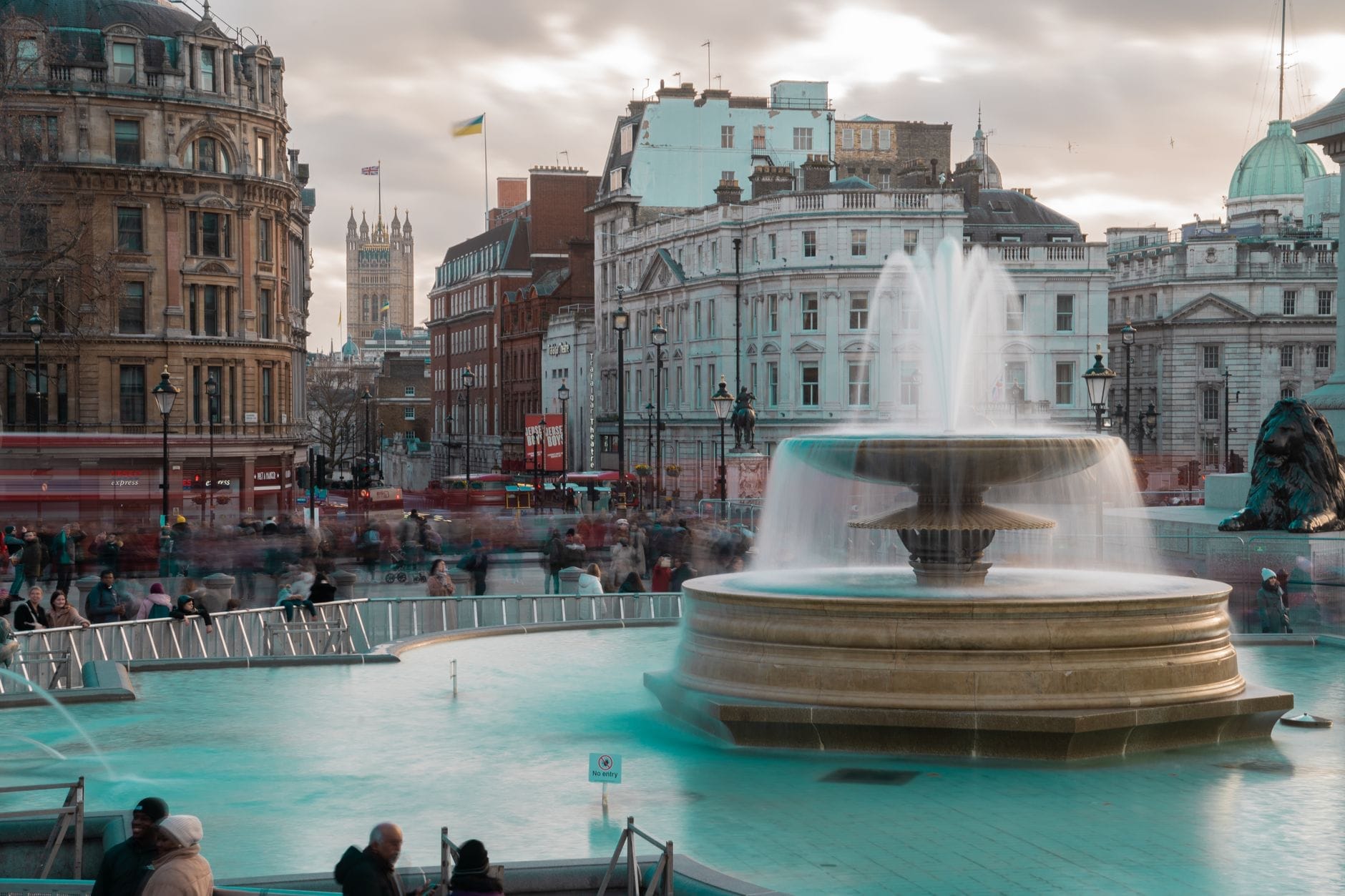
Two large fountains occupy the central basin, redesigned in 1939 by Sir Edwin Lutyens to their current form. On warm afternoons, the sound of moving water softens the traffic noise from the surrounding roads. The pools are illuminated after dark and change colour during certain events. Around the perimeter, four plinths were originally intended to hold equestrian statues. Three now carry historic bronzes: King George IV on horseback (northeast), General Sir Charles James Napier (southwest), and Major General Sir Henry Havelock (southeast). The fourth plinth, in the northwest corner, was left empty and has since 1999 hosted a rotating programme of contemporary public art commissioned by the Mayor of London — it is one of the most talked-about public art initiatives in the UK.
The square is classified as a Grade I listed structure by Historic England. Its layout, including the balustraded terraces and stairways, was shaped by architect Sir Charles Barry in the 1840s. The paved surface was pedestrianised and significantly improved under a project completed in 2003, closing the northern side to traffic and creating a wide, accessible concourse directly connecting the square to the National Gallery.
Tickets & tours
Hand-picked options from our booking partner. Prices are indicative; availability and final rates are confirmed when you complete your booking.
London Christmas bus tour with afternoon tea and snacks
From 52 €Instant confirmationFree cancellationSoho Instagram a self-guided walking tour to top photo spots
From 6 €Instant confirmationFree cancellationTootbus London by Night: Bus tour
From 32 €Instant confirmationFree cancellationIFS Cloud Cable Car Ride and Uber Boat Hop-on Hop-off 1 Day Ticket
From 38 €Instant confirmationFree cancellation
How the Square Changes Through the Day
Early morning, before 8am, Trafalgar Square is remarkably quiet. The fountain jets are often running, pigeons (far fewer than in previous decades following a managed cull and feeding ban) pick at the stone, and the light from the east catches the upper half of Nelson's Column in a way that photographs rarely capture. This is the best time for architectural shots without crowds in the frame.
By mid-morning the square fills with a constant, shifting population: school groups gathering at the base of the column, tourists consulting phones against the backdrop of the National Gallery portico, office workers cutting through on their way from Charing Cross. The steps leading up to the gallery become an informal seating area where people eat, rest, and watch. The noise level rises steadily through the afternoon, reaching its peak between noon and 4pm.
At dusk, the square takes on a different quality. The column is floodlit, the fountains glow, and the surrounding buildings — including the spire of St Martin-in-the-Fields — create a skyline that is cinematic. Evening visits during winter months, when it gets dark before 5pm, are particularly atmospheric. The square does not close, so late-night visits are possible, though the surrounding streets merit standard urban caution.
ℹ️ Good to know
Photography tip: The most dramatic angle on Nelson's Column is from the southern end of the square looking north, with the National Gallery's portico visible behind the column. Use the wide northern terrace for a head-on view of the gallery facade without compression from a long lens.
What Happens Here: Events and Cultural Life
Trafalgar Square functions as London's default public gathering space for major events. New Year's Eve celebrations draw large crowds. The annual Norwegian Christmas tree, a gift from the city of Oslo since 1947 as a gesture of thanks for British support during World War II, is erected in December and becomes a focal point of London's winter landscape. Diwali on the Square and Chinese New Year celebrations both use the space, reflecting the city's diverse communities.
The Mayor of London's events programme brings free concerts, outdoor cinema screenings, and sporting watch parties to the square across the year. During major international sporting tournaments, the screens installed here draw thousands. Political demonstrations have historically used the square as a staging point — its proximity to Parliament and symbolic significance make it London's most visible place of public protest.
St Martin-in-the-Fields, on the northeast corner, is a working church open daily and hosts lunchtime and evening concerts throughout the year. Its crypt café is a practical and atmospheric place for a coffee break. For broader context on the area's cultural offerings, the Westminster neighbourhood guide covers nearby institutions in detail.
Getting There and Getting Around
Charing Cross station is the closest stop, a two-minute walk from the square's southeast corner. It is served by National Rail as well as the Bakerloo and Northern lines on the London Underground. Leicester Square (Piccadilly and Northern lines) is roughly five minutes on foot from the northeast side. Embankment station (Bakerloo, Circle, District, and Northern lines) is a short walk south. Bus routes converge on the Strand and Whitehall from multiple directions.
The square sits at a natural junction in any central London walking route. The South Bank, with Tate Modern and the Southbank Centre, is a 15-minute walk across Hungerford Bridge. Westminster Abbey and the Houses of Parliament are under 15 minutes south along Whitehall. Covent Garden is under 10 minutes northeast.
Accessibility: The 2003 pedestrianisation project included step-free access routes across the square and ramps connecting the upper terrace to the main paved area. The surrounding roads can be noisy and require care at crossings. Visitors with mobility considerations should use the northern terrace approach from the National Gallery side, which is flat and well-maintained.
Who Will Get the Most from a Visit — and Who Might Not
Trafalgar Square rewards visitors who treat it as a starting point rather than a destination. Spending 20 minutes in the square and then walking into the free permanent collection of the National Gallery is one of the great free combinations in any world city. The collection includes Van Eyck, Velázquez, Monet, and Seurat, and it opens at 10am daily.
Families will find the lions, fountains, and open space useful for letting children move around, though there are no dedicated play facilities. The guide to London with kids suggests combining Trafalgar Square with St James's Park and Buckingham Palace as part of a broader Westminster morning.
Visitors who dislike crowds during peak tourist season (July and August) may find the square feels congested between 11am and 4pm. If the experience of open space matters to you, early morning remains the reliable solution. Those seeking a quiet, meditative visit to a London landmark should temper expectations: Trafalgar Square is a civic and social space, not a tranquil one. The noise is real — traffic, tour guides, buskers — but it is also part of what makes the square feel alive.
Practical Notes
- Open 24 hours, every day. Free to enter.
- No booking or ticket required for the square itself.
- Nearest Tube: Charing Cross (Bakerloo, Northern lines) or Leicester Square (Piccadilly, Northern lines).
- The National Gallery (free entry to permanent collection) is directly adjacent on the north side.
- Events can temporarily restrict access to parts of the square; check the Mayor of London's events calendar before visiting if crowds are a concern.
- Toilets are available in the National Gallery and the crypt of St Martin-in-the-Fields (small charge may apply at the latter).
- Bag theft is the primary concern in this heavily touristed area; keep bags on your front in dense crowds.
⚠️ What to skip
During major public events — particularly New Year's Eve, Diwali on the Square, and large political demonstrations — the square and surrounding streets can become extremely crowded. Check the Mayor of London's events calendar before planning a visit on specific dates.
Insider Tips
- The upper terrace directly in front of the National Gallery gives a different perspective on the square — from here you can see the full layout including both fountains, the column, and the street level beyond, making it the best overall vantage point without climbing anything.
- The Fourth Plinth artwork changes every one to two years. Check the Mayor of London's website for the current commission before visiting — the work ranges from quietly thoughtful to deliberately provocative, and knowing what you are looking at adds considerably to the experience.
- St Martin-in-the-Fields runs free lunchtime recitals (typically Mondays, Tuesdays, and Fridays) in its main church. The acoustics are excellent and the admission is free, making it one of the better midday options in central London.
- If you visit in December, the Norwegian Christmas tree is usually lit in early December and stays up until early January. The lighting ceremony is a public event, but the tree itself is impressive on any evening visit — the scale is larger than most people expect.
- The café in the crypt of St Martin-in-the-Fields is directly accessible from the square, open most days, and substantially less crowded than the tourist-oriented cafés on the Strand. It is housed in an 18th-century vaulted brick crypt and is worth the minor detour.
Who Is Trafalgar Square For?
- First-time visitors to London wanting a single orientation point that connects history, art, and architecture
- Architecture and history enthusiasts interested in 19th-century urban planning and monumental sculpture
- Art lovers using the square as an entry point to the National Gallery's free permanent collection
- Photographers seeking iconic London compositions at dawn or dusk without paying for a viewpoint
- Families looking for a large, free, open space within walking distance of multiple major attractions
Nearby Attractions
Other things to see while in Westminster:
- Apsley House
Known as 'Number 1 London', Apsley House at Hyde Park Corner was the London residence of the Duke of Wellington after his victory at Waterloo. Today it holds one of the finest private art collections in Britain, including old masters, Napoleonic silverware, and the famous colossal nude statue of Napoleon himself.
- Banqueting House
Banqueting House is the sole surviving structure of the vast Palace of Whitehall, designed by Inigo Jones in 1622 and home to the finest painted ceiling in England. It is also the spot where King Charles I was executed in 1649. Admission is just £7.50 for adults, but opening is seasonal — check dates before you go.
- Big Ben & the Houses of Parliament
Few sights in London carry the weight of Big Ben and the Palace of Westminster. The Gothic clock tower rising above the Thames is instantly recognisable, but the complex behind it holds over nine centuries of British political history. Here is everything you need to plan a worthwhile visit.
- Buckingham Palace
Buckingham Palace is the official London residence and administrative headquarters of the UK's sovereign, serving that role since 1837. Whether you are watching the Changing of the Guard from the forecourt railings or touring the lavish State Rooms in summer, this guide covers everything you need to plan a worthwhile visit.