Banqueting House: Rubens, Royalty, and a Royal Execution on Whitehall
Banqueting House is the sole surviving structure of the vast Palace of Whitehall, designed by Inigo Jones in 1622 and home to the finest painted ceiling in England. It is also the spot where King Charles I was executed in 1649. Admission is just £7.50 for adults, but opening is seasonal — check dates before you go.
Quick Facts
- Location
- Whitehall, Westminster, London SW1A 2ER
- Getting There
- Westminster or Embankment Underground (both ~10 min walk); Charing Cross rail (~10 min walk)
- Time Needed
- 45 minutes to 1.5 hours
- Cost
- Adults £7.50 · Children (5–15) free · Historic Royal Palaces members free
- Best for
- History enthusiasts, architecture lovers, art admirers, first-time London visitors
- Official website
- www.hrp.org.uk/banqueting-house
What Banqueting House Actually Is
Banqueting House on Whitehall is one of those London attractions that rewards the curious and mystifies everyone else. From the street, it reads as an unusually elegant stone facade among the grey government buildings of central Westminster — dignified, Italianate, and clearly older than its neighbours, but easy to walk past without registering what it contains. Step inside, and you find yourself in a single magnificent room of extraordinary historical weight.
This is the only complete surviving structure of the Palace of Whitehall, which served as a principal royal residence from 1530 until a catastrophic fire destroyed almost the entire complex in 1698. Out of that sprawling Tudor and Stuart palace, Banqueting House alone survived. It was designed by Inigo Jones for King James I and completed in 1622, making it the first building in England to be designed in a Palladian style. In a city still dominated by Jacobean timber and Gothic masonry, it was a genuine architectural revolution.
⚠️ What to skip
Banqueting House has limited opening in 2026 due to ongoing conservation work. Public Open Days are scheduled for 29 May and 26 June 2026, then from 1 August to 20 September 2026. Always confirm dates at hrp.org.uk/banqueting-house before visiting.
The Rubens Ceiling: The Real Reason to Come
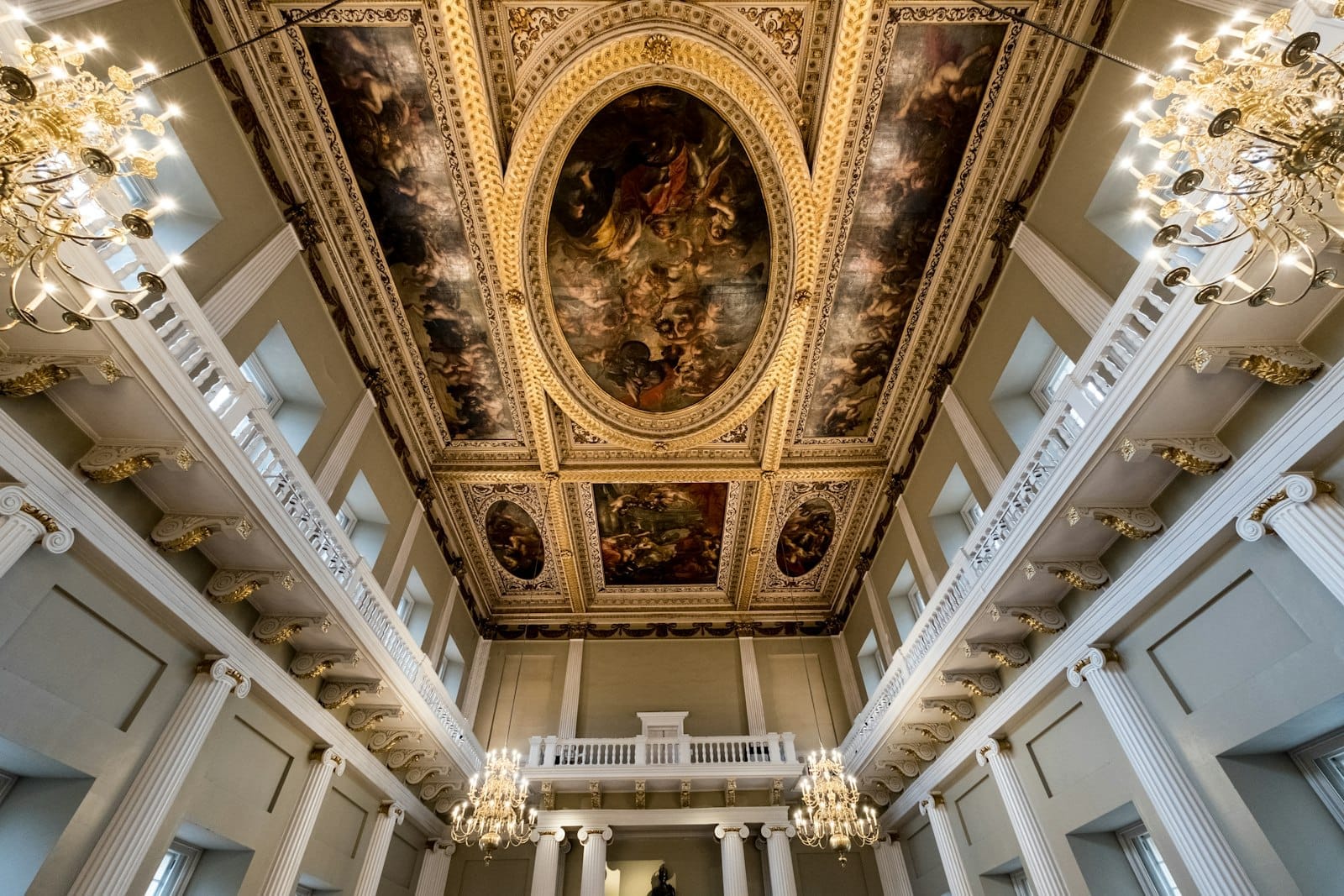
The Main Hall is effectively one room, and that room contains one of the finest painted ceilings in England. The nine large canvases were commissioned by King Charles I from Sir Peter Paul Rubens and installed in 1635–1636. They remain in their original location, which makes them extraordinarily rare: most major Baroque commissions of this era have been moved, dispersed, or lost entirely. Here, you see them exactly as Rubens intended, in the space they were made for.
The central oval depicts the apotheosis of James I — the king ascending to heaven — while flanking panels illustrate the benefits of wise rule and the union of England and Scotland. The scale is overwhelming at first. The canvases fill the entire ceiling of a double-height hall, and your neck cranes back as you try to take in the figures: massive, luminous, painted with the full force of Rubens at the height of his powers. The flesh tones glow even in flat light. On a morning with sunlight angling through the tall windows, the effect is theatrical.
There are benches and mirrors provided to help you look up without discomfort — a practical touch that most visitors appreciate within the first two minutes. The room is not huge, so even on a moderately busy day you can usually find a position directly beneath the central oval with nothing but ceiling above you.
💡 Local tip
Bring or borrow the handheld mirrors available on site. Lying the mirror flat and looking down at it while you hold it chest-height is a surprisingly effective way to study the ceiling detail without neck strain.
Tickets & tours
Hand-picked options from our booking partner. Prices are indicative; availability and final rates are confirmed when you complete your booking.
Guided tour inside Westminster Abbey and outside the Houses of Parliament
From 103 €Instant confirmationFree cancellationHouses of Parliament and Westminster Abbey guided tour
From 149 €Instant confirmationFree cancellationLondon Main Sights Guided Tour with Visit to The Houses of Parliament
From 110 €Instant confirmationFree cancellationHouses of Parliament and Westminster Walking Tour
From 110 €Instant confirmationFree cancellation
History You Can Stand On: Charles I and the Execution
On 30 January 1649, King Charles I walked through Banqueting House and out through a window onto a scaffold erected in the street outside. He was beheaded publicly on Whitehall — the first and only time a reigning English monarch was executed in England. The spot where the scaffold stood is marked outside on the pavement, just steps from the main entrance.
The irony of his execution taking place directly beneath the Rubens ceiling — which his father commissioned as a celebration of divinely ordained royal power — is not lost on visitors who know the history. Charles I had, in fact, expanded and refined the palace's art collection into one of the greatest in Europe before parliament dispersed it following his death. The empty hooks and ghost-shapes of where paintings once hung are long gone, but standing in the Main Hall with that context makes the room feel heavier than its limestone walls suggest.
The broader story of Stuart London, royal ceremony, and the political upheaval of the Civil War fits naturally within a visit to the Westminster area, where you can walk within minutes to Horse Guards Parade, Downing Street, and the Houses of Parliament — all part of the same corridor of English political history.
The Architecture: Why Inigo Jones Changed Everything
Before Banqueting House, English architecture was largely a continuation of late Gothic and Jacobean traditions: asymmetrical, decorative, ornate. Inigo Jones had studied Andrea Palladio's buildings in northern Italy, and he returned with a conviction that classical proportion, symmetry, and restraint were the proper language of serious architecture. Banqueting House was his first major royal commission in London, and it landed like a statement.
The exterior is Portland stone, arranged across two main storeys with Ionic columns on the lower level and Composite columns above. The proportions are exact and deliberate. Stand back on the opposite pavement on Whitehall and you can see how the building controls the eye — nothing is accidental. It is worth spending a few minutes outside before you enter, because the facade is half the point. The building's influence on English architecture extended for generations: Wren, Hawksmoor, and the great Baroque and Georgian builders all worked within a tradition that Jones helped establish here.
The Visit: What to Expect When You Arrive
The entrance is on Whitehall. Tickets can be booked in advance through Historic Royal Palaces. The building is compact — essentially the Main Hall on the upper floor, accessed via a staircase from the ground level — so a visit moves at its own pace rather than following a fixed route. An audio guide is available and provides good historical context on the ceiling panels and the building's history.
The ground floor has a small exhibition space and information panels. The Main Hall is upstairs: a long, double-height room with the Rubens ceiling above and tall windows on each long side. The floor is largely clear. The room is used for events and private hire outside public opening hours, which keeps it in active use but also means it sometimes feels more like a formal venue than a museum. That is not necessarily a drawback — the lack of display cases and interpretation boards in the main space means nothing competes with the ceiling.
Visitor numbers during public opening are generally manageable. The summer daily opening period from August draws more foot traffic, but the space is large enough that it rarely feels congested. Morning sessions tend to be quieter than afternoons.
ℹ️ Good to know
Wheelchair users should contact Historic Royal Palaces in advance. The site has some accessibility limitations, including lift access details for the Main Hall. Assistance dogs are welcome, and the access team can be reached by email for specific arrangements.
Getting There and Planning Around It
Westminster Underground station (Circle, District, and Jubilee lines) puts you on Whitehall within a five-minute walk. Embankment (Bakerloo, Circle, District, Northern lines) is also around five minutes on foot. From Charing Cross National Rail station, allow ten minutes. Numerous bus routes serve Whitehall directly, including the 3, 11, 12, 24, 53, 87, 88, and 159. For a broader map of how to get around this part of London, the guide to getting around London covers all transport options in detail.
Banqueting House sits at the heart of one of London's most historically concentrated areas. Horse Guards Parade is directly opposite, and the walk from here to Westminster Abbey takes under ten minutes. If you're building a half-day itinerary around the area, the Royal London guide maps out a logical route that takes in several nearby landmarks without unnecessary backtracking.
The building does not have an on-site cafe. There are coffee shops and sandwich counters along Whitehall and on the surrounding streets. St James's Park is a short walk south if you want to sit outside after your visit.
Is It Worth Your Time?
At £7.50 for adults, Banqueting House is one of the better-value admissions in central London. The Rubens ceiling alone justifies the ticket price — this is world-class painting in an original setting, which is rarer than it sounds. If you have any interest in Stuart history, the English Civil War, or the development of British architecture, you will find more here than the modest exterior implies.
Who should probably skip it: visitors whose primary interests are hands-on, interactive, or family-friendly experiences. The building is a single grand room with a painted ceiling and a lot of historical significance. There are no multimedia shows, no costumed interpreters during regular opening, and nothing aimed specifically at young children. It asks for a certain kind of attention, and if the Stuart period and classical architecture hold no interest, an hour here may feel slow.
First-time visitors to London covering the main sights should absolutely include it if they have room in their itinerary. It pairs naturally with the Churchill War Rooms, which are a ten-minute walk away, for a long half-day that moves from the seventeenth century to the twentieth without leaving the Westminster core.
Insider Tips
- Book tickets in advance for the limited 2026 Open Days on 29 May and 26 June — these are single-day events and capacity is finite. The summer opening from 1 August is easier to walk into, but checking the official site before you travel is always worth doing.
- The ceiling is best studied section by section rather than all at once. Start with the central oval (the apotheosis of James I), then work outward to the flanking panels. The mirrors and benches provided make this far more comfortable than it sounds.
- Stand outside on the opposite pavement before entering. The Whitehall facade is a key part of the experience and easy to overlook if you go straight inside. Morning light hits the Portland stone particularly well.
- Historic Royal Palaces membership covers entry to Banqueting House along with several other London sites including the Tower of London and Kew Palace. If you are visiting multiple HRP properties, the membership pays for itself quickly.
- Combine the visit with the Changing of the Guard at Horse Guards — the ceremony happens at 11:00 on weekdays and 10:00 on Sundays, directly across Whitehall. Timing your arrival at Banqueting House just after the ceremony disperses means a quieter interior.
Who Is Banqueting House For?
- History enthusiasts with a specific interest in the Stuart period and the English Civil War
- Architecture lovers drawn to early classical and Palladian buildings
- Art visitors who want to see Baroque painting in its original, purpose-built setting
- First-time London visitors building a Westminster itinerary around the major royal and political landmarks
- Travellers on a budget looking for a high-quality, low-cost cultural stop in central London
Nearby Attractions
Other things to see while in Westminster:
- Apsley House
Known as 'Number 1 London', Apsley House at Hyde Park Corner was the London residence of the Duke of Wellington after his victory at Waterloo. Today it holds one of the finest private art collections in Britain, including old masters, Napoleonic silverware, and the famous colossal nude statue of Napoleon himself.
- Big Ben & the Houses of Parliament
Few sights in London carry the weight of Big Ben and the Palace of Westminster. The Gothic clock tower rising above the Thames is instantly recognisable, but the complex behind it holds over nine centuries of British political history. Here is everything you need to plan a worthwhile visit.
- Buckingham Palace
Buckingham Palace is the official London residence and administrative headquarters of the UK's sovereign, serving that role since 1837. Whether you are watching the Changing of the Guard from the forecourt railings or touring the lavish State Rooms in summer, this guide covers everything you need to plan a worthwhile visit.
- Churchill War Rooms
Buried beneath Whitehall, the Churchill War Rooms preserve the underground bunker where Winston Churchill and his War Cabinet directed Britain's Second World War effort. The rooms have been left largely untouched since 1945, making this one of the most atmospheric and moving historical sites in London.