Nihonbashi Bridge & District: Tokyo's Historic Zero-Point
Nihonbashi is where Japan's road network begins. The current stone double-arch bridge, completed in 1911 and designated an Important Cultural Property, stands at the geographic and symbolic heart of Tokyo's oldest commercial district. Free to visit, rich in history, and quieter than most central Tokyo sights.
Quick Facts
- Location
- Nihonbashi 1-chome to Muromachi 1-chome, Chuo-ku, Tokyo
- Getting There
- Nihombashi Station (Tokyo Metro Ginza, Tozai & Toei Asakusa lines); also walkable from Tokyo Station
- Time Needed
- 45–90 minutes for the bridge and surrounding district
- Cost
- Free (public bridge and road); individual shops and restaurants vary
- Best for
- History enthusiasts, architecture fans, and travelers curious about Edo-era merchant culture
- Official website
- www.nihonbashi-tokyo.jp/en
What Is Nihonbashi and Why Does It Matter?
Nihonbashi, literally 'Japan Bridge,' is one of those places that carries far more weight than its modest appearance suggests. The bridge itself is compact — about 49 meters long and 28 meters wide — yet it marks the point from which road distances across the entire country are measured. A bronze plaque embedded in the center of the road surface reads 'Origin of Japanese Highways.' When the Tokugawa shogunate established the Five Highways radiating out from Edo in 1603, this is where they all began. That same year, the first Nihonbashi Bridge was constructed.
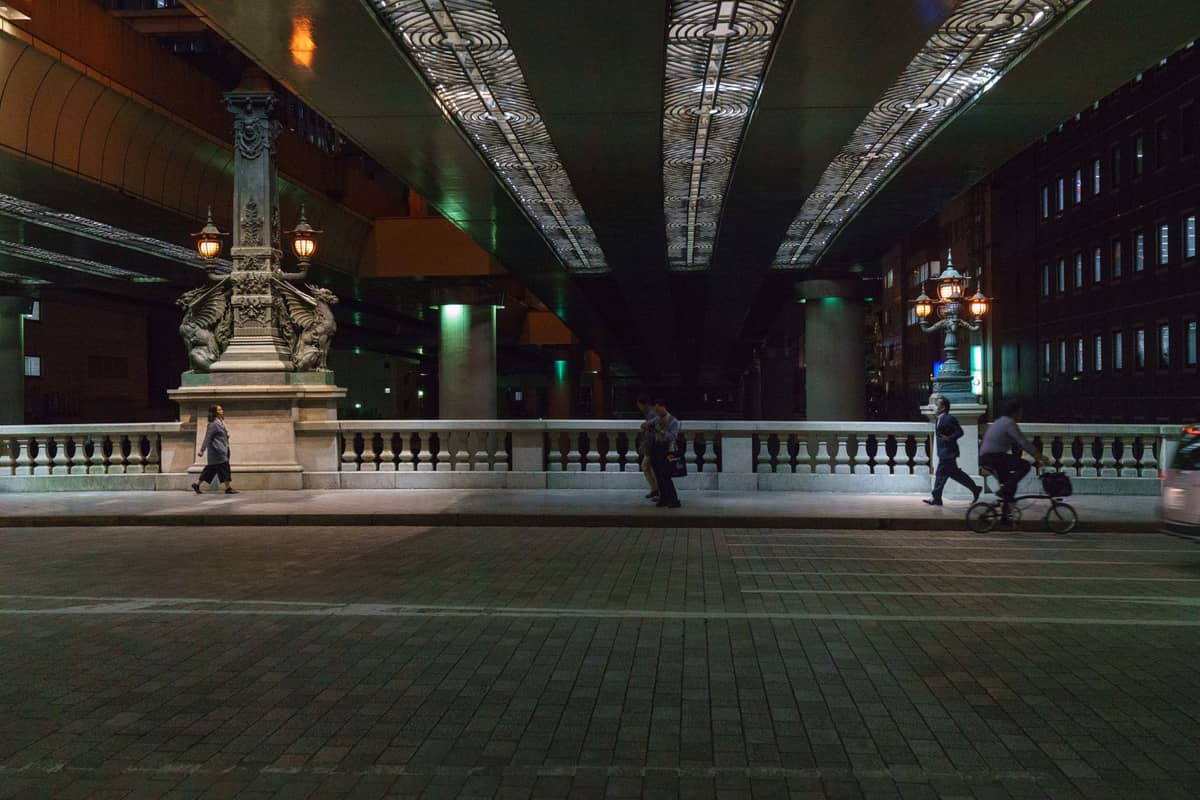
The bridge standing today is the 20th generation, completed in 1911 during the Meiji era. It is a granite double-arch structure decorated with ornate bronze railings, lamp posts topped with phoenix sculptures, and kirin (mythical creatures) at each corner. The design reflects Meiji Japan's embrace of Western-influenced civic architecture while retaining distinctly Japanese decorative motifs. It was designated one of Japan's Important Cultural Properties in May 1999.
ℹ️ Good to know
The Nihonbashi Tourism Information center at 1-1-1 Nihonbashi, Chuo City, is open 10:00–17:00 and is a useful first stop for area maps and event schedules.
The Elephant in the Room: The Expressway Overhead
No honest account of Nihonbashi can avoid this: the bridge is overshadowed by a concrete expressway that was built directly above it in 1963, constructed hastily ahead of the Tokyo Olympics. The result is jarring. A graceful Meiji-era stone bridge sits beneath a gray slab of elevated highway, robbing it of the sky and the river views it once commanded. Photographs taken from certain angles can minimize the expressway, but standing on the bridge itself, you cannot ignore it.
There is a long-running project to reroute the expressway underground and restore open skies above the bridge, with work anticipated to unfold over several decades. For now, the contrast between the ornate stonework below and the concrete infrastructure above is part of the story — a visible record of how postwar Tokyo prioritized speed over heritage, and how the city is now reconsidering that trade-off.
⚠️ What to skip
If unobstructed river and skyline views are what you are looking for, Nihonbashi will disappoint. The expressway is a permanent visual presence. Visit for the history and the surrounding district, not for scenic photography.
Tickets & tours
Hand-picked options from our booking partner. Prices are indicative; availability and final rates are confirmed when you complete your booking.
Tsukiji Fish Market Walking Food Tour
From 40 €Instant confirmationFree cancellationMt.Fuji,Owakudani, Hakone Cruise & Ropeway, Oshino Hakkai 1-Day Trip
From 54 €Instant confirmationFree cancellationTour to Mt. Fuji Area, Oshino Hakkai and Kawaguchi Lake from Tokyo
From 57 €Instant confirmationFree cancellationNikko UNESCO Shrine and Nature View 1-Day Tour from Tokyo
From 78 €Instant confirmationFree cancellation
How the Bridge Changes Across the Day
Early mornings, from around 7:00 to 8:30, the bridge draws a thin stream of suited commuters crossing on foot from nearby stations. The area smells faintly of the Nihonbashi River below and the cooler air that collects under the expressway. At this hour the ornate bronze lamp posts and the kirin statues are easy to examine without other visitors in the way. The surrounding streets, lined with long-established department stores and financial institutions, are just beginning to open their shutters.
By late morning the neighborhood around the bridge fills with a different crowd: shoppers heading into Mitsukoshi, one of Japan's oldest department stores, which has occupied this corner since the Edo period in various forms. Lunchtime brings office workers from the surrounding financial district. The streets narrow and quicken. If you want to examine the bridge's bronze details and read the marker plaques without being jostled, the early morning or the 30-minute window just after most offices open at 9:00 is the clearest opportunity.
Late afternoon light, low and angled from the west, catches the patina on the bronze railings in a way that rewards photographers who accept the expressway as part of the composition rather than fighting it. By evening, the district quiets considerably. Unlike Ginza to the south, Nihonbashi does not have a strong nightlife draw, and most shops close by 20:00.
The District Around the Bridge
The bridge is the anchor, but the surrounding Nihonbashi district is the full experience. This has been Tokyo's commercial and financial center since the Edo period. The area is home to the Tokyo Stock Exchange, Mitsukoshi department store (founded 1673 as a dry-goods merchant), and dozens of specialty shops that have operated for generations. Unlike the manufactured heritage of some tourist districts, the businesses here are largely functional and used by locals: knife makers, lacquerware dealers, pharmaceutical wholesalers.
Wandering the side streets north of the bridge toward Muromachi turns up the highest concentration of these long-running shops. Coredo Muromachi, a modern commercial complex in the area, has introduced younger-oriented retailers and restaurants while preserving the neighborhood's low-rise scale. For a broader look at Tokyo's historic commercial culture, the Edo-Tokyo Museum in nearby Ryogoku provides essential context on how merchant life in Edo shaped the city you see today.
The district also makes sense as part of a wider walk through central Tokyo. Ginza is about 15 minutes south on foot, and the Imperial Palace East Gardens are a 20-minute walk west. Nihonbashi fits naturally into a half-day itinerary that covers this stretch of old downtown Tokyo.
Historical Depth: From Shogunate to Stock Exchange
When Tokugawa Ieyasu established his government in Edo in the early 17th century, Nihonbashi became the commercial engine of the new capital. Fish markets, rice brokers, and dry-goods dealers clustered here. The Nihonbashi fish market, which operated in this area for centuries, was the forerunner of what eventually became the Tsukiji Market and later Toyosu. The concentration of wealth and trade along this riverfront helped establish Nihonbashi as Edo's cultural as well as commercial center, giving rise to the kabuki theater tradition and the ukiyo-e woodblock print industry that flourished among the merchant class.
The Meiji Restoration of 1868 brought modernization but did not diminish Nihonbashi's centrality. Banks, insurance companies, and trading houses moved in alongside the older merchant families. The 1911 bridge was itself a Meiji statement of modernity. The area's financial identity endures: the Tokyo Stock Exchange remains just minutes from the bridge. Visitors interested in how this commercial history played out visually should note that the Tokyo National Museum in Ueno holds significant collections of ukiyo-e prints, many depicting Nihonbashi street scenes from the Edo period.
Practical Walkthrough: Getting There and What to Do
Nihombashi Station is directly beneath the district, served by the Tokyo Metro Ginza Line, Tozai Line, and the Toei Asakusa Line. Exits B6 and B12 bring you up within a short walk of the bridge. Tokyo Station is also walkable in roughly 10 minutes via the Yaesu side. The underground concourses connecting these stations to the area's buildings are step-free, making this one of the more accessible historic sites in central Tokyo.
The bridge itself requires no planning: it is a public road, open at all hours, with pedestrian sidewalks on both sides. Stand at the center to find the bronze road-origin marker embedded in the pavement. Look south down the Nihonbashi River for the clearest view of the bridge's stone arches. On either end of the bridge, the bronze kirin and lion statues are worth examining closely; the kirin bear wings, a detail unique to this bridge and not standard in East Asian iconography.
After the bridge, the most rewarding direction is north into the Muromachi blocks, where specialty food and craft shops are densest. If you are building a full day, consider pairing Nihonbashi with the nearby Tsukiji Outer Market for a morning food walk, or heading to Hamarikyu Gardens in the afternoon for contrast. Both are within 20 minutes on foot or by subway.
💡 Local tip
Photography tip: for the cleanest shot of the bridge arches, position yourself on the riverside walkway below street level on the south bank and shoot upward. This eliminates most of the expressway from the frame and captures the stone arch and bronze lamp posts against the sky.
Who Should Skip This
Travelers looking for dramatic skyline views or riverside scenery will find the expressway overhead frustrating rather than interesting. If your Tokyo time is short and you are choosing between sights, the bridge itself is secondary to the district around it. Someone who has no interest in commercial history, Edo-period urban culture, or Meiji architecture will get limited return from the 30 minutes spent crossing and examining the bridge. The area is also not a strong choice for families with young children, who will find little to engage with beyond the bronze animal sculptures.
For those drawn to Tokyo's architectural history more broadly, the Tokyo architecture guide maps out other Meiji and Taisho-era structures around the city that complement a visit here.
Insider Tips
- The bronze kirin statues at the bridge corners have wings, a deliberate design choice by the Meiji-era architects to symbolize Japan's emergence onto the world stage. Most visitors walk past without noticing. Stop and look closely at the creature's back.
- The road-origin marker is set into the road surface at the center of the bridge, between lanes of traffic. Look for it from the pedestrian sidewalk; it is visible but easy to miss if you are not specifically watching for it.
- Mitsukoshi department store's basement food hall (depachika) a two-minute walk from the bridge is among the best in Tokyo for high-quality prepared foods, sweets, and bento. It opens at 10:00 and is often less crowded on weekday mornings than on weekends.
- The Nihonbashi River has small stone-paved walkways at water level on the south side of the bridge. Descend from street level here to see the arches from below and to get a sense of how the waterway once functioned as a commercial transport route.
- If you visit on a weekday, the surrounding financial district has several long-established coffee shops that cater to office workers rather than tourists: lower prices, no queues, and a more authentic slice of everyday Tokyo than the tourist cafes nearer to Tokyo Station.
Who Is Nihonbashi Bridge & District For?
- History and Edo-period Japan enthusiasts who want to stand at the literal starting point of the country's road network
- Architecture fans interested in Meiji-era civic design and the blend of Western and Japanese decorative traditions
- Travelers building a walking itinerary through central Tokyo's old commercial core, from Nihonbashi through Ginza
- Visitors who want a genuine, low-tourist-density experience in central Tokyo without paying an admission fee
- Food-focused travelers using Nihonbashi as a base to explore the area's long-established specialty food shops and the Mitsukoshi depachika
Nearby Attractions
Combine your visit with:
- Akasaka Palace (State Guest House)
The State Guest House, Akasaka Palace is Japan's principal diplomatic residence and one of the few Western-style palaces in Asia open to the public. Built in neo-baroque style for the Crown Prince in the early 20th century, it now receives heads of state and, on select days, ordinary visitors. The combination of ornate gilded interiors, formal French gardens, and a Japanese-style annex makes it one of the most architecturally unusual stops in Tokyo.
- Edo-Tokyo Open Air Architectural Museum
Spread across the grounds of Koganei Park, the Edo-Tokyo Open-Air Architectural Museum rescues and reassembles more than 30 historic structures spanning the Edo period through the early 20th century. From a dismantled farmhouse to a reconstruction of a Showa-era Tokyo streetscape, it is one of the most thoughtful and undervisited cultural sites in the metropolitan area.
- Enoshima
A small island off the Shonan coast of Kanagawa Prefecture, Enoshima packs a surprising amount into a short walk: a three-part Shinto shrine, ancient sea caves, a hilltop botanical garden, a lighthouse observation tower, and seafood stalls lining a stone-paved shopping street. It works as a half-day excursion or a full day if you combine it with nearby Kamakura.
- Gotokuji Temple
Gotokuji Temple in Setagaya is a working Soto Zen Buddhist temple that happens to be one of the claimed birthplaces of the maneki-neko, Japan's iconic beckoning cat. Hundreds of white ceramic cats line the shelves of a dedicated shrine, creating one of Tokyo's most quietly striking visual spectacles. Entry is free, crowds are manageable, and the surrounding grounds offer genuine calm.