Hamarikyu Gardens: Tokyo's Most Dramatic Historic Park
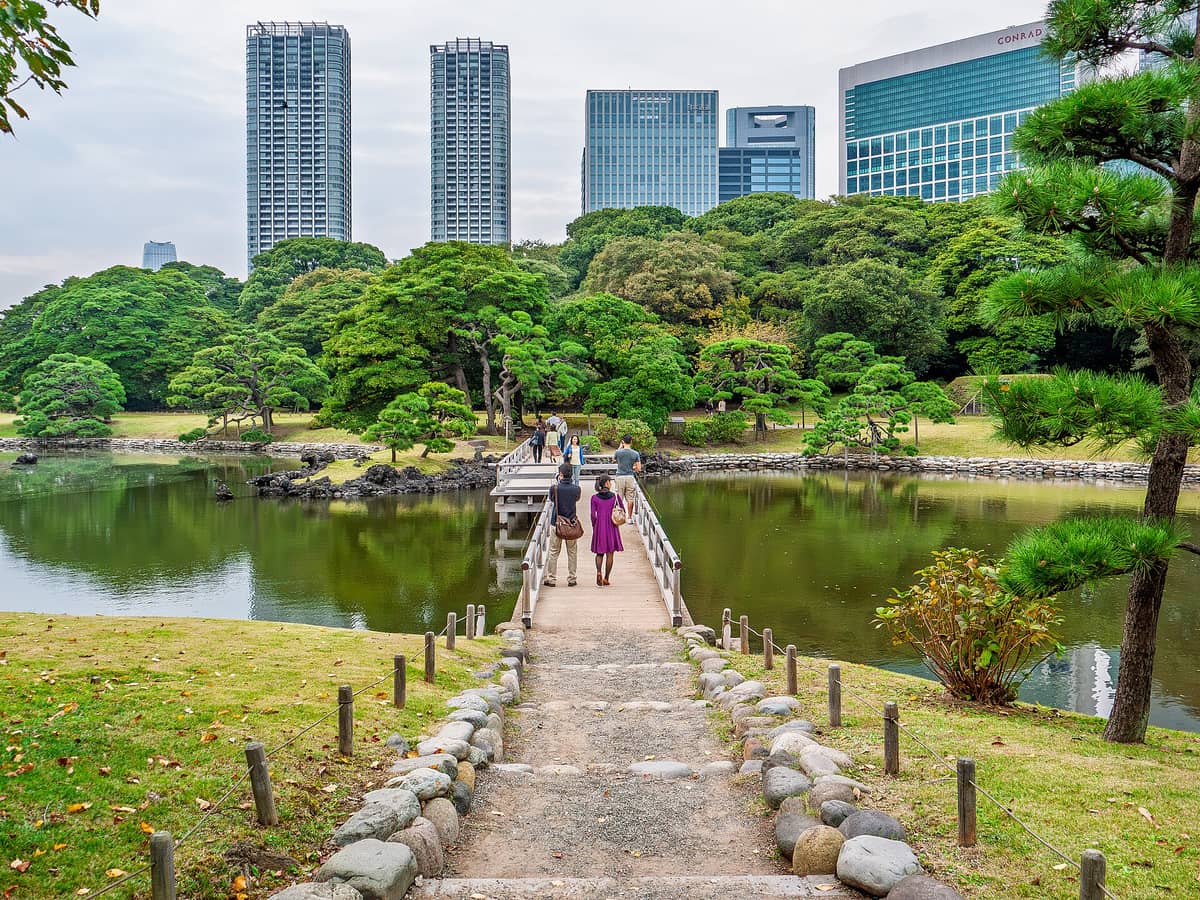
Hamarikyu Gardens (浜離宮恩賜庭園) is a roughly 250,000 sqm tidal garden in Chuo Ward that once belonged to the Tokugawa shoguns and later served as an imperial retreat. Today, its seawater ponds, flowering plum and rapeseed fields, and framing views of the Shiodome skyscrapers make it one of the most visually striking public parks in central Tokyo.
Quick Facts
- Location
- 1-1 Hamarikyu-teien, Chuo-ku, Tokyo (Shiodome / Shimbashi area)
- Getting There
- Shiodome Station (Oedo/Yurikamome lines); Shimbashi Station (JR/subway, 10 min walk); Water Bus from Asakusa or Odaiba
- Time Needed
- 1.5 to 2.5 hours
- Cost
- ¥300 general; ¥150 for ages 65+; free for preschoolers and elementary and middle school students living in Tokyo
- Best for
- History lovers, photographers, garden enthusiasts, peaceful midday escapes from central Tokyo
- Official website
- www.tokyo-park.or.jp/teien/en/hama-rikyu/
What Hamarikyu Gardens Actually Is
Hamarikyu Gardens (浜離宮恩賜庭園, officially Hama-rikyu Gardens) is a tidal-fed strolling garden covering roughly 250,000 square meters along the edge of Tokyo Bay. The garden is managed by the Tokyo Metropolitan Park Association and sits at 1-1 Hamarikyu-teien, Chuo-ku, well within walking distance of the Shiodome business district. It is open daily from 9:00 to 17:00, with last admission at 16:30, and closes for New Year holidays (December 29 to January 1); hours may vary slightly by season.
The entry fee is ¥300 for adults, ¥150 for visitors aged 65 and over, and free for preschoolers and elementary and middle school students living in Tokyo. For a central Tokyo attraction of this scale and historical weight, that price is remarkably low. On any given weekday morning, you are likely to share it with joggers doing laps, elderly residents doing slow walks, and a handful of tourists who came via the Tokyo Water Bus from Asakusa or Odaiba — which is, by far, the most satisfying way to arrive.
💡 Local tip
Arriving by water bus from Asakusa adds real drama to the entry — the garden's cypress-wood bridges and pine groves appear as you pull into the dock, framed against the Shiodome glass towers. Check Tokyo Cruise Ship Co. for current schedules and fares before you go.
History: From Shogunal Duck Hunt to Imperial Retreat
The land on which Hamarikyu sits was reclaimed from Tokyo Bay in the mid-17th century by the Matsudaira clan. The Tokugawa shogunate took control of the property in 1709 and developed it into an elaborate garden estate used for duck hunting, fishing, and entertaining. The distinctive tidal ponds — which remain one of the garden's defining features — were engineered so that seawater flows in and out with the tide, a technical achievement that also sustained the ecosystem used for hunting waterfowl.
After the Meiji Restoration in 1868, the garden was transferred to the Imperial Household Agency and served as an imperial detached palace, used for hosting foreign dignitaries. Former U.S. President Ulysses S. Grant, during his visit to Japan in 1879, was received here — one of the earlier high-profile state uses of the garden in the modern era. The space was donated to Tokyo Metropolitan Government after World War II and opened to the public in April 1946. It was designated a National Special Historic Site and Special Place of Scenic Beauty, one of the few dual-designation protected sites in Tokyo.
That designation matters practically: it restricts the kinds of changes that can be made to the site. The result is a garden that has changed relatively little in layout since the Edo period, even as the skyscrapers of Shiodome rose directly on its northern boundary. The visual contrast between centuries-old pine trees and glass towers is not accidental — it is one of the most photographed perspectives in the garden.
Tickets & tours
Hand-picked options from our booking partner. Prices are indicative; availability and final rates are confirmed when you complete your booking.
Tsukiji Fish Market Walking Food Tour
From 40 €Instant confirmationFree cancellationMt.Fuji,Owakudani, Hakone Cruise & Ropeway, Oshino Hakkai 1-Day Trip
From 54 €Instant confirmationFree cancellationTour to Mt. Fuji Area, Oshino Hakkai and Kawaguchi Lake from Tokyo
From 57 €Instant confirmationFree cancellationNikko UNESCO Shrine and Nature View 1-Day Tour from Tokyo
From 78 €Instant confirmationFree cancellation
What You Actually See and Hear Inside
The first thing you notice after passing through the entrance gates is quiet. Not complete silence — the hum of the city is present, and there are birds — but the dense pine and cherry plantings around the perimeter walls absorb traffic noise more effectively than most Tokyo parks. The paths are wide, graveled, and easy underfoot. Most are flat, which makes this comfortable for older visitors and accessible for wheelchair users; the park has wheelchair-accessible toilets and a wheelchair loan service.
The large tidal pond at the garden's center is the visual anchor. Two teahouses sit on small islands connected by wooden bridges. The Nakajima no Ochaya (Nakajima Teahouse) is the one currently in operation, offering matcha tea and traditional Japanese sweets for an additional fee. Sitting on the teahouse's low wooden platform with a bowl of tea and a view across the water to the tower blocks is one of those genuinely disorienting moments Tokyo occasionally offers — a sensory contrast with no easy parallel in Western cities.
Depending on the season, the planting character of the garden changes significantly. The rapeseed fields (nanohana) bloom bright yellow from late February through March, drawing photographers and a noticeably larger crowd. Late March to early April brings cherry blossoms, which are good here but not exceptional compared to nearby alternatives. Autumn foliage in November is understated but pleasant. The garden is least crowded and most atmospheric in summer (July to August), when the heat keeps casual visitors away and the reflections on the tidal pond are at their most vivid.
ℹ️ Good to know
The garden's seasonal hours may be extended for special events such as night illuminations. Check the Tokyo Metropolitan Park Association website before your visit if timing flexibility matters to you.
How the Garden Changes by Time of Day
Opening time at 9:00 is the quietest period by a wide margin. The light is low and directional, which is good for photography. The ponds have a stillness they lose later in the day as foot traffic and wind pick up. Morning also tends to bring more birds to the water edge: grey herons are common, and the tidal pond habitat supports seasonal migratory species.
Midday, particularly on weekends, sees a sizable increase in visitors. School groups, tourists from nearby Tsukiji, and office workers from Shiodome using the garden as a lunch space all converge between 11:30 and 13:30. It remains manageable — Hamarikyu's scale means crowds rarely feel oppressive except during peak cherry blossom weekends — but if solitude matters to you, weekday mornings are clearly preferable.
Late afternoon, in the hour before closing, is another good window. The western light makes the Shiodome towers behind the pines glow in a way the midday sun does not produce. The garden empties noticeably after 15:30 as day-trippers move on, and the last 45 minutes before 17:00 have a different, slower quality. Note that last admission is 16:30 — arriving at 16:20 gives you just enough time for a brisk circuit but not a careful one.
Getting There and Practical Walkthrough
The most straightforward approach is Shiodome Station, served by the Toei Oedo Line and the Yurikamome Line, from which the garden is a short walk south. Shimbashi Station (served by JR Yamanote Line, Tokyo Metro Ginza Line, and other lines) is about a 10-minute walk. The water bus option from Asakusa or Odaiba is slower but genuinely enjoyable, and the dock drops you directly at the garden's riverside entrance — the only entry point with an immediate view of the grounds.
Inside, the main loop circuit around the large tidal pond and back via the outer perimeter takes about 45 to 60 minutes at a comfortable pace. A second, inner path visits the peony garden and the rapeseed field areas and adds another 20 to 30 minutes. There are no confusing fork points — the garden is large enough to feel expansive but not large enough to get disoriented.
Facilities are adequate: there are clean public restrooms at multiple points, a small kiosk near the main entrance selling drinks, and the Nakajima Teahouse for refreshments mid-circuit. There is no major restaurant inside, so if you plan a long visit around lunch, bring food or plan to exit to the Shiodome or Tsukiji areas afterward.
The garden is a natural pairing with the Tsukiji Outer Market, about 15 minutes on foot to the northeast. Many visitors do a morning food walk through Tsukiji and then come to Hamarikyu for a slower, quieter counterpart to the market's energy.
Photography Notes and What to Shoot
The classic shot — old pine trees in the foreground, Shiodome skyscrapers rising behind the tidal pond — is best from the bridge connecting the Nakajima Teahouse island, looking north. Wide-angle lenses make the scale clearer. In early morning, the glass towers catch a warmth that helps balance the cool greens of the garden.
For close-up botanical work, the peony garden and the plum grove (ume blossom, typically late January to February) offer good material. The rapeseed field in early spring gives a shock of yellow color that works well against the neutral tones of the garden's stonework and water. Reflections on the tidal pond are sharpest from about 30 minutes after opening when the water is calm and foot traffic has not yet disturbed the surface.
⚠️ What to skip
On weekends during cherry blossom season (late March to early April), the garden sees its largest visitor numbers. Expect less solitude and more noise, particularly on sunny Saturdays. If you visit during this period, aim for the first 30 minutes after opening.
Honest Assessment: Who This Garden Is For, and Who It Is Not
Hamarikyu Gardens rewards visitors who slow down. If your priority is ticking off famous sights efficiently, the ¥300 entry and the roughly 90-minute time commitment are better spent at Shinjuku Gyoen for sheer floral spectacle, or at Imperial Palace East Gardens if historical prestige is the draw. Hamarikyu is neither the most flower-dense nor the most historically accessible of Tokyo's major parks.
What it does well is specific: the combination of tidal ecology, Edo-period garden design, and the strange beauty of 300-year-old pines silhouetted against glass office towers is genuinely unlike anything else in central Tokyo. The low admission price means the risk of disappointment is also low. Families with young children will find it pleasant but not activating — there are no playgrounds and relatively few interactive elements. Visitors with serious mobility limitations should note that while most paths are flat and accessible, some bridge crossings have uneven surfaces.
For context on how Hamarikyu fits into Tokyo's broader garden landscape, the Tokyo gardens guide covers all the major metropolitan and imperial gardens worth considering during a visit.
Insider Tips
- The Nakajima Teahouse charges separately for matcha and sweets. Bring an extra ¥800–¥900 in cash for the full experience — it is one of the more civilized ways to spend 20 minutes in central Tokyo.
- The water bus from Asakusa runs to Odaiba via several riverside and bayside piers; check whether any current services stop near Hamarikyu so you can combine a morning at the garden with an afternoon on the waterfront without backtracking through the city center.
- The garden's seawater tidal pond changes character with the tide. Visit at or near high tide for the fullest, most reflective water surface. Low tide exposes mudflats that reduce the visual impact of the main pond.
- February and early March, before the cherry blossom crowds arrive, is arguably the best time to visit. The rapeseed fields are in bloom, the light is clear, and visitor numbers are a fraction of what they will be a month later.
- The footbridge near the Otemon (main) gate offers a clear vantage point for the Shiodome skyline-over-pines photograph without requiring you to walk to the interior. It takes about 5 minutes to reach from the entrance.
Who Is Hamarikyu Gardens For?
- Photographers seeking the contrast of Edo-period garden design against a modern Tokyo skyline
- History enthusiasts interested in shogunal and imperial-era landscape design
- Visitors wanting a quiet, affordable pause between Tsukiji and the Shiodome/Shimbashi area
- Anyone arriving or departing Tokyo via the water bus route between Asakusa and Odaiba
- Travelers visiting in late January to March for ume blossoms and rapeseed fields before peak tourist season
Nearby Attractions
Other things to see while in Ginza & Tsukiji:
- Ginza Shopping District
Ginza is Tokyo's most storied commercial district, where Meiji-era brick boulevards gave way to gleaming flagship stores, world-class galleries, and some of the city's finest restaurants. Walking its grid of avenues costs nothing, and even window-shopping here is a refined experience in itself.
- Kabukiza Theatre
Kabukiza Theatre is Tokyo's most celebrated kabuki venue, a grand neo-baroque building in Ginza where centuries-old theatrical tradition plays out on stage daily. Whether you want a full program or just a single act, this guide tells you exactly how to visit, what to see, and what to expect.
- Tsukiji Outer Market
Tsukiji Outer Market (築地場外市場) is Tokyo's most concentrated stretch of seafood stalls, tamagoyaki shops, and counter sushi bars. Free to enter and open most mornings, it rewards early risers with fresh uni, grilled skewers, and some of the best street-level food in Japan.