Tsukiji Outer Market: What to Expect, When to Go, and What to Eat
Tsukiji Outer Market (築地場外市場) is Tokyo's most concentrated stretch of seafood stalls, tamagoyaki shops, and counter sushi bars. Free to enter and open most mornings, it rewards early risers with fresh uni, grilled skewers, and some of the best street-level food in Japan.
Quick Facts
- Location
- 4-16-2 Tsukiji, Chuo City, Tokyo 104-0045
- Getting There
- Tsukiji Station (Tokyo Metro Hibiya Line, 1 min walk); Tsukijishijo Station (Toei Oedo Line, 1 min walk)
- Time Needed
- 1.5 to 3 hours; longer if dining
- Cost
- Free entry; food and goods priced per vendor (JPY cash recommended)
- Best for
- Food lovers, early risers, seafood enthusiasts, photographers
- Official website
- www.tsukiji.or.jp/english
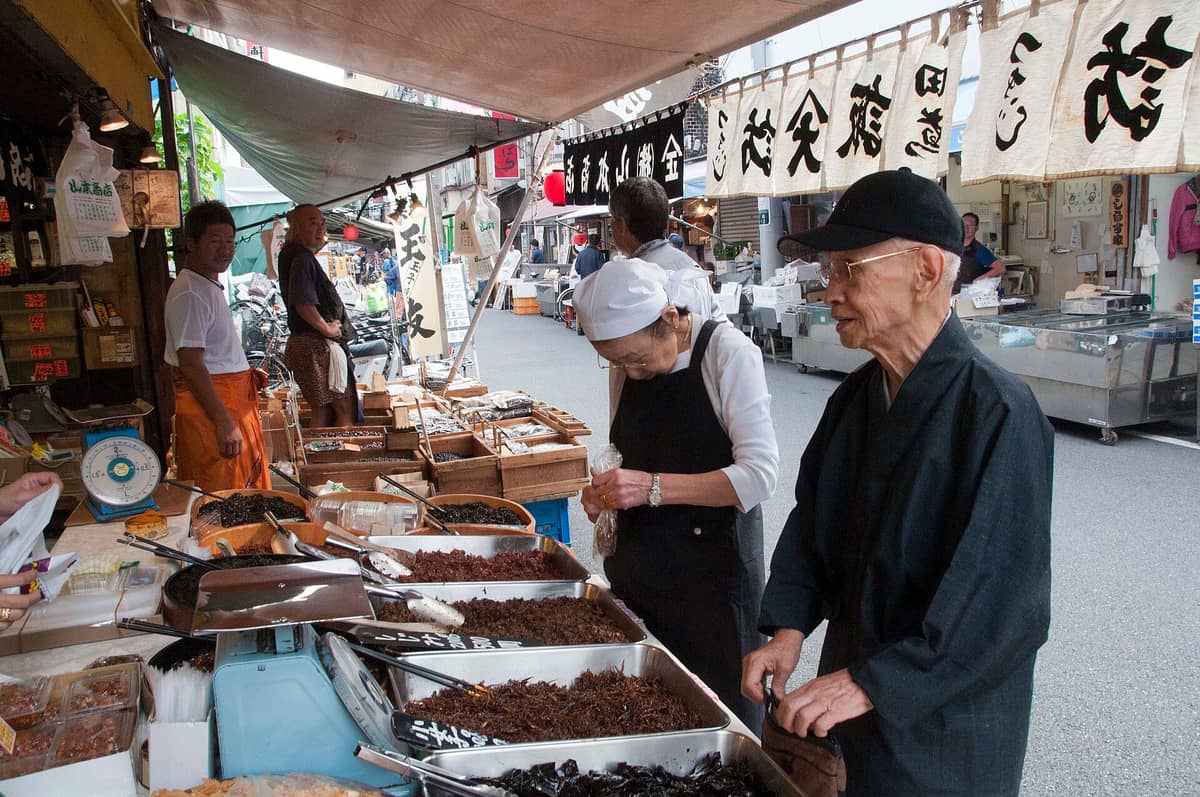
What Tsukiji Outer Market Actually Is
Tsukiji Outer Market is a retail and restaurant district that grew up around what was once Tokyo's central wholesale fish market. When the inner wholesale market relocated to Toyosu in October 2018, many commentators assumed Tsukiji was finished. It wasn't. The Outer Market, which had always operated independently from the wholesale side, stayed open and has continued drawing serious food-seekers every morning since.
The market occupies a dense grid of covered arcades and open-air lanes in Chuo City, roughly between Harumi-dori and the Sumida River waterfront. Roughly 460 vendors operate across the area: fishmongers selling whole tuna collars and live shellfish, shops pressing fresh tamagoyaki to order, knife dealers whose blades range from affordable to heirloom-grade, tea importers with open jars of sencha and hojicha, and counter restaurants where the day's menu is written in marker on a whiteboard by the door.
ℹ️ Good to know
Most shops open around 5:00–6:00 and begin winding down after 12:00. The window from 9:00 to 11:30 gives the broadest access for general visitors: stalls are fully stocked, sushi counters are taking walk-ins, and the morning rush of professional buyers has eased slightly.
Tsukiji is located in the Ginza-Tsukiji neighborhood, easily combined with a walk through the luxury shopping streets of Ginza after the market winds down around midday.
How the Market Changes Through the Morning
Arriving before 8:00 puts you in the middle of a working food district. Delivery carts weave through the lanes, vendors arrange product in crushed ice, and the smell of charcoal and salted fish hits you from the main arcade entrance. The pace is fast and there is a clear professional purpose to everything happening around you. This is the most atmospheric time, but also the most congested; groups with large bags or strollers will find the narrow corridors difficult.
Between 9:00 and 11:00, the tempo shifts. Queues form outside the best-known sushi counters and tamagoyaki stalls. The lanes fill with tourists and Tokyo residents shopping for weekend cooking. Vendors are more receptive to questions, and the pace slows enough to actually browse. This is the best window for photography: natural light filters into the covered arcades, stalls are fully displayed, and vendors aren't yet packing down for the day.
After 11:30, the market begins to close incrementally. Some stalls sell out of key items and shutter by noon. By 13:00, roughly half the vendors have closed. If your priority is eating, aim to be seated at a restaurant by 11:00 at the latest. If you arrive at 12:30 expecting full market energy, you will be disappointed.
⚠️ What to skip
Tsukiji Outer Market is largely closed on Sundays and national holidays. Many shops also close on Wednesdays. Check the official market calendar at tsukiji.or.jp before planning your visit.
Tickets & tours
Hand-picked options from our booking partner. Prices are indicative; availability and final rates are confirmed when you complete your booking.
Tsukiji Outer Market Seafood Breakfast Tour
From 144 €Instant confirmationFree cancellationTsukiji Fish Market Walking Food Tour
From 40 €Instant confirmationFree cancellationTsukiji Fish Market Tour
From 105 €Instant confirmationFree cancellationToyosu tuna auction, seafood breakfast, and tsukiji stroll in Tokyo
From 80 €Instant confirmationFree cancellation
What to Eat and Where to Focus
The most honest thing to say about eating at Tsukiji is this: the quality ceiling is extremely high, but so is the variance. Some stalls have been here for generations and are producing food that would justify a dedicated trip. Others exist purely to serve the tourist foot traffic and are notably less interesting. The best approach is to walk the length of the main arcade first, note what's drawing local attention, and then commit.
Tamagoyaki, the sweet rolled omelette that is a staple of Tsukiji stalls, is worth eating here even if you've had it elsewhere in Tokyo. The fresh version, cooked to order and handed to you in a paper sleeve while still warm, has a texture closer to custard than the cold, pre-sliced version served in most convenience stores and bento shops. Several shops offer small tasting slices so you can compare styles before buying.
For sushi, the counters along the inner lanes often serve omakase sets at prices that seem low relative to equivalent quality elsewhere in the city. Expect to wait, expect to sit close to other guests, and expect to order quickly once seated. These are working counters that move at pace. Pointing at what your neighbor has ordered is a perfectly acceptable strategy.
Tsukiji's knife and kitchenware shops are legitimately worth your attention if you cook seriously. The blades sold here range from affordable stainless entry-level knives to hand-forged carbon steel pieces made by named craftspeople. For broader context on Tokyo's food equipment culture, the Kappabashi kitchen district offers an even more comprehensive selection, though the cooking atmosphere is less immediate.
Historical Context: From Wholesale Hub to Open Market
The story of Tsukiji as a food district begins in 1935, when the Tokyo Metropolitan Government developed the area as a wholesale seafood market after the original Nihonbashi fish market was destroyed in the 1923 Great Kanto Earthquake. For nearly nine decades, the Tsukiji inner market operated as the logistical heart of Tokyo's seafood supply chain, handling daily auctions of tuna and other catch at volumes few markets in the world could rival.
The Outer Market developed organically alongside this wholesale activity, serving the professional buyers, restaurant owners, and eventually curious civilians who wanted access to the same produce. When the inner market relocated to Toyosu in October 2018, the wholesale auction infrastructure moved with it, but the Outer Market's retail identity was already decades old and thoroughly independent.
If you want to see where the professional tuna auctions now take place, Toyosu Market offers a visitor observation program, though it requires advance registration and operates on a very different schedule from Tsukiji.
Getting There and Getting Around
The most direct approach is the Tokyo Metro Hibiya Line to Tsukiji Station, which exits almost directly into the market area. Walking time from the exit is one to two minutes. The Toei Oedo Line stops at Tsukijishijo Station, a five-minute walk away, and can be useful depending on where you're coming from in the city. Higashi-ginza Station, served by both the Toei Asakusa Line and the Hibiya Line, is a short walk if you're arriving from the Ginza direction.
From Tokyo Station, the easiest route is the Marunouchi Line to Ginza, followed by a transfer to the Hibiya Line for one stop to Tsukiji. Toei bus routes 都04, 都05-1, and 都05-2 also connect Tokyo Station to a Tsukiji stop, which can be preferable if you have luggage or prefer above-ground navigation.
💡 Local tip
Bring cash in yen. While some larger vendors now accept IC cards or credit cards, many stalls and small counters are cash only. An ATM is available at a 7-Eleven convenience store near the market entrance.
The market's narrow lanes are not well-suited for wheelchairs or wide strollers, particularly during peak morning hours when the corridors fill with pedestrian and small vehicle traffic. The surfaces in parts of the market are uneven, and some covered sections have low overhangs. If mobility is a consideration, arriving just before 9:00 when professional traffic has eased is marginally easier, though the fundamental layout does not change.
Photography and Practical Preparation
The covered arcades at Tsukiji have inconsistent lighting: some sections are well-lit by overhead fluorescents, others are dim and atmospheric. A phone camera handles the brightly lit stalls well. For the more shadowed counter restaurants and narrow alleys, something with better low-light performance makes a noticeable difference.
Always ask before photographing a vendor directly, particularly those handling food. Most are accustomed to tourist cameras and won't object to wide shots of product displays, but pointing a lens at a person working requires a brief gesture of acknowledgment. A small nod and a camera raised with a questioning look is usually enough to establish permission.
Wear shoes you don't mind getting wet or soiled. Parts of the market floor are damp from ice and water runoff, and the lanes near active seafood stalls are routinely hosed down. Light-colored trainers will likely look worse by the time you leave.
If you're building a broader food-focused Tokyo itinerary, the Tokyo fish market guide covers both Tsukiji and Toyosu in detail, including how to structure a morning that visits both.
Who This Market Is For and Who Might Reconsider
Tsukiji Outer Market rewards visitors who come with genuine appetite and some flexibility. If you are there to eat well and browse a working food culture, the experience consistently delivers. If your expectation is a perfectly curated, pristine market experience with easy navigation and clear price lists, the reality will feel chaotic by comparison.
Visitors who are not particularly interested in food and are visiting primarily to check a well-known Tokyo attraction off a list may find the experience underwhelming, especially if they arrive late in the morning when many stalls are already closing. The market is best understood as a place to eat and shop, not a passive sightseeing destination.
For first-time visitors to Tokyo trying to structure a full itinerary, the Tokyo first-time visitor guide provides broader context on how to allocate your time across neighborhoods and attraction types.
Insider Tips
- The tamagoyaki stalls near the main Outer Market arcade often give free samples. Walk the full length before committing to a purchase; the variations in sweetness and texture between vendors are more pronounced than you'd expect.
- If you want to eat sushi at a counter and don't want to queue, the restaurants on the outer edges of the market (particularly along side streets rather than the main arcade) often have shorter waits than the ones featured in tourist guides, and quality is comparable.
- Knife shops here will engrave your name on a blade while you wait, often in under 15 minutes. If you're buying a serious kitchen knife as a souvenir, this is worth knowing in advance so you can budget time.
- The market operates on a calendar posted on the official website (tsukiji.or.jp/english/calendar). Wednesday closures catch many visitors off guard. Check the calendar for the specific date of your visit, not just the general weekly pattern.
- Combine Tsukiji with Hamarikyu Gardens, a short walk south along the waterfront. The contrast between the early market energy and the quiet formal garden makes for an unusually satisfying morning in two completely different registers.
Who Is Tsukiji Outer Market For?
- Food-focused travelers who want to eat well before the rest of Tokyo wakes up
- Serious home cooks interested in Japanese knives, cookware, or specialty ingredients
- Photographers drawn to working food markets and early-morning urban atmospheres
- Tokyo regulars returning for a specific vendor or meal rather than general sightseeing
- Travelers pairing a morning market visit with a walk through Ginza or Hamarikyu Gardens
Nearby Attractions
Other things to see while in Ginza & Tsukiji:
- Ginza Shopping District
Ginza is Tokyo's most storied commercial district, where Meiji-era brick boulevards gave way to gleaming flagship stores, world-class galleries, and some of the city's finest restaurants. Walking its grid of avenues costs nothing, and even window-shopping here is a refined experience in itself.
- Hamarikyu Gardens
Hamarikyu Gardens (浜離宮恩賜庭園) is a roughly 250,000 sqm tidal garden in Chuo Ward that once belonged to the Tokugawa shoguns and later served as an imperial retreat. Today, its seawater ponds, flowering plum and rapeseed fields, and framing views of the Shiodome skyscrapers make it one of the most visually striking public parks in central Tokyo.
- Kabukiza Theatre
Kabukiza Theatre is Tokyo's most celebrated kabuki venue, a grand neo-baroque building in Ginza where centuries-old theatrical tradition plays out on stage daily. Whether you want a full program or just a single act, this guide tells you exactly how to visit, what to see, and what to expect.