Kappabashi Kitchen Town: Inside Tokyo's Professional Kitchenware District
Kappabashi Dōgu-gai is a 800-metre stretch of over 170 specialist shops selling everything from hand-forged knives and lacquerware to industrial woks and the famous plastic food models you see in restaurant windows across Japan. Free to enter, easy to walk, and unlike anywhere else in Tokyo.
Quick Facts
- Location
- Matsugaya, Taito-ku, Tokyo (between Asakusa and Ueno)
- Getting There
- Tawaramachi Station (Tokyo Metro Ginza Line) – about 5 min walk; Iriya Station (Tokyo Metro Hibiya Line) – about 10–15 min walk
- Time Needed
- 1–2 hours for a thorough browse; 30–45 min if focused
- Cost
- Free to enter; purchases vary by shop
- Best for
- Food enthusiasts, home cooks, photographers, and anyone curious about Japan's food culture
- Official website
- www.kappabashi.or.jp/en/
What Kappabashi Kitchen Town Actually Is
Kappabashi Dōgu-gai (かっぱ橋道具街) is a dedicated wholesale and retail shopping street running roughly 800 metres through the Taito ward, positioned in the corridor between Asakusa and Ueno. More than 170 specialist shops line both sides of the road, each focused on a narrow slice of the food-service supply chain: one store sells nothing but bamboo steamers and wooden cutting boards; the next carries industrial-grade crockery stacked floor to ceiling; another deals exclusively in paper lanterns and shop signage. The street has historically served Tokyo's restaurant industry, which is why the merchandise skews professional, the quantities can be commercial, and the prices are often surprisingly fair compared to department store kitchenware floors.
Despite its wholesale roots, Kappabashi is thoroughly welcoming to individual visitors and tourists. Most shops sell single items with no minimum order. English signage has improved substantially in recent years, and several stores have staff with basic English. The street is free to walk, has no gates or barriers, and requires no reservation. It is, in the most literal sense, an open district.
💡 Local tip
Most shops open around 10:00 and close between 17:00 and 18:00. Many are closed on Sundays — confirm with individual shops before making a special trip on that day.
The Street Hour by Hour: How the Experience Changes
Arriving around 10:00–10:30 is the clearest window for a relaxed visit. Shopkeepers are restocking displays, delivery trucks are pulling away, and the footpath is calm enough to stop and examine things properly. The light in the morning cuts at a low angle and catches the glint of stainless-steel bowls and copper pots arranged outside several shops, which makes for better photography than you might expect from a commercial street.
By midday, particularly on weekdays, a mix of professional buyers and curious tourists fills the street. The hum becomes more purposeful — you can overhear restaurant managers in work aprons discussing wok gauges with shop assistants, while a few metres away a tourist is photographing a tray of hyper-realistic plastic gyoza. The contrast is the point. Kappabashi is a working district that happens to be fascinating to watch.
After 15:00, foot traffic thins again, giving you the best chance to speak with staff at length. This is particularly useful in the knife shops, where the difference between a 210mm gyuto and a yanagiba is worth understanding before you spend a serious amount of money. By 17:00, many shops begin pulling displays inside and shutting their shutters with a metallic clatter that signals the end of the working day.
Tickets & tours
Hand-picked options from our booking partner. Prices are indicative; availability and final rates are confirmed when you complete your booking.
Yanaka: historical walking tour in Tokyo's old town
From 40 €Instant confirmationFree cancellationAkihabara Electric Town Adventure with an Expert Guide
From 130 €Instant confirmationFree cancellationAsakusa Japanese Kitchen Knife Store
From 70 €Instant confirmationFree cancellation3-hour food tour of Tokyo's Old Town
From 129 €Instant confirmationFree cancellation
What You'll Find: A Category-by-Category Guide
The knives are what draw serious cooks. Several shops along the street stock Japanese kitchen knives at a range of price points, from entry-level stainless blades to hand-forged carbon-steel knives made by individual smiths in Sakai or Seki. The quality difference between a Kappabashi knife shop and a generic department store display is significant, and the staff in specialist knife stores can explain steel type, blade geometry, and maintenance in enough detail to help you make a considered purchase. Many shops will engrave a name or wrap a knife safely for travel on request.
Ceramic and lacquerware shops carry ramen bowls, soba trays, sake sets, and small plates in quantities and variety you will not find in tourist-area shops. Because these outlets supply restaurants, the stock tends toward durable, practical pieces rather than decorative ones — which, for most home kitchens, is exactly what you want. Prices per piece are reasonable, though bulk discounts apply mainly to professional buyers.
The plastic food model shops are among the most photographed spots on the street. Japan's sampuru industry — the production of hyper-realistic fake food displays used in restaurant windows — has its commercial home here. You can buy individual pieces: a gleaming plastic parfait, a bowl of fake ramen with visible steam sculpted in resin, individual sushi pieces accurate to the grain of the fish. These make unusual, lightweight souvenirs and hold up far better on a shelf than anything edible.
Beyond these categories, the street carries professional baking equipment, paper and fabric shop curtains (noren), industrial food storage containers, washi paper goods, and specialty cleaning tools. If you are planning a longer exploration of Asakusa alongside Kappabashi, the two areas complement each other well — Senso-ji and the Nakamise shopping arcade represent the traditional tourist face of the district, while Kappabashi shows you the infrastructure behind Tokyo's extraordinary food culture.
Historical and Cultural Context
Kappabashi developed as a wholesale kitchen-supply district during the early twentieth century, serving the dense concentration of restaurants, izakayas, and food stalls that had made the Asakusa area one of Tokyo's liveliest entertainment and dining quarters. As Tokyo's restaurant industry expanded through the postwar decades, Kappabashi expanded with it, consolidating into a single-purpose street where restaurant owners could source an entire kitchen fit-out without leaving the neighbourhood.
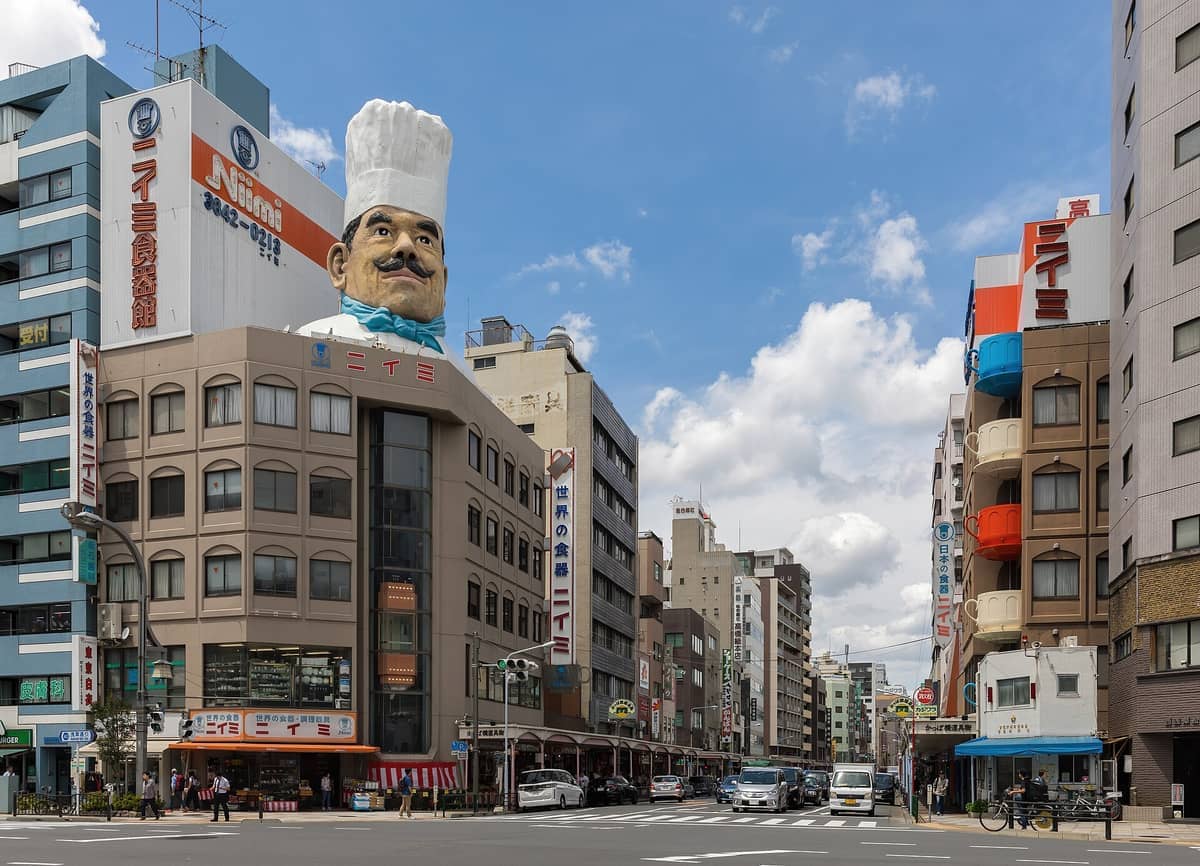
The street's name references the kappa, a water creature from Japanese folklore, whose statue appears on the street and gives the area a slightly playful identity amid the serious commercial activity. The kappa mascot appears on signage and shop goods throughout, and a large chef's-head statue marks one end of the street as a landmark. For context on how this neighbourhood sits within the broader fabric of the city, the Tokyo neighborhoods guide covers the Taito ward and its distinct character relative to central Tokyo's commercial districts.
Getting There and Practical Logistics
Tawaramachi Station on the Tokyo Metro Ginza Line is the most direct access point, about a five-minute walk from the main stretch of the street. The Ginza Line connects directly from Shibuya, Aoyama, Nihonbashi, and Ueno, making Kappabashi straightforward to reach from most central Tokyo hotels. Iriya Station on the Hibiya Line is around a 10–15-minute walk and useful if you are coming from the Akihabara or Roppongi direction.
If you are already visiting Senso-ji or the Asakusa area, Kappabashi is about a 15-minute walk west. The walk itself passes through quiet residential streets that give a sense of the older, lower-rise Tokyo still surviving in Taito-ku. Comfortable shoes matter here: you will be on your feet for the full visit, and many shops have smooth stone or tile floors that can be slippery in wet weather.
ℹ️ Good to know
The street itself is flat and wide with minimal vehicle traffic during shop hours, making it one of the more wheelchair-accessible shopping areas in the Asakusa neighbourhood. Individual shop interiors vary — some have small steps at the threshold — so check in advance if accessibility is a priority.
Payment is accepted in cash at virtually all shops. Credit and IC card acceptance has improved in recent years but is not universal, particularly in smaller or older family-run stores. Bring enough yen if you are planning serious purchases. There are no ATMs directly on the street, but convenience stores are within a short walk.
Photography Tips and Sensory Notes
The visual density of Kappabashi rewards slow walking. Shops arrange their goods outside on racks and tables: towers of steel colanders, long wooden rolling pins sorted by diameter, crates of terracotta sake cups. The textures range from rough unglazed pottery to mirror-polished stainless steel, and the contrast between them in a single shop front can make for strong close-up photography. A 50mm equivalent lens or a phone camera in portrait mode handles the shallow depth of field well.
The smells along the street are subtle but specific: the raw cedar scent drifting from a wooden-goods shop, faint machine oil near the industrial equipment stores, and occasionally the warm, sweet smell of freshly lacquered goods. It is a working commercial street rather than a food market, so there is no cooking smell to guide you — the sensory experience is more tactile than olfactory, built around handling merchandise.
For visitors planning a food-focused day, pairing Kappabashi with a morning visit to Tsukiji Outer Market makes thematic sense: the market shows you the raw ingredients of Japanese food culture, while Kappabashi shows you the tools used to prepare and present it. The two are not walking distance from each other but are linked easily by the Ginza Line.
Who This Street is For — and Who Might Skip It
Kappabashi has a clear audience: people who cook, people who are curious about how Tokyo's restaurant industry operates, and people who want souvenirs with genuine utility rather than decorative clutter. It also works well as part of a broader food culture itinerary or a day that combines several Taito-ward highlights.
Travellers with no interest in cooking or food service will find the street repetitive after the first few blocks. There are no restaurants, no performances, and no interactive experiences beyond shopping itself. Children may enjoy the plastic food models briefly, but the overall environment is adult and commercial. If you are looking for the atmospheric, lantern-lit character of old Tokyo, Senso-ji Temple nearby delivers that far more effectively.
Budget travellers who are not planning to buy anything can still walk the street at no cost and absorb the atmosphere, but the value of the visit scales directly with whether you have the luggage space and inclination to carry something home. Knives, for instance, must be packed in checked luggage. Ceramics require careful wrapping. The plastic food models are lightweight and shatter-resistant, which is why they tend to be the default choice for visitors who want something distinctive. For guidance on pairing this visit with other nearby options, the free things to do in Tokyo guide includes several Taito-ward options that complement a Kappabashi visit.
Insider Tips
- Visit on a weekday rather than Saturday — weekends bring more tourist foot traffic and the professional buyers who make the atmosphere interesting are largely absent. The balance shifts noticeably.
- The knife shops will often allow you to handle blades before purchasing. Ask politely, and do not touch the edge; instead, examine the spine, the balance point, and the handle fit in your hand. Staff appreciate engaged buyers and will spend more time with you.
- If you want to watch plastic food models being made, some specialist sampuru shops hold occasional workshops or demonstrations — check the official Kappabashi Dougu Street website for scheduled events before your visit.
- Street-end landmarks help with orientation: a large chef's head statue (the 'Niimi' building mascot) marks the southern end near Tawaramachi Station. Use it as your meeting point or navigation anchor.
- Bring a tote bag or small folding bag for purchases. Many shops provide minimal packaging, and carrying several ceramic bowls in a thin plastic bag down 800 metres of street gets uncomfortable quickly.
Who Is Kappabashi Kitchen Town For?
- Home cooks and professional chefs looking for quality Japanese knives, ceramics, or specialist equipment at trade-adjacent prices
- Food writers, culinary students, and anyone researching Japan's restaurant supply culture
- Souvenir hunters wanting something functional and genuinely Japanese rather than mass-produced tourist goods
- Photographers interested in textures, commercial still-life compositions, and the visual language of Japanese food service
- Visitors pairing Kappabashi with an Asakusa day who want to add a non-temple, non-shopping-mall dimension to the neighbourhood
Nearby Attractions
Other things to see while in Asakusa:
- Senso-ji Temple
Senso-ji in Asakusa is Tokyo's oldest Buddhist temple, founded in 628 CE and dedicated to Kannon, the Bodhisattva of Compassion. Senso-ji in Asakusa is Tokyo's oldest Buddhist temple, founded in 628 CE and dedicated to Kannon, the Bodhisattva of Compassion. Entry to the grounds is free, and the experience changes dramatically depending on when you arrive.
- Sumida Park
Sumida Park stretches along both banks of the Sumida River in Asakusa and Mukojima, offering some of Tokyo's most celebrated hanami scenery. With hundreds of cherry trees, unobstructed Tokyo Skytree views, and free admission year-round, it rewards visitors across every season.
- Tokyo Skytree
At 634 meters, Tokyo Skytree is one of the tallest structures in the world and the city's dominant broadcasting tower. It offers two observation levels, a large shopping complex at its base, and some of the clearest long-range views in Tokyo on a good day. This guide covers what the experience actually feels like, when to go, how much it costs, and whether it is worth your time.