Tokyo Skytree: What to Expect Before You Go Up
At 634 meters, Tokyo Skytree is one of the tallest structures in the world and the city's dominant broadcasting tower. It offers two observation levels, a large shopping complex at its base, and some of the clearest long-range views in Tokyo on a good day. This guide covers what the experience actually feels like, when to go, how much it costs, and whether it is worth your time.
Quick Facts
- Location
- 1-1-2 Oshiage, Sumida-ku, Tokyo 131-0045
- Getting There
- Tokyo Skytree Station (Tobu Skytree Line) or Oshiage Station (Tokyo Metro Hanzomon Line, Toei Asakusa Line)
- Time Needed
- 1.5 to 3 hours including Tokyo Solamachi
- Cost
- Tembo Deck from approx. ¥2,100–¥2,300 (adult); combo with Tembo Galleria from approx. ¥3,100–¥3,400 (adult). Children under 6 free. Dynamic pricing applies — check official site.
- Best for
- Clear-day panoramas, nighttime city lights, architecture enthusiasts, families with children
- Official website
- www.tokyo-skytree.jp/en
What Tokyo Skytree Actually Is
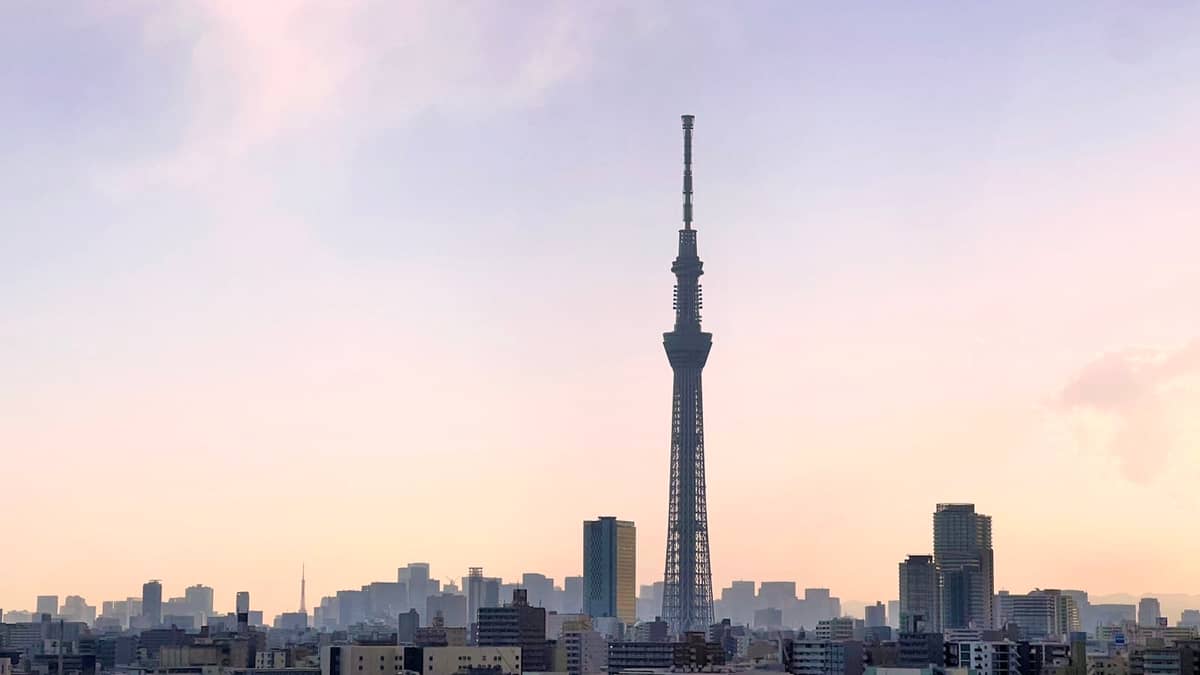
Tokyo Skytree is a self-broadcasting tower and observation complex in the Sumida ward of eastern Tokyo. It stands 634 meters tall, making it one of the tallest freestanding structures in the world, and its primary practical function is transmitting digital terrestrial broadcasting signals across the Kanto region. The observation component, the shops, and the restaurants are layered on top of that utility.
The tower's height of 634 meters is not accidental. In old Japanese, 6-3-4 can be read as "mu-sa-shi," a historical name for the region that once encompassed Edo and its surroundings. That kind of deliberate wordplay is very Tokyo. The structure was completed in 2012, replacing Tokyo Tower as the city's main broadcast transmitter due to interference from surrounding high-rises.
The tower anchors the Tokyo Solamachi complex at its base: a large shopping and dining mall spread across multiple floors that connects directly to the station concourse. Even if you skip the observation decks, Tokyo Solamachi functions as a neighborhood destination in its own right, particularly for food and Japanese craft goods. The surrounding Asakusa and Sumida area rewards those who build extra time into the visit.
The Two Observation Levels: What You Actually See
There are two distinct observation spaces. The Tembo Deck sits at floors 340 to 350, with the main viewing floor at 350 meters. It is a circular, enclosed deck with floor-to-ceiling glass panels and a partial glass floor section that looks straight down to the streets below. On clear days, the view extends across the low-rise eastern half of Tokyo, past Asakusa and the Sumida River, and in optimal conditions toward Mount Fuji to the southwest. The deck has a cafe and small souvenir areas, and it can feel crowded during peak hours.
The Tembo Galleria, accessible via an additional ticket, occupies floors 445 to 450. This upper level uses a spiraling glass walkway rather than a static viewing platform. The sense of being inside the tower's steel lattice is stronger here, and on very clear winter mornings, the view of Fuji from this height is genuinely striking. However, the Galleria is not always open independently — it requires the combo ticket purchased in advance or on-site.
⚠️ What to skip
Visibility is the single biggest factor affecting whether this visit is worth the ticket price. Hazy summer days and overcast skies can reduce the view to just a few kilometers. Check a Tokyo visibility forecast the morning of your visit and consider rescheduling if conditions look poor. Winter months, especially January and February, typically offer the best long-range clarity.
Tickets & tours
Hand-picked options from our booking partner. Prices are indicative; availability and final rates are confirmed when you complete your booking.
Meiji Shrine, Imperial Palace, Asakusa and Tokyo Skytree Entry
From 34 €Instant confirmationFree cancellationTour to Mt. Fuji Area, Oshino Hakkai and Kawaguchi Lake from Tokyo
From 57 €Instant confirmationFree cancellationNikko UNESCO Shrine and Nature View 1-Day Tour from Tokyo
From 78 €Instant confirmationFree cancellationYanaka: historical walking tour in Tokyo's old town
From 40 €Instant confirmationFree cancellation
How the Experience Changes by Time of Day
Mornings on weekdays are the quietest window. Arriving just after opening at 10:00 means shorter queues at the ticket counter and elevators, and if the sky is clear, the low morning light casts long shadows across the eastern wards below. The Solamachi shops are still warming up, the tower lobby smells of fresh air conditioning, and you can take your time at the glass panels without someone pressing against you for a selfie angle.
Midday on weekends is the hardest stretch. School groups, families, and tour buses converge, and the elevator queue can stretch significantly. If you have no flexibility and must visit on a weekend, the late afternoon slot around 16:00 to 17:30 is a reasonable compromise: the rush thins slightly, and you can watch the city transition from daytime to dusk from the deck.
Nighttime is where Tokyo Skytree becomes a different experience altogether. The city below resolves into a dense grid of light, with the Yamanote Line arc visible as a thread of moving brightness, and the towers of Shinjuku glowing in the west. The Skytree itself is lit in seasonal colors after dark, which changes the atmosphere on the deck as well. Last admission is typically at 20:00 (or 21:00 on some weekdays — confirm current hours on the official site before visiting), so a sunset visit that extends into early evening is the most efficient use of a single ticket.
Getting There and Buying Tickets
Access is straightforward. Tokyo Skytree Station on the Tobu Skytree Line places you directly at the base of the tower. Oshiage Station, served by the Tokyo Metro Hanzomon Line, Toei Asakusa Line, and Keisei Oshiage Line, is equally convenient and often used by visitors coming from the Asakusa side. The walk between Senso-ji Temple in Asakusa and the tower is roughly 15 minutes on foot along the Sumida River bank, making it a logical pairing.
Tickets can be purchased on-site at the 4th floor ticket counter or booked online in advance through the official site. Dynamic pricing applies: weekday adult tickets for the Tembo Deck start around ¥2,100, rising to approximately ¥2,300 on weekends and public holidays. The combo ticket adding Tembo Galleria starts around ¥3,100 (weekday) and ¥3,400 (holiday) for adults. If you are visiting during a busy period such as Golden Week, cherry blossom season, or autumn foliage weekends, advance purchase is strongly recommended. For more on navigating Tokyo's rail network efficiently, see the guide to getting around Tokyo.
💡 Local tip
Purchase tickets online before arrival. Same-day tickets at the counter can sell out during peak periods, and online booking lets you select a specific entry time slot, which means far less waiting in the lobby queue.
Accessibility and Practical Details
Tokyo Skytree is one of the more accessible observation towers in Asia. The entrance at floor 4 is step-free from street level, and elevators connect directly to the Tembo Deck at floor 350. Wheelchair-accessible restrooms are available on the 1st, 4th, and 5th floors, as well as across the Tembo Deck floors (340, 345, and 350) and at floor 450 on the Tembo Galleria. Wheelchair rental is available within the Tokyo Solamachi complex at designated information counters.
Photography is permitted throughout both observation levels. The main challenge is glass glare. Bring a lens hood or use a rubber lens ring pressed against the glass to eliminate reflections. On the glass floor sections, wide-angle shots looking straight down work well in good light. At night, slower shutter speeds help if you are shooting on a mirrorless or DSLR without a tripod, though tripods are generally not permitted.
The elevators are fast — among the fastest in Japan — and the ascent itself is part of the experience. The interior of each elevator capsule is decorated with imagery referencing Edo-period Tokyo, and the ride takes roughly 50 seconds to reach floor 350. First-time visitors often find this brief vertical sprint disorienting in the best way.
Weather, Seasons, and When to Prioritize This Visit
Winter, specifically January through early March, gives the best chance of seeing Mount Fuji from the upper deck. Cold, dry air from the northwest clears the haze that plagues Tokyo in summer and early autumn. If a view of Fuji is your reason for coming, plan accordingly. For context on how seasons affect Tokyo travel more broadly, the guide on the best time to visit Tokyo covers conditions city-wide.
Spring brings cherry blossoms to the parks along the Sumida River below the tower, which makes early April a genuinely atmospheric time to visit. Looking down at the pink canopy of Sumida Park from 350 meters is an unusual perspective on a quintessentially Tokyo scene. Autumn follows similar logic: the foliage in surrounding neighborhoods adds texture to the view, and the air is often clearer than summer.
Summer visits are risky for visibility but not without appeal at night. The city feels alive in a different way in July and August, and the Skytree lights up for summer festivals and Tanabata events. Just do not pay full price for a daytime summer ticket if the forecast shows haze — wait for a clear day or pivot to a different activity.
ℹ️ Good to know
Tokyo Skytree is located in Sumida ward, not technically within Asakusa (which sits in neighboring Taitō ward), but the two are closely linked in most visitors' itineraries. Allow at least half a day to combine both properly.
Is It Worth It? An Honest Assessment
For first-time visitors to Tokyo, the Skytree delivers something genuinely useful: a spatial orientation of the city at a scale that no map or street-level walk can provide. Seeing how vast and flat the eastern wards are, how the Yamanote Line loops around the center, and where the towers cluster versus where low residential neighborhoods stretch to the horizon, these are real insights. Pair it with the free observation deck at the Tokyo Metropolitan Government Building in Shinjuku for a contrasting western perspective, and you will understand the city's geography far better.
Repeat visitors and those who have already seen Tokyo from other vantage points may find the ticket price harder to justify, especially on days with limited visibility. The experience at the Tembo Galleria (floor 450) is distinctive and worth the upgrade if you are already committed to going up, but the lower deck alone may feel routine once you have done it.
Those primarily interested in Tokyo's skyline without paying for an enclosed observation deck might also consider alternatives. Shibuya Sky offers an open-air rooftop element that some visitors prefer, while Mori Art Museum in Roppongi combines a view platform with contemporary art for a more layered experience.
Insider Tips
- Book a time slot for around 30 to 45 minutes before sunset, then stay until dark. You get the daytime city spread, the dusk transition, and the full nighttime light show on a single ticket.
- The glass floor section on the Tembo Deck at floor 340 is less photographed than the main floor 350 viewing area. Go there first before crowds gather around it.
- Tokyo Solamachi's basement and first-floor food sections stock regional Japanese snacks and gift sets that are less touristy than the Skytree-branded merchandise upstairs. If you are buying food souvenirs, browse there.
- On winter mornings after a cold front passes, check the Skytree's own social media channels — they sometimes post real-time visibility reports and Fuji sighting confirmations.
- Oshiage Station exit B3 leads directly into the Solamachi complex and skips the outdoor plaza crowds entirely, which is useful on rainy days or when the ground-level queues look daunting.
Who Is Tokyo Skytree For?
- First-time Tokyo visitors wanting a geographic overview of the city
- Families with children who find the elevator speed and glass floor genuinely exciting
- Photography enthusiasts willing to time visits around weather and light conditions
- Travelers combining with a Asakusa temple visit for a half-day eastern Tokyo itinerary
- Anyone visiting in winter who wants a realistic chance of seeing Mount Fuji
Nearby Attractions
Other things to see while in Asakusa:
- Kappabashi Kitchen Town
Kappabashi Dōgu-gai is a 800-metre stretch of over 170 specialist shops selling everything from hand-forged knives and lacquerware to industrial woks and the famous plastic food models you see in restaurant windows across Japan. Free to enter, easy to walk, and unlike anywhere else in Tokyo.
- Senso-ji Temple
Senso-ji in Asakusa is Tokyo's oldest Buddhist temple, founded in 628 CE and dedicated to Kannon, the Bodhisattva of Compassion. Senso-ji in Asakusa is Tokyo's oldest Buddhist temple, founded in 628 CE and dedicated to Kannon, the Bodhisattva of Compassion. Entry to the grounds is free, and the experience changes dramatically depending on when you arrive.
- Sumida Park
Sumida Park stretches along both banks of the Sumida River in Asakusa and Mukojima, offering some of Tokyo's most celebrated hanami scenery. With hundreds of cherry trees, unobstructed Tokyo Skytree views, and free admission year-round, it rewards visitors across every season.