Tokyo Metropolitan Government Building: The Best Free View in Tokyo
Designed by Kenzo Tange and completed in 1990, the Tokyo Metropolitan Government Building offers free observation decks at 202 meters overlooking Shinjuku. It is one of the few high-altitude viewpoints in Tokyo that costs absolutely nothing to enter, making it a rare and genuinely worthwhile stop for any traveler.
Quick Facts
- Location
- 2-8-1 Nishishinjuku, Shinjuku, Tokyo
- Getting There
- Tochōmae Station (Oedo Line, direct access) or 10-min walk from JR Shinjuku Station
- Time Needed
- 45–90 minutes
- Cost
- Free (no ticket required)
- Best for
- Budget travelers, evening skyline views, architecture enthusiasts
- Official website
- www.english.metro.tokyo.lg.jp
What the Tokyo Metropolitan Government Building Actually Is
The Tokyo Metropolitan Government Building is not a tourist attraction that happens to have a view. It is a working government complex, the administrative headquarters of Tokyo Metropolis, a prefecture that governs roughly 14.27 million people across about 2,199 square kilometers. The fact that it opens its observation decks to the public, free of charge, is almost incidental to its primary function. That combination, genuine architectural scale, civic purpose, and no entry fee, is what makes it worth your attention.
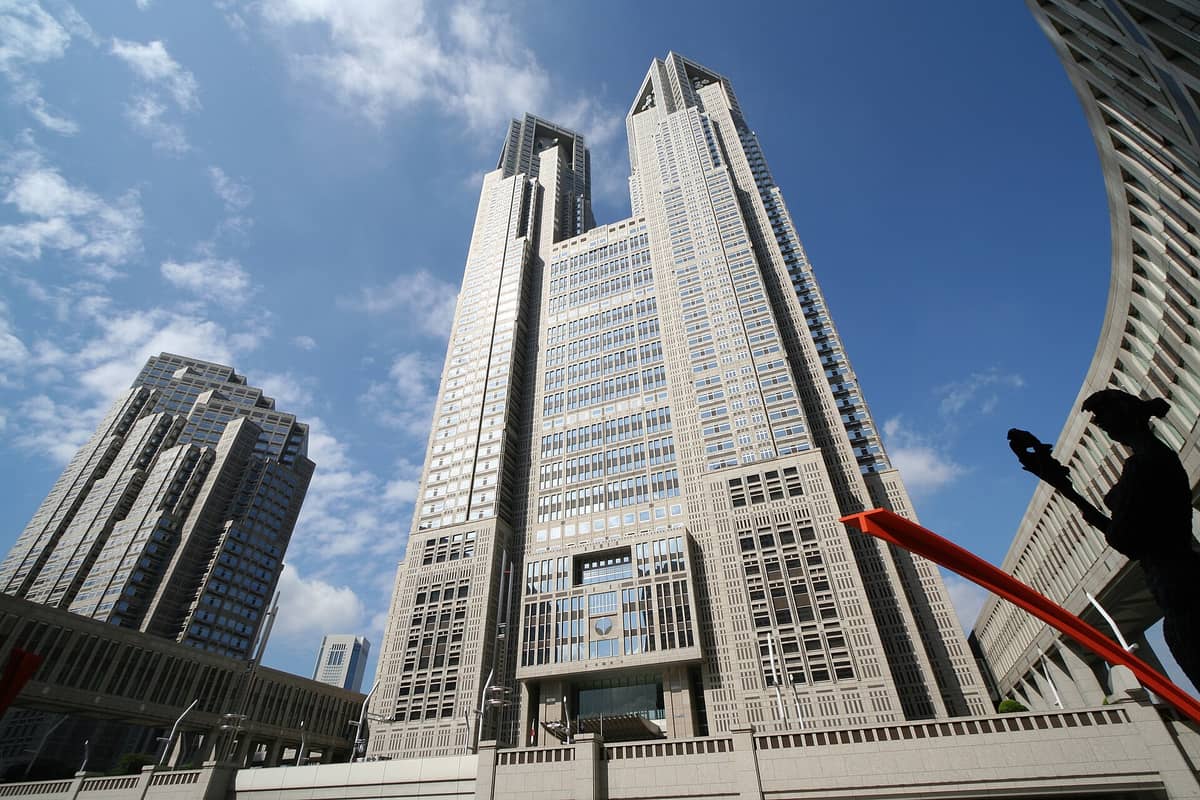
The complex was designed by Kenzo Tange, one of Japan's most celebrated postwar architects, and completed in 1990. Tange drew inspiration from Gothic cathedral forms, and if you look at the upper portion of the twin towers from street level, the comparison holds: the facades are divided into grid-like panels that converge at pointed peaks, giving the building a weight and verticality unusual for government architecture. Each tower rises to approximately 243 meters in height. The observation decks on both sit on the 45th floor, about 202 meters above ground.
ℹ️ Good to know
There are two separate observation decks: the North Observatory and the South Observatory. They are in different towers and operate on different schedules. Always check which one is open on the day you plan to visit before making the trip.
The Two Observation Decks: What to Expect on Each
The South Observatory generally operates from 9:30 to around 22:00, with last admission 30 minutes before closing. It is closed on the 1st and 3rd Tuesday of each month. The North Observatory runs from approximately 9:30 to 17:30 on most days, though it stays open later on days when the South deck is closed. The North deck is closed on the 2nd and 4th Monday of each month. Both close over the New Year period, typically December 29 to 31 and January 2 to 3, and occasional closures occur for maintenance.
In practical terms, this staggered schedule means you have options. If you want evening or night views, the South Observatory is your target. If you are visiting on a Tuesday when the South is closed, the North often compensates with extended hours. The layouts of the two decks are broadly similar: wide windows on all sides, a small café or gift counter area, and seating near the glass. Neither deck feels cramped, though the South tends to draw more visitors on a given evening.
Both decks use dedicated high-speed elevators accessed from the basement level of the No.1 Building. The ride takes around 55 seconds. When you step out, the scale of the view takes a moment to process. On a clear day, Shinjuku's secondary skyline sits directly below you, and the city extends in every direction with no obvious edge. On very clear winter mornings, Mount Fuji is visible to the southwest, its snowcapped cone floating above the urban haze.
For context on what else Tokyo's skyline has to offer from altitude, the best views in Tokyo guide compares the government building with paid alternatives like Shibuya Sky and Tokyo Skytree.
Tickets & tours
Hand-picked options from our booking partner. Prices are indicative; availability and final rates are confirmed when you complete your booking.
Tour to Mt. Fuji Area, Oshino Hakkai and Kawaguchi Lake from Tokyo
From 57 €Instant confirmationFree cancellationNikko UNESCO Shrine and Nature View 1-Day Tour from Tokyo
From 78 €Instant confirmationFree cancellationYanaka: historical walking tour in Tokyo's old town
From 40 €Instant confirmationFree cancellationMeiji Shrine, Imperial Palace, Asakusa and Tokyo Skytree Entry
From 34 €Instant confirmationFree cancellation
How the Experience Changes at Different Times of Day
Morning visits, particularly on weekdays before 11:00, tend to be quiet. The office workers streaming through the lobby below create a low hum of activity, but the observatory itself is rarely crowded at this hour. The light from the east falls cleanly across the city, and Shinjuku's towers cast long shadows toward you. It is a good time to photograph the urban geometry without the flat midday glare.
Midday and early afternoon bring the largest crowds, especially on weekends. Families, school groups, and tour parties arrive in waves, and the observation deck can feel congested near the windows. The views are fine, but the ambient noise rises and the experience loses some of its contemplative quality.
The hour around sunset is the most compelling time to visit. As the light drops, the city shifts from a grey-and-beige patchwork into something more layered: the orange glow from the western sky, the gradual illumination of thousands of office windows below, and the first appearance of the city's neon signage further east. By full dark, the view is panoramic and genuinely impressive. The lack of an entry fee makes lingering feel low-stakes, which is itself a small pleasure.
💡 Local tip
For Mount Fuji sightings, visit on a clear winter morning (December through February) before 10:00. Summer humidity and haze reduce visibility significantly, and the mountain is often obscured entirely from June through September.
Getting There and Getting In
The most direct route is the Toei Oedo Line to Tochōmae Station, which connects directly to the government complex via an underground passage. You exit directly into the building's lower floors. From JR Shinjuku Station, the walk west through the Nishi-Shinjuku skyscraper district takes about 10 minutes and is well signposted. If you are arriving from the east side of Shinjuku Station, allow an extra few minutes to navigate the station's underground passages.
Entry to the observation decks requires no ticket purchase, no reservation, and no queue at most times. You walk to the basement level of Building No.1, find the observatory elevator lobby, and go up. The elevators are fast and clearly marked. The whole process from street level to the 45th floor takes under five minutes.
The building is barrier-free. Elevators accommodate wheelchairs throughout, and the observatory floor itself is fully accessible. Restrooms are available on the observation level.
If you are navigating from elsewhere in the city, the Tokyo transit guide covers IC card setup and line transfers in straightforward detail.
The Architecture Worth Paying Attention To
Most visitors arrive for the view and leave without thinking much about the building itself. That is a small missed opportunity. Kenzo Tange's design was controversial when it was built. Critics at the time called it overly theatrical for a civic office, and the Gothic-influenced facade was seen by some as a departure from his earlier, more rational modernist work. From the outside, particularly looking up at the towers from the plaza below, the sheer density of the surface detailing is striking. The stonework grid panels, the recessed windows, and the stepped profile give the structure a presence that most contemporary towers lack.
The main plaza between the buildings is worth a few minutes of your time, particularly in the morning when office workers cross it and the scale of the two towers is clearest. At night, the towers are lit from below and take on a different character: more monumental, less corporate.
Tange's government building sits within a broader cluster of 1980s and 1990s corporate towers in Nishi-Shinjuku. For a wider look at what Tokyo's built environment offers, the Tokyo architecture guide maps out the city's most architecturally significant districts and structures.
Practical Details and What to Bring
There is a small café on the observation floor, though the selection is limited and prices are slightly elevated for what you get. If you are planning an evening visit, bringing your own drink is reasonable. Photography from the decks is permitted without restriction: tripods are allowed, and the windows are relatively clean. Window reflections are the main challenge for interior shots; pressing your lens against the glass or using a rubber lens hood helps eliminate glare.
In winter, the observation floor can feel cool even with the heating running, particularly if there are open sections or if the windows are drafty. A light layer is useful. In summer, the floor is air-conditioned and provides welcome relief from the street-level heat.
⚠️ What to skip
Both decks close on different weekdays and during public holidays. Check the Tokyo Metropolitan Government website before you go, as closures for inspections or special events occasionally fall outside the regular schedule.
The government building sits in Shinjuku, one of Tokyo's most layered neighborhoods. After your visit, the area around Omoide Yokocho is a 10-minute walk east and offers a sharp contrast to the administrative towers surrounding you.
Is It Worth Your Time?
For a free experience at 202 meters, the honest answer is yes, particularly if you are visiting Tokyo on a budget or simply do not want to spend ¥2,000 or more on a different observation deck. The views are genuinely wide and clear. The building itself is architecturally interesting. The lack of commercialization, no ticketing system, no themed gift shop sprawling across the entry, gives the whole experience a low-pressure quality that paid attractions rarely manage.
That said, if you are comparing it directly to the paid alternatives, there are differences. The observation windows have frames and some structural elements that cut into wide-angle views. The interior is functional rather than designed for atmosphere. And the two-deck system, with its staggered closure days, requires a small amount of advance planning that more commercial attractions do not.
Travelers who want a curated, fully designed viewing experience with cafes, interactive elements, and floor-to-ceiling glass will find the government building underwhelming. Travelers who simply want to stand 202 meters above Tokyo and look at one of the world's largest cities spread out below them, at no cost, will find it exactly right.
First-time visitors to the city can get broader orientation in the Tokyo first-time visitor guide, which covers how to structure your days across the city's major areas.
Insider Tips
- The North Observatory is almost always less crowded than the South, even when both are open simultaneously. If the view is your priority and the crowd is not, start with the North.
- Weekday evenings between 18:30 and 20:00 offer a sweet spot: office workers have cleared out, the city lights are building, and visitor numbers are lower than on weekend evenings.
- Mount Fuji is visible from the South Observatory on clear winter mornings, but only before late morning. Arrive before 10:00 and look southwest past the lower buildings of Nishi-Shinjuku.
- The Tochōmae Station connection means you can exit the train and reach the elevator lobby without going outside at all, which matters on rainy days or during summer heat.
- If you are already in Shinjuku for another reason, the observatory requires no additional trip planning. The walk from the east side of Shinjuku Station through the underground passages takes about 12–15 minutes and keeps you out of traffic entirely.
Who Is Tokyo Metropolitan Government Building For?
- Budget travelers who want high-altitude Tokyo views without a ticket price
- Architecture enthusiasts interested in Kenzo Tange's postwar civic design
- Evening visitors looking for a panoramic night view with low crowds
- Travelers with accessibility requirements: the building is fully barrier-free
- First-time visitors to Tokyo wanting geographic orientation across the city
Nearby Attractions
Other things to see while in Shinjuku:
- Golden Gai
Golden Gai is a cluster of six narrow alleys in Shinjuku holding around 200 micro-bars, most seating fewer than ten people. Built on postwar foundations and surviving decades of development pressure, it remains one of Tokyo's most distinctive after-dark experiences — intimate, occasionally eccentric, and unlike anything else in the city.
- Kabukicho
Kabukicho is Tokyo's most infamous entertainment district, a dense grid of neon-lit streets northeast of Shinjuku Station where izakayas, host clubs, cinemas, and karaoke towers operate from dusk until well past dawn. Entry to the district is free and unrestricted, but the experience varies dramatically depending on when you arrive and where you look.
- Omoide Yokocho
Tucked alongside the JR tracks at Shinjuku Station's west exit, Omoide Yokocho is a tightly packed alley of about 80 premises, including around 60 bars and eateries, that has been a postwar Tokyo dining and drinking district since the late 1940s. There is no admission fee, no gate, and no showmanship — just charcoal smoke, cold beer, and a Showa-era atmosphere that has somehow survived decades of redevelopment around it.
- Shinjuku Gyoen National Garden
Shinjuku Gyoen National Garden packs three distinct garden styles, a Victorian greenhouse, and over a thousand cherry trees into 58 hectares of central Tokyo. It is one of the few places in this city where the noise of Shinjuku Station genuinely disappears within two minutes of walking through the gate.