Golden Gai: Inside Shinjuku's Labyrinth of Micro-Bars
Golden Gai is a cluster of six narrow alleys in Shinjuku holding around 200 micro-bars, most seating fewer than ten people. Built on postwar foundations and surviving decades of development pressure, it remains one of Tokyo's most distinctive after-dark experiences — intimate, occasionally eccentric, and unlike anything else in the city.
Quick Facts
- Location
- 1 Chome-1-6 Kabukicho, Shinjuku City, Tokyo 160-0021
- Getting There
- JR Shinjuku Station (East Exit, 5-10 min walk); Seibu Shinjuku Station (5 min walk)
- Time Needed
- 2–4 hours for a proper evening out; 20 minutes to walk through
- Cost
- Free to enter; individual bars charge cover fees (typically around ¥500–¥1,500) plus drinks
- Best for
- Solo travelers, night owls, anyone curious about Tokyo's postwar drinking culture
- Official website
- http://goldengai.jp
What Golden Gai Actually Is
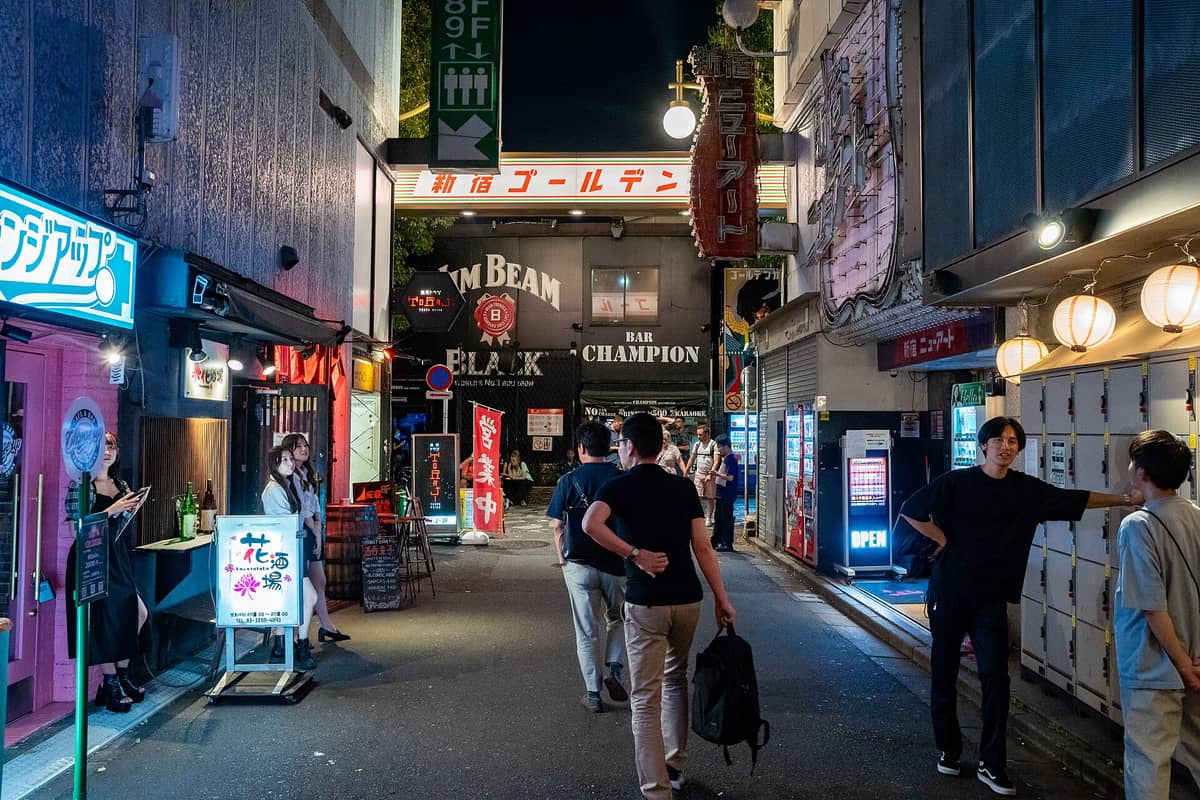
Shinjuku Golden Gai occupies a footprint smaller than a city block, yet it contains approximately 200 individual bars spread across six narrow lanes. Each bar is roughly the size of a walk-in wardrobe — many seat between five and eight people, with stools pressed tight against a counter and the bartender close enough to hand you a drink without leaning forward. The alleys themselves are too narrow for two umbrellas side by side. At street level, the density of hand-painted signs, paper lanterns, and faded photographs taped to windows creates something that resembles a film set more than a functioning neighborhood.
But it is entirely real, and it has been here far longer than most of what surrounds it. Golden Gai grew in the years following World War II, when small traders and vendors occupied this part of Shinjuku. Over time, the stalls and black-market shops gave way to bars catering to artists, writers, filmmakers, and journalists. That creative-bohemian identity persisted through the decades of rapid development that erased most of Tokyo's postwar urban texture. Today, the wooden structures remain largely as they were in the Showa era, making Golden Gai one of the most intact examples of mid-20th century bar culture still operating in the city.
ℹ️ Good to know
Entry to the Golden Gai district itself is completely free. Costs begin when you enter a bar — most charge a cover fee of around ¥500 up to around ¥1,500, plus the cost of at least one drink. Check the notice posted at each bar's entrance before stepping inside.
The Experience by Time of Day
During the day, Golden Gai is quiet in a way that rewards a brief detour. The alleys are easy to walk without crowds, and you can read the bar signs, peer through small windows, and get a sense of the scale without the noise. The peeling paint, weathered wood, and dense stacking of signage is photogenic in daylight, though some travelers find it looks unexpectedly rundown without the evening atmosphere.
Things shift around 19:00 to 21:00, when most bars open. Warm light spills from tiny doorways, and the smell of cigarette smoke mixes with grilled food drifting over from neighboring Kabukicho. By 22:00, the alleys have a low, murmuring energy: groups of two or three clustered at bar entrances deciding whether to enter, regulars greeting bartenders through open doors, occasional laughter from within. It rarely gets loud in the way a conventional bar district does, because the individual spaces are simply too small to hold enough people.
After midnight, Golden Gai thins out on weeknights, but on Friday and Saturday nights it stays active until the early hours. Some bars operate until 05:00. Many bars close on Sundays or Mondays, and irregular schedules are common — a bar that was open last weekend may be dark this one. This unpredictability is part of the place's character, but it means there is no guarantee that any specific bar you have read about will be open on a given evening.
💡 Local tip
Aim to arrive between 20:00 and 21:00 on a Thursday, Friday, or Saturday. Early enough to find a seat, late enough that the atmosphere has built. Avoid Sunday nights — many bars are closed.
Tickets & tours
Hand-picked options from our booking partner. Prices are indicative; availability and final rates are confirmed when you complete your booking.
3-Hour Guided Food Tour of Tokyo's Shinjuku Golden Gai
From 127 €Instant confirmationFree cancellationAnime-Themed Electric Bike Tour Through Tokyo's Golden Route
From 48 €Instant confirmationFree cancellationTsukiji Fish Market Walking Food Tour
From 40 €Instant confirmationFree cancellationMt.Fuji,Owakudani, Hakone Cruise & Ropeway, Oshino Hakkai 1-Day Trip
From 54 €Instant confirmationFree cancellation
How to Navigate the Alleys
Getting to Golden Gai from JR Shinjuku Station is straightforward: take the East Exit, cross over toward Kabukicho along Yasukuni-dori, and look for Hanazono Shrine on your right. The entrance to Golden Gai sits directly behind the shrine. From Seibu Shinjuku Station, it is about five minutes on foot in the same direction. Neither route requires navigation skills — the shrine is visible and the alleys branch immediately off the main street.
The six alleys run parallel and are connected by short cross-passages. There is no map you need to follow, and no wrong turn. Walking the full length of all six takes under fifteen minutes at a relaxed pace. The practical challenge is not finding the place but choosing where to enter. Most visitors pick a bar by reading the notice at the door, glancing inside to gauge the atmosphere, and deciding whether the current occupants look like people they would like to spend an hour next to.
Each bar has a strong individual identity, often reflected in the themed decor: film memorabilia, jazz records, vintage manga, hand-written poetry. Some cater openly to foreign visitors; others are effectively regulars-only spaces where a stranger's arrival is met with polite but cool acknowledgment. Both are legitimate Golden Gai experiences, and neither type is better than the other.
Golden Gai sits at the edge of Kabukicho, Shinjuku's large entertainment district. If you are combining the two in one evening, read about the Kabukicho area beforehand so you understand the different character of each zone. Kabukicho is larger, louder, and more commercial; Golden Gai is quieter, smaller, and more idiosyncratic.
Cultural and Historical Context
The survival of Golden Gai through Tokyo's several waves of urban redevelopment is genuinely unusual. In the 1980s, during Japan's property bubble, there were serious efforts to demolish the district and replace it with modern construction. Residents and bar owners organized to resist, and the area was ultimately preserved. The episode is sometimes cited as an early example of grassroots heritage advocacy in Tokyo, and the result is that Golden Gai functions today both as a working entertainment district and as an accidental preservation of postwar urban fabric.
The bars themselves have histories. Some have been run by the same families for decades; others have changed hands repeatedly. A few became known specifically as gathering places for creative figures in Japanese film, literature, and theater during the 1960s through 1980s. That heritage lingers more in reputation than in daily reality — most bars now serve a mix of locals, young Japanese professionals, and increasing numbers of foreign visitors — but the atmosphere it created, where a conversation between strangers at a tiny counter is considered normal, has not entirely disappeared.
For broader context on the neighborhood, the Shinjuku neighborhood guide covers how Golden Gai fits into Shinjuku's geography alongside its commercial and cultural districts.
Practical Details for Your Visit
Cover charges are standard in Golden Gai and exist to compensate bartenders for the cost of running a bar that can hold only six customers at peak capacity. A bar charging ¥1,000 cover and expecting one drink purchase is not being unreasonable given the economics of the space. Confirming the charge before sitting down is sensible and not considered rude.
Cash remains preferred in the majority of bars, though some now accept cards. Carrying yen is strongly recommended. ATMs are available near Shinjuku Station and at the 7-Eleven and Family Mart branches within a short walk of the district.
Accessibility is limited throughout Golden Gai. The alleys are pedestrian-only, but uneven underfoot in places. Many bars require ducking through low doorways and ascending steep, narrow staircases to reach upper-floor seating. Wheelchair access is not feasible in most of the district, and visitors with significant mobility limitations will find many bars physically inaccessible.
Weather has modest effect on the experience. The alleys are uncovered, so walking between bars on a rainy night means getting wet. A compact umbrella is useful from June through September. Cold winter evenings are actually pleasant in Golden Gai because the bars are heated and the warmth from a full counter makes even a small space feel welcoming.
⚠️ What to skip
A small number of bars in Golden Gai post signs indicating they do not welcome first-time visitors or non-Japanese speakers. Respect these notices without taking offense. There are plenty of welcoming alternatives within the same alleys.
Photography and What to Expect Visually
Golden Gai photographs well in the evening, particularly in the transitional period between dusk and full dark, when the lanterns and neon signs are lit but there is still some ambient light in the sky. The alleys are narrow enough that a wide-angle lens or a smartphone camera captures the full atmosphere without needing to stand far back. The exteriors are legitimate subjects for street photography; interiors require the agreement of the bartender and other guests.
If you are building a broader Shinjuku evening itinerary, Omoide Yokocho — the narrow yakitori alley near the West Exit of Shinjuku Station — offers a different but thematically related atmosphere and makes a natural pairing.
Who Should Reconsider This Visit
Golden Gai is sometimes treated in travel coverage as Tokyo's definitive after-dark experience, which sets expectations it cannot always meet. If you are primarily looking for cocktail craft, extensive menus, or reliable hours, there are better options in Shinjuku and elsewhere. The appeal here is atmospheric and social, not gastronomic. Visitors who find small, noisy, smoke-affected spaces uncomfortable, or who are traveling with a group larger than three, will find the format awkward. Similarly, anyone with significant mobility needs should be aware that the physical environment is genuinely constraining.
The increasing number of tourists has changed the dynamic in some bars, particularly those that have been featured prominently in foreign travel media. A few now feel more like a staged experience than an authentic one. This is not universal, but it is worth approaching individual bars with some flexibility — the best evenings in Golden Gai tend to happen in bars you found by walking in on instinct rather than following a list.
For a broader look at Tokyo's after-dark options beyond Shinjuku, the Tokyo nightlife guide covers other districts and formats worth considering.
Insider Tips
- Read the notice posted at each bar's entrance before stepping in. It typically states the cover charge, whether first-timers are welcome, and sometimes the bar's theme. This takes ten seconds and avoids awkward exits.
- If a bar you want to enter is full — which is easy to achieve with a capacity of six — wait outside for five minutes. Turnover is fast in tiny bars, and a seat often opens before you finish your drink on the street.
- Some of the most interesting bars are on the upper floors of the two-story buildings, accessible only by steep interior staircases. They tend to be quieter and less visited simply because they are less visible from the alley.
- Hanazono Shrine, directly adjacent to Golden Gai's main entrance, is worth a brief stop before the bars open. At dusk, with lanterns lit and the sound of the city muffled by the shrine's grounds, it provides a useful moment of calm before the evening begins.
- Weeknight visits — particularly Tuesday through Thursday — offer a noticeably more local crowd and a better chance of genuine conversation at the bar counter. Friday and Saturday nights bring more tourists and higher competition for seats.
Who Is Golden Gai For?
- Solo travelers comfortable starting conversations in close quarters
- Anyone interested in Tokyo's postwar urban history and drinking culture
- Night owls looking for something open well past midnight
- Travelers who want a small, specific experience rather than a large venue
- Photographers drawn to layered, atmospheric, low-light urban environments
Nearby Attractions
Other things to see while in Shinjuku:
- Kabukicho
Kabukicho is Tokyo's most infamous entertainment district, a dense grid of neon-lit streets northeast of Shinjuku Station where izakayas, host clubs, cinemas, and karaoke towers operate from dusk until well past dawn. Entry to the district is free and unrestricted, but the experience varies dramatically depending on when you arrive and where you look.
- Omoide Yokocho
Tucked alongside the JR tracks at Shinjuku Station's west exit, Omoide Yokocho is a tightly packed alley of about 80 premises, including around 60 bars and eateries, that has been a postwar Tokyo dining and drinking district since the late 1940s. There is no admission fee, no gate, and no showmanship — just charcoal smoke, cold beer, and a Showa-era atmosphere that has somehow survived decades of redevelopment around it.
- Shinjuku Gyoen National Garden
Shinjuku Gyoen National Garden packs three distinct garden styles, a Victorian greenhouse, and over a thousand cherry trees into 58 hectares of central Tokyo. It is one of the few places in this city where the noise of Shinjuku Station genuinely disappears within two minutes of walking through the gate.
- Tokyo Metropolitan Government Building
Designed by Kenzo Tange and completed in 1990, the Tokyo Metropolitan Government Building offers free observation decks at 202 meters overlooking Shinjuku. It is one of the few high-altitude viewpoints in Tokyo that costs absolutely nothing to enter, making it a rare and genuinely worthwhile stop for any traveler.