Kabukicho: Inside Shinjuku's Legendary Entertainment District
Kabukicho is Tokyo's most infamous entertainment district, a dense grid of neon-lit streets northeast of Shinjuku Station where izakayas, host clubs, cinemas, and karaoke towers operate from dusk until well past dawn. Entry to the district is free and unrestricted, but the experience varies dramatically depending on when you arrive and where you look.
Quick Facts
- Location
- Kabukicho, Shinjuku City, Tokyo 160-0021
- Getting There
- Seibu-Shinjuku Station (1 min walk); JR Shinjuku Station East Exit (5–8 min walk); Higashi-Shinjuku Station
- Time Needed
- 1–3 hours for a walk-through; longer if dining or visiting venues
- Cost
- Free to enter the district; individual venues charge their own prices in JPY
- Best for
- Night owls, curious travelers, urban photography, izakaya-hopping
- Official website
- http://www.kabukicho.or.jp/index.php?lang=en
What Is Kabukicho?
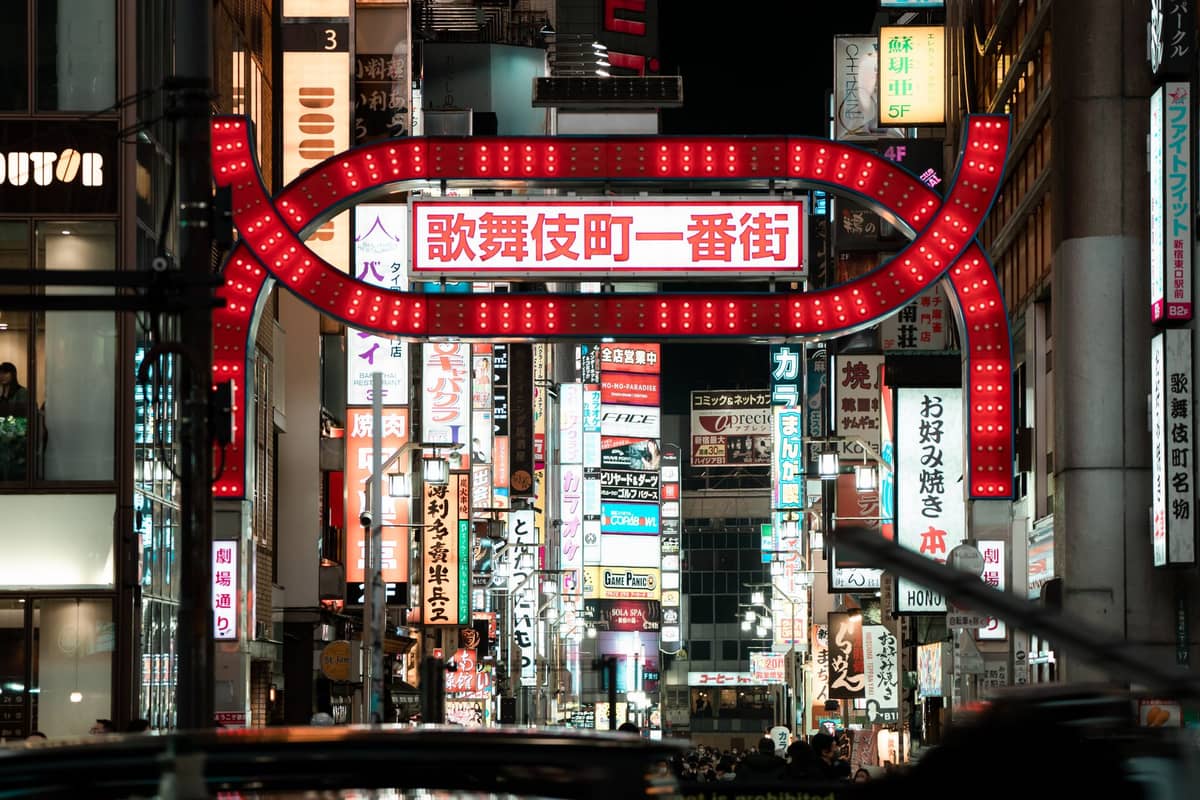
Kabukicho (歌舞伎町) is a dense entertainment district occupying roughly a dozen city blocks in Shinjuku ward, Tokyo. It is a public area with streets accessible 24 hours a day, has no gates, no entry fee, and no single defining landmark — only a relentless accumulation of bars, restaurants, host and hostess clubs, karaoke buildings, cinemas, pachinko parlors, and everything in between. Walking through the district's entrance arch on Yasukuni-dori, the scale of it hits immediately: several stories of signage stacked above narrow alleyways, red and gold neon competing with the glow of vending machines, and a crowd that shifts in character as the evening deepens.
The name carries an irony that locals appreciate. The area that would become Kabukicho was named Kabuki-chō on April 1, 1948, after post-war redevelopment planners proposed building a kabuki theater on the site. The theater was never built, but the name stuck. The surrounding neighborhood had historically been called Tsunohazu, and was largely rebuilt from scratch after World War II. What emerged gradually over the following decades was one of Asia's largest adult entertainment districts, a title it still holds today. For a deeper dive into the neighborhood it sits within, the Shinjuku neighborhood guide provides broader context.
ℹ️ Good to know
Kabukicho is a public district, not a ticketed attraction. The streets are always accessible. What you spend, if anything, depends entirely on which venues you enter.
Daytime vs. Nighttime: Two Very Different Districts
Arriving in Kabukicho at noon is an instructive experience. The main streets are calm enough to be slightly underwhelming. Convenience stores are open, a few ramen shops are pulling lunch crowds, and workers in black uniforms are hosing down the pavement outside clubs that won't open for hours. The signage that looks overwhelming at midnight reads as slightly shabby in daylight — peeling laminate photo menus, handwritten touts' placards, delivery bikes parked at odd angles. Tourists who visit only during the day often leave wondering what the fuss is about.
After 8 PM, the transformation is significant. The neon activates in full. Touts in matching outfits materialize at corners along Ichibangai (the district's main drag), approaching passersby with laminated menus for host clubs and bars. The sound environment thickens: J-pop bleeding from open doorways, the mechanical symphony of pachinko parlors, groups of salary workers in loosened ties making their way toward izakayas. By midnight on a Friday or Saturday, the alleyways around Golden Gai (technically a short walk east and on the edge of Kabukicho but closely associated with the area) are at full capacity. Between 2 and 4 AM, Kabukicho reaches its most cinematic state: the crowds thin slightly, the light seems impossibly bright against the dark, and the city's famous last-train anxiety is nowhere to be felt here, because the trains stopped running an hour ago and nobody seems to care.
💡 Local tip
If photography is your goal, arrive around 9–10 PM on a weekday. Crowds are present but not overwhelming, and the neon is fully lit. Weekends after 11 PM become genuinely difficult to navigate for composition shots.
Tickets & tours
Hand-picked options from our booking partner. Prices are indicative; availability and final rates are confirmed when you complete your booking.
Kabukicho Higashi Tokyo Dining Experience at an Izakaya Restaurant
From 35 €Instant confirmationFree cancellationKabukicho Central Road Dining Experience at an Izakaya Restaurant
From 35 €Instant confirmationFree cancellationHost Club and Kabukicho Private Tour in Tokyo
From 64 €Instant confirmationFree cancellationRamen Making Experience in Kabukicho
From 21 €Instant confirmationFree cancellation
The Physical Layout: How to Navigate It
Kabukicho is more compact than first impressions suggest. The core area runs roughly from the iconic entrance gate on the south side to Okubo Park on the north, and from Seibu-Shinjuku Station on the east to the broader Shinjuku entertainment sprawl on the west. The main artery, often called Ichibangai, runs north from the gate and is lined with the district's most prominent establishments. Side alleys branch off in both directions and become progressively narrower and more varied the further you explore.
The quickest entry point is Seibu-Shinjuku Station, approximately one minute on foot from the gate. From JR Shinjuku Station's East Exit, the walk takes five to eight minutes along a pedestrian shopping street, passing through the transition zone where Shinjuku's department stores give way to the entertainment district. Higashi-Shinjuku Station (on the Toei Oedo and Tokyo Metro Fukutoshin lines) provides another access point from the southeast/east.
Within the district, the Tower Records building and the Toho Cinema complex (home to Godzilla's famous rooftop statue) serve as reliable orientation landmarks. The Toho Cinemas Shinjuku building, opened in 2015, anchors the north end of the main plaza and represents a significant recent investment in the district's mainstream entertainment credentials. Nearby, Golden Gai lies just west of Kabukicho proper — a maze of roughly 200 tiny bars, each seating fewer than ten people, that represents an entirely different face of Shinjuku's nightlife.
What to Do (and What to Expect)
Most travelers visit Kabukicho to observe rather than participate in its more notorious offerings. The host and hostess clubs, which charge by the hour for the company and conversation of professionally trained staff, are an industry unto themselves, and are not designed for casual drop-in visits by tourists. The touts outside these establishments are persistent but rarely aggressive; a firm, polite refusal ends the interaction immediately.
What is genuinely accessible and enjoyable for visitors covers a wide range. The ramen shops concentrated around the district's backstreets — particularly the cluster sometimes called Ramen Street — are legitimate and often excellent, typically operating through the late-night hours when the district's crowds are hungriest. Karaoke chains like Shidax and Big Echo have locations nearby and welcome walk-in customers. The izakayas along the side streets offer standard Japanese pub dining with few language barriers given the picture menus. The Toho cinema complex screens major releases including Japanese-language films with and without subtitles.
For travelers who want to understand Japanese nightlife culture more broadly before visiting, the Tokyo nightlife guide covers the range of options across the city, from Kabukicho to Roppongi to the smaller bars of Shimokitazawa.
⚠️ What to skip
Be cautious of establishments that don't display prices upfront, particularly smaller bars in the side alleys. 'Table charges' and 'service fees' can multiply unexpectedly. If a menu has no prices listed, ask before sitting down.
Who Should Reconsider This Visit
Kabukicho is frequently described in hyperbolic terms — either as dangerously seedy or as a harmless neon playground. The reality is more nuanced. It is a functioning commercial district with real edge, particularly in its back alleys late at night, and travelers who are uncomfortable in environments with visible adult entertainment, persistent street touts, and occasional intoxicated crowds may find the experience genuinely unpleasant rather than thrilling.
Families with children will find the daytime visit manageable as a walk-through, but the evening environment is not well suited to children given the volume of adult-oriented signage and the increasingly rowdy street atmosphere after 9 PM. Budget travelers should know that the district itself is free, but the temptation to spend is omnipresent and often the cost of individual venues is higher than equivalent establishments in other parts of Tokyo.
Practical Details: Getting There, What to Bring, Photography
Entry to the district requires nothing beyond shoes and a charged phone. Most visitors walk directly from Shinjuku Station, which is served by the JR Yamanote, Chuo (including Chuo-Sobu), Saikyo, and Shonan-Shinjuku lines, as well as the Tokyo Metro Marunouchi line and several Toei and private lines. Seibu-Shinjuku Station, on the Seibu Shinjuku Line, is the single closest station and deposits visitors almost directly in front of the district entrance.
Late-night transportation is worth planning in advance. Tokyo's train network typically stops running between about 00:30 and 01:30 AM and resumes around 5 AM. Taxis are available throughout the night and can be hailed on the street or booked via app. Fares from Kabukicho to other central neighborhoods range considerably depending on destination and time; late-night surcharges apply. Alternatively, a number of 24-hour establishments in the district make it entirely possible to simply stay until the trains restart.
For photography, a wide-angle lens captures the overwhelming density of signage; a longer focal length pulls individual details out of the chaos. Shoot from street level rather than elevated positions for the most immersive results. Flash photography is generally unnecessary given the ambient light levels at night. The main plaza in front of the Toho Cinema building offers the most iconic wide-angle views of the district.
Weather affects the experience more than many visitors anticipate. Rain transforms Kabukicho into a different visual environment: reflections on the wet pavement multiply the neon in every direction, umbrella density increases, and the covered arcades and internal walkways fill with people avoiding the downpour. Summer visits (July and August) bring genuine heat and humidity that makes long walks through the district tiring by midnight; winter visits (December through February) are brisk but the dry air keeps the neon crisp and the crowds move faster. For guidance on the best time to plan your Tokyo trip overall, the best time to visit Tokyo guide breaks down each season.
Insider Tips
- The stretch of side streets directly east of the main gate — away from Ichibangai — contains some of the district's best-value izakayas, where picture menus and the fact that staff are accustomed to non-Japanese speakers make ordering straightforward.
- The rooftop Godzilla statue on the Toho Cinemas building is visible from street level but most dramatically framed from the open plaza below. It is an external decorative feature, not a ticketed viewing point.
- Kabukicho becomes noticeably calmer between 4 and 6 AM — the late-night crowd has dispersed, the delivery trucks haven't arrived yet, and the district has an almost surreal quiet. If you are already awake at this hour, it is worth a short walk.
- Touts approaching you on the street are not dangerous, but they are trained for extended engagement. The most effective response is a brief head-shake and continued walking; stopping to explain yourself only prolongs the interaction.
- Many of the ramen and gyoza shops in and around Kabukicho display their menus in both Japanese and English, or have plastic food displays outside — these tend to be reliable, unpretentious options that serve until 3 or 4 AM.
Who Is Kabukicho For?
- Night owls who want to see Tokyo operating at full intensity after midnight
- Street and urban photographers looking for neon-saturated visual environments
- Travelers curious about Japanese nightlife culture as an observer rather than participant
- Ramen and late-night food seekers who need to eat after the trains stop
- Anyone building a broader Shinjuku itinerary who wants to understand what makes the ward so distinct
Nearby Attractions
Other things to see while in Shinjuku:
- Golden Gai
Golden Gai is a cluster of six narrow alleys in Shinjuku holding around 200 micro-bars, most seating fewer than ten people. Built on postwar foundations and surviving decades of development pressure, it remains one of Tokyo's most distinctive after-dark experiences — intimate, occasionally eccentric, and unlike anything else in the city.
- Omoide Yokocho
Tucked alongside the JR tracks at Shinjuku Station's west exit, Omoide Yokocho is a tightly packed alley of about 80 premises, including around 60 bars and eateries, that has been a postwar Tokyo dining and drinking district since the late 1940s. There is no admission fee, no gate, and no showmanship — just charcoal smoke, cold beer, and a Showa-era atmosphere that has somehow survived decades of redevelopment around it.
- Shinjuku Gyoen National Garden
Shinjuku Gyoen National Garden packs three distinct garden styles, a Victorian greenhouse, and over a thousand cherry trees into 58 hectares of central Tokyo. It is one of the few places in this city where the noise of Shinjuku Station genuinely disappears within two minutes of walking through the gate.
- Tokyo Metropolitan Government Building
Designed by Kenzo Tange and completed in 1990, the Tokyo Metropolitan Government Building offers free observation decks at 202 meters overlooking Shinjuku. It is one of the few high-altitude viewpoints in Tokyo that costs absolutely nothing to enter, making it a rare and genuinely worthwhile stop for any traveler.