Shinjuku Gyoen National Garden: Tokyo's Most Rewarding Green Space
Shinjuku Gyoen National Garden packs three distinct garden styles, a Victorian greenhouse, and over a thousand cherry trees into 58 hectares of central Tokyo. It is one of the few places in this city where the noise of Shinjuku Station genuinely disappears within two minutes of walking through the gate.
Quick Facts
- Location
- 11 Naito-machi, Shinjuku-ku, Tokyo 160-0014
- Getting There
- Shinjuku-gyoemmae Station (Tokyo Metro Marunouchi Line, Okido Gate); JR Shinjuku Station (10 min walk, Shinjuku Gate); JR Sendagaya Station (Sendagaya Gate)
- Time Needed
- 1.5 to 3 hours depending on season and pace
- Cost
- Adults ¥500; Students (high school+) & Seniors ¥250; Under 15 Free. Annual pass ¥2,000 (Adults), ¥1,000 (High school students).
- Best for
- Cherry blossom viewing, garden photography, quiet afternoon escapes, families with children
- Official website
- fng.or.jp/shinjuku/en
What Shinjuku Gyoen Actually Is
Shinjuku Gyoen National Garden is a 58-hectare public garden managed by Japan's Ministry of the Environment, located in the Shinjuku ward of central Tokyo. Its full Japanese name, 新宿御苑, translates literally as Shinjuku Imperial Garden, and the imperial connection is real: the garden served as an imperial estate before World War II, before opening to the public in 1949. Today it is one of the largest and most carefully maintained green spaces within Tokyo's 23 special wards.
What makes it different from other Tokyo parks is the deliberate variety. Three distinct garden zones sit within the same enclosure: a French formal garden with symmetrical flowerbeds and a central promenade, an English landscape garden with wide open lawns and mature trees, and a Japanese traditional garden with ponds, stone lanterns, tea houses, and clipped azalea mounds. The transition between them is abrupt enough to be genuinely surprising, even on a second or third visit.
ℹ️ Good to know
Alcohol is not permitted inside Shinjuku Gyoen. This is actively enforced at peak seasons, particularly during cherry blossom viewing. The garden also prohibits ball games and barbecues, which keeps the atmosphere noticeably calmer than nearby Yoyogi Park during hanami season.
The Experience by Time of Day
Arriving at opening time, around 09:00, puts you in a different garden entirely from the midday version. The light comes in at a low angle through the camphor trees lining the main promenade, the lawns are still damp, and the garden is mostly occupied by elderly residents doing slow morning walks and the occasional serious photographer. The sounds are birdsong, gravel underfoot, and distant station announcements carried by wind. By 11:00 on a weekend, that quiet begins to dissolve into the low murmur of school groups and family picnic parties spreading blankets across the English landscape zone.
Early afternoon is the busiest window, typically between 12:00 and 14:00, when office workers from the surrounding Shinjuku blocks use the garden for lunch. The lawns fill up quickly on clear days. If you visit during this window, the narrower paths around the Japanese garden area tend to stay quieter than the open central sections. Late afternoon, from around 15:00 onward, is a good recovery window: crowds thin, the light becomes warmer, and the tea houses around the Japanese zone offer a natural endpoint to a long circuit of the grounds.
On certain days the Shinjuku Gate opens early at 07:00 until 09:00, offering a genuinely rare chance to walk the main promenade alone. The Okido and Sendagaya gates remain closed during this early window, so access is limited to Shinjuku Gate only. Check the official site before planning an early visit, as the schedule varies.
Tickets & tours
Hand-picked options from our booking partner. Prices are indicative; availability and final rates are confirmed when you complete your booking.
100-minute all-you-can-eat of Wagyu in Shinjuku
From 38 €Instant confirmationFree cancellationBar-hopping night tour in Shinjuku
From 61 €Instant confirmationFree cancellationNishi-Shinjuku Tokyo Dining Experience at an Izakaya Restaurant
From 35 €Instant confirmationFree cancellationShinjuku 3-Chome Tokyo Dining Experience at an Izakaya
From 35 €Instant confirmationFree cancellation
Cherry Blossoms and Seasonal Character
Shinjuku Gyoen is widely considered one of the best cherry blossom viewing locations in Tokyo, and this reputation is earned rather than overstated. The garden holds around 1,000 cherry trees across around 65 varieties, which means the flowering period here is unusually long: early bloomers like Kanzakura and Okanzakura flower in late January, while varieties like Ichiyo and Kanzan peak in mid-to-late April, well after the famous Somei Yoshino have finished across the rest of the city. A single visit in early April can catch overlapping variety peaks simultaneously.
The garden is typically open on Mondays during the official cherry blossom and chrysanthemum festival periods, when it would normally be closed. But plan early: gates can reach capacity on peak weekends in late March and early April, and queues form at all three entrances. If you are visiting Tokyo specifically for sakura season, the guide to Tokyo in spring covers timing strategies across the city, including how Shinjuku Gyoen compares to alternatives like Ueno Park and Chidorigafuchi.
Autumn brings a different but equally worthwhile transformation. November chrysanthemum exhibitions are held in the greenhouse and formal garden areas, and the maples in the Japanese garden section turn from late November into December, often peaking when most of the city's other foliage has already dropped. The atmosphere in November is less crowded and more relaxed than cherry blossom season, making it arguably the better time for visitors who want the garden's full character without the festival energy.
💡 Local tip
For cherry blossom season, arrive at gate opening (09:00) on a weekday rather than a Saturday afternoon. The no-alcohol rule means the garden stays cleaner and quieter than other hanami spots, but it still fills up fast on weekends. Bring a picnic mat and plan to stay for at least two hours to properly walk all three garden zones.
The Three Garden Zones and the Greenhouse
The French formal garden occupies the central section and is the first major space most visitors encounter from the Shinjuku Gate. It is laid out with geometric precision: trimmed plane trees line a central path, rectangular flowerbeds are planted in season with tulips in spring and salvias in summer, and the whole composition feels more like a Parisian park than anything typically associated with Japan. It photographs well in the early morning, when the perspective lines are clear and there are few people on the central axis.
The English landscape garden is the heart of the space in practical terms: a broad, gently rolling lawn bordered by towering London plane trees and ancient camphor trees, some with canopies wide enough to shelter dozens of people. This is where picnic blankets appear, where children run, and where the sense of genuine open space is most striking given that Shinjuku Station is less than a kilometer away. The turf quality is maintained carefully, which is relatively unusual for Tokyo parks.
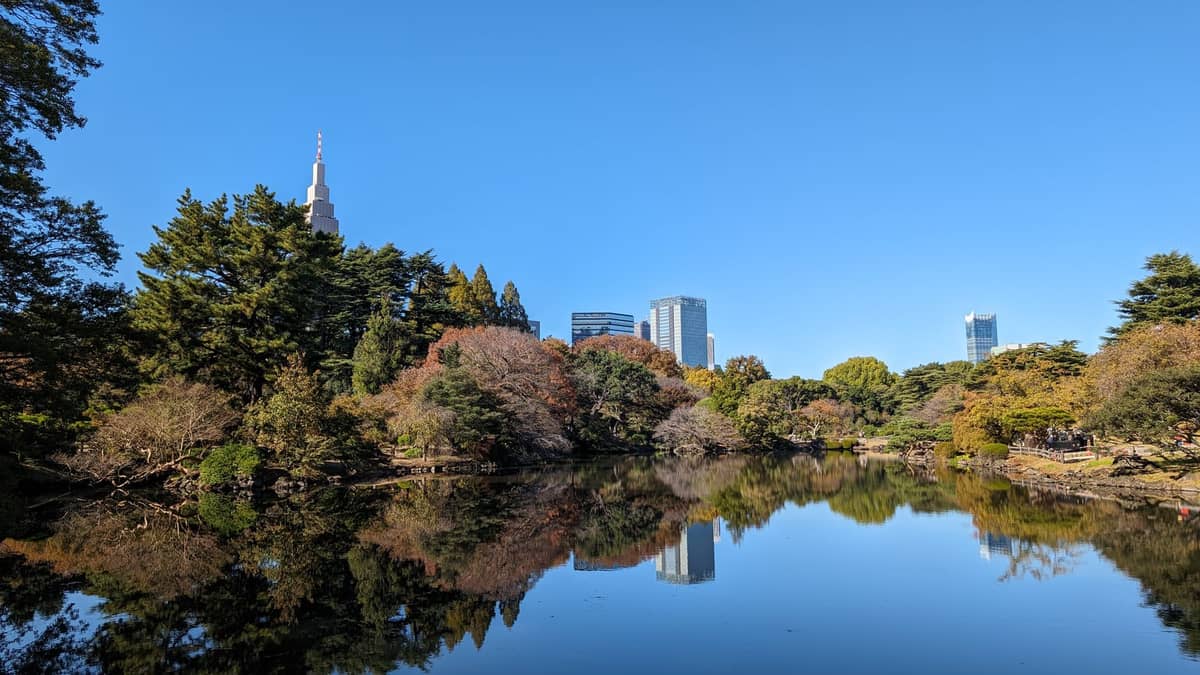
The Japanese traditional garden, toward the eastern end of the grounds, requires slower walking. Paths narrow around the central pond, stone bridges cross to small islands, and clipped evergreen shrubs shape the views into carefully composed frames. Two traditional tea houses, the Rakuutei and the Kyu-Goryo-Tei, sit within this zone. The Kyu-Goryo-Tei is a Western-style building dating to the Meiji period, and the contrast between it and the surrounding Japanese garden is intentional: it served as an imperial rest house and represents the period's fascination with blending design traditions.
The large-scale greenhouse near the center of the garden is included in the admission price and contains subtropical and tropical plant collections, including a walkway through dense ferns, cycads, and flowering plants maintained at controlled humidity. On a cold winter day or a rainy afternoon, it provides a warm, sensory break from the outdoor gardens. The current glass and steel structure is a modern facility built after the war, replacing the earlier greenhouse that was lost during World War II.
History and Cultural Context
The land that forms Shinjuku Gyoen was originally a feudal domain during the Edo period, attached to the Naito clan. In the late 19th century it was incorporated into the imperial estate system and developed as a botanical and agricultural testing ground before being refined into an imperial garden in 1906. The garden opened to the public in 1949, after the war and the dissolution of the imperial estate system, and was later designated a national garden under Ministry of the Environment management.
This history distinguishes it from parks like Ueno Park, which evolved around temples and museums, or Yoyogi Park, which was repurposed postwar from a military parade ground. Shinjuku Gyoen's design reflects the Meiji-era ambition to absorb and integrate Western garden aesthetics while preserving Japanese horticultural traditions — an ambition made visible in the way the three garden zones sit side by side without hierarchy.
Getting There, Tickets, and Practical Details
There are three gates, each served by different stations. The Okido Gate, on the eastern side, is closest to Shinjuku-gyoemmae Station on the Tokyo Metro Marunouchi Line: exit the station and the gate is a short, direct walk. The Shinjuku Gate, on the western side, is the main entrance and requires about 10 minutes of walking from JR Shinjuku Station's south exit, passing through a quiet residential block. The Sendagaya Gate, on the northern side, is a short walk from JR Sendagaya Station on the Sobu Line and tends to be the least crowded of the three.
Admission is ¥500 for adults, ¥250 for students holding valid ID (high school level and above) and for seniors aged 65 and over, and free for children in junior high school and below. Annual passes are available at ¥2,000 for adults and ¥1,000 for high school students, making them worthwhile for anyone visiting Tokyo across multiple trips in a year or staying for an extended period. Tickets are purchased at the gate; there is no advance online booking required for general admission.
Opening hours follow a seasonal schedule. From October 1 to March 14, the garden is open 09:00 to 16:00, with last entry at 15:30. From March 15 through June 10, and again from August 1 through September 30, closing extends to 17:30, with last entry at 17:00. From June 11 through July 31, the garden stays open until 18:30, with last entry at 18:00. The garden is closed every Monday (unless Monday falls on a public holiday, in which case it closes the following weekday instead) and from December 29 to January 3. Always verify the current schedule on the official website before visiting, as seasonal events can shift hours.
⚠️ What to skip
The Okido Gate (closest to Shinjuku-gyoemmae Station) is not included in the early morning opening hours on days when the 07:00 access is offered. Only the Shinjuku Gate opens at that time. If you are planning a dawn visit, plan your route accordingly.
Accessibility within the garden is reasonable for a space of this scale. The Shinjuku Gate area includes paved, level paths suitable for wheelchairs, and accessible restrooms are located at multiple points around the grounds. The Japanese garden section has some uneven stone paths where wheelchair navigation requires more care. A printed map in English is available at each gate and shows restroom locations, garden zones, and the greenhouse entrance.
Photography Conditions and What to Bring
The French formal garden shoots best in the first hour after opening, when the light is directional and the central path is clear. The English landscape zone photographs well in mid-morning on overcast days, when the flat light brings out the green saturation of the turf and the texture of the large tree canopies. During cherry blossom peak, the grove of Somei Yoshino near the central lawn creates strong foreground-background compositions, especially when blossoms are at full bloom against clear blue skies.
For autumn foliage photography, the Japanese garden section in late November is the priority. The maple reflections in the main pond produce some of the most photogenic autumn imagery in Shinjuku. Bring a wide-angle lens for the greenhouse interior and a short telephoto for isolating garden details. Tripods are permitted but require some negotiation around other visitors in tight garden paths.
Comfortable walking shoes are worth prioritizing over style here. A complete circuit of all three zones, including a stop at the greenhouse and the Japanese garden pond, covers between 3 and 5 kilometers depending on your route. In summer, the humidity inside the tree canopy areas is lower than on open streets, but bring water and consider visiting in the late afternoon when temperatures drop. In winter, the garden can feel cold and exposed on the lawns, but the Japanese garden zone and greenhouse provide natural warm pauses.
Insider Tips
- The Sendagaya Gate is consistently the least-used entrance, which means shorter queues during peak cherry blossom weekends. JR Sendagaya Station is one stop from Shinjuku on the Sobu Line.
- The Kyu-Goryo-Tei building in the Japanese garden zone is often overlooked by visitors focused on the ponds and cherry trees. It is one of the few surviving Meiji-era imperial rest houses in Tokyo and worth a close look at the exterior woodwork and the surrounding planted composition.
- During chrysanthemum season in November, the formal greenhouse displays are free with garden admission. These are serious horticultural exhibitions, not tourist arrangements, and include elaborate training styles rarely seen outside Japan.
- Picnic food can be purchased from convenience stores immediately outside the Shinjuku Gate (a FamilyMart is within two minutes of the entrance). Inside the garden, the restaurant near the main lawn serves simple set meals and seasonal sweets, but queues build quickly from 11:30 onward.
- On overcast days outside of peak seasons, the garden can feel quiet to the point of solitude by mid-week afternoon. This is genuinely one of the few places in central Tokyo where you can sit on a bench for thirty minutes without another person nearby.
Who Is Shinjuku Gyoen National Garden For?
- Cherry blossom viewers who want to avoid the drinking crowds of Ueno and Yoyogi without sacrificing tree quality or quantity
- Garden and botanical photography at any season, with particularly strong autumn foliage and spring bloom conditions
- Families with young children who need open lawns and safe, enclosed green space in central Tokyo
- Travelers on tight budgets who want a full afternoon of calm and visual interest for ¥500
- Visitors recovering from Shinjuku sensory overload who need a genuine decompression stop
Nearby Attractions
Other things to see while in Shinjuku:
- Golden Gai
Golden Gai is a cluster of six narrow alleys in Shinjuku holding around 200 micro-bars, most seating fewer than ten people. Built on postwar foundations and surviving decades of development pressure, it remains one of Tokyo's most distinctive after-dark experiences — intimate, occasionally eccentric, and unlike anything else in the city.
- Kabukicho
Kabukicho is Tokyo's most infamous entertainment district, a dense grid of neon-lit streets northeast of Shinjuku Station where izakayas, host clubs, cinemas, and karaoke towers operate from dusk until well past dawn. Entry to the district is free and unrestricted, but the experience varies dramatically depending on when you arrive and where you look.
- Omoide Yokocho
Tucked alongside the JR tracks at Shinjuku Station's west exit, Omoide Yokocho is a tightly packed alley of about 80 premises, including around 60 bars and eateries, that has been a postwar Tokyo dining and drinking district since the late 1940s. There is no admission fee, no gate, and no showmanship — just charcoal smoke, cold beer, and a Showa-era atmosphere that has somehow survived decades of redevelopment around it.
- Tokyo Metropolitan Government Building
Designed by Kenzo Tange and completed in 1990, the Tokyo Metropolitan Government Building offers free observation decks at 202 meters overlooking Shinjuku. It is one of the few high-altitude viewpoints in Tokyo that costs absolutely nothing to enter, making it a rare and genuinely worthwhile stop for any traveler.