Ueno Park: Tokyo's Grand Public Park and Cultural Heart
Ueno Park (上野恩賜公園) is one of Tokyo's oldest and most storied public spaces, offering free access to vast lawns, Shinobazu Pond, and a cluster of world-class museums and temples. Whether you come for cherry blossoms in spring, autumn foliage, or a quiet afternoon by the water, Ueno rewards every kind of visitor.
Quick Facts
- Location
- Uenokoen, Taito City, Tokyo 110-0007
- Getting There
- JR Ueno Station (Park Exit), Keisei Ueno Station, Tokyo Metro Ueno Station
- Time Needed
- 2–5 hours (park only); full day if visiting museums
- Cost
- Park entry free; individual museums and zoo charge separate admission
- Best for
- Families, museum-lovers, spring cherry blossoms, solo walkers, history enthusiasts
What Is Ueno Park?
Ueno Park, officially 上野恩賜公園 (Ueno Onshi Kōen), translates roughly as 'Ueno Imperial Gift Park', a name that hints at its origins as land gifted by the imperial household to the city during the Meiji era. Opened in 1873 as one of Japan's first designated public parks, it stretches across the Ueno hill that was once the domain of the Kaneiji Temple, the Tokugawa shogunate's great mortuary temple. Much of that temple was destroyed during the battles of the Boshin War in 1868, but the land's cultural weight never diminished. Today the park covers roughly 53 hectares in Taito City and anchors one of Tokyo's most culturally dense neighborhoods.
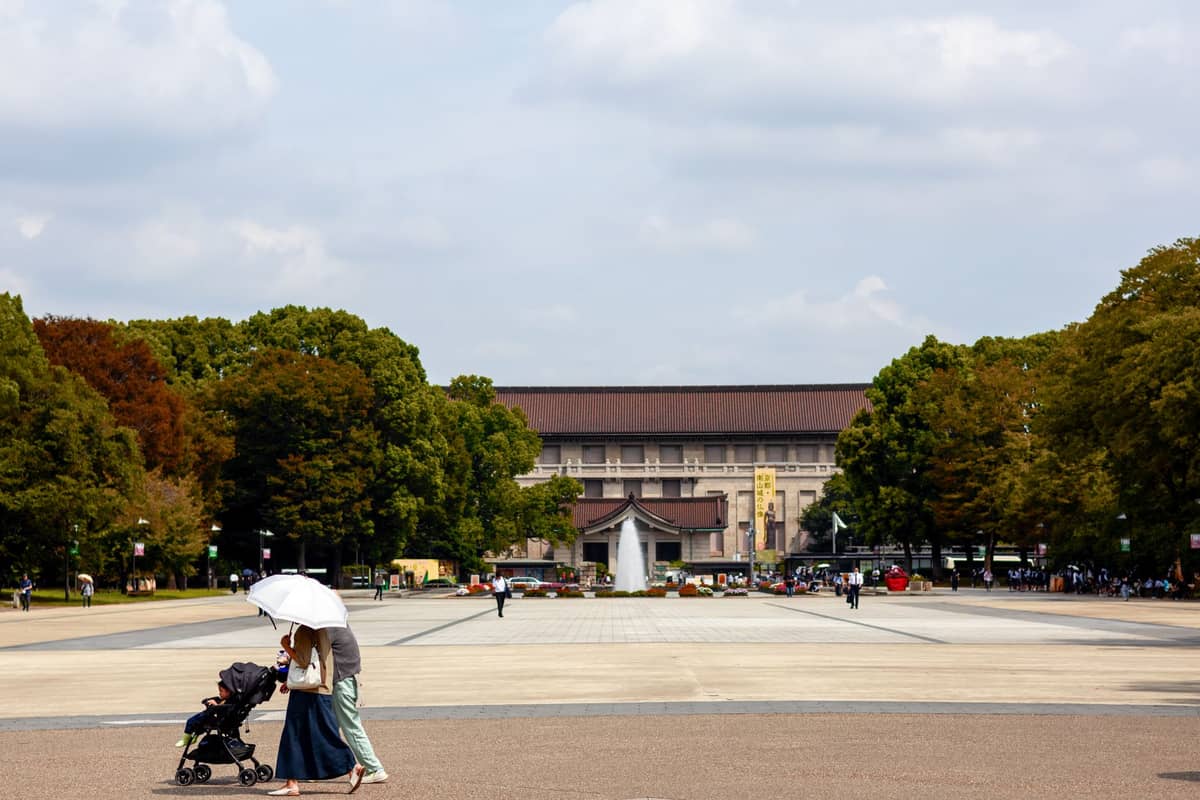
The park grounds are free to enter and open daily from 05:00 to 23:00. Within its boundaries, however, sits an extraordinary concentration of paid attractions: the Tokyo National Museum, the National Museum of Western Art (a UNESCO World Heritage building designed by Le Corbusier), the National Museum of Nature and Science, the Tokyo Metropolitan Art Museum, and Ueno Zoo. You can spend a full day here without running out of things to see, which is both the park's great strength and its occasional weakness on crowded weekends.
💡 Local tip
The park is most enjoyable on weekday mornings. Arrive before 09:00 via the JR Ueno Station Park Exit and you'll have the main avenue nearly to yourself, which feels startling given how busy this area gets by midday.
How the Park Changes Through the Day
Early morning in Ueno Park is a different world from the afternoon. From around 06:00, elderly residents do tai chi near the fountain plaza, joggers circle Shinobazu Pond, and food vendors start setting up their carts. The air carries the smell of damp stone and, depending on the season, either fallen leaves or blooming wisteria. The crows, which are bold and vocal, are already at work. By 09:00, school groups begin filtering through the main gates, and the museum queues start forming.
Midday on weekends, especially from March through May and in autumn, is genuinely crowded. The central promenade between the fountain and Shinobazu Pond becomes a slow-moving river of people. Food stalls selling taiyaki, yakitori, and canned drinks do brisk business. Street performers set up near the main avenue. This is not necessarily unpleasant, but it is not the quiet park stroll some visitors expect.
Late afternoons offer a partial reset. Families with young children start leaving around 16:00, and the golden light that hits the Shinobazu Pond lotus bed from the west becomes one of the more photogenic moments the park offers. By dusk, the remaining visitors tend to be locals walking dogs or couples sitting by the water. The park does not close until 23:00, and on warm evenings the benches around the pond stay occupied well past sunset.
Tickets & tours
Hand-picked options from our booking partner. Prices are indicative; availability and final rates are confirmed when you complete your booking.
100-minute all-you-can-eat of Wagyu in Ueno Park
From 38 €Instant confirmationFree cancellationGuided Bar Hopping Night Tour in Ueno with Food and Drinks
From 80 €Instant confirmationFree cancellationUeno Tokyo Dining Experience at an Izakaya with Sashimi and King Crab
From 35 €Instant confirmationFree cancellationCosplayers Photo Boot Experience at Ueno No Mori in Tokyo
From 122 €Instant confirmationFree cancellation
Cherry Blossoms and Seasonal Character
Ueno Park is, by widespread consensus, Tokyo's most famous cherry blossom destination. During peak bloom, typically late March to early April depending on the year, the roughly 1,200 cherry trees along the central promenade form a continuous canopy of pale pink. The hanami (flower-viewing) parties that take place beneath them are festive and often very loud, with blue tarps covering almost every patch of grass, groups sharing bento boxes and convenience-store beer from early afternoon, and a genuinely carnival atmosphere after dark when the trees are lit up.
For visitors who want cherry blossoms without the crowds, note that Ueno is the most popular site in Tokyo during this period, so 'less crowded' is relative. If you prioritize quiet, Shinjuku Gyoen prohibits alcohol and tends to draw a calmer crowd. That said, Ueno's hanami energy is itself worth experiencing at least once. The key is timing: aim for a weekday and go either before 11:00 or after 19:00 when the lit trees thin out the daytime hordes.
Autumn brings a different kind of beauty. From late November into early December, the ginkgo trees in the park turn a sharp, luminous yellow, and the maple groves near the smaller shrines go red. This is a significantly less crowded time to visit than spring, and the combination of cool air and color makes it arguably the better season for a contemplative walk. For more on timing your trip, see the guide to Tokyo in autumn.
Shinobazu Pond: The Park's Quiet Core
Shinobazu Pond sits at the park's southwestern edge and functions as a kind of counterweight to the cultural intensity of the museum quarter. The pond is divided into three sections: a lotus-covered area (magnificent from July through August when the flowers bloom), a boating pond where you can rent pedal boats by the hour, and a cormorant sanctuary. Black-crowned night herons roost in the trees along the eastern bank, and egrets wade in the shallows. For a park in the middle of a city of 14 million people, it can feel surprisingly remote.
Bentendo Temple stands on a small island connected to the main bank by a narrow causeway, and it is worth a short detour. The walk along the pond's perimeter takes about 20 minutes at a relaxed pace and offers some of the park's best birdwatching. Bring binoculars if you have them. The path can be uneven in places, particularly on the eastern side, so this is one section where wheelchair users may want to check the barrier-free map published by local authorities before proceeding.
The Museum Quarter: What to Prioritize
The concentration of major museums within a short walk of each other is the clearest argument for spending a full day in Ueno rather than just passing through. The Tokyo National Museum is the oldest and largest museum in Japan, holding over 110,000 objects spanning Japanese art and archaeology. Its main building, the Honkan, was designed in the Imperial Crown Style completed in 1938 and is itself worth examining. Admission is charged separately from the park.
The National Museum of Western Art (not in the linked slug list, but easily found on-site) was designed by Le Corbusier and is the only site in Japan inscribed in the transnational 'Le Corbusier Architectural Work' UNESCO World Heritage designation. Its permanent collection emphasizes Impressionism and Post-Impressionism. Next to it, the National Museum of Nature and Science is particularly strong for families, with full-scale dinosaur skeletons and an interactive science dome.
A practical note: most museums in Ueno are closed on Mondays (or the following Tuesday if Monday is a national holiday for some). Ueno Zoo, one of Japan's oldest zoos and home to giant pandas, keeps its own schedule and charges separate admission. If you are planning to visit multiple institutions in one day, check each venue's current schedule before you go, as closure days and special exhibition hours vary.
⚠️ What to skip
Do not plan a major museum visit on a Monday. The majority of Ueno's museums close on Mondays, and several close on additional days during exhibition changeovers. Always confirm hours directly with each museum before visiting.
Shrines, Temples, and Quieter Corners
Beyond the pond and the museum buildings, Ueno Park contains several religious sites that most visitors walk past without stopping. Ueno Toshogu Shrine, dedicated to Tokugawa Ieyasu and constructed in 1627, is one of the few structures in Tokyo to survive both the Great Kanto Earthquake of 1923 and the Second World War. Its peony garden blooms in winter and again in April (seasonal entry fee applies for the garden), and the stone lanterns lining the approach are atmospheric at any time of year.
Kiyomizu Kannondo, a smaller temple modeled after the famous Kiyomizudera in Kyoto, sits on an elevated platform overlooking the park. It receives far fewer visitors than its Kyoto counterpart and offers a brief, genuinely quiet moment. Five-storied pagodas and small memorial stones are scattered throughout the park's wooded sections, most with minimal signage in English but worth finding if you have the time.
Getting There and Getting Around
JR Ueno Station's Park Exit deposits you almost directly onto the main park promenade, making it the most straightforward arrival point. The Yamanote Line, Keihin-Tohoku Line, and several other JR lines stop here. The Keisei Skyliner from Narita Airport terminates at Keisei Ueno Station, which is a short walk from the park's southern entrance, making Ueno a practical first stop on arriving in Tokyo from the airport. Tokyo Metro's Ginza and Hibiya lines both stop at Ueno Station, adding further options.
Within the park, the main avenues are wide and paved, with accessible restrooms near the central fountain, the park office, and the zoo entrance. Wheelchairs are available at the Tokyo National Museum reception. A barrier-free map is available from the park administration office (+81-3-3828-5644). For a broader look at navigating the city's transit network, the guide to getting around Tokyo covers IC card usage, rail passes, and route planning in detail.
ℹ️ Good to know
The park grounds are open 05:00–23:00 daily with no entry fee. Entry outside these hours is prohibited. Individual facilities inside the park (museums, zoo, temple gardens) have separate admission charges and hours.
Who Might Want to Look Elsewhere
Ueno Park is large and varied enough to suit most visitors, but it is not the right choice for everyone. If you are seeking a traditional Japanese garden experience with manicured landscapes and a sense of design, Rikugien Garden or Koishikawa Korakuen Garden will be more satisfying. Ueno Park is a public park in the urban sense: lively, occasionally noisy, with concrete paths and food stalls alongside its greenery.
During cherry blossom peak and on warm spring weekends, the park's central areas can feel more like a street festival than a park. Visitors who are sensitive to crowds or noise should plan their visit for weekday mornings or outside the March-to-May spring period. On those busiest days, the museum buildings offer a quieter alternative: you can step inside and escape the hanami crowd entirely.
Insider Tips
- The south entrance near Keisei Ueno Station is used by far fewer visitors than the main JR Park Exit entrance. Arriving from this direction on a busy spring day puts you at the Shinobazu Pond end of the park, which is considerably calmer than the central promenade.
- Ueno Toshogu Shrine's inner precincts charge a small entry fee that most visitors skip. The peonies in winter and in April are remarkable, and the crowd inside is a fraction of what you'll find on the main paths 50 meters away.
- The sculpture garden between the National Museum of Western Art and the Tokyo National Museum contains several Rodin bronzes, including 'The Thinker', and is free to view without entering either museum. It is a useful option if you want a dose of art without paying admission.
- For the best lotus photographs at Shinobazu Pond, come in late July or early August between 07:00 and 09:00. The flowers open fully in the morning and begin to close by midday. The early light also reduces glare on the water.
- The park's food stall area near the main avenue shuts down well before the 23:00 park closing time. If you are visiting in the evening, bring your own food or eat before arriving. The area around Ueno Station has dozens of affordable restaurants that stay open late.
Who Is Ueno Park For?
- Families spending a full day combining the zoo, nature museum, and outdoor space
- Museum enthusiasts wanting to cover Japan's top cultural institutions in one walkable area
- Visitors arriving from Narita Airport who want to begin exploring immediately (Keisei Skyliner terminates at Keisei Ueno Station)
- Photographers targeting spring cherry blossoms or summer lotus blooms at Shinobazu Pond
- Travelers on a budget seeking a free, spacious outdoor space with significant cultural depth
Nearby Attractions
Other things to see while in Ueno & Akihabara:
- Akihabara Electric Town
Akihabara Electric Town (秋葉原電気街) is the beating heart of Tokyo's electronics and otaku culture. Stretching from Akihabara Station along Chuo-dori and its surrounding alleys, the district packs multi-story electronics megastores, retro game shops, anime merchandise outlets, and maid cafés into a few dense city blocks. Entry is free. The real cost is time and willpower.
- Ameyoko Market
Ameyoko Market (Ameya-Yokocho) stretches between Ueno and Okachimachi stations in central Tokyo, packing fresh seafood, discount clothing, snacks, and cosmetics into roughly 500 meters of covered and open-air stalls. Entry is free, the energy is genuine, and the history runs deep.
- Kanda Myojin Shrine
Kanda Myojin Shrine has stood as Edo's spiritual guardian for nearly 1,300 years, yet sits a seven-minute walk from one of Tokyo's most modern districts. The shrine grounds are free to enter and effectively accessible at all hours, making it an accessible counterpoint to the neon intensity of nearby Akihabara.
- Kyu-Iwasaki-tei Garden
Kyu-Iwasaki-tei Garden preserves the former Tokyo residence of the Iwasaki family, founders of Mitsubishi, in the Ikenohata area of Taito Ward near Ueno. The estate combines a Victorian-style wooden mansion, a connected billiard hall, and a traditional Japanese garden — all for one of the lowest admission prices of any historic site in the city.