Koishikawa Korakuen Garden: Tokyo's Most Complete Edo-Era Landscape
Begun in the 1620s by the Mito Tokugawa clan, Koishikawa Korakuen is one of Tokyo's oldest and best-preserved Japanese strolling gardens. Its central pond, miniature mountains, and references to classical Chinese and Japanese scenery make it a serious garden — not a decorative park — worth at least two hours of careful exploration.
Quick Facts
- Location
- 1-6-6 Koraku, Bunkyo-ku, Tokyo 112-0004
- Getting There
- Korakuen Station (Tokyo Metro Marunouchi/Namboku Lines), about 8 min walk; Iidabashi Station (Toei Oedo Line/JR/Metro), about 3–8 min walk depending on exit
- Time Needed
- 1.5 to 2.5 hours
- Cost
- ¥300 adults / ¥150 seniors (65+) / Free for elementary school children and younger, plus junior high school students who live or attend school in Tokyo
- Best for
- Garden enthusiasts, history seekers, autumn foliage, cherry blossom season, quiet morning walks
- Official website
- www.tokyo-park.or.jp/park/format/index030.html
What Koishikawa Korakuen Actually Is
Koishikawa Korakuen Garden is not the kind of place you wander into by accident and feel underwhelmed. It is a deliberate, highly composed landscape that took decades to build and has survived centuries of urban change largely intact. That survival alone is remarkable: the garden exists today within walking distance of a baseball stadium, a roller coaster, and two busy metro stations, yet inside its walls almost none of that registers.
Construction began in 1629 under Tokugawa Yorifusa, the founder of the Mito Tokugawa branch — one of the three senior houses of the Tokugawa shogunate. His son, Tokugawa Mitsukuni, continued developing the garden, drawing on input from a Chinese Confucian scholar named Zhu Shunshui, whose influence is visible in several garden features that reference classical Chinese landscapes. The result is a kaiyu-shiki (strolling garden) that functions like a curated anthology of famous scenic spots from both Japan and China, scaled down and arranged around a large central pond.
The name itself carries meaning: 'korakuen' derives from a line in a Chinese classical text expressing the idea that those in power should worry first and only enjoy pleasures later. It reflects a Confucian ideal of placing public welfare before personal enjoyment, which was an unusual philosophical statement for a private daimyo garden. For historical context on how this fits within Tokyo's broader garden heritage, the Tokyo gardens guide covers the city's major landscape gardens in depth.
ℹ️ Good to know
Opening hours: Daily 09:00–17:00 (last entry 16:30). Closed December 29 to January 1. Admission: ¥300 adults / ¥150 seniors (65+). Contact: 03-3811-3015.
The Experience: Walking the Garden
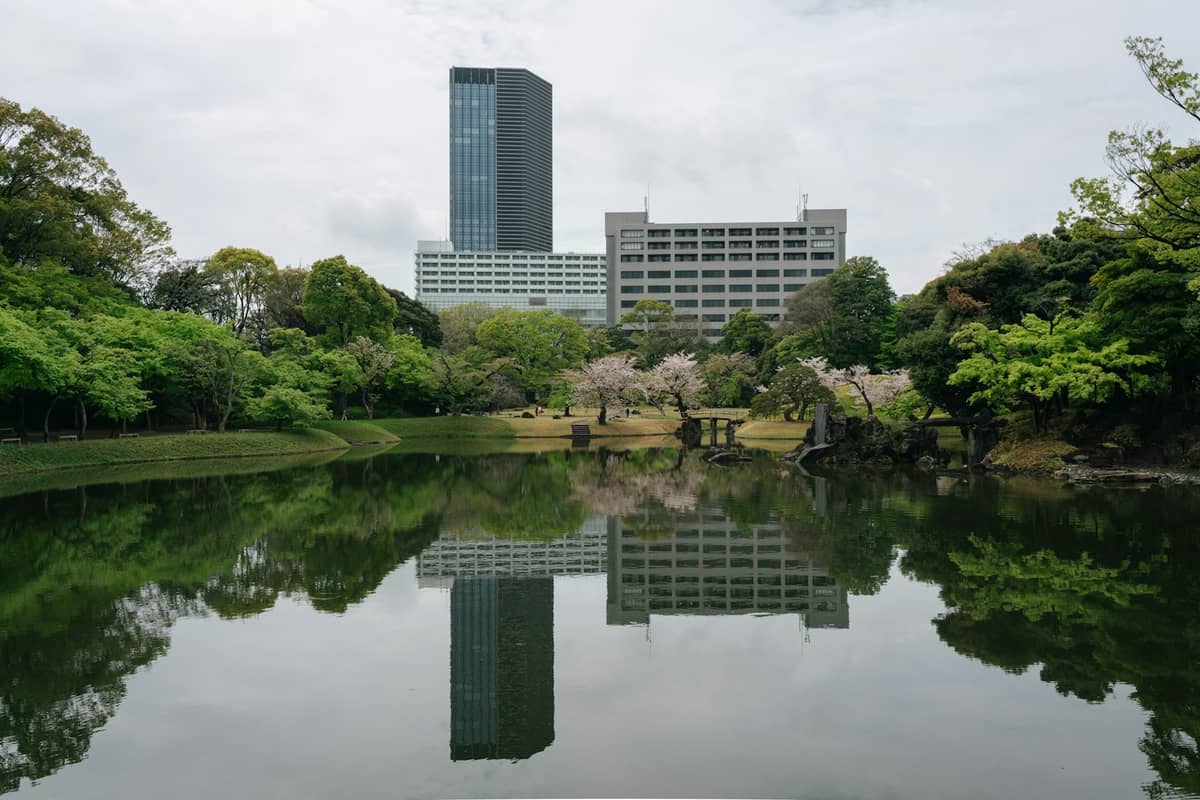
The entrance brings you almost immediately to the edge of the Dai Sensui, the garden's large central pond. On a calm morning, the water reflects the treeline and the low stone bridges with enough clarity to make you pause before moving on. The air carries the mild damp of standing water and mossy stone, especially in spring and autumn when the surrounding trees are most active.
The strolling route traces the pond's perimeter but repeatedly departs from it, climbing small constructed hills that offer elevated views back across the water, descending into narrow passages between stone lanterns and bamboo groves, and passing through a rice paddy that is still cultivated seasonally — a direct reference to the agrarian landscape the original garden designers wished to honor. That rice paddy, small as it is, reads as unexpectedly earnest in a city of this scale.
Miniature recreations of famous Japanese and Chinese landscapes are embedded throughout: a compressed version of Lushan (a sacred mountain in China), a representation of the West Lake in Hangzhou, and features referencing the Oi River in Kyoto. To a casual visitor these might read simply as picturesque scenery, but they give the garden a layered quality that rewards closer attention.
Tickets & tours
Hand-picked options from our booking partner. Prices are indicative; availability and final rates are confirmed when you complete your booking.
Tsukiji Fish Market Walking Food Tour
From 40 €Instant confirmationFree cancellationMt.Fuji,Owakudani, Hakone Cruise & Ropeway, Oshino Hakkai 1-Day Trip
From 54 €Instant confirmationFree cancellationTour to Mt. Fuji Area, Oshino Hakkai and Kawaguchi Lake from Tokyo
From 57 €Instant confirmationFree cancellationNikko UNESCO Shrine and Nature View 1-Day Tour from Tokyo
From 78 €Instant confirmationFree cancellation
How the Garden Changes Through the Day
Arriving at opening (09:00) gives you the garden at its quietest. Weekday mornings see mostly older Tokyo residents on slow, purposeful walks. The low light in autumn and winter cuts across the pond at an angle that photographers work hard to find, and the only sounds in the first hour are gravel underfoot and the occasional call of a waterfowl on the pond. This is the best window for unobstructed photography at the stone bridges and the Engetsu-kyo (Full Moon Bridge), a curved stone arch that reflects into a perfect circle in still water.
By late morning on weekends, particularly during cherry blossom and autumn foliage peaks, the main pond path becomes noticeably busier. The garden is compact enough (approximately 7 hectares) that crowds concentrate quickly around the most photogenic spots. By midday the atmosphere is social rather than meditative, which is a different but still valid way to experience the place.
The two-hour window before closing (15:00–17:00) sees a secondary quieting. School groups and tour parties have usually left, and the afternoon light in autumn in particular warms the maple foliage to a degree that rivals the morning. Last entry is 16:30 and the garden closes promptly at 17:00, so this window requires some awareness of time.
💡 Local tip
For cherry blossoms, the weeping cherry near the Keitoku-in memorial is one of the garden's signature spring sights. It typically blooms slightly earlier than the standard somei yoshino varieties, so check in advance rather than relying on general Tokyo bloom forecasts.
Seasonal Highlights and When to Visit
Koishikawa Korakuen is genuinely rewarding in all four seasons, but its two peaks are late March to early April (cherry blossoms) and mid-November to early December (autumn foliage). The garden's mix of weeping cherries, standard cherry varieties, plum trees, and maples means at least one species is usually near peak during these windows. Spring in Tokyo tends to draw the heaviest domestic visitors, so arriving early is more important then than at any other time of year.
Summer is the least visited season and, honestly, the least comfortable: the garden offers limited shade in the midday hours and Tokyo's July-August heat and humidity (typically highs around 29–31°C with significant moisture) make long walks taxing. Early morning visits in summer are workable, and the irises bloom in June around the edge of the pond in striking purple clusters. For broader seasonal planning, the best time to visit Tokyo guide covers climate and crowd patterns across the year.
Autumn is arguably the finest season for this garden. The Japanese maple (momiji) foliage turns from late October through mid-November and the contrast against the pond surface is vivid on clear days. If your dates overlap with Tokyo's autumn colour season, Koishikawa Korakuen is among the most reliable spots in the city for this experience — less theatrical than Rikugien Garden but more intimate, and the admission price is considerably lower.
Getting There and Practical Logistics
The simplest approach is Korakuen Station on the Tokyo Metro Marunouchi or Namboku Line, about five minutes on foot. Exit 1 is typically closest to the garden entrance. Iidabashi Station (accessible via JR Sobu Line as well as Metro) is about seven to eight minutes away and is useful if you are connecting from Shinjuku or the JR network without a Metro transfer.
The entrance on Koraku is clearly marked and there is a small gate office where you pay admission and pick up a bilingual (Japanese/English) map. The map is genuinely useful because the path layout is not immediately intuitive and several of the garden's key features are easy to miss if you stick only to the main pond circuit.
Footwear matters. The paths are unpaved in most sections, with compacted gravel and stone steps that become slippery in wet conditions. Flat, closed shoes are the practical choice. Wheelchair access is limited by the historical path surfaces and uneven terrain; the garden office (03-3811-3015) can advise on which sections are passable and which to avoid.
⚠️ What to skip
There are no cafes or food vendors inside the garden. If you plan a longer visit, bring water, especially in summer. The nearest convenience stores are outside the main gate near Korakuen Station.
Photography and What to Look For
The Engetsu-kyo (Full Moon Bridge) is the garden's most photographed feature, a stone arch bridge designed so that its reflection in the pond below completes a full circle. The reflection works best in calm morning conditions before wind disturbs the surface. Afternoon light from the west catches the bridge face directly in autumn.
Beyond the iconic bridge, the garden rewards a slower pace. The Tsutenkyo (Connecting-to-Heaven Bridge), a wooden bridge painted red in contrast to the green surroundings, appears at a bend in the path that many visitors rush past. The rice paddy, usually planted in early summer and harvested in autumn, is worth pausing at — it is genuinely unusual in the context of a city garden and connects the space to a tradition of landscape design that valued agricultural scenes alongside aesthetic ones.
Wide-angle lenses work well for the pond panoramas. A short telephoto is useful for isolating individual stone lanterns and the texture of the mossy banks. Tripods are permitted but given the compact path widths during busy periods, they can create friction with other visitors.
Who Should Consider Skipping This
Koishikawa Korakuen is a quiet, deliberately paced experience. Visitors expecting the scale of Shinjuku Gyoen or the social energy of Ueno Park will find it restrained by comparison. At roughly 7 hectares, it is not large, and the walk can be completed in under an hour if you move at a standard tourist pace. The value of the garden is in slowing down, not covering ground.
Visitors with significant mobility limitations should be aware that much of the garden's path network involves slopes, unpaved surfaces, and stone steps without handrails. The garden's historical status means these features cannot easily be modified. Contact the garden office directly before visiting to understand what is accessible on a given day.
If you are in Tokyo for only one or two days and prioritising maximum contrast of experiences, Koishikawa Korakuen might not make the first cut. But for anyone spending three or more days in the city, particularly in spring or autumn, it is a high-quality half-morning that leaves a stronger impression than many more prominent attractions.
Insider Tips
- The rice paddy in the garden's northwest section is planted in early summer and harvested in autumn. Visiting in June lets you see the young plants taking hold; visiting in September or October catches the golden stalks before harvest — a detail most visitors walk past without registering its significance.
- The Engetsu-kyo (Full Moon Bridge) reflection photograph requires still water and soft light. Arrive within the first 30 minutes of opening on a calm weekday morning for the best chance. Weekend mornings bring too many people on the bridge itself, breaking the reflection.
- The bilingual map from the entrance gate lists features by number, but the numbering does not follow the path in sequence. Study the map before you walk, not while you walk, so you can plan which features to prioritise.
- Admission is paid at the gate office. IC cards and other cashless payment methods are now accepted for entry, but having ¥300 in small change still keeps things quick.
- The plum blossoms (ume) typically appear in February, well before the famous cherry season. The garden is significantly less crowded at this time and the bare winter branches give the landscape a different kind of clarity. It is one of the better times to visit if your travel dates are flexible.
Who Is Koishikawa Korakuen Garden For?
- Garden and landscape photography enthusiasts seeking genuine Edo-period design
- Travellers with an interest in Japanese and East Asian cultural history
- Cherry blossom and autumn foliage seekers who want an alternative to overcrowded sites
- Early risers looking for a quiet, considered start to a Tokyo morning
- Visitors on a budget: one of Tokyo's great historical gardens at ¥300 entry
Nearby Attractions
Combine your visit with:
- Akasaka Palace (State Guest House)
The State Guest House, Akasaka Palace is Japan's principal diplomatic residence and one of the few Western-style palaces in Asia open to the public. Built in neo-baroque style for the Crown Prince in the early 20th century, it now receives heads of state and, on select days, ordinary visitors. The combination of ornate gilded interiors, formal French gardens, and a Japanese-style annex makes it one of the most architecturally unusual stops in Tokyo.
- Edo-Tokyo Open Air Architectural Museum
Spread across the grounds of Koganei Park, the Edo-Tokyo Open-Air Architectural Museum rescues and reassembles more than 30 historic structures spanning the Edo period through the early 20th century. From a dismantled farmhouse to a reconstruction of a Showa-era Tokyo streetscape, it is one of the most thoughtful and undervisited cultural sites in the metropolitan area.
- Enoshima
A small island off the Shonan coast of Kanagawa Prefecture, Enoshima packs a surprising amount into a short walk: a three-part Shinto shrine, ancient sea caves, a hilltop botanical garden, a lighthouse observation tower, and seafood stalls lining a stone-paved shopping street. It works as a half-day excursion or a full day if you combine it with nearby Kamakura.
- Gotokuji Temple
Gotokuji Temple in Setagaya is a working Soto Zen Buddhist temple that happens to be one of the claimed birthplaces of the maneki-neko, Japan's iconic beckoning cat. Hundreds of white ceramic cats line the shelves of a dedicated shrine, creating one of Tokyo's most quietly striking visual spectacles. Entry is free, crowds are manageable, and the surrounding grounds offer genuine calm.