Edo-Tokyo Open-Air Architectural Museum: Tokyo's Living Archive of Lost Architecture
Spread across the grounds of Koganei Park, the Edo-Tokyo Open-Air Architectural Museum rescues and reassembles more than 30 historic structures spanning the Edo period through the early 20th century. From a dismantled farmhouse to a reconstruction of a Showa-era Tokyo streetscape, it is one of the most thoughtful and undervisited cultural sites in the metropolitan area.
Quick Facts
- Location
- 3-7-1 Sakura-cho, Koganei City, Tokyo — inside Koganei Park
- Getting There
- JR Chuo Line to Musashi-Koganei Station, then bus or a short walk into Koganei Park
- Time Needed
- 2.5 to 4 hours for a thorough visit
- Cost
- Adults ¥400; university students ¥320; seniors (65+) ¥200; junior high school students and younger free
- Best for
- Architecture lovers, history enthusiasts, photographers, families with older children
- Official website
- www.tatemonoen.jp/english/raien/holiday.php
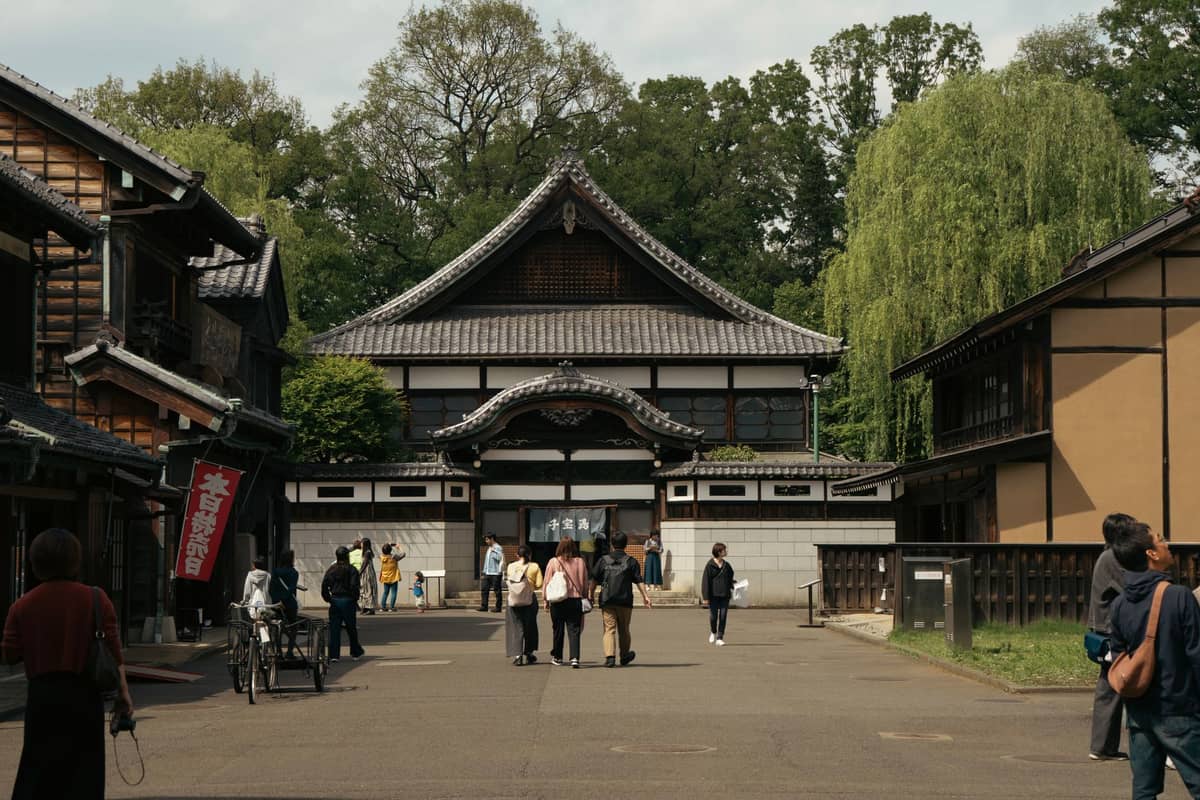
What the Edo-Tokyo Open-Air Architectural Museum Actually Is
The Edo-Tokyo Open-Air Architectural Museum is a branch facility of the Edo-Tokyo Museum, established to preserve historically significant buildings that could not be kept in their original locations. Rather than photographs or scale models, the museum presents more than 30 actual structures, relocated from across Tokyo and painstakingly reassembled on the grounds of Koganei Park in western Tokyo. They range from a relocated farmhouse with a heavy thatched roof dating to the Edo period, to a reconstructed row of Showa-era commercial shopfronts, to a Western-style summer villa that once belonged to a prominent industrialist.
The official Japanese name, 江戸東京たてもの園, translates roughly as the Edo-Tokyo Buildings Garden, which captures the ethos better than the English title: this is a garden of buildings, not a conventional indoor museum. You walk between them along gravel and stone paths, enter most structures freely, smell the aged timber, and in some cases sit on the tatami floors. No glass cases, no velvet ropes around the architecture itself.
ℹ️ Good to know
Opening hours change by season: April through September, the museum is open 9:30 to 17:30. October through March, it closes at 16:30. Last entry is 30 minutes before closing. The museum is closed on Mondays (or the following Tuesday if Monday falls on a public holiday) and during the New Year holidays.
A Walk Through the Three Zones
The grounds are divided into three loosely themed areas. The West Zone holds several large rural and aristocratic structures: gabled farmhouses with interiors that still carry the faint scent of old wood and ash, and a formal Western-style residence with decorative plasterwork that looks wildly incongruous in this wooded park setting. The scale surprises you. These are full-size buildings, not reconstructions at 80% — when you stand inside the former Koide Residence, a 1920s Japanese-Western hybrid home, the ceiling heights and room proportions feel genuinely lived-in rather than museum-sterile.
The Center Zone is anchored by the museum's main building, the former Musashino Government Building, a handsome 1940 structure in the restrained modernist style that Japanese public architecture favored in that decade. This is where you find the visitor center, a small shop, and temporary exhibitions. It also gives context for what you are about to see, with maps and brief histories of each relocated building.
The East Zone is the emotional core of the museum for most visitors. This is where a replica Showa-era downtown Tokyo streetscape has been assembled, complete with a rice cracker shop, a paper goods store, a public bathhouse, and a small bar. The interiors are period-accurate with original or era-matched objects: enamel signage, wooden counters worn smooth, glass medicine cabinets still stocked with replica tins. Late afternoon light angles through narrow shopfronts in a way that makes the whole block feel genuinely cinematic.
💡 Local tip
The East Zone streetscape is the section that inspired Hayao Miyazaki while he was developing the bathhouse setting for Spirited Away. Ghibli fans often make the connection on-site — the Kado-yu bathhouse structure in particular has the tile-roofed proportions and faded grandeur that feature in the film.
Tickets & tours
Hand-picked options from our booking partner. Prices are indicative; availability and final rates are confirmed when you complete your booking.
Haneda Airport One-way Private Transfer to or from Tokyo
From 165 €Instant confirmationFree cancellationNarita Airport One-Way Private Transfer to and from Tokyo
From 93 €Instant confirmationFree cancellationTokyo private transfer to or from Narita Airport
From 193 €Instant confirmationFree cancellationIzakaya Style Home Cooking Experience and Sake Pairing in Tokyo
From 86 €Instant confirmationFree cancellation
How the Experience Changes by Time of Day
Arriving at opening time, around 9:30, you often have the grounds largely to yourself. The park light at that hour is cool and flat, which is actually good for photographing building exteriors — shadows are soft and the thatching on the farmhouse roofs reads as texture rather than silhouette. The main downside of early arrival is that some interior demonstrations or costumed staff activities, where they occur, may not have started yet.
Midday brings school groups on weekdays, which can fill the narrow Showa streetscape with noise and movement. For photography, the harsh overhead light at noon works poorly in the East Zone, where deep eaves create harsh contrast. The West Zone's forested setting buffers this somewhat, and the tall trees keep the farmhouse interiors dim and atmospheric at any hour.
The best overall window is roughly 14:00 to 16:00, when afternoon light hits the front facades of the East Zone shops at a low angle, school groups are typically departing, and the winter closing time of 16:30 is still distant. In autumn, this timing also lets you catch the foliage in the surrounding Koganei Park on the way back to the station.
Historical and Cultural Context
The museum's mandate sits within a broader challenge Tokyo has faced for over a century: rapid urban growth combined with earthquake, wartime destruction, and postwar redevelopment has erased most of what the city looked like before 1945Edo-Tokyo Museum The structures here represent what survived by luck or careful advocacy. Some were slated for demolition when the museum was established in 1993 as a branch of the Edo-Tokyo Museum. Others had already been moved to Koganei Park earlier under preservation efforts dating to the 1960s.
The Edo period structures (pre-1868) on display reflect the domestic architecture of farmers and merchants from the western Tokyo basin area, then known as Musashino. The Meiji and Taisho era buildings (roughly 1868 to 1926) show the collision between traditional Japanese carpentry and imported Western architectural ideas — you can stand in a room that has tatami on the floor, shoji screens on one wall, and a Victorian-style bay window on another. The Showa-era commercial buildings (1926 onwards) document urban merchant culture in the decades before the postwar economic boom transformed Tokyo's street-level economy beyond recognition.
ForEdo-Tokyo Open-Air Architectural Museumvisitors who want to understand how this architecture fits into Tokyo's broader built heritage, the Tokyo architecture guide covers the full range from Edo-era remnants to contemporary landmarks.
Practical Walkthrough: Getting There and Getting Around
From central Tokyo, take the JR Chuo Line to Musashi-Koganei Station. From the station's north exit, buses serve Koganei Park directly — the stop is clearly signed in English — and the ride takes about five minutes. Alternatively, the park entrance is walkable in around 10 to 15 minutes for those who prefer to see the surrounding residential neighborhood on foot.
Inside the museum grounds, the paths are mostly compacted gravel and gentle gradients, manageable for most visitors. Wheelchairs and strollers can be borrowed free of charge from the information desk. Six accessible toilet facilities are distributed across the grounds. Be aware that the interiors of some traditional structures involve raised wooden thresholds, steep interior stairs, or low doorways — these are not modifications that can reasonably be made without destroying the buildings' character, so full interior access to every structure is not guaranteed for all visitors.
Wear comfortable, slip-on shoes if possible. Many interiors require removing footwear, and you will do this repeatedly across a three-hour visit. A light bag works better than a rolling case for the same reason. There is a small restaurant and café on-site for lunch or a break, and benches are distributed throughout the grounds.
💡 Local tip
Persons with Japanese disability certificates receive free admission, as do up to two accompanying carers. If you are visiting with a large group (20 or more people), group discount rates apply: ¥320 for adults, ¥250 for university students, ¥160 for seniors and qualifying high school students.
Weather, Seasons, and When to Visit
Spring and autumn are the most rewarding seasons for a visit. In April and early May, the surrounding Koganei Park fills with cherry blossoms, and the combination of historic architecture framed by sakura is genuinely striking. Autumn, from late October through mid-November, brings similar photogenic conditions with foliage replacing blossom. Both periods align with Tokyo's broader most comfortable visiting conditions in terms of temperature and rainfall.
The rainy season from early June to mid-July is workable — the grounds have good tree cover and the buildings shelter you during light rain — but heavy downpours make the gravel paths messy and some interiors close temporarily. Summer heat in July and August can be significant at 31°C and humid; the forested West Zone offers shade, but the open East Zone streetscape can feel punishing between 11:00 and 15:00 in August. Bring water and sunscreen.
Winter visits between December and February are genuinely atmospheric. Crowds thin considerably, the bare trees allow long sightlines across the grounds, and the farmhouse interiors with their earthen floors and heavy timber frames feel particularly authentic in the cold. The shorter October-to-March closing time of 16:30 requires planning, but the grounds never feel rushed at this scale.
Photography Tips
The Showa streetscape in the East Zone photographs best in late afternoon, when the low sun catches the painted wooden signboards and enamel shop fronts. Use a wide-angle lens in the bathhouse interior to capture the full tiled volume of the room. The farmhouse roofs in the West Zone read best in overcast conditions, which flatten the light and bring out the texture of the thatching. Tripods are permitted in most outdoor areas but check with staff for interior restrictions.
For inspiration on combining this visit with other architectural and cultural sites across the city, the Tokyo walking tours guide suggests several routes that complement a day trip to western Tokyo.
Who Should Consider Skipping This
Visitors with very limited time in Tokyo and a checklist-style itinerary will find the journey to Koganei a difficult sell. The museum sits outside the central 23 wards, and the round trip from Shinjuku adds roughly an hour of transit. If your primary interest is modern Tokyo — technology, fashion, food — this attraction is unlikely to resonate strongly. It rewards patience, some baseline interest in architecture or social history, and the willingness to read the small interpretive panels that explain what each building was and where it came from.
Very young children may find the long walking distances and remove-your-shoes routine frustrating, though the stroller loan service and the novelty of entering different buildings does hold some children's attention. The museum is not particularly well-suited to visitors who need continuous accessibility — the traditional architecture creates genuine barriers inside several structures.
Insider Tips
- The Kado-yu bathhouse in the East Zone is the structure most associated with the visual inspiration for Spirited Away. Arrive early on a weekday to photograph it without crowds filling the frame.
- Pick up the English-language building guide at the entrance kiosk, not just the map. The individual building histories transform what looks like a pleasant old building into something specific and irreplaceable.
- Combine the visit with a walk through Koganei Park itself, which is one of the better cherry blossom parks in western Tokyo and essentially free. The park entrance is just outside the museum gates.
- The small museum shop near the Center Zone stocks architecture and history books, period-reproduction stationery, and local craft items that you will not find in central Tokyo souvenir shops.
- On weekend afternoons, traditional craft demonstrations occasionally take place inside some of the buildings. Check the official website before your visit — dates are posted in advance and change by season.
Who Is Edo-Tokyo Open Air Architectural Museum For?
- Architecture and design enthusiasts who want to see Edo-period and Meiji-era buildings up close, not behind glass
- Ghibli fans tracing the visual references in Spirited Away
- Photographers seeking cinematic interiors and Showa-era street compositions
- Travelers who have already covered central Tokyo's main sights and want something genuinely different
- History-minded visitors seeking social and domestic history rather than military or political narratives
Nearby Attractions
Combine your visit with:
- Akasaka Palace (State Guest House)
The State Guest House, Akasaka Palace is Japan's principal diplomatic residence and one of the few Western-style palaces in Asia open to the public. Built in neo-baroque style for the Crown Prince in the early 20th century, it now receives heads of state and, on select days, ordinary visitors. The combination of ornate gilded interiors, formal French gardens, and a Japanese-style annex makes it one of the most architecturally unusual stops in Tokyo.
- Enoshima
A small island off the Shonan coast of Kanagawa Prefecture, Enoshima packs a surprising amount into a short walk: a three-part Shinto shrine, ancient sea caves, a hilltop botanical garden, a lighthouse observation tower, and seafood stalls lining a stone-paved shopping street. It works as a half-day excursion or a full day if you combine it with nearby Kamakura.
- Gotokuji Temple
Gotokuji Temple in Setagaya is a working Soto Zen Buddhist temple that happens to be one of the claimed birthplaces of the maneki-neko, Japan's iconic beckoning cat. Hundreds of white ceramic cats line the shelves of a dedicated shrine, creating one of Tokyo's most quietly striking visual spectacles. Entry is free, crowds are manageable, and the surrounding grounds offer genuine calm.
- Hakone
Hakone is a mountain hot-spring area in Kanagawa Prefecture, about 85 to 90 minutes from Shinjuku by direct train. It offers volcanic landscapes, onsen ryokan, views of Mount Fuji across Lake Ashi, and a density of quality museums that rewards both a rushed day trip and a leisurely overnight stay.