Gotokuji Temple: Tokyo's Beckoning Cat Shrine and Zen Sanctuary
Gotokuji Temple in Setagaya is a working Soto Zen Buddhist temple that happens to be one of the claimed birthplaces of the maneki-neko, Japan's iconic beckoning cat. Hundreds of white ceramic cats line the shelves of a dedicated shrine, creating one of Tokyo's most quietly striking visual spectacles. Entry is free, crowds are manageable, and the surrounding grounds offer genuine calm.
Quick Facts
- Location
- 2-24-7 Gotokuji, Setagaya-ku, Tokyo 154-0021
- Getting There
- Miyanosaka Station (Tokyu Setagaya Line, 5–10 min walk) or Gotokuji Station (Odakyu Line, around 10–12 min walk)
- Time Needed
- 45 minutes to 1.5 hours
- Cost
- Free entry; maneki-neko figurines and amulets available for purchase (temple office open 08:00–15:00)
- Best for
- Temple photography, cultural curiosity, quiet escapes from central Tokyo
- Official website
- gotokuji.jp/en
What Gotokuji Temple Actually Is
Gotokuji Temple, officially Daikeizan Gotokuji Temple, is a Soto school Zen Buddhist temple in Setagaya, one of Tokyo's quieter residential wards southwest of Shibuya. Unlike many of Tokyo's famous religious sites, Gotokuji is not a major pilgrimage destination or a landmark attached to a bigger tourist district. It is a genuine neighborhood temple that has attracted international attention for one very specific reason: it is widely regarded as one of the original birthplaces of the maneki-neko, the iconic beckoning cat figurine seen across Japan and East Asia.
That reputation draws visitors from across Tokyo and from overseas, but the temple grounds themselves remain far calmer than you might expect. On a weekday morning, you are likely to share the space with a handful of other visitors, a local or two making offerings, and the sound of birds in the old cemetery trees. The atmosphere is contemplative, not performative.
ℹ️ Good to know
The temple grounds are open daily from 06:00 to 17:00. The temple office, where you can purchase maneki-neko figurines and amulets, is only open from 08:00 to 15:00. If buying a cat figure matters to your visit, time your arrival accordingly.
The Maneki-Neko Shrine: What You Will Find
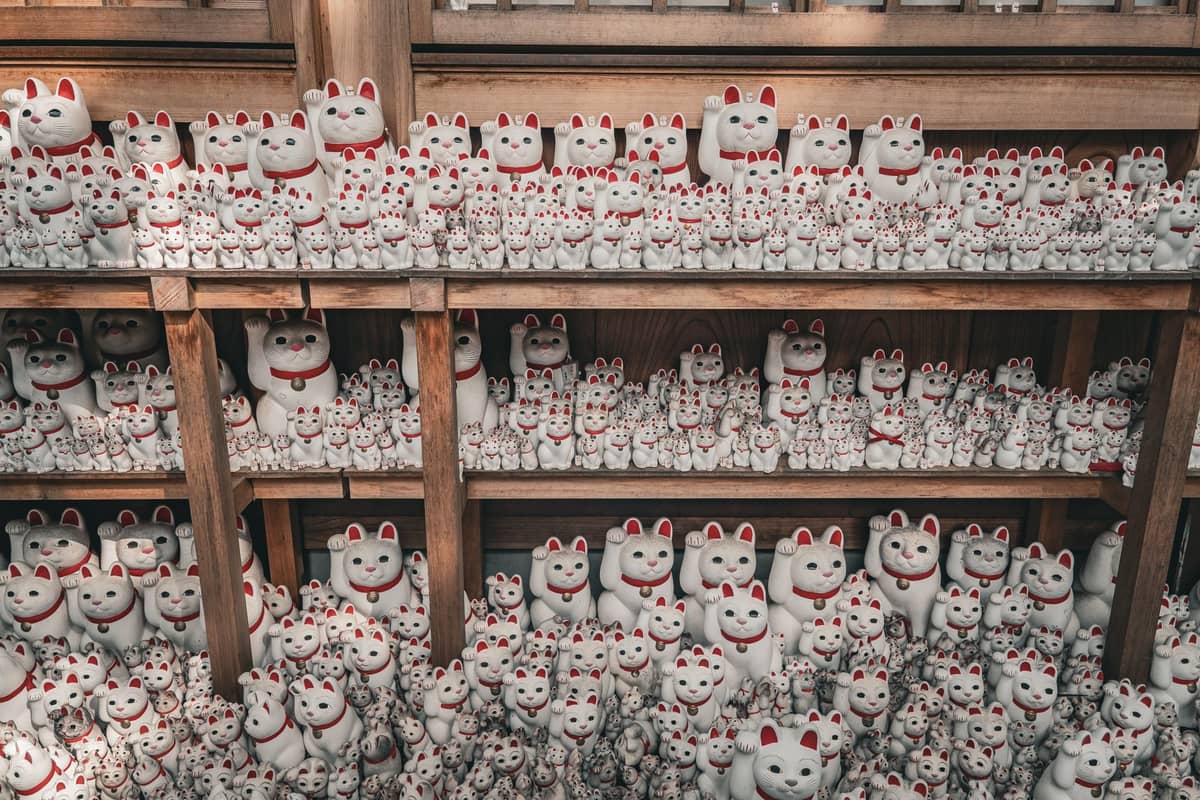
The focal point of most visits is the Neko-do, a small wooden hall dedicated to Shofukusonten, the deity associated with the beckoning cat legend here. The shelves and steps surrounding this structure are lined with hundreds, potentially thousands, of small white ceramic maneki-neko figurines, each with one paw raised. They are not decorations placed by the temple. They are votive offerings left by visitors who purchased a cat, made a wish, and returned to leave the figure as thanks after their wish was fulfilled.
Up close, the effect is genuinely striking. The cats are identical in form but vary in size, from figures small enough to fit in a palm to larger specimens on the upper shelves. They accumulate over time, and the rows behind rows create a depth that photographs rarely capture fully. Many cats are slightly weathered, giving the shrine an organic rather than curated quality. The scent of incense drifts from the main hall nearby.
The legend connected to Gotokuji holds that a feudal lord took shelter under a tree near the temple during a storm, drawn there by a beckoning cat belonging to the resident priest. Shortly afterward, lightning struck the tree. Grateful for his narrow escape, the lord became a patron of the temple. Versions of this legend are attached to other locations in Japan, and Gotokuji does not claim to be the sole origin point. What it does claim, with supporting historical depth, is a strong and documented connection to the maneki-neko tradition.
Tickets & tours
Hand-picked options from our booking partner. Prices are indicative; availability and final rates are confirmed when you complete your booking.
Tsukiji Fish Market Walking Food Tour
From 40 €Instant confirmationFree cancellationMt.Fuji,Owakudani, Hakone Cruise & Ropeway, Oshino Hakkai 1-Day Trip
From 54 €Instant confirmationFree cancellationTour to Mt. Fuji Area, Oshino Hakkai and Kawaguchi Lake from Tokyo
From 57 €Instant confirmationFree cancellationNikko UNESCO Shrine and Nature View 1-Day Tour from Tokyo
From 78 €Instant confirmationFree cancellation
The Wider Temple Grounds
Beyond the cat shrine, Gotokuji is a functioning Buddhist temple with architecture and gardens worth your attention. The main gate, a tall wooden sanmon, opens onto a stone path flanked by maple trees. In autumn, typically late November, these trees turn amber and gold, and the path becomes genuinely beautiful. In spring, cherry trees on the grounds bloom briefly. Neither season draws the same crowds you would find at Shinjuku Gyoen or Ueno Park, which makes Gotokuji a good alternative for visitors who want seasonal foliage without the mass tourism.
The cemetery grounds to the rear of the main buildings are extensive and include the graves of the Ii clan, the feudal lords who were patrons of the temple during the Edo period. The graves are marked by distinctive large stone monuments. Visiting a Japanese temple cemetery may feel unfamiliar to some travelers, but it is entirely normal and permitted here. The cemetery is part of the temple's historical fabric. For context on how Tokyo's temple culture fits into the broader city, the guide to Tokyo's best temples and shrines covers the full range, from grand to intimate.
The three-story pagoda on the grounds is modest in scale but sits in a pocket of green that muffles the surrounding residential streets. This part of the temple is easy to miss if you head straight for the cat shrine, but it rewards a slower circuit of the grounds.
How the Experience Changes by Time of Day
Early morning, between 06:00 and 09:00, is the best time to visit if solitude matters to you. The gates open at 6:00, and in that first hour the grounds belong almost entirely to you and the birds. The light at this hour is soft and low, especially in winter, and hits the rows of white cats at an angle that makes them glow. If you carry a camera, this is the window you want.
Midday and early afternoon bring the most visitors, particularly on weekends and during holidays. The cat shrine area can become crowded enough that moving around freely requires patience. Groups form for photographs. The experience is still good, but the contemplative quality of the space is harder to access.
Late afternoon, in the hour before the 17:00 closing, is a secondary sweet spot. Visitor numbers thin, the light shifts warmer, and the grounds settle into quiet again. Note that the temple office closes at 15:00, so if you want to buy a figurine or amulet, late afternoon visits mean the shop will be shut.
💡 Local tip
Weekday mornings between 06:00 and 09:00 offer the most atmospheric visit with the fewest other people around. If you can only come on a weekend, aim to arrive right at opening.
Getting There from Central Tokyo
Gotokuji's location in Setagaya means it requires a small transit effort from central Tokyo, which is partly why it stays manageable crowd-wise. The easiest approach is the Tokyu Setagaya Line, a short tram-like line that runs between Sangenchaya (on the Tokyu Den-en-toshi Line) and Shimotakaido. Miyanosaka Station on this line is about a five-minute walk from the temple entrance. From Shibuya, take the Den-en-toshi Line to Sangenchaya and transfer to the Setagaya Line.
Alternatively, Gotokuji Station on the Odakyu Odawara Line is a 15-minute walk. The Odakyu Line runs from Shinjuku, making this a practical option if you are combining the visit with a morning or afternoon in Shinjuku. The walk from Gotokuji Station passes through quiet residential streets with a few small cafes and a convenience store.
Photography, Accessibility, and Practical Details
Photography is welcome throughout the grounds, including at the cat shrine. The main challenge is composing a shot that captures the scale of the figurine display without other visitors in the frame. A wide-angle lens or a camera with good low-light performance helps in the early morning. The cats are arranged on a stepped wooden structure, so shooting from a low angle looking upward gives a sense of depth and volume that a straight-on shot tends to flatten.
The grounds are largely accessible for wheelchair users, though the surface is cobbled stone in places. The Tokyo Metropolitan Government accessibility guide notes that wheelchairs can traverse the cobbled ground and that a slope in front of the main shrine allows wheelchair users to approach and make offerings. Guide and service dogs are permitted on the grounds. General pets are allowed only if carried or kept in a carrier.
There are no coin lockers at the temple. If you are arriving with luggage from elsewhere in the city, the nearest storage options are at major stations on your route. For broader logistics around getting between Tokyo's neighborhoods efficiently, the guide to getting around Tokyo covers IC card use, line transfers, and how to read the rail system.
Is Gotokuji Worth the Journey?
That depends on what you are after. If your Tokyo itinerary is tightly packed with major landmarks and you are trying to see Senso-ji, Meiji Jingu, and Asakusa in a few days, Gotokuji might not make the cut. It is not a grand religious complex, and the visual centerpiece, while genuinely striking, takes perhaps ten minutes to absorb fully.
But if you have a morning free and want to experience a Tokyo that most short-stay visitors never find, the trip is well worth it. The combination of the cat shrine, the Zen temple architecture, the Edo-period grave monuments, and the residential neighborhood surrounding it adds up to something that feels authentically lived-in rather than curated for tourists. Pair it with a visit to nearby Shimokitazawa, a short trip away on the Odakyu Line, for a full half-day in southwestern Tokyo. For a broader context of what else the city offers away from the main circuits, the guide to Tokyo's lesser-known spots is useful.
Travelers who find heavily photographed Instagram landmarks exhausting will feel at home here. The cat shrine is famous, yes, but the temple absorbs that attention quietly and gives back something genuinely peaceful in return.
Insider Tips
- To purchase your own maneki-neko figurine as a votive offering, visit the temple office (open 08:00–15:00). You can take the figure home after making your wish, then return one day to leave it at the shrine as thanks. If you cannot return, leaving it at the shrine on the same day is also acceptable.
- The Tokyu Setagaya Line is a rare above-ground tram-style line in Tokyo. The ride itself, from Sangenchaya to Miyanosaka, takes only a few stops but feels noticeably different from the underground metro. Factor in a few extra minutes to enjoy the ride.
- The maple trees lining the main path peak in color during late November. Check local foliage reports before visiting in autumn; the window is only one to two weeks, but the temple is dramatically more beautiful during that period.
- The cemetery at the rear of the grounds holds the family graves of the Ii clan, Edo-period lords who were major patrons of the temple. The stone monuments are unusually large and elaborately carved compared to typical Japanese grave markers.
- Gotokuji is about a 20-minute walk from Setagaya Park, which has a small open-air train museum popular with children. Combining both in an afternoon makes for a full half-day excursion in a part of Tokyo that sees relatively few foreign visitors.
Who Is Gotokuji Temple For?
- Photography enthusiasts looking for a visually distinctive temple outside the main tourist circuit
- Travelers with a specific interest in Japanese folklore, folk religion, or the history of the maneki-neko
- Visitors who want a calm, unhurried temple experience without Asakusa-level crowds
- Autumn leaf seekers wanting a quieter alternative to the major foliage spots
- Anyone with a free morning and a willingness to take the smaller rail lines into residential Tokyo
Nearby Attractions
Combine your visit with:
- Akasaka Palace (State Guest House)
The State Guest House, Akasaka Palace is Japan's principal diplomatic residence and one of the few Western-style palaces in Asia open to the public. Built in neo-baroque style for the Crown Prince in the early 20th century, it now receives heads of state and, on select days, ordinary visitors. The combination of ornate gilded interiors, formal French gardens, and a Japanese-style annex makes it one of the most architecturally unusual stops in Tokyo.
- Edo-Tokyo Open Air Architectural Museum
Spread across the grounds of Koganei Park, the Edo-Tokyo Open-Air Architectural Museum rescues and reassembles more than 30 historic structures spanning the Edo period through the early 20th century. From a dismantled farmhouse to a reconstruction of a Showa-era Tokyo streetscape, it is one of the most thoughtful and undervisited cultural sites in the metropolitan area.
- Enoshima
A small island off the Shonan coast of Kanagawa Prefecture, Enoshima packs a surprising amount into a short walk: a three-part Shinto shrine, ancient sea caves, a hilltop botanical garden, a lighthouse observation tower, and seafood stalls lining a stone-paved shopping street. It works as a half-day excursion or a full day if you combine it with nearby Kamakura.
- Hakone
Hakone is a mountain hot-spring area in Kanagawa Prefecture, about 85 to 90 minutes from Shinjuku by direct train. It offers volcanic landscapes, onsen ryokan, views of Mount Fuji across Lake Ashi, and a density of quality museums that rewards both a rushed day trip and a leisurely overnight stay.