Edo-Tokyo Museum: Tokyo's Most Ambitious History Museum
The Edo-Tokyo Museum in Ryogoku traces four centuries of Tokyo's transformation, from a feudal shogunate capital to a modern megalopolis. Spread across full-scale reconstructions, original artifacts, and immersive dioramas, it delivers more depth than almost any other museum in the city.
Quick Facts
- Location
- 1-4-1 Yokoami, Sumida-ku, Tokyo 130-0015
- Getting There
- Ryogoku Station (JR Sobu Line, 3-min walk from West Exit) or Ryogoku Station (Toei Oedo Line, 1-min walk from Exits A3/A4)
- Time Needed
- 2 to 3.5 hours for permanent exhibition
- Cost
- Adults ¥800 / Students ¥480 / Seniors 65+ ¥400 / Under junior high age free (verify current prices at official site)
- Best for
- History lovers, architecture enthusiasts, families, first-time Tokyo visitors
- Official website
- www.edo-tokyo-museum.or.jp/en
What Is the Edo-Tokyo Museum?
The Edo-Tokyo Museum (official Japanese name: 東京都江戸東京博物館, Tokyo Metropolitan Edo-Tokyo Museum) is one of Tokyo's most comprehensive history institutions, dedicated entirely to the city's evolution from the early Edo period of the 1600s through to the modern era. It sits in Ryogoku, a neighborhood better known for sumo wrestling, but the museum is a destination in its own right and deserves a dedicated half-day.
The permanent exhibition is organized into two primary zones: the Edo Zone, which covers the city under Tokugawa shogunate rule, and the Tokyo Zone, which picks up from the Meiji Restoration of 1868 and carries the story forward through industrialization, earthquake, wartime destruction, and postwar rebuilding. A Feature Exhibition Gallery hosts rotating special exhibitions alongside these permanent displays.
Unlike many urban history museums that rely heavily on text panels and glass cases, this one goes large in every sense. Full-scale reconstructed buildings, intricate scale models of entire neighborhoods, and life-sized dioramas of merchant streets and domestic interiors fill the floor. If you are planning a broader museum crawl through Tokyo, the best museums in Tokyo guide puts this one in context alongside the other major institutions.
💡 Local tip
The museum is closed on Mondays. If Monday falls on a public holiday, it opens that day and closes the following Tuesday instead. Last entry is 30 minutes before closing.
The Building: A Statement Before You Even Enter
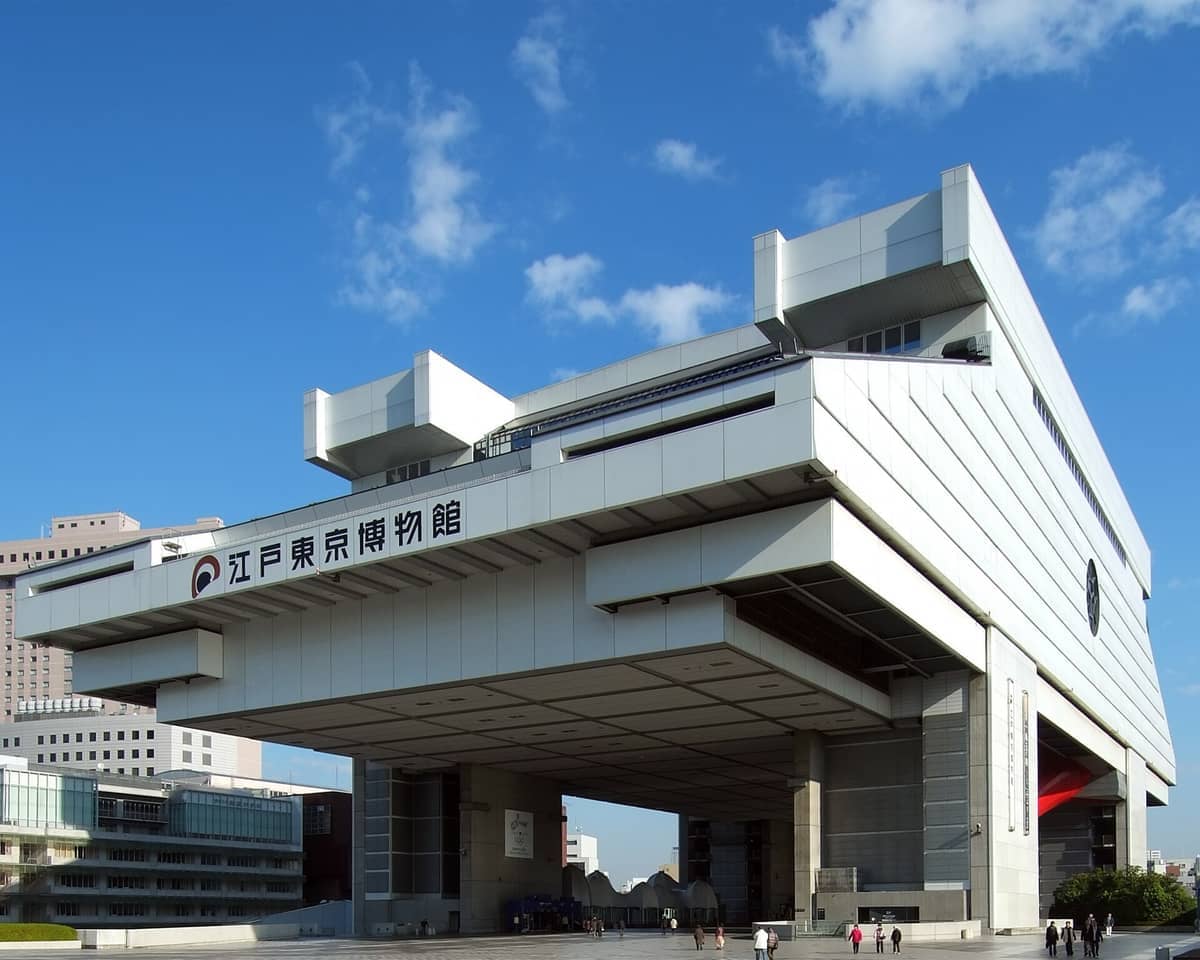
The building itself prepares you for what is inside. Designed by architect Kiyonori Kikutake and completed in 1993, it sits on massive piloti columns that raise the main exhibition floors high above street level, giving the structure a silhouette that reads as something between a traditional raised-floor storehouse and a spacecraft. The exterior is clad in gray and silver, and from a distance it looks almost too large for its footprint.
On approach from Ryogoku Station's West Exit, you cross a wide plaza. The scale of the columns only becomes apparent as you walk beneath them. The ground-floor entrance is understated relative to the drama above. Wheelchair users and anyone who prefers to skip the escalator climb should use the ground-floor entrance directly for elevator access to the exhibition levels.
Ryogoku is one of Tokyo's more distinctive neighborhoods, still carrying traces of Edo-period merchant and craftsmen culture alongside the sumo stables and arenas. The Ryogoku neighborhood rewards an hour of wandering before or after your visit, particularly around the streets near the Kokugikan arena.
Tickets & tours
Hand-picked options from our booking partner. Prices are indicative; availability and final rates are confirmed when you complete your booking.
Tour to Mt. Fuji Area, Oshino Hakkai and Kawaguchi Lake from Tokyo
From 57 €Instant confirmationFree cancellationNikko UNESCO Shrine and Nature View 1-Day Tour from Tokyo
From 78 €Instant confirmationFree cancellationYanaka: historical walking tour in Tokyo's old town
From 40 €Instant confirmationFree cancellationMeiji Shrine, Imperial Palace, Asakusa and Tokyo Skytree Entry
From 34 €Instant confirmationFree cancellation
Inside the Permanent Exhibition: What You Actually See
The Edo Zone
The Edo Zone opens with a reproduction of the Nihonbashi Bridge, scaled to full size, and it sets the tone immediately. This was the symbolic center of the shogunate's road network, the zero-point from which all distances in Japan were measured. Walking across it into the exhibition is a deliberate curatorial choice rather than mere spectacle.
Beyond the bridge, the zone spreads into reconstructed sections of Edo-period streets, merchant houses, and domestic interiors. The textures here are worth slowing down for: the grain of wooden shop counters, the tight layout of a townhouse where a whole family lived and worked in a few small rooms, the scale of a daimyo's formal reception hall by comparison. Scale models of the city show just how densely Edo was packed, particularly the shitamachi (low city) districts where craftsmen and merchants lived.
Information panels include English translations throughout, though the depth of annotation varies by section. The audio guide, available for rent at the museum, fills in the gaps considerably and is worth the extra cost if you want context beyond what the labels provide.
The Tokyo Zone
The transition from Edo to Tokyo is handled as a physical shift in the exhibition space. The materials change, the lighting shifts, and the artifacts begin to include Western-influenced objects: cast-iron lampposts, early tram components, Meiji-era printed newspapers. The smell of old paper and lacquered wood gives way to something harder to name, a faint industrial metallic quality that suits the period.
Two disasters reshape the narrative in this section. The Great Kanto Earthquake of 1923 and the firebombing of Tokyo in 1945 are covered with quiet directness. Photographs, personal belongings, and architectural fragments from both events are displayed without sensationalism. This section is sobering and should not be rushed.
The postwar recovery section brings the story into living memory, including artifacts from the 1964 Tokyo Olympics, early consumer electronics, and photographs of neighborhoods that would later be redeveloped beyond recognition. For travelers curious about how contemporary Tokyo came to look and feel the way it does, this final stretch of the Tokyo Zone provides a coherent answer.
How the Experience Changes by Time of Day
The museum opens at 09:30, and the first hour is noticeably quieter. School groups tend to arrive mid-morning, so arriving at opening gives you the Nihonbashi Bridge area and the large dioramas largely to yourself. The full-scale reconstructions are easier to photograph without people filling the frame at this hour, and the natural light filtering through the high atrium windows has a different quality in the morning.
By 11:00, the main floor fills noticeably. Afternoons on weekdays are manageable but not empty. Saturday evening sessions, when the museum stays open until 19:30, are worth considering if you want a calmer experience in the back half of the afternoon. The extended Saturday hours are underused by most tourists and make for a genuinely pleasant visit.
ℹ️ Good to know
Opening hours: Tuesday to Friday and Sunday (including holidays) 09:30–17:30. Saturday 09:30–19:30. Closed Mondays and New Year's holidays. Last entry 30 minutes before closing.
Practical Walkthrough: Getting There and Getting Around
The most direct approach is via the Toei Oedo Line to Ryogoku Station (Edo-Tokyo Hakubutsukan-mae), which delivers you within one minute of the museum entrance via Exits A3 or A4. From the JR Sobu Line at Ryogoku Station West Exit, it is a three-minute walk across the plaza. Both routes are well-signposted in English.
Buy tickets at the entrance level. The permanent exhibition fee is ¥800 for adults, ¥480 for university and vocational students, ¥300 for high school students, ¥400 for seniors aged 65 and over, and free for junior high school students and younger. Visitors holding a disability certificate (physical, intellectual, mental health, or atomic bomb survivor documentation) and up to two accompanying caregivers are admitted free. Special exhibitions carry separate charges. Always confirm current prices at the official site before your visit, as fees may be adjusted.
The main exhibition space is on the sixth and seventh floors. Navigation is logical and follows a chronological route, though the floor plan can feel slightly sprawling at the midpoint. Comfortable shoes matter here. There are rest areas and benches distributed through the galleries, and a museum shop and cafe on the premises.
💡 Local tip
Photography is permitted throughout most of the permanent exhibition. Flash is prohibited. Some special exhibition areas may have additional restrictions.
Accessibility is well-considered. Elevators serve all exhibition floors from the ground-level entrance. Accessible toilets are located on the first, third, fifth, sixth, and seventh floors. The museum's barrier-free infrastructure is among the better examples in Tokyo's major institutions.
Who Should Skip This Museum
The Edo-Tokyo Museum rewards visitors who come with some patience and genuine curiosity about urban history. If your interest in Tokyo is primarily contemporary, whether that means contemporary art, street fashion, food culture, or nightlife, the museum will feel like a long detour from what you actually want.
Travelers with very limited time in the city face a real trade-off. Two to three hours here is time not spent at somewhere like Senso-ji, the teamLab venues, or the neighborhoods that define modern Tokyo. This is not a criticism of the museum. It is simply a different kind of experience, one that pays off most when you have context for what you are seeing.
For visitors building a temple and shrine itinerary, the best temples and shrines in Tokyo guide will be more directly useful. For those focused on contemporary digital and immersive art, see the teamLab Tokyo guide for a very different kind of experience.
Visiting as Part of a Ryogoku Day
Ryogoku is compact enough to combine with the museum without overextending a day. The Ryogoku Kokugikan sumo arena is a short walk away and has a small sumo museum inside with free admission on non-tournament days. The neighborhood around the station has a handful of chanko nabe restaurants (the hearty stew traditionally eaten by sumo wrestlers) that make for an atmospheric lunch before or after your museum visit.
The museum building itself is visible from Sumida Park across the river on clear days, and the walk along the Sumida riverbank connecting Ryogoku to Asakusa takes about 25 minutes on foot. This makes a logical afternoon extension if you have energy to spare after the museum.
Insider Tips
- Arrive within the first 30 minutes of opening to have the full-scale Nihonbashi Bridge reconstruction and the large Edo-period dioramas to yourself. School groups arrive mid-morning and change the atmosphere considerably.
- Saturday evening sessions until 19:30 are significantly quieter than weekend daytimes and are almost entirely overlooked by international visitors. The lighting at this hour also suits photography well.
- The audio guide is worth renting. English signage is thorough but the audio adds narrative depth to the earthquake and wartime sections that transforms them from informative to genuinely affecting.
- If you have a disability certificate or are accompanying someone who does, bring the documentation. Admission is free for the certificate holder and up to two companions, which is not prominently advertised at the entrance.
- After your visit, cross to the east side of Ryogoku Station and walk south for five minutes to find several old-school chanko nabe restaurants. They are filling, inexpensive, and entirely off the tourist circuit.
Who Is Edo-Tokyo Museum For?
- First-time visitors to Tokyo who want historical grounding before exploring the city's neighborhoods
- History and architecture enthusiasts interested in Edo-period urban planning and the Meiji transformation
- Families with children aged 8 and above, who will engage with the full-scale reconstructions and interactive models
- Travelers visiting Ryogoku for sumo who want to extend their understanding of the area's historical context
- Rainy-day visitors looking for a full half-day indoor experience with genuine substance
Nearby Attractions
Other things to see while in Ryogoku:
- Ryogoku Kokugikan
Ryogoku Kokugikan is the spiritual and sporting home of sumo wrestling in Japan, hosting three of the six annual Grand Sumo Tournaments in Tokyo's Sumida ward. Whether you're attending a live bout or visiting the free Sumo Museum on a quiet weekday, this is one of Tokyo's most distinctive and culturally specific experiences.