Kanda Myojin Shrine: The Ancient Guardian at Akihabara's Doorstep
Kanda Myojin Shrine has stood as Edo's spiritual guardian for nearly 1,300 years, yet sits a seven-minute walk from one of Tokyo's most modern districts. The shrine grounds are free to enter and effectively accessible at all hours, making it an accessible counterpoint to the neon intensity of nearby Akihabara.
Quick Facts
- Location
- 2-16-2 Sotokanda, Chiyoda City, Tokyo 101-0021
- Getting There
- Ochanomizu Station (4-5 min walk); Akihabara Station (7 min walk)
- Time Needed
- 30–60 minutes for a self-guided visit
- Cost
- Free entry; omamori charms and ritual prayers charged separately
- Best for
- History seekers, first-time visitors to Tokyo, photographers, anime fans
- Official website
- www.kandamyoujin.or.jp
What Is Kanda Myojin Shrine?
Kanda Myojin Shrine, officially known in Japanese as Edo Sochinja Kanda Myojin (Kanda Jinja), is one of the oldest and most historically significant Shinto shrines in Tokyo. Its origins are traced to 730 CE, placing it centuries before Edo became the city we now know as Tokyo. After the city was reorganized under the Tokugawa shogunate in the early 17th century, the shrine was relocated to its current position in Sotokanda, Chiyoda, around 1616, where it has served as the designated guardian of the entire Edo area ever since.
The shrine enshrines three deities: Daikokuten (god of fortune and business), Ebisu (god of fishing and commerce), and Taira no Masakado, a 10th-century warrior who became a local hero figure. This combination makes it a popular destination for business owners seeking blessings, and prayers for commerce and prosperity are deeply woven into the shrine's identity. For broader context on Tokyo's temple and shrine landscape, see this guide to the best temples and shrines in Tokyo.
ℹ️ Good to know
The shrine grounds are open all day, every day of the year. Office hours for receiving prayers and purchasing omamori charms are generally around 9:00–17:00, but these can vary. Confirm current service hours via the official site or at the information desk on arrival.
Arriving at the Shrine: The First Impressions
The approach from Akihabara sets up a striking contrast. You leave behind the loud storefronts stacked with electronics and anime merchandise, walk uphill along a residential lane, and the shrine's grand stone torii gate appears at the top of a wide staircase. The air smells faintly of incense long before you reach the main hall, drifting down to street level on still mornings. Stone lanterns flank the steps, their surfaces worn and slightly mossy, giving the stone a silver-grey texture that reads as genuinely old against the newer concrete buildings nearby.
Through the EDOCCO cultural complex, which was added in 2018 as a modern supplement to the historic grounds, you can also access the shrine via ramps and elevators if stairs are a concern. The EDOCCO building houses a small gift shop and information center and is visually distinct from the main shrine structures: clean lines and pale cedar against the more ornate vermilion of the traditional buildings. The coexistence is deliberate, not jarring, and the shrine administration has been thoughtful about not letting modern additions overwhelm the historic core.
Tickets & tours
Hand-picked options from our booking partner. Prices are indicative; availability and final rates are confirmed when you complete your booking.
Nikko UNESCO Shrine and Nature View 1-Day Tour from Tokyo
From 78 €Instant confirmationFree cancellationMeiji Shrine, Imperial Palace, Asakusa and Tokyo Skytree Entry
From 34 €Instant confirmationFree cancellationTrip to Mt. Fuji 5th Station or Arakura Shrine, Oshino Hakkai, Onsen
From 51 €Instant confirmationFree cancellationNoh Performance, Overnight Stay, and Afuri Shrine Pilgrimage
From 429 €Instant confirmationFree cancellation
The Main Hall and the Grounds
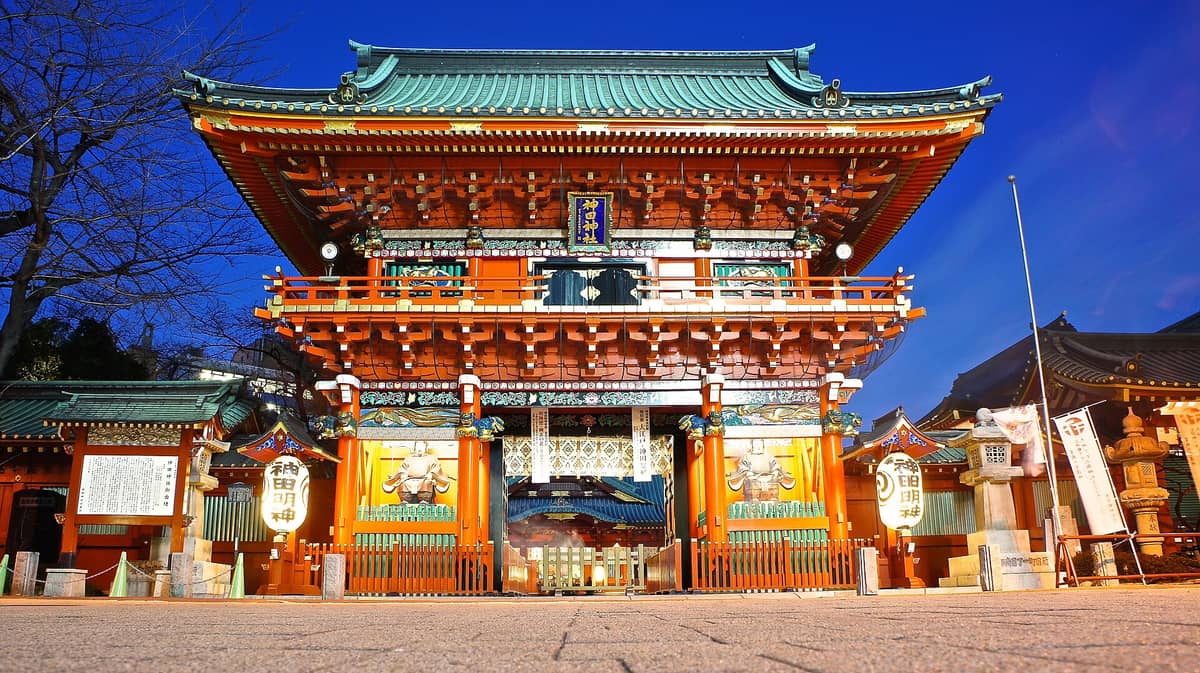
The main hall, rebuilt in 1934 in the gongen-zukuri architectural style, is finished in bright vermilion lacquer with gold accents and an ornately carved roof. Unlike some Tokyo shrines that feel subdued, Kanda Myojin wears its color confidently. The roof ridgeline is decorated with mythological figures, and the overall scale feels substantial without being overwhelming. Morning light hitting the hall's facade between 8:00 and 10:00 produces excellent photography conditions, particularly in spring when plum trees bloom in the grounds.
To the left of the main hall, a pair of large stone guardian lions flank the path to a smaller sub-shrine dedicated to Ebisu. Small wooden ema votive tablets hang in dense rows nearby, their handwritten messages ranging from exam wishes to business prayers to, more recently, requests connected to anime and gaming characters. Kanda Myojin has cultivated an unusually open relationship with otaku culture, and official ema featuring characters from popular franchises are sold at the shrine shop, a detail that surprises first-time visitors expecting a strictly austere atmosphere.
The water purification basin (temizuya) near the entrance offers visitors the ritual handwashing before approaching the main hall. The basic process involves ladling water over each hand in a prescribed order, a practice common across Shinto shrines. If this is your first time at a Japanese shrine, the temple and shrine etiquette guide covers the steps clearly.
How the Experience Changes by Time of Day
Early mornings, between 7:00 and 9:00, attract office workers and local residents stopping briefly before heading to work. The atmosphere is quiet and efficient, with people making quick prayers and moving on. The sound of wooden sandals on stone, low murmured prayers, and the occasional toll of a bell carry easily in the morning stillness. This is the most contemplative time to visit.
Midday brings a different crowd: tourists from Akihabara, school groups, and visitors who have combined the shrine with a walk through the electronics district. The volume picks up, and the ema boards become a point of congregation as people photograph the anime-themed tablets. Weekends amplify this further, and the narrow paths between sub-shrines can get crowded between 11:00 and 14:00.
Late afternoon, especially on weekdays after around 15:00, offers a pleasant middle ground. The tourist rush has usually thinned, but the office visitors haven't yet arrived for the evening. Light comes in at a lower angle, casting longer shadows across the stone lanterns and giving the main hall's vermilion a deeper, warmer tone. Evening visits are perfectly feasible since the grounds stay open all night, but most of the service windows close by 17:00–18:00, so purchasing charms or arranging a formal prayer should happen earlier in the day.
💡 Local tip
For the best combination of atmosphere and light, aim for a weekday arrival between 8:00 and 10:00. The crowds from Akihabara haven't arrived yet, and the morning quality of light on the vermilion main hall is noticeably better than midday.
The Kanda Matsuri: When the Shrine Comes Fully Alive
Kanda Myojin is the organizing center of the Kanda Matsuri, one of the three great festivals of Japan alongside the Gion Matsuri in Kyoto and the Tenjin Matsuri in Osaka. Held in mid-May in odd-numbered years (with a smaller celebration in even-numbered years), the full festival involves over 200 mikoshi portable shrines and thousands of participants processing through the streets of Chiyoda and neighboring wards. The procession covers the former Edo downtown area, a direct echo of the shrine's historical role as guardian of the city. If your trip coincides with the full festival, plan in advance: crowds are intense, streets are partially closed, and accommodation nearby fills up quickly. For timing advice, the guide on the best time to visit Tokyo includes notes on major festivals.
Outside the main festival period, the shrine hosts smaller seasonal events, including a New Year's hatsumode period when tens of thousands of visitors arrive in the first days of January to pray for the new year. This is one of the most atmospheric times to visit, but also the most intensely crowded, with queues stretching well beyond the torii gate.
The Akihabara Connection: Shrine Meets Subculture
The proximity to Akihabara has created a genuinely interesting cultural overlap. Kanda Myojin began selling character-themed ema boards and accepting prayers related to gaming and anime success, positioning itself as a spiritually legitimate destination for otaku culture rather than treating it as a nuisance. The shrine's IT industry blessing ceremonies, started in the 2000s, attract companies seeking prayers for the success of new software, websites, and products. This is not a gimmick: the ceremonies follow the same Shinto formats as any other blessing ritual, applied to modern contexts.
If the Akihabara electronics and anime district is already on your itinerary, combining it with a visit to Kanda Myojin adds depth to the day without requiring much extra time. The Akihabara district guide outlines the best way to structure that kind of combined visit.
Practical Information for Your Visit
The shrine is at 2-16-2 Sotokanda, Chiyoda City, Tokyo 101-0021. The most convenient stations are Ochanomizu (JR Chuo-Sobu Line, Tokyo Metro Marunouchi Line), about 4 to 5 minutes on foot; Shin-Ochanomizu Station (Tokyo Metro Chiyoda Line), about 5 to 7 minutes on foot; Akihabara Station (JR lines, Tokyo Metro Hibiya Line), about 7 minutes on foot; and Suehirocho Station on the Tokyo Metro Ginza Line, approximately 5 minutes away on foot. There is no dedicated parking; arriving by train is strongly recommended.
Entry to the grounds is completely free. Omamori (amulets) and ema (votive tablets) are available for purchase, with standard prices in the range common for Tokyo shrines, typically a few hundred yen each. Formal prayer ceremonies conducted by priests involve separate fees; details are available at the prayer reception window during office hours.
The shrine sits on elevated ground. From the Akihabara side, a staircase climbs to the main precinct. The EDOCCO building provides elevator access as an alternative, making the main hall reachable without navigating stairs. Some slope and level variation remains within the grounds, so visitors with limited mobility should plan accordingly. For specific barrier-free routing, contacting the shrine directly at +81 3-3254-0753 before visiting is advisable.
⚠️ What to skip
During the New Year period (roughly January 1–3) and the full Kanda Matsuri in odd-numbered years (mid-May), the shrine and surrounding streets become extremely congested. Wait times to reach the main hall can exceed an hour. If crowd-heavy environments are not for you, these periods are best avoided.
Who Should Skip This Attraction
Travelers who find Shinto shrines interchangeable or who have already visited several in Tokyo may find Kanda Myojin relatively compact compared to larger complexes like Meiji Jingu or Nikko Tosho-gu. The grounds are not extensive, and a visit covers the main sights in 30 to 45 minutes without rushing. If you are looking for expansive forested grounds or absolute quiet, this is not that kind of shrine. Its strength is historical density and cultural specificity, not scale or natural atmosphere.
For a larger shrine experience with sweeping forested grounds in the heart of Tokyo, Meiji Jingu Shrine in Harajuku offers a genuinely different kind of visit.
Insider Tips
- The EDOCCO building's small gallery sometimes hosts rotating exhibitions on Edo-period culture and the shrine's history. Entry is sometimes free and often overlooked by visitors who head straight for the main hall.
- The staircase approach from the Akihabara side is the most dramatic entry point and the best for photography, but if you come via Ochanomizu Station, the upper road approach brings you directly to the gate level without climbing stairs.
- Character-themed ema boards sold at the shrine shop change seasonally and sometimes reflect currently popular anime titles. They sell out during festival periods, so if you want a specific design, shop early in your visit.
- For New Year's visits, arriving in the late evening of December 31 rather than the morning of January 1 gives you access to the midnight atmosphere with slightly shorter queues than the first full day of January.
- The sub-shrine dedicated to Daikokuten, to the right of the main hall, is a quieter spot even when the central precinct is busy and worth a few minutes of separate attention.
Who Is Kanda Myojin Shrine For?
- First-time visitors to Tokyo who want a historically grounded shrine visit close to Akihabara
- Anime and gaming enthusiasts curious about the intersection of otaku culture and traditional Shinto practice
- Photographers looking for strong architectural color and morning light on traditional structures
- Anyone combining a Chiyoda or Akihabara itinerary and wanting a cultural counterpoint to electronics shopping
- Travelers interested in Edo-period Tokyo history and the city's spiritual geography
Nearby Attractions
Other things to see while in Ueno & Akihabara:
- Akihabara Electric Town
Akihabara Electric Town (秋葉原電気街) is the beating heart of Tokyo's electronics and otaku culture. Stretching from Akihabara Station along Chuo-dori and its surrounding alleys, the district packs multi-story electronics megastores, retro game shops, anime merchandise outlets, and maid cafés into a few dense city blocks. Entry is free. The real cost is time and willpower.
- Ameyoko Market
Ameyoko Market (Ameya-Yokocho) stretches between Ueno and Okachimachi stations in central Tokyo, packing fresh seafood, discount clothing, snacks, and cosmetics into roughly 500 meters of covered and open-air stalls. Entry is free, the energy is genuine, and the history runs deep.
- Kyu-Iwasaki-tei Garden
Kyu-Iwasaki-tei Garden preserves the former Tokyo residence of the Iwasaki family, founders of Mitsubishi, in the Ikenohata area of Taito Ward near Ueno. The estate combines a Victorian-style wooden mansion, a connected billiard hall, and a traditional Japanese garden — all for one of the lowest admission prices of any historic site in the city.
- National Museum of Nature and Science
The National Museum of Nature and Science (国立科学博物館) is Japan's leading institution for natural history and the history of science and technology. Spread across two pavilions in Ueno Park, it covers everything from dinosaur fossils to the development of Japanese industry — and admission for high school students and under is free.