Meiji Jingu Shrine: Tokyo's Forest Sanctuary in the Heart of the City
Meiji Jingu is a Shinto shrine set within 70 hectares of forested grounds in Harajuku, dedicated to Emperor Meiji and Empress Shoken. Entry to the main shrine is free, the atmosphere shifts dramatically by time of day, and it remains one of Tokyo's most genuinely calming places to visit year-round.
Quick Facts
- Location
- 1-1 Yoyogi Kamizono-cho, Shibuya-ku, Tokyo 151-8557 (Harajuku area)
- Getting There
- JR Harajuku Station (Yamanote Line) or Tokyo Metro Meiji-jingumae Station (Chiyoda & Fukutoshin Lines)
- Time Needed
- 1–2 hours for the main shrine; add 45 min for the Inner Garden (Gyoen)
- Cost
- Main shrine: Free. Inner Garden (Gyoen): ¥500. Museum: ¥1,000 adults / ¥900 students
- Best for
- First-time visitors, solo travelers, couples, those seeking calm away from Tokyo's commercial core
- Official website
- www.meijijingu.or.jp/en
What Meiji Jingu Actually Is
Meiji Jingu (明治神宮) is a Shinto shrine in the Harajuku district of Tokyo, dedicated to the deified spirits of Emperor Meiji and his consort Empress Shoken. The shrine was completed in 1920, roughly eight years after the Emperor's death in 1912, and quickly became one of the most important Shinto sites in Japan. The original structures were destroyed during the Second World War and meticulously rebuilt in 1958, following the architectural forms of the original.
What makes Meiji Jingu unusual in central Tokyo is the sheer scale of its forested grounds: approximately 70 hectares of woodland that feel almost improbably removed from the city pressing in on every side. The forest itself was largely planted at the time of the shrine's construction, with trees donated from across Japan and beyond. Over a century later, it has matured into a dense canopy that muffles street noise and drops the temperature perceptibly, even in summer.
The shrine sits at the northern edge of the Harajuku and Omotesando area, separated from the crowds of Takeshita Street by little more than a train station and the tree line. That contrast, between one of Tokyo's noisiest youth-culture corridors and one of its quietest sacred sites, is part of what makes visiting both in a single morning so striking.
The Walk In: Three Gates and a Gravel Path
Most visitors enter from the south, through the main torii gate near JR Harajuku Station. This first gate, built from approximately 1,500-year-old Taiwanese cypress, stands around 12 meters tall and sets an immediate sense of scale. The path beyond it is wide gravel, lined on both sides by ancient cryptomeria trees that close overhead into a green tunnel. Even on a busy weekend afternoon, the gravel path absorbs sound in a way that feels almost architectural.
Along the approach, look for the wall of sake barrels on the left side: 'kazaridaru' decorated casks donated by sake brewers from across Japan, and on the opposite side, barrels of Burgundy wine donated by French winemakers, a reflection of Emperor Meiji's famously international outlook. These details reward walkers who slow down rather than marching straight through.
💡 Local tip
The south entrance near Harajuku Station is the busiest approach. If you want a quieter arrival, try the north entrance from Sangubashi Station (Odakyu Line) or the east entrance from Yoyogi-koen, especially on weekday mornings.
Gravel paths throughout the grounds are manageable for wheelchairs and strollers on dry days, though the loose surface requires some effort. The distance from the south gate to the inner shrine is roughly 700 meters, so factor that into your timing if mobility is a consideration.
Tickets & tours
Hand-picked options from our booking partner. Prices are indicative; availability and final rates are confirmed when you complete your booking.
Meiji Shrine, Imperial Palace, Asakusa and Tokyo Skytree Entry
From 34 €Instant confirmationFree cancellationNikko UNESCO Shrine and Nature View 1-Day Tour from Tokyo
From 78 €Instant confirmationFree cancellationTrip to Mt. Fuji 5th Station or Arakura Shrine, Oshino Hakkai, Onsen
From 51 €Instant confirmationFree cancellationNoh Performance, Overnight Stay, and Afuri Shrine Pilgrimage
From 429 €Instant confirmationFree cancellation
The Inner Shrine: What You'll Find at the Core
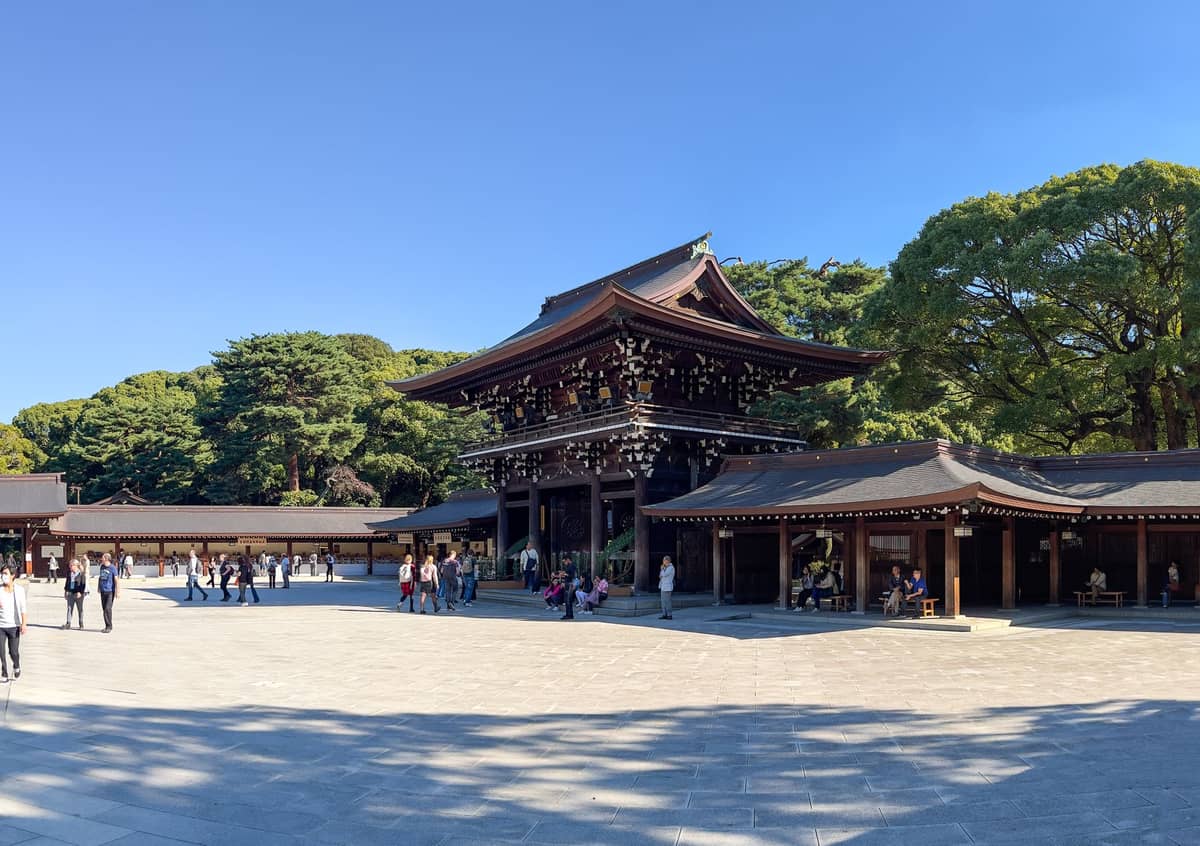
The inner shrine complex is entered through a covered wooden gate, where visitors observe a standard Shinto etiquette: a brief bow, hand-cleansing at the 'temizuya' water pavilion, and then a walk into the main courtyard. The primary hall is built in the 'nagare-zukuri' style, with a sweeping forward extension of the roof over an open veranda. The wood is unpainted, treated with oil and time rather than lacquer, giving it a warm grey-brown tone that looks genuinely aged even though the current buildings date from 1958.
On weekdays before 9am, the courtyard can hold just a handful of people, many of them engaged in quiet prayer rather than photography. By midday on weekends, numbers increase considerably, though the space is large enough that it rarely feels overcrowded the way some of Kyoto's more compact shrines do. Wedding processions take place here regularly, particularly on auspicious calendar dates, and watching a 'Shinto wedding' (san-san-kudo ceremony participants in formal kimono) crossing the inner courtyard is one of the more memorable things a visitor can witness without any planning.
ℹ️ Good to know
Shinto weddings at Meiji Jingu happen most often on weekends and public holidays, usually in the late morning. If you arrive between 10am and noon on a weekend, there's a reasonable chance you'll see a procession.
Time of Day: How the Experience Changes
Early morning, within the first hour after the grounds open, is categorically different from any other time. The light filters through the canopy in long angles, the gravel is raked and undisturbed, and the only sounds are birds and the occasional distant train. This is when the forest's atmospheric weight is most tangible. Birdsong here is notably varied, because the mature woodland supports species rarely heard in urban Tokyo.
Midmorning brings the first organized tour groups and individual visitors in increasing numbers. The paths are still pleasant, but the sense of solitude is gone. By midafternoon on weekends, the south approach can feel like a procession rather than a walk, though it never reaches the density of, say, the Senso-ji precincts in Asakusa. Late afternoon, especially in autumn and winter when the grounds close earlier, sees a second, quieter wave of visitors arriving for golden-hour photography.
Opening times shift month by month, with the grounds opening as early as 5:00 in June and as late as 6:40 in December, and closing between 16:00 and 18:30 depending on season. Always check the official site before visiting, particularly if you plan an early arrival. For broader context on planning your Tokyo trip around seasons and daylight hours, the best time to visit Tokyo guide covers seasonal light and crowd patterns across the city.
The Inner Garden (Gyoen) and the Museum
The Meiji Jingu Gyoen, the Inner Garden, requires a separate admission of ¥500 and sits to the left of the main approach path. It was a favorite retreat of Emperor Meiji and Empress Shoken, and contains a wooden iris garden that draws particular attention in June, when many varieties flower simultaneously. Outside of iris season, the garden is a quieter, less-visited corner of the grounds, with a traditional wooden pavilion overlooking a pond.
The Meiji Jingu Museum, designed by architect Kengo Kuma and opened in 2019, houses imperial artifacts and items connected to Emperor Meiji and Empress Shoken. Admission is ¥1,000 for adults and ¥900 for students. The museum is closed on Thursdays and during changeover periods between exhibitions. It opens at 10:00 and last admission is at 16:00 (closing at 16:30). For visitors already interested in Meiji-era history, it adds meaningful context; for those primarily drawn by the forest and shrine atmosphere, it can be skipped without missing the core experience.
💡 Local tip
The iris garden in the Gyoen peaks typically in mid-to-late June, coinciding with Tokyo's rainy season. The combination of misty mornings and flowering iris can be exceptionally photogenic, and the crowds in the garden itself are far smaller than you might expect.
Practical Details: Getting There, What to Bring, Photography
JR Harajuku Station on the Yamanote Line puts you at the main torii gate in under two minutes. Tokyo Metro Meiji-jingumae Station (Chiyoda and Fukutoshin Lines) is equally convenient, with exits signposted toward the shrine. There is no parking lot for general visitors, and the surrounding streets are not suited to a drop-off approach.
Wear comfortable flat shoes: the gravel paths are approximately 700 meters from south gate to inner shrine, and longer if you include the garden loop. There is no dress code for entry to the grounds, but modest clothing is appropriate within the inner shrine area. Photography of the outer buildings and forest paths is generally fine; always follow signage near the inner sanctum. For a full overview of how to move around this part of the city, see the getting around Tokyo guide.
There are no large food vendors inside the grounds. A small rest area near the inner shrine sells drinks and light snacks. For a proper meal or coffee, Harajuku and Omotesando are immediately adjacent and offer a very wide range of options.
Accessibility: the main paths are wide and mostly flat, with gravel that is firm enough for wheelchairs on dry days. The distance involved is substantial, so visitors with limited mobility should plan accordingly. The Inner Garden has some uneven surfaces near the pond path.
Honest Assessment: What Works and What Doesn't
Meiji Jingu is genuinely impressive in its scale and forested setting, and the main shrine visit is free, which makes it easy to include even on a tight budget. It features in virtually every Tokyo itinerary, and for good reason. That said, visitors hoping for the ornate, lacquered red-and-gold aesthetic of shrines like Nezu Shrine or Nikko's Tosho-gu will find Meiji Jingu restrained by comparison. The architectural language here is deliberately plain, almost austere, and the spiritual atmosphere is the main draw rather than visual spectacle.
Visitors who struggle with walking on uneven surfaces, or who have very limited time in Tokyo and need high visual density per hour, might find the experience underwhelming relative to the time investment. The walk in and out alone is around 20-25 minutes of gravel path. If your Tokyo day is already packed, allocate at least 90 minutes to do this properly.
For those interested in exploring more of Tokyo's shrine and temple landscape, the best temples and shrines in Tokyo guide gives a wider comparative view, including sites in Yanaka, Ueno, and further afield.
Insider Tips
- The New Year (Hatsumode) period, January 1–3, draws around three million visitors to Meiji Jingu, making it one of the most-visited shrines in Japan during that window. Unless you specifically want to experience this event, avoid the first week of January entirely.
- The sake barrel display on the approach path is refreshed periodically. The barrels are decorative and sealed, but the names on them represent some of Japan's most respected breweries: worth pausing to read if you have any interest in sake culture.
- On weekday mornings you may encounter groups of elderly practitioners doing 'misogi' purification rituals near the inner water pavilion. This is a genuine religious practice, not a performance: observe quietly from a distance.
- The Meiji Jingu Museum's Kengo Kuma-designed building is worth a look even if you skip the interior. Its thatched and wooden exterior sits unusually well in the forested setting and represents a considered piece of contemporary Japanese architecture.
- If you're visiting in autumn, the ginkgo trees along the approach path turn a sharp yellow in late November, and the fallen leaves on the gravel path create a visual that no Tokyo travel photograph can fully convey from ground level.
Who Is Meiji Jingu Shrine For?
- First-time visitors to Tokyo wanting an accessible, free introduction to Shinto shrine culture
- Early risers who can arrive at opening time for an atmospheric, near-empty forest walk
- Couples and those interested in witnessing traditional Shinto wedding ceremonies on weekend mornings
- Travelers combining the Harajuku and Omotesando areas into a single half-day, using the shrine as a calm counterpoint to the retail and cafe scene nearby
- Photographers working in natural light who want canopy-filtered morning shots without the crowds of better-known Kyoto locations
Nearby Attractions
Other things to see while in Harajuku & Omotesando:
- Omotesando
Omotesando is Tokyo's most architecturally ambitious street: a broad, zelkova-lined avenue connecting the entrance of Meiji Shrine to the galleries of Aoyama. Lined with flagship stores designed by the world's most celebrated architects, it moves at a different pace from the rest of the city. Free to walk, endlessly rewarding to explore.
- Takeshita Street
Takeshita Street (竹下通り) is a roughly 350-meter pedestrian shopping corridor in Harajuku that has defined Tokyo's youth fashion scene since the 1970s. Free to enter and open year-round, it packs crepe stands, second-hand clothing stores, costume jewelry, and some of Japan's most visually intense street fashion into a single impossibly crowded lane.
- Ukiyo-e Ota Memorial Museum of Art
The Ukiyo-e Ota Memorial Museum of Art holds one of Tokyo's most important private collections of Japanese woodblock prints, with over 12,000 works rotated through intimate, carefully curated exhibitions. Tucked just off Omotesando's main boulevard, it offers a rare moment of quiet contemplation in one of the city's most frenetic neighborhoods.
- Yoyogi Park
Yoyogi Park is one of Tokyo's largest and most relaxed green spaces, sitting just steps from Harajuku Station. Free to enter year-round, it draws everyone from joggers and picnickers to festival crowds and amateur musicians, offering a rare pocket of open sky in one of the world's densest cities.