Ukiyo-e Ota Memorial Museum of Art: Tokyo's Woodblock Print Sanctuary in Harajuku
The Ukiyo-e Ota Memorial Museum of Art holds one of Tokyo's most important private collections of Japanese woodblock prints, with over 12,000 works rotated through intimate, carefully curated exhibitions. Tucked just off Omotesando's main boulevard, it offers a rare moment of quiet contemplation in one of the city's most frenetic neighborhoods.
Quick Facts
- Location
- 1-10-10 Jingumae, Shibuya-ku, Tokyo 150-0001
- Getting There
- Meiji-Jingumae Station (Exit 5), 3 min walk; Harajuku Station (Omotesando Exit), 5 min walk
- Time Needed
- 1 to 1.5 hours
- Cost
- Adults from ¥700 (regular) to ¥1,000 (special exhibitions); students from ¥500; under junior high school age free
- Best for
- Art lovers, Japan history enthusiasts, travelers seeking calm amid Harajuku chaos
- Official website
- www.ukiyoe-ota-muse.jp/eng
What Is the Ukiyo-e Ota Memorial Museum of Art?
The Ukiyo-e Ota Memorial Museum of Art (太田記念美術館) is a specialist woodblock print museum founded on the private collection of Seizō Ōta V, former president of Tōhō Insurance Company. Before his death, Ōta amassed about 12,000 ukiyo-e works (part of a collection now totaling around 14,000 pieces) spanning the full arc of the genre, from early Edo-period masters to the late 19th-century artists who influenced Western Impressionism. The museum opened in 1980 with a clear mission: to display this collection properly, in conditions that respect the fragility of paper and pigment, and to rotate the works so a broader range of pieces reaches the public over time.
Ukiyo-e, literally translated as "pictures of the floating world," captured the pleasures, fashions, and theatrical life of Edo (present-day Tokyo) from the 17th century onward. The genre gave the world Katsushika Hokusai's Great Wave, Utagawa Hiroshige's misty landscapes, and Kitagawa Utamaro's close studies of women. The Ota collection holds significant works by all three, plus dozens of other print masters whose names are less famous outside Japan but whose output is equally compelling.
ℹ️ Good to know
The museum runs rotating thematic exhibitions, so the specific works on display change every few weeks. Check the official English-language website before visiting to see what's currently showing. There may also be brief closure periods between exhibitions.
The Setting: A Quiet Anomaly in Harajuku
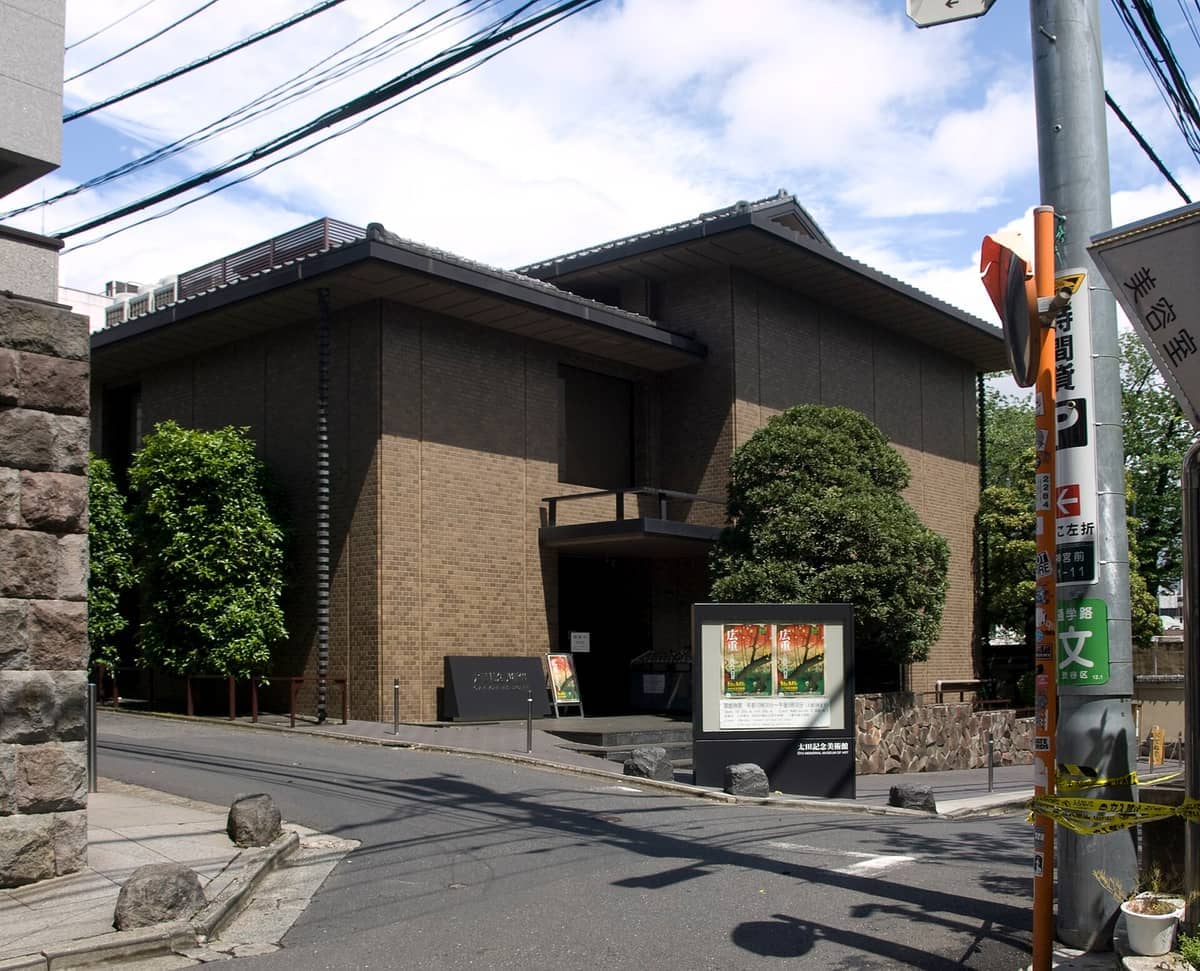
The museum's location is quietly remarkable. It sits two minutes' walk from the commercial intensity of Takeshita Street and a short walk from the broad avenue of Omotesando, yet the building occupies a narrow residential lane where the noise drops away almost immediately. The street-level entrance is understated: a low wooden gate, a small garden forecourt, and a facade that doesn't announce itself the way larger institutions do.
Inside, the museum occupies two gallery floors in a compact building. The rooms are deliberately small, lit to protect the prints from UV degradation, and arranged so visitors slow down. This is not a museum where you walk quickly. The scale enforces attention: you stand close to a single sheet of paper printed with mulberry-bark ink and mineral pigments, and the detail rewards the proximity.
There is a tea house area on the ground floor where visitors can pause. The scent of old timber, the soft lighting, and the near-silence create an atmosphere that feels genuinely at odds with the neighborhood outside. For travelers who have spent a day navigating the crowds around Harajuku and Shibuya, the contrast is stark and welcome.
Tickets & tours
Hand-picked options from our booking partner. Prices are indicative; availability and final rates are confirmed when you complete your booking.
100-minute all-you-can-eat of Wagyu in Gotanda
From 38 €Instant confirmationFree cancellationTsukiji Fish Market Walking Food Tour
From 40 €Instant confirmationFree cancellationMt.Fuji,Owakudani, Hakone Cruise & Ropeway, Oshino Hakkai 1-Day Trip
From 54 €Instant confirmationFree cancellationTour to Mt. Fuji Area, Oshino Hakkai and Kawaguchi Lake from Tokyo
From 57 €Instant confirmationFree cancellation
The Collection and What You'll Actually See
Because the full collection of around 14,000 works (including about 12,000 collected by Ōta) cannot be displayed simultaneously, the museum presents themed exhibitions that typically run four to six weeks. One exhibition might focus on Hiroshige's travel series, another on depictions of Edo's pleasure districts, another on the technical evolution of the beni-e (safflower-red print) style. Each show runs with scholarly precision: wall text in Japanese and English explains the historical context, the printing techniques, and the individual artists' careers.
Common highlights that rotate through the collection include prints by Hokusai from the Thirty-Six Views of Mount Fuji series, Hiroshige's Fifty-three Stations of the Tōkaidō, and Utamaro's bijin-ga (portraits of beautiful women). The museum also holds strong holdings of yakusha-e (actor portraits) by Tōshūsai Sharaku, whose identity remains one of ukiyo-e's enduring mysteries. Even visitors with no prior knowledge of the genre find these works accessible, partly because the exhibitions are well-labeled and partly because the prints themselves are immediately readable as images.
💡 Local tip
If you have a particular print master or series you want to see, email the museum in advance or check the exhibition schedule online. The Ota's website lists upcoming exhibitions several months ahead, and works from the permanent collection only appear when the thematic program calls for them.
Visiting by Time of Day
The museum opens at 10:30 and closes at 17:30, with last admission at 17:00. Mornings on weekdays, particularly Tuesday through Thursday, tend to be the quietest. The galleries hold relatively few people at any given time, but the rooms are small enough that even eight or ten simultaneous visitors can feel slightly crowded around the same display case.
Weekend afternoons draw more visitors, including school groups and organized tours. If you arrive after 14:00 on a Saturday, expect company. The experience doesn't deteriorate significantly, but the careful, unhurried attention the space encourages becomes harder to sustain when others are waiting behind you at each display.
On weekday mornings, the neighborhood itself is calmer. Walking from Harajuku Station along the back streets to the museum takes about five minutes, and at 10:30 those streets are quiet in a way they won't be by noon. If you plan to combine this visit with time on Omotesando or a walk through Yoyogi Park, a morning museum start lets you do both without feeling rushed.
Practical Walkthrough: Getting There and Getting In
The most direct route is from Meiji-Jingumae Station on the Tokyo Metro Chiyoda and Fukutoshin lines. Take Exit 5 and walk roughly three minutes northwest. Alternatively, from JR Harajuku Station (served by the Yamanote Line), use the Omotesando Exit and walk about five minutes south. Neither route requires navigating Takeshita Street's crowds if you choose your lanes carefully. The museum is tucked into the Jingumae residential block between Omotesando and the back streets behind Harajuku and Omotesando.
Admission fees vary by exhibition. As of recent listings, regular and planned exhibitions cost ¥700 for adults and ¥500 for high school and university students. Special exhibitions are priced at ¥1,000 for adults and ¥700 for students. Junior high school students and younger enter free. These prices should be confirmed on the official website before visiting, as they can vary by show.
The museum is closed on Mondays. If Monday falls on a national holiday, the closure shifts to the following Tuesday. There are also periodic closure periods between exhibitions, sometimes lasting several days. Arriving to find the museum shut is a real possibility if you haven't checked ahead.
⚠️ What to skip
The museum has no elevator. Due to building structure and safety requirements, visitors using wheelchairs can only access the first-floor gallery. Mobility scooters and powered wheelchairs are not permitted. This is a significant limitation for some visitors, and the museum is transparent about it on its official website.
Photography and What to Bring
Photography policies vary by exhibition and are enforced at the door. Many shows prohibit photography of the prints entirely, to protect both the works and copyright arrangements. Some exhibitions permit photography in designated areas. Check the current policy at the entrance or on the museum's website. Either way, plan to look rather than photograph: the prints are best experienced at close range, not through a screen.
No particular clothing is required, but the galleries are climate-controlled and tend to run slightly cool to protect the paper works. A light layer is worth having in summer, when the contrast with Tokyo's outdoor heat can be sharp. The museum has a small shop near the entrance selling reproductions, postcards, and exhibition catalogs. The catalogs in particular are well-produced and serve as a useful reference if you want to continue studying a particular period or artist.
Who Will Get the Most From This Museum (And Who Might Not)
Visitors with an existing interest in Japanese art history, printmaking technique, or the Edo period will find the Ota Memorial rewarding at almost any level of engagement. The exhibitions are pitched to be accessible rather than academic, but the curatorial depth is genuine. If you're working through Tokyo's art landscape more broadly, the Ota sits naturally alongside larger institutions: the Tokyo National Museum in Ueno has an extensive ukiyo-e holding, but the Ota's focused programming and intimate scale offer something the larger museum cannot.
Travelers who prefer immersive, technology-driven art experiences will likely find the Ota too quiet and conventional. This is a museum for looking at framed prints in still rooms, not for walking through projected light installations. Children under about twelve tend to lose patience quickly, though the free admission for younger students is a thoughtful policy if you do bring them.
The Ota is also genuinely worth the visit for anyone staying in the Harajuku and Omotesando area who wants a counterpoint to the shopping and crowds. Pairing it with a late morning walk through Yoyogi Park or a visit to Meiji Jingu Shrine makes for an unhurried, culturally coherent half-day in one of Tokyo's most interesting neighborhoods.
Insider Tips
- The museum publishes its exhibition schedule well in advance on the English website. Plan your Tokyo itinerary around an exhibition that interests you rather than visiting blind — the difference between a show you're genuinely curious about and one you're not is significant in a space this focused.
- Between exhibitions, the museum sometimes closes for several days. Always check the calendar within a week of your planned visit, not just at initial planning.
- The museum shop's exhibition catalogs are reasonably priced and significantly better produced than typical museum store fare. They're worth buying even if you can't photograph the works inside.
- If you're visiting in spring or autumn, the small forecourt garden has seasonal plantings that are worth a moment on the way in or out. It's one of the few genuinely calm outdoor spots in this part of Harajuku.
- Combine this visit with the neighborhood's back streets between Omotesando and Cat Street rather than the main boulevard. The quieter lanes have independent cafes and small galleries that reward slow walking, and the walk to or from the museum passes several of them.
Who Is Ukiyo-e Ota Memorial Museum of Art For?
- Art lovers and anyone with a specific interest in Japanese printmaking or Edo-period culture
- Travelers who want a slower, more contemplative museum experience in the middle of a busy Harajuku day
- First-time visitors to Tokyo who want to understand the visual culture that defined the city before modernization
- Photographers and designers interested in ukiyo-e's influence on composition, color, and graphic art
- Couples or solo travelers looking for a quiet two-hour interlude without spending a full afternoon
Nearby Attractions
Other things to see while in Harajuku & Omotesando:
- Meiji Jingu Shrine
Meiji Jingu is a Shinto shrine set within 70 hectares of forested grounds in Harajuku, dedicated to Emperor Meiji and Empress Shoken. Entry to the main shrine is free, the atmosphere shifts dramatically by time of day, and it remains one of Tokyo's most genuinely calming places to visit year-round.
- Omotesando
Omotesando is Tokyo's most architecturally ambitious street: a broad, zelkova-lined avenue connecting the entrance of Meiji Shrine to the galleries of Aoyama. Lined with flagship stores designed by the world's most celebrated architects, it moves at a different pace from the rest of the city. Free to walk, endlessly rewarding to explore.
- Takeshita Street
Takeshita Street (竹下通り) is a roughly 350-meter pedestrian shopping corridor in Harajuku that has defined Tokyo's youth fashion scene since the 1970s. Free to enter and open year-round, it packs crepe stands, second-hand clothing stores, costume jewelry, and some of Japan's most visually intense street fashion into a single impossibly crowded lane.
- Yoyogi Park
Yoyogi Park is one of Tokyo's largest and most relaxed green spaces, sitting just steps from Harajuku Station. Free to enter year-round, it draws everyone from joggers and picnickers to festival crowds and amateur musicians, offering a rare pocket of open sky in one of the world's densest cities.