Nezu Shrine: Tokyo's Ancient Sanctuary of Torii Tunnels and Azalea Blooms
Nezu Shrine (根津神社) is one of Tokyo's oldest and most atmospheric Shinto sanctuaries, its current buildings dating to 1706 and designated as Important Cultural Properties. Set in the quiet Yanaka district, it draws visitors year-round for its winding torii gate corridors, historic architecture, and a spectacular azalea garden that erupts in color each spring.
Quick Facts
- Location
- 1-28-9 Nezu, Bunkyō-ku, Tokyo 113-0031
- Getting There
- Nezu Station or Sendagi Station (Tokyo Metro Chiyoda Line), both about 5 min walk; Todaimae Station (Namboku Line), about 10 min walk
- Time Needed
- 45–90 minutes for the full grounds; longer during Azalea Festival
- Cost
- Free entry to shrine grounds; Azalea Garden approx. ¥500–1,000 adults, free for elementary school children and younger during festival period only
- Best for
- History lovers, photographers, spring foliage seekers, Edo architecture enthusiasts
- Official website
- nedujinja.or.jp
What Makes Nezu Shrine Worth Your Time
Nezu Shrine occupies a rare position in Tokyo: it is genuinely old, architecturally significant, and located far enough from the main tourist circuits to retain a local, unhurried atmosphere. The shrine's history is said to stretch back roughly 1,900 years in some form, but the structures you see today were built in 1706 under the patronage of Tokugawa Tsunayoshi, the fifth Tokugawa shogun. That makes Nezu Shrine one of the very few Edo-period shrine complexes in Tokyo to have survived wars, fires, and the 1923 Great Kanto Earthquake largely intact. The main hall, worship hall, and ornate gate are designated Important Cultural Properties by the Japanese government.
What you get here is not just spiritual atmosphere. The complex offers a textbook lesson in Edo shrine architecture: cinnabar-red lacquer, copper rooftops gone green with age, carved wooden details layered with centuries of accumulated soot and incense smoke. The contrast with Tokyo's surrounding concrete is striking, and the scale feels intimate rather than overwhelming.
💡 Local tip
Arrive before 9:00 on weekdays and you'll often share the grounds with only a handful of early-morning worshippers. The morning light filters through the torii corridors at a low angle between roughly 7:00 and 8:30, which makes for exceptional photography with almost no crowds.
The Torii Tunnels: Nezu's Most Photographed Feature
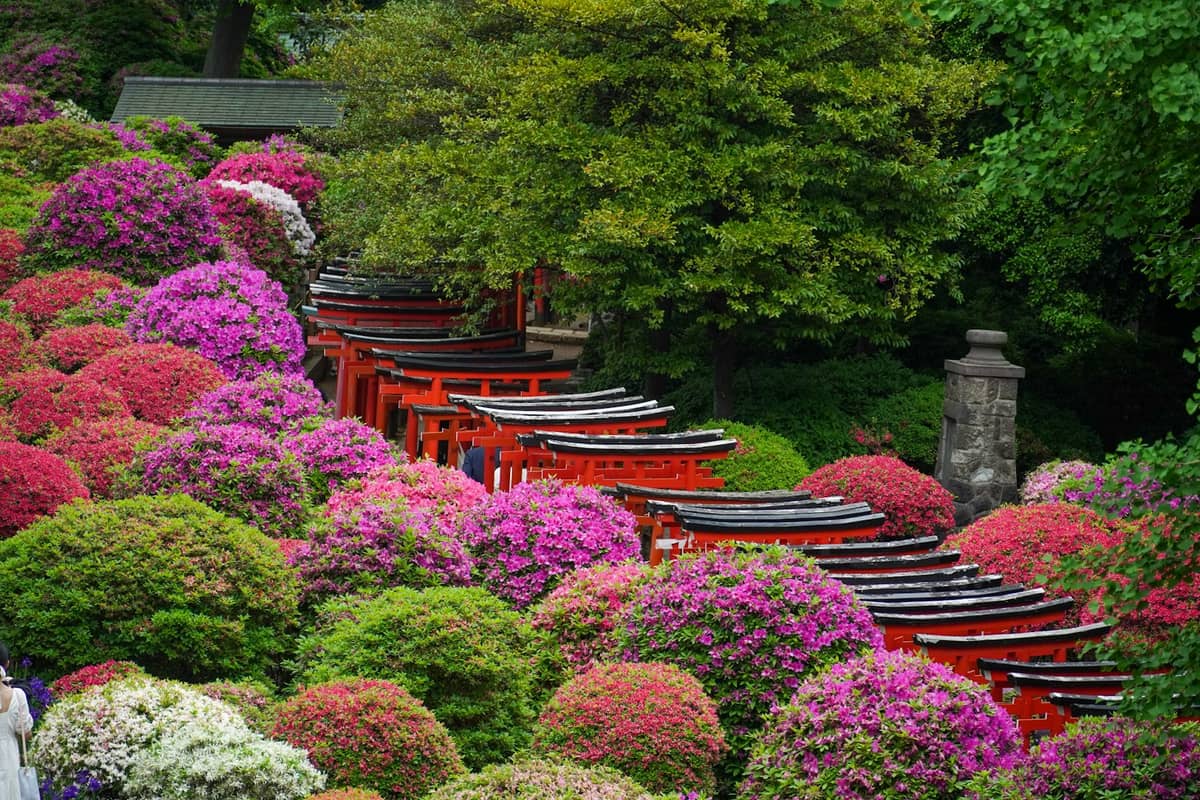
Nezu Shrine is best known outside Japan for its corridor of small vermilion torii gates that wind up a wooded hillside at the back of the compound. These are often compared to the famous torii tunnels at Kyoto's Fushimi Inari Taisha, though Nezu's version is considerably shorter and more intimate in scale. That difference is actually an advantage: you can walk the full path in about five minutes, photograph it from multiple angles without a hundred other visitors in every frame, and loop back without the physical exertion of Fushimi Inari's mountain trail.
The gates are smaller than the grand torii you find at major shrines, close together, and set on a gentle slope through dense greenery. In summer, the foliage overhead creates a cool, darkened tunnel effect. In autumn, fallen leaves collect at the base of the wooden posts. The late afternoon light cuts between the gates in narrow golden bars, which is worth timing if you can manage it. The path leads to a small secondary shrine at the top, surrounded by older trees and moss-covered stone.
Nezu Shrine is not quite as remote as the Meiji Jingu Shrine, which sits in a much larger forested area, but it has a similar quality of separation from the city. The sounds shift noticeably once you step inside the grounds: less traffic noise, more birdsong and the soft sound of water from a small stream near the south entrance.
Tickets & tours
Hand-picked options from our booking partner. Prices are indicative; availability and final rates are confirmed when you complete your booking.
Nikko UNESCO Shrine and Nature View 1-Day Tour from Tokyo
From 78 €Instant confirmationFree cancellationMeiji Shrine, Imperial Palace, Asakusa and Tokyo Skytree Entry
From 34 €Instant confirmationFree cancellationTrip to Mt. Fuji 5th Station or Arakura Shrine, Oshino Hakkai, Onsen
From 51 €Instant confirmationFree cancellationNoh Performance, Overnight Stay, and Afuri Shrine Pilgrimage
From 429 €Instant confirmationFree cancellation
The Azalea Festival: Nezu's Peak Season
For roughly four to six weeks each spring, typically from early to mid-April through late April, Nezu Shrine hosts its Azalea Festival (Bunkyo Tsutsuji Matsuri). The terraced garden on the eastern slope of the grounds fills with thousands of azalea plants in shades of deep pink, magenta, purple, and white. The blooms are dense enough that at peak flowering, the hillside looks almost entirely covered in color.
Entry to the Azalea Garden costs around ¥500–1,000 for adults, while elementary school children and younger can enter free when accompanied by a guardian during the festival period; the rest of the shrine remains free. The garden paths are narrow and can become congested on weekends when the azaleas peak. Visiting on a weekday morning gives you a meaningfully better experience: you can move at your own pace, stop to sit on the wooden viewing platforms, and actually hear the wind in the trees rather than the murmur of crowds.
⚠️ What to skip
The exact bloom dates shift year to year depending on winter temperatures. Check the shrine's official site or Tokyo tourism resources in the week before your planned visit rather than relying on fixed calendar dates.
If you're planning a spring visit to Tokyo and want to compare garden experiences, Shinjuku Gyoen is the go-to for cherry blossoms, but Nezu holds its own as the definitive Tokyo azalea destination. The two don't compete — they bloom at slightly different times and have entirely different atmospheres.
Architectural Details Worth Slowing Down For
The main gate (karamon) leading to the inner precinct is among the most elaborately decorated structures on the grounds. Its curved gabled roof and carved wooden panels beneath the eaves reward close attention — figures of cranes, pine branches, and mythological animals appear in the lacquerwork. The main hall (honden) sits behind it on a slightly raised platform, with a worship hall (haiden) in front where visitors make offerings. Both structures follow the Gongen-zukuri architectural style common to prestigious Edo-period shrines, characterized by a connecting passageway between the inner and outer buildings.
The stone lanterns lining the main approach (sando) are worn smooth and slightly uneven after centuries of use. The ground around the inner precinct is packed gravel, which makes a distinct crunching sound underfoot that most visitors barely register but that contributes to the overall sensory atmosphere of the place. The smell of incense from the offering hall is present throughout the day, stronger in the morning when shrine staff perform daily rituals.
For a deeper understanding of how Nezu fits into Tokyo's broader tradition of Shinto architecture, the guide to Tokyo's best temples and shrines covers the full range from grand civic shrines to intimate neighborhood sanctuaries.
How Nezu Fits into the Yanaka Neighborhood
Nezu Shrine sits at the southern edge of the Yanaka area, one of Tokyo's most intact pre-war neighborhoods. The streets around the shrine are narrow, lined with small wooden houses, neighborhood temples, and independent shops that have operated for decades. There is a slower pace here that is largely absent from the more commercialized areas of the city.
A natural extension of a visit to Nezu Shrine is a walk north through the neighborhood toward Yanaka Ginza, a short traditional shopping street with vendors selling pickles, tofu, grilled skewers, and handmade goods. The walk from the shrine to the shopping street takes about ten minutes. The combination makes for one of the most unhurried and genuinely local half-days you can spend in Tokyo.
The broader Yanaka district also contains a significant cemetery, several minor shrines, and some excellent traditional crafts shops. It is a neighborhood that rewards wandering rather than planning, and Nezu Shrine makes a logical anchor point.
Practical Visitor Information
The shrine grounds and main gate are generally open from around 6:00 to 17:00, with slight seasonal variations by month; hours may be extended during the Azalea Festival, so check current information before visiting.
Getting here is straightforward from central Tokyo. Nezu Station and Sendagi Station on the Tokyo Metro Chiyoda Line are both about five minutes on foot. The walk from Nezu Station is flat and easy to follow. The Todaimae Station option (Namboku Line) involves a steeper hill and takes around ten minutes. For wheelchair users, the route from Sendagi Station is generally more practical due to elevator placement, though some inner areas of the shrine involve steps and thresholds.
ℹ️ Good to know
Accessible restrooms with wheelchair facilities, diaper-changing areas, and ostomate equipment are located on the south (Omotesando) side and north side entrances to the grounds. The main paths through the shrine are largely flat, but entry gates have raised thresholds of around 15–20 cm and some garden areas are only accessible via steps.
Photography is generally permitted throughout the grounds, including of the torii corridors and main buildings. There is no fee for taking photographs as a visitor. The shrine is not typically used for tourist selfie-rush culture; observe the etiquette of not blocking worshippers who are there to pray. Mornings on weekdays are the most photographically productive times. By 10:30 on weekends during azalea season, the garden paths can be uncomfortably crowded.
Nezu Shrine is free to enter year-round (except the Azalea Garden during festival season), which makes it a natural fit for a Tokyo itinerary focused on free attractions. Budget travelers can spend a genuinely rewarding morning here without spending anything.
Insider Tips
- The torii corridor photograph works best when shot from the bottom of the path looking upward, using a wide-angle setting. Early morning (before 8:30) gives you warm directional light; overcast days produce even tones with no harsh shadows, which also works well.
- The small shrine at the top of the torii path (Otome Inari) is often overlooked by visitors who turn back after the corridor. It has a stone fox guardian and a quieter atmosphere that is worth the extra two minutes of climbing.
- A wooden omamori (charm) or ema (wishing plaque) from the shrine office makes a more meaningful and genuinely local souvenir than most of what is sold near bigger tourist sites. The shrine office is at the inner precinct; follow the signs for 'Shamusho'.
- If you visit during the Azalea Festival on a weekend, arrive at opening time (around 6:00 or 7:00 depending on season) rather than mid-morning. The garden is noticeably less crowded before 8:30 and the slanted light on the blooms is better.
- Combine Nezu Shrine with Yanaka Cemetery and Yanaka Ginza for a full half-day in the area. The cemetery, which sounds morbid, is actually a pleasant green space popular with local joggers and cats, and some of its older sections contain notable historical graves.
Who Is Nezu Shrine For?
- Architecture enthusiasts who want to see authentic Edo-period shrine construction without Asakusa crowds
- Spring travelers looking for azalea gardens as a complement or alternative to cherry blossom spots
- Photographers who want the torii-tunnel aesthetic without the queues of Fushimi Inari in Kyoto
- Walkers doing a Yanaka neighborhood circuit combining temple culture with traditional street life
- Travelers on a tight budget seeking a genuinely atmospheric experience with no entry fee
Nearby Attractions
Other things to see while in Yanaka:
- Yanaka Ginza
Yanaka Ginza is a 170-meter pedestrian shopping street in one of Tokyo's last intact shitamachi neighborhoods. Free to enter, lined with family-run shops and street food stalls, it offers a rare glimpse of everyday Tokyo life before mass redevelopment.