Kyu-Iwasaki-tei Garden: The Mitsubishi Dynasty's Remarkable Tokyo Estate
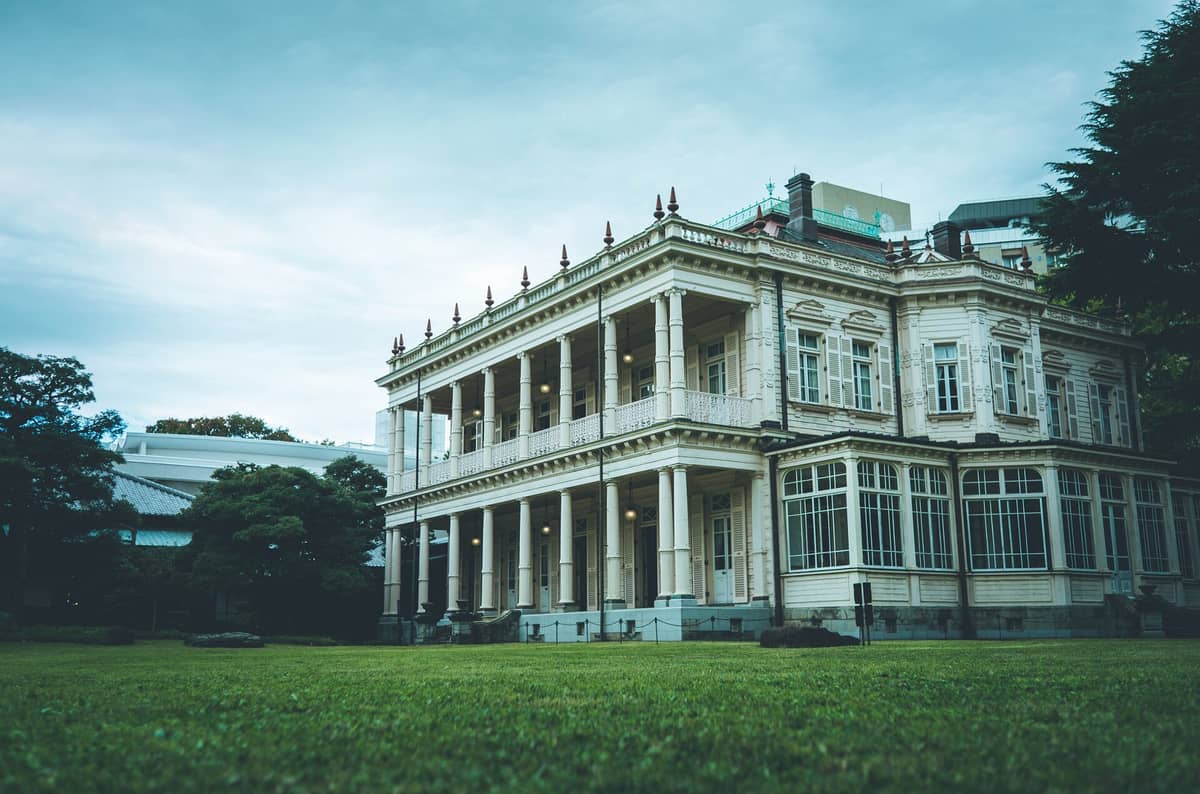
Kyu-Iwasaki-tei Garden preserves the former Tokyo residence of the Iwasaki family, founders of Mitsubishi, in the Ikenohata area of Taito Ward near Ueno. The estate combines a Victorian-style wooden mansion, a connected billiard hall, and a traditional Japanese garden — all for one of the lowest admission prices of any historic site in the city.
Quick Facts
- Location
- 1-3-45 Ikenohata, Taito-ku, Tokyo 110-0008 (near Ueno)
- Getting There
- Yushima Station (Tokyo Metro Chiyoda Line, Exit 1) — approx. 3 min walk
- Time Needed
- 60–90 minutes
- Cost
- ¥400 adults / ¥200 seniors (65+) / Free for young children and junior high school students living or attending school in Tokyo
- Best for
- Architecture lovers, Meiji-era history, quiet weekday escapes, photographers
- Official website
- www.tokyo-park.or.jp/teien/en/kyu-iwasaki/index.html
What Is Kyu-Iwasaki-tei Garden?
Kyu-Iwasaki-tei Garden (旧岩崎邸庭園) is one of Tokyo's most undervisited historic sites — a preserved Meiji-era estate that once belonged to the Iwasaki family, the industrial dynasty behind Mitsubishi. Located in Taito Ward, a short walk from Yushima Station, the estate sits on what was once a much larger compound of over 15,000 tsubo (roughly 49,500 square meters). What remains today is a fraction of the original grounds, but the surviving buildings alone make it exceptional. For context on how this neighborhood fits into the wider city, see our guide to the Ueno-Akihabara area.
The central attraction is a wooden Western-style mansion completed in 1896 and designed by Josiah Conder, the British architect who also shaped much of Meiji Tokyo's foreign-influenced streetscape. Conder studied under William Burges and brought a confident Jacobean Revival style to the building, complete with a long verandah trimmed with Moorish latticework — an architectural combination that would look at home in colonial India as much as in the heart of Japan. Adjacent to the main house is a billiard hall connected by an underground passage, and the broader grounds include a surviving Japanese-style residence. The contrast between the three structures tells you almost everything about the Meiji-era elite's relationship with the West: eager to absorb it, unwilling to abandon the familiar.
💡 Local tip
The garden opens at 9:00 and closes at 17:00 (last entry 16:30), closed December 29 to January 1. Weekday mornings before 11:00 are the quietest windows — you may have the mansion verandah almost entirely to yourself.
The Architecture: Three Buildings, One Extraordinary Contradiction
The Western mansion is the focal point, and it earns the attention. Josiah Conder designed it with a double-height entrance hall, elaborately patterned wood ceilings, and carved plaster walls that would not look out of place in a Victorian country house. Removed shoes are required inside, which creates an unusual sensory experience: ornate English-influenced interiors encountered in stockinged feet, the way any formal Japanese residence would be entered. The floors creak underfoot in that particular way old wooden buildings do — not alarmingly, but enough to remind you that the structure is well over a century old.
Look closely at the verandah. The latticework is Moorish-influenced, consisting of geometric interlocking patterns in dark-stained timber. On a bright morning, the shadows it casts onto the wooden floor shift slowly as the sun moves — a detail that rewards arriving early rather than at midday. The verandah faces the garden, and from this vantage point the design intention becomes clear: Conder wanted the occupants to experience the Japanese landscape framed by a Western architectural lens.
The billiard hall, connected via an underground corridor, is a smaller but architecturally distinctive structure with Swiss chalet elements in its facade. It now functions as an exhibition space. The Japanese-style residence at the rear of the grounds is less immediately dramatic but offers a quieter, more contemplative atmosphere — its tatami rooms and sliding screens representing exactly the domestic tradition the main mansion was designed to complement and contrast.
Tickets & tours
Hand-picked options from our booking partner. Prices are indicative; availability and final rates are confirmed when you complete your booking.
Tsukiji Fish Market Walking Food Tour
From 40 €Instant confirmationFree cancellationMt.Fuji,Owakudani, Hakone Cruise & Ropeway, Oshino Hakkai 1-Day Trip
From 54 €Instant confirmationFree cancellationTour to Mt. Fuji Area, Oshino Hakkai and Kawaguchi Lake from Tokyo
From 57 €Instant confirmationFree cancellationNikko UNESCO Shrine and Nature View 1-Day Tour from Tokyo
From 78 €Instant confirmationFree cancellation
The Garden: Understated but Carefully Considered
The garden at Kyu-Iwasaki-tei is not a large strolling garden in the tradition of Tokyo's grander green spaces. It is compact, and visitors expecting something on the scale of Rikugien or Koishikawa Korakuen will be mildly surprised by its modesty. What it offers instead is a considered relationship between the surviving architecture and the planting — mature trees providing deep shade in summer, and in spring a scattering of blossoms that frame the mansion's verandah in ways that feel almost compositionally deliberate.
In autumn, the garden earns more attention than at other times of year. The deciduous trees turn amber and gold in late November, and the low morning light catches the mansion's facades at an angle that makes the building look genuinely extraordinary. If Tokyo's autumn color is on your itinerary, this site pairs well with nearby Ueno Park and the canal-side foliage of the surrounding neighborhood.
Summer visits are perfectly fine but come prepared for humidity. The shade provided by mature trees makes the garden more tolerable than open riverside spots, and the mansion interiors stay relatively cool. Rainy days, counterintuitively, can be among the most atmospheric times to visit: the sound of rain on the verandah roof, the reflective sheen on the wooden floors visible through open doorways, and near-empty grounds combine to give the place a quality that photographs rarely capture.
Historical Context: The Iwasaki Family and the Meiji Transformation
Yataro Iwasaki founded Mitsubishi in 1870, building it from a small shipping operation into one of Japan's most powerful industrial conglomerates. By the 1890s, the family's wealth was comparable to the great industrial dynasties of Europe and America, and this estate was an expression of that status. Commissioning a foreign architect to design the main residence was not merely fashionable — it was a statement about Japan's position in the global order. The Meiji government had actively encouraged Western-influenced architecture for exactly this symbolic purpose.
Josiah Conder designed numerous buildings for the Meiji elite, including the original Rokumeikan (a social club for Westernized entertainment of foreign dignitaries, since demolished) and several other private residences. His work at Kyu-Iwasaki-tei is considered among the finest surviving examples of his Japanese residential commissions. The estate was designated an Important Cultural Property, recognizing both the architectural significance of the buildings and their historical role in documenting the Meiji-era encounter between Japan and Western culture.
For visitors interested in the broader architectural history of this period across Tokyo, our Tokyo architecture guide covers other significant Meiji and Taisho-era structures worth seeking out.
How to Visit: Practical Walkthrough
The most straightforward approach is via Tokyo Metro Chiyoda Line to Yushima Station, Exit 1. From the exit, the garden entrance is approximately three minutes on foot — a mostly flat, uncomplicated walk through a quiet residential street. Visitors coming from the Ueno direction can walk from Ueno-Hirokoji Station (Ginza Line) or Ueno-Okachimachi Station (Toei Oedo Line) in around ten minutes. From JR Okachimachi Station it is around fifteen minutes on foot.
Admission is ¥400 for adults and ¥200 for those 65 and over. Primary school-age children and younger are admitted free. Junior high school students who live or attend school in Tokyo are also admitted free. For groups of 20 or more, a discount of approximately 20% applies. Tickets are purchased at the entrance gate.
Inside the main mansion, shoes must be removed before entry and plastic bags are provided at the entrance. The rooms are viewed from a designated indoor path — you cannot freely enter every room, but the circulation takes you through the key spaces, including the verandah, entrance hall, and several decorated reception rooms. Allow roughly 30 to 40 minutes inside the buildings and another 20 to 30 minutes in the garden. The whole site can be done comfortably in 90 minutes, or in under an hour if you keep moving.
ℹ️ Good to know
Photography is permitted throughout the grounds and inside the mansion. Tripods may be restricted in some interior rooms. Natural light inside the building is good in the morning when sunlight reaches the verandah side; afternoon light works better for exterior shots of the facade.
Honest Assessment: Who Will Love It and Who Won't
Kyu-Iwasaki-tei Garden is genuinely worth the ¥400 admission if you have any interest in Meiji-era history, Japanese-Western architectural hybrids, or simply a peaceful garden experience away from the tourist circuit. The site sees far fewer visitors than nearby Ueno Park, and on weekday mornings it can feel almost private.
However, if your priority is grand strolling gardens, this is not the right choice. Tokyo has much more expansive green spaces: Rikugien Garden and Koishikawa Korakuen Garden both offer richer garden experiences if landscape is the main draw. Similarly, visitors primarily interested in historic interiors with more extensive room access may find the mansion's restricted circulation slightly frustrating.
Children old enough to appreciate the architecture may find the building interesting, but there is limited outdoor space for them to move around freely. Families with very young children or those expecting an active outdoor experience may prefer the open lawns of nearby Ueno Park instead.
Accessibility for visitors with mobility limitations should be confirmed directly with the garden office (+81-3-3823-8340) before visiting. The approach from Yushima Station Exit 1 is short and reasonably flat, which helps, but the historic buildings themselves have steps and may present challenges. Official materials do not provide comprehensive step-free access information.
Insider Tips
- Arrive at or shortly after 9:00 on a weekday. The garden typically sees its first visitors trickle in from around 10:00, giving you a 30- to 45-minute window with the mansion verandah and garden largely to yourself.
- The underground corridor connecting the billiard hall to the main mansion is easy to miss. Ask at the entrance if you cannot locate the access point — it is a distinctive architectural feature and worth seeing.
- Exterior shots of the main mansion look best from the garden side rather than the entrance path. Position yourself on the lawn opposite the verandah for the full Moorish latticework effect, ideally in morning light when shadows from the screen pattern fall cleanly onto the wooden floor.
- The site is closed December 29 to January 1, but the days immediately surrounding these closures — late December and early January — are among the quietest times of the year. The garden takes on a stark, wintery quality that works particularly well photographically.
- Combine this visit with the nearby Nezu Shrine or a walk through the Yanaka neighborhood, both reachable on foot in roughly 15–20 minutes. The three together make a coherent half-day route through some of Tokyo's most historically layered streets.
Who Is Kyu-Iwasaki-tei Garden For?
- Architecture and design enthusiasts interested in Meiji-era Westernization and Josiah Conder's work
- Visitors seeking a quiet, low-crowd cultural site away from Ueno's busier attractions
- History travelers tracing the industrial dynasties that shaped modern Japan
- Photographers looking for a mix of Victorian interiors and Japanese garden framing
- Travelers combining a morning here with the Yanaka neighborhood or Nezu Shrine for a full half-day itinerary
Nearby Attractions
Other things to see while in Ueno & Akihabara:
- Akihabara Electric Town
Akihabara Electric Town (秋葉原電気街) is the beating heart of Tokyo's electronics and otaku culture. Stretching from Akihabara Station along Chuo-dori and its surrounding alleys, the district packs multi-story electronics megastores, retro game shops, anime merchandise outlets, and maid cafés into a few dense city blocks. Entry is free. The real cost is time and willpower.
- Ameyoko Market
Ameyoko Market (Ameya-Yokocho) stretches between Ueno and Okachimachi stations in central Tokyo, packing fresh seafood, discount clothing, snacks, and cosmetics into roughly 500 meters of covered and open-air stalls. Entry is free, the energy is genuine, and the history runs deep.
- Kanda Myojin Shrine
Kanda Myojin Shrine has stood as Edo's spiritual guardian for nearly 1,300 years, yet sits a seven-minute walk from one of Tokyo's most modern districts. The shrine grounds are free to enter and effectively accessible at all hours, making it an accessible counterpoint to the neon intensity of nearby Akihabara.
- National Museum of Nature and Science
The National Museum of Nature and Science (国立科学博物館) is Japan's leading institution for natural history and the history of science and technology. Spread across two pavilions in Ueno Park, it covers everything from dinosaur fossils to the development of Japanese industry — and admission for high school students and under is free.