Mori Art Museum: Contemporary Art Above the Tokyo Skyline
Perched on the 53rd floor of Roppongi Hills Mori Tower, the Mori Art Museum is Tokyo's highest-altitude contemporary art space. Open until 22:00 most nights, it combines serious international exhibitions with one of the city's most dramatic elevated settings. Open until 22:00 most nights, it combines serious international exhibitions with one of the city's most dramatic elevated settings.
Quick Facts
- Location
- 53F, Roppongi Hills Mori Tower, 6-10-1 Roppongi, Minato City, Tokyo
- Getting There
- Roppongi Station (Toei Oedo Line, 4 min walk; Tokyo Metro Hibiya Line, 0 min walk) or Azabu-juban Station (Toei Oedo Line, 5 min walk)
- Time Needed
- 1.5–3 hours depending on exhibition size
- Cost
- Approx. ¥2,300–¥2,500 for adults (varies by day/exhibition); free for junior high school students and younger; combined tickets with Tokyo City View observatory available
- Best for
- Contemporary art, evening culture, architecture enthusiasts, rainy-day plans
- Official website
- www.mori.art.museum
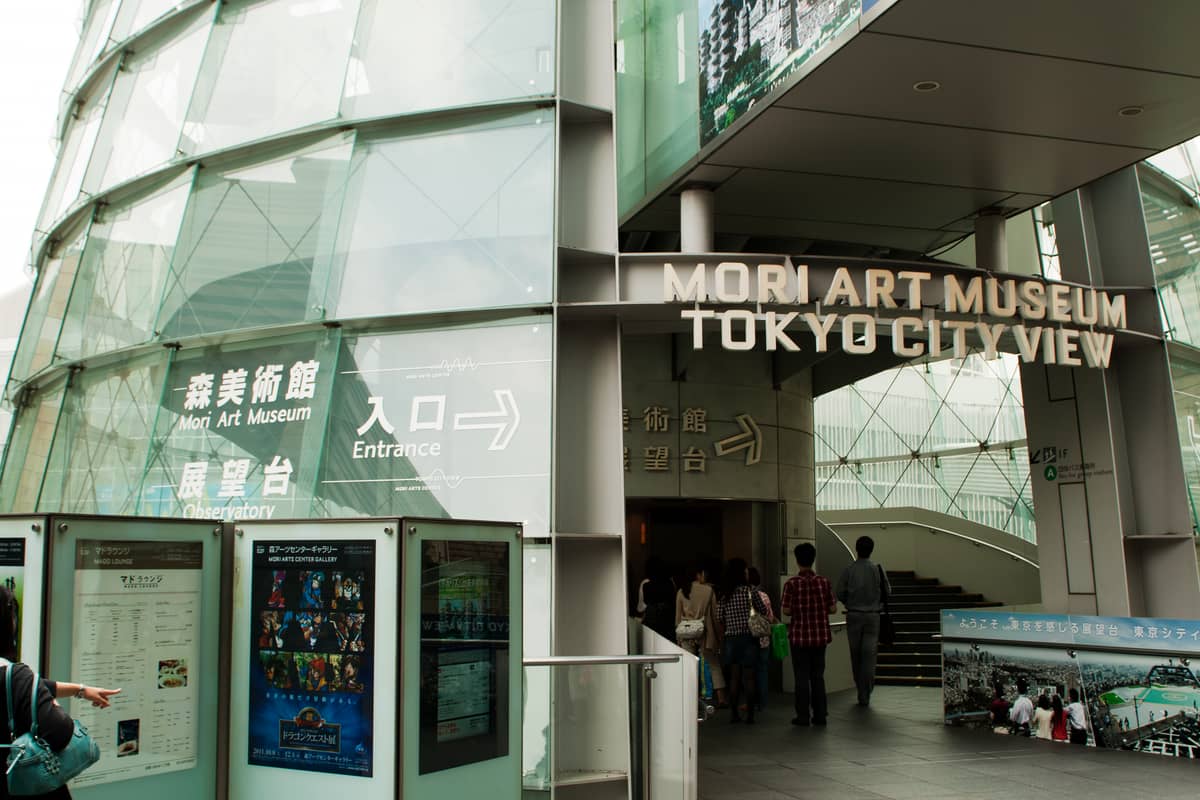
What the Mori Art Museum Actually Is
The Mori Art Museum (森美術館, Mori Bijutsukan) opened in October 2003 as the anchor cultural institution of Roppongi Hills, the large-scale mixed-use development that reshaped this corner of Minato Ward. The Mori Art Museum (森美術館, Mori Bijutsukan) opened in October 2003 as the anchor cultural institution of Roppongi Hills, the large-scale mixed-use development that reshaped this corner of Minato Ward. It occupies the 53rd floor of the Mori Tower, meaning you arrive not by walking through a street-level entrance but by taking a dedicated elevator from the third-floor ticketing counter up into the sky. That vertical journey is itself a signal that this is not a conventional museum visit. That vertical journey is itself a signal that this is not a conventional museum visit.
The museum does not hold a permanent collection in the traditional sense. Instead, it runs a rotating programme of large-scale contemporary art exhibitions, typically two to four per year, that draw on both Japanese and international artists. Past exhibitions have covered everything from Yayoi Kusama retrospectives to explorations of architecture, science fiction aesthetics, and pan-Asian contemporary practices. The programming is ambitious and often genuinely difficult, which places it closer in spirit to institutions like the Hayward Gallery in London or MoMA PS1 in New York than to a standard Tokyo tourist attraction.
ℹ️ Good to know
The museum's exhibition content changes several times a year. Before visiting, check the official website to confirm what is currently showing. Some exhibitions are more accessible to general audiences than others, and this will significantly affect how much you get out of the visit.
The Experience: Arriving at Height
Tickets and information are handled on the third floor of Mori Tower, inside the Roppongi Hills complex. From there, a high-speed elevator carries you to the museum entrance at altitude. The transition is quick but the effect is disorienting in a good way: you step out into gallery-lit space with the knowledge that Tokyo is spread out around you, even if the galleries themselves have no windows.
The gallery spaces are clean and flexible, designed to accommodate large installations, video work, and sculpture at scale. Ceiling heights are generous for a structure this high up, and the curators make use of them. Light and sound bleed between some rooms in ways that feel intentional. During well-funded international exhibitions, the production quality can be striking.
During the day, natural light does not enter the exhibition spaces, so the atmosphere stays consistent whether you visit at noon or at 9pm. This is worth knowing: the Mori Art Museum is one of the few serious art institutions in Tokyo open until 22:00 (last entry 21:30) on most nights, This is worth knowing: the Mori Art Museum is one of the few serious art institutions in Tokyo open until 22:00 (last entry 21:30) on most nights, closing earlier at 17:00 on Tuesdays. That late closing time is genuinely useful and relatively rare in the city. That late closing time is genuinely useful and relatively rare in the city.
💡 Local tip
Arrive after 18:00 on a weekday for the quietest experience. Daytime weekend crowds can make the galleries feel cramped, especially for immersive installations. Evening visits also let you combine the Tokyo City View observatory on the same ticket, watching the lights come on across the city.
Tickets & tours
Hand-picked options from our booking partner. Prices are indicative; availability and final rates are confirmed when you complete your booking.
Art and soul of the sword samurai experience
From 156 €Instant confirmationFree cancellationTokyo Dining Bar Experience with Darts Throwing Plan
From 8 €Instant confirmationFree cancellationTokyo Dining Darts Bar Experience with Unlimited Darts Plan
From 8 €Instant confirmationFree cancellationManga Art Workshop in a Traditional Tokyo House
From 88 €Instant confirmationFree cancellation
The Tokyo City View Connection
Most visitors buy a combined ticket that includes the Tokyo City View observatory, located on the 52nd floor of the same tower. The observatory wraps around the building with floor-to-ceiling glass and, on the roof, an open-air deck called Sky Deck at 270 metres. The combination makes practical sense: you get the art, then the view, or vice versa, in a single visit. The observatory wraps around the building with floor-to-ceiling glass and, on the roof, an open-air deck called Sky Deck at 270 metres. The combination makes practical sense: you get the art, then the view, or vice versa, in a single visit.
The view from the indoor observatory on a clear day stretches across the full metropolitan spread, with Tokyo Tower directly to the south and, on exceptional days, Mount Fuji visible to the west. At night the cityscape is particularly compelling: the ordered grid of Minato and Shibuya wards giving way to the irregular density of the older shitamachi neighborhoods further east. If you are trying to understand Tokyo's scale and geography, spending 20 minutes here pays off.
The observatory is separately ticketed from the museum and has different operating hours; the combined ticket is generally the better value. Verify current pricing before visiting, as it shifts with each exhibition cycle.
Historical Context: Why Roppongi and Why Here
Roppongi Hills was completed in 2003 after 17 years of planning and negotiation under developer Minoru Mori. The intention was to create a self-contained urban district with offices, residences, hotels, retail, and culture, anchored by the Mori Art Museum at the top of the central tower. The choice to put the museum at the pinnacle was a deliberate philosophical statement: art as the literal summit of the development, not an afterthought in a corner of a lobby. Whether that vision has been fully realized is debatable, but the museum has maintained a serious programme over two decades, earning genuine critical attention beyond the novelty of its location. The Roppongi neighborhood has long been associated with Tokyo's international community and nightlife, and the Hills complex shifted part of that reputation toward daytime culture and architecture.
Roppongi's art geography is notable. Within a short walk you can also reach the National Art Center Tokyo and the 21_21 Design Sight, making Roppongi the most concentrated cluster of contemporary art institutions in the city. The Mori sits at the center of this triangle both geographically and in terms of exhibition ambition.
Practical Walkthrough: Getting There and Getting In
The fastest approach from central Tokyo is the Toei Oedo Line to Roppongi Station, which puts you about four minutes on foot from the Mori Tower entrance. The Hibiya Line also stops at Roppongi Station but the exit is a longer walk, roughly ten minutes. From Azabu-juban Station on the Oedo Line, the walk is similarly four minutes via a slightly quieter approach through the residential back streets of Azabu.
Once inside Roppongi Hills, follow signs to the Mori Tower main entrance. The ticketing counter is on the third floor. Staff speak English and signage is bilingual. You will go through a security-style bag scan before boarding the elevator, which is common for observatory-level facilities in Tokyo.
Visitors with a disability certificate receive free admission for themselves and one companion, with no advance booking required. Show documentation at the Museum and Observatory Tickets counter on the third floor. A limited number of wheelchairs are available at the Roppongi Hills Information Counter on a first-come, first-served basis. The entire route from street level to gallery is elevator-accessible.
⚠️ What to skip
The museum is closed between exhibitions. Short gaps of several days to a couple of weeks occur between show changeovers. Always confirm current status on the official website before making the trip, especially if visiting in a shoulder period between major exhibitions.
Photography, Weather, and Honest Limitations
Photography policies vary by exhibition. Some shows permit photography throughout; others restrict it to specific zones or prohibit it entirely. Check the current exhibition page on the museum website for the specific rules. When photography is allowed, the clean, controlled gallery lighting makes for good conditions without the harsh contrasts you get in naturally lit spaces.
For the observatory component, clear days offer dramatically better views. Tokyo's summer months bring haze that can reduce visibility significantly; autumn and winter days, particularly after rain when the air clears, tend to give the sharpest sightlines. The open-air Sky Deck is weather-dependent and may be closed during rain or high winds.
One honest note: the Mori Art Museum will not suit every visitor. The exhibitions are often conceptually demanding and may feel alienating if contemporary art is not your interest. The admission price is moderate to high, and value is closely tied to how engaged you are with the current show. If you are primarily drawn by the view, you can purchase observatory-only tickets and skip the galleries. If you are after a broader Tokyo art experience, the best museums in Tokyo guide can help you compare options before deciding.
Combining the Visit: What's Around
The immediate Roppongi Hills precinct includes the Roppongi Hills complex itself, with its outdoor plaza, garden areas, and the Mori Garden at ground level. The garden is small but a useful decompression point after time in the galleries, particularly on mild evenings.
The broader Roppongi arts cluster is walkable. The National Art Center and 21_21 Design Sight are both within 10–15 minutes on foot. For those building a full day around contemporary culture in Tokyo, pairing the Mori with one or both of these makes a coherent itinerary. The area around Tokyo Midtown, where 21_21 sits, is also worth exploring for its Suntory Museum of Art, which focuses on traditional applied arts and offers a useful contrast to the Mori's international contemporary programme.
Insider Tips
- Tuesday hours end at 17:00, not 22:00. If you want the full late-evening experience, avoid Tuesdays entirely and come on a weeknight instead.
- The elevator wait on busy weekend afternoons can be 15–20 minutes. If you arrive at opening time (10:00) on a weekday, you will often have the galleries nearly to yourself for the first hour.
- The museum shop on the gallery level stocks exhibition catalogues, artist monographs, and design goods that are specific to the current show. These are not available online and sell out quickly for popular exhibitions.
- If you buy a combined Mori Art Museum and Tokyo City View ticket, visit the observatory first at sunset, then move into the galleries as the evening light fades. This sequence gives you both the transitional sky colors and then the full nighttime cityscape if you return to the observatory windows before leaving.
- The free audio guide (where available) adds substantial context to exhibitions that would otherwise feel opaque. Check the museum website or ask at the ticket counter whether an English audio guide exists for the current show.
Who Is Mori Art Museum For?
- Contemporary art enthusiasts who want to see Tokyo's most ambitious international programming
- Evening visitors looking for a cultural option that stays open until 22:00
- Architecture and urban planning fans interested in how major developers integrate cultural institutions
- Travelers who want a city overview combined with a museum visit in a single stop
- Rainy-day plans where an indoor, fully climate-controlled experience is a priority
Nearby Attractions
Other things to see while in Roppongi:
- 21_21 Design Sight
Tucked into the garden of Tokyo Midtown, 21_21 Design Sight is a world-class design museum conceived by Issey Miyake and designed by architect Tadao Ando. Its rotating exhibitions challenge how visitors perceive everyday objects and experiences, making it one of Roppongi's most rewarding cultural stops for curious minds.
- The National Art Center, Tokyo
The National Art Center, Tokyo is Japan's largest exhibition facility, housed in a wave-fronted glass building in Roppongi. Entry to the building is free, though major exhibitions require tickets. Expect rotating international and Japanese art shows, a serious architecture experience, and a surprisingly good restaurant inside.
- Roppongi Hills
Roppongi Hills is a large-scale mixed-use complex in Minato City that anchors one of Tokyo's most international neighborhoods. Beyond its shopping floors and restaurants, it houses the Mori Art Museum and Tokyo City View observatory, making it a serious cultural destination as well as a place to simply wander for an afternoon.
- Suntory Museum of Art
Tucked inside Tokyo Midtown's Galleria in Roppongi, the Suntory Museum of Art dedicates itself entirely to Japanese art through carefully curated rotating exhibitions. From ancient lacquerware to Edo-period textiles, each show is a deep dive into a single theme, presented in a calm, gallery-quality setting that rewards slow looking.