The National Art Center, Tokyo: What to Know Before You Visit
The National Art Center, Tokyo is Japan's largest exhibition facility, housed in a wave-fronted glass building in Roppongi. Entry to the building is free, though major exhibitions require tickets. Expect rotating international and Japanese art shows, a serious architecture experience, and a surprisingly good restaurant inside.
Quick Facts
- Location
- 7-22-2 Roppongi, Minato-ku, Tokyo 106-8558
- Getting There
- Nogizaka Station (Chiyoda Line) Exit 6 — direct covered access. Also ~5 min walk from Roppongi Station (Hibiya Line, Exit 4a) and ~4 min walk from Roppongi Station (Oedo Line, Exit 7).
- Time Needed
- 1.5 to 3 hours depending on exhibitions running
- Cost
- Building entry free. Exhibition fees vary by show and visitor category; check current prices on the official website. Some discounts and free admission categories apply.
- Best for
- Art lovers, architecture enthusiasts, and anyone wanting a calm, uncrowded cultural afternoon in Roppongi
- Official website
- www.nact.jp/english
What the National Art Center, Tokyo Actually Is
The National Art Center, Tokyo, known in Japanese as 国立新美術館, opened in 2007 with an explicit mission: to contribute to a new culture through art by providing space for exchange and mutual understanding. That framing matters, because this is not a permanent collection museum. The center owns no artworks of its own. Instead, it functions as Japan's largest exhibition facility, rotating through major loan exhibitions, art federation shows, and international presentations across a combined gallery floor area of around 14,000 square meters.
For visitors, this means the experience changes completely depending on when you arrive. A show of French Impressionists, a retrospective of a major Japanese painter, a contemporary design exhibition — the building hosts all of these across its multiple galleries. Check the official website before you visit to understand exactly what's running. Arriving without checking is a gamble that occasionally pays off but more often leaves visitors slightly confused about what they've just paid to see.
💡 Local tip
Check the NACT website before visiting. The building itself is always worth seeing, but the exhibitions change frequently and some periods see less compelling programming than others. Online tickets are often available and may include discounts compared to buying at the door.
The Architecture Alone Justifies the Trip
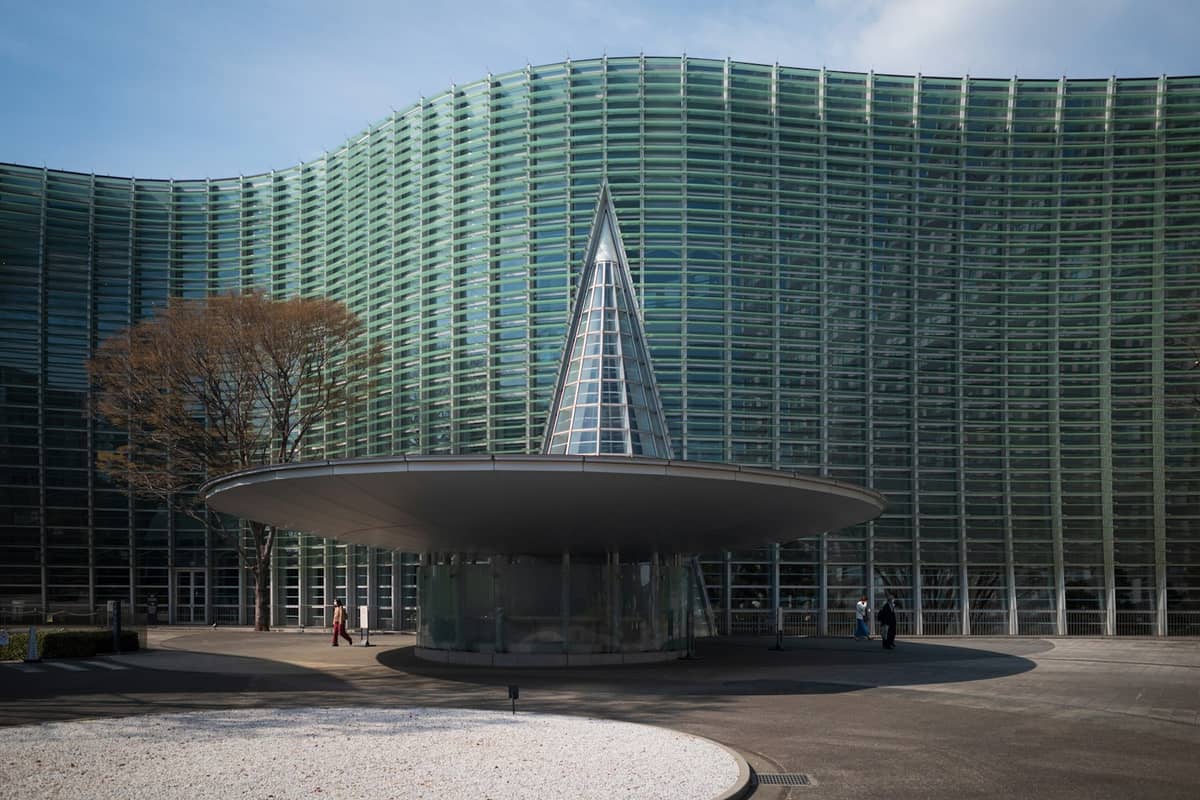
The building was designed by architect Kisho Kurokawa, one of the founding figures of the Metabolism movement that reshaped Japanese architecture in the postwar decades. The facade is a continuous undulating wave of glass, roughly 150 meters long, that catches and refracts light differently across the day. From the outside, especially on overcast mornings when the glass takes on a pewter tone, the structure has a sculptural weight that most museums only achieve through their contents.
The interior is where the spatial drama really registers. The atrium rises the full height of the building, capped by a conical skylight that floods the central hall with natural light. Two inverted cone-shaped columns taper toward the floor and contain a cafe at lower levels and the acclaimed Brasserie Paul Bocuse Le Musée on the third floor. Standing at ground level and looking upward through the atrium in the late afternoon, when the sun angles through the western glass panels, the space achieves something that most contemporary museum buildings never do: it feels genuinely surprising.
The building is discussed in depth in our guide to Tokyo's most significant architecture, which places it alongside other key structures from the same period.
Tickets & tours
Hand-picked options from our booking partner. Prices are indicative; availability and final rates are confirmed when you complete your booking.
Tokyo Dining Bar Experience with Darts Throwing Plan
From 8 €Instant confirmationFree cancellationTokyo Dining Darts Bar Experience with Unlimited Darts Plan
From 8 €Instant confirmationFree cancellationManga Art Workshop in a Traditional Tokyo House
From 88 €Instant confirmationFree cancellationTour to Mt. Fuji Area, Oshino Hakkai and Kawaguchi Lake from Tokyo
From 57 €Instant confirmationFree cancellation
How the Visit Unfolds: Floor by Floor
The layout across three floors is organized around a central atrium, with gallery wings radiating outward. Ticketed exhibitions occupy the enclosed gallery rooms on each level; the atrium circulation areas, including a museum shop and the lower cafe, are accessible without paying for any exhibition. On quieter weekday mornings, particularly Wednesday through Friday before noon, the atrium feels genuinely peaceful, with polished concrete floors that amplify footsteps and the low background hum of climate control systems.
Fridays and Saturdays the center stays open until 20:00 (last admission 19:30), making evening visits possible. The atmosphere shifts noticeably: the natural light drops away entirely, the artificial lighting flattens the wave-glass facade from the inside, and the visitor mix changes toward couples and after-work crowds from the surrounding Roppongi office district. If you're visiting for the architecture alone, daytime is more rewarding. If you're visiting for an exhibition and want to avoid weekend afternoon crowds, a Friday evening is often the better choice.
ℹ️ Good to know
Opening hours: 10:00–18:00 daily (last admission 17:30). Fridays and Saturdays: 10:00–20:00 (last admission 19:30). Closed Tuesdays. When a national holiday falls on Tuesday, the center opens that day and closes the following Wednesday instead.
Crowds, Timing, and What the Experience Feels Like in Practice
For a major exhibition destination, the National Art Center is notably uncrowded compared to equivalent institutions in London, Paris, or New York. Part of this is structural: the scale of the building absorbs visitors without the feeling of bottleneck that smaller Tokyo museums create. Part of it is also that Roppongi requires a deliberate transit decision — you come here on purpose, rather than passing through on the way to something else.
Blockbuster shows tied to specific anniversaries or international loans do draw significant weekend crowds, particularly in spring and autumn when tourism in Tokyo peaks. During golden week in late April and early May, and during the autumn foliage period in November, expect queues for popular exhibitions. If you're visiting during these periods, the online ticket option effectively functions as a timed entry shortcut and saves the queue time at the counter.
Roppongi is one of Tokyo's most internationally oriented neighborhoods, and the center sits comfortably within a cluster of serious cultural institutions. The Mori Art Museum and 21_21 Design Sight are both within reasonable walking distance, making a full day of Roppongi art institutions genuinely viable.
Getting There and Accessibility
The most practical entry point is Nogizaka Station on the Tokyo Metro Chiyoda Line. Exit 6 connects directly to the center via a covered walkway, which is elevator-equipped and wheelchair accessible. This makes the National Art Center one of the most straightforwardly accessible major cultural venues in Tokyo, without the steep staircases or crowded transfers that characterize access to some other Roppongi attractions.
From Roppongi Station itself, served by the Hibiya Line (Exit 4a, approximately 5 minutes on foot) and the Toei Oedo Line (Exit 7, approximately 4 minutes on foot), the walk is mostly flat and clearly signed. This route is mostly flat and clearly signed. Wheelchair users will find the Nogizaka approach more comfortable. Inside the building, elevators serve all floors, complimentary wheelchair loans are available at the information desk, and each level has multipurpose restrooms. Guide dogs, hearing dogs, and service dogs are all welcome. The third-floor auditorium is fitted with an induction loop system and ten hearing receivers available free of charge on advance request.
💡 Local tip
Visitors with disability certificates are admitted to exhibitions free of charge, along with one accompanying person. Bring valid documentation.
Food, Shopping, and the Brasserie Question
Brasserie Paul Bocuse Le Musée, on the third floor inside one of the atrium's inverted conical towers, is a fully licensed French restaurant with white tablecloths and a menu priced accordingly. Lunch sets typically run several thousand yen per person. The setting, looking out over the atrium from inside a cone suspended above the ground floor, is genuinely unusual. It's worth a look even if you don't eat there, and the observation that very few cities have a Lyonnaise brasserie inside a Japanese national museum is accurate.
For something more casual, the lower-level cafe serves coffee, light meals, and seasonal items. The museum shop stocks exhibition catalogs, design goods, and a selection of art books that tilts toward Japanese contemporary art and design. Catalog quality here tends to be high, and they make better souvenirs than the generic options sold near Roppongi Station.
Who This Attraction Suits and Who Should Reconsider
The National Art Center works best for visitors with a genuine interest in contemporary and modern art, design, or architecture. The building alone makes the visit worthwhile for anyone following the trajectory of postwar Japanese architecture, and the rotating exhibitions consistently reach a serious curatorial standard. Travelers who find art museums engaging but not essential to a trip are likely to feel the exhibition ticket price harder to justify unless the current show aligns with specific interests.
Families with younger children may find the atmosphere more restrictive than the hands-on experience at venues like the Miraikan science museum in Odaiba. The galleries are quiet, supervision is attentive, and the exhibitions are not designed for interactive engagement. That said, entry to the building is free, the atrium is impressive to anyone regardless of age, and the cafe is a reasonable stop.
If you're building an art-focused itinerary, the NACT fits naturally into a broader guide to Tokyo's best museums, which covers the full range of permanent collection institutions and specialist spaces across the city.
Insider Tips
- The Nogizaka Station Exit 6 connection is covered and air-conditioned — useful in July and August when the walk from Roppongi Station becomes genuinely unpleasant in the heat and humidity.
- Friday evenings after 18:00 see a noticeable drop in visitor numbers even during popular exhibitions. The galleries stay open until 20:00, giving you a quieter two-hour window that doesn't require arriving before the crowds.
- The upper floors of the atrium offer the best vantage points for photographing Kurokawa's wave-glass facade from the interior. The glass cone structures read very differently depending on the angle and time of day.
- Exhibition catalogs sold in the museum shop are often the most complete Japanese-language documentation of shows that don't get wide international coverage. If you read Japanese or collect art publications, browse the shop even if you skip the exhibition.
- The outdoor sculpture garden and surrounding grounds can be explored without entering the building. On clear days in autumn, approaching via the footpath between the center and Nogizaka Station offers a pleasant short walk through a quieter Roppongi side street before you reach the wave-glass facade.
Who Is The National Art Center, Tokyo For?
- Art and design enthusiasts wanting serious exhibition programming in a world-class building
- Architecture followers interested in Kisho Kurokawa's Metabolist legacy
- Travelers building a full Roppongi cultural day combining multiple institutions
- Anyone seeking an air-conditioned, calm mid-afternoon break from the busier parts of the city
- Visitors with mobility considerations who need an accessible and well-equipped museum environment
Nearby Attractions
Other things to see while in Roppongi:
- 21_21 Design Sight
Tucked into the garden of Tokyo Midtown, 21_21 Design Sight is a world-class design museum conceived by Issey Miyake and designed by architect Tadao Ando. Its rotating exhibitions challenge how visitors perceive everyday objects and experiences, making it one of Roppongi's most rewarding cultural stops for curious minds.
- Mori Art Museum
Perched on the 53rd floor of Roppongi Hills Mori Tower, the Mori Art Museum is Tokyo's highest-altitude contemporary art space. Open until 22:00 most nights, it combines serious international exhibitions with one of the city's most dramatic elevated settings. Open until 22:00 most nights, it combines serious international exhibitions with one of the city's most dramatic elevated settings.
- Roppongi Hills
Roppongi Hills is a large-scale mixed-use complex in Minato City that anchors one of Tokyo's most international neighborhoods. Beyond its shopping floors and restaurants, it houses the Mori Art Museum and Tokyo City View observatory, making it a serious cultural destination as well as a place to simply wander for an afternoon.
- Suntory Museum of Art
Tucked inside Tokyo Midtown's Galleria in Roppongi, the Suntory Museum of Art dedicates itself entirely to Japanese art through carefully curated rotating exhibitions. From ancient lacquerware to Edo-period textiles, each show is a deep dive into a single theme, presented in a calm, gallery-quality setting that rewards slow looking.