Miraikan: Inside Tokyo's National Museum of Emerging Science and Innovation
Miraikan, officially the National Museum of Emerging Science and Innovation, sits on the artificial island of Odaiba and takes visitors through Japan's most pressing scientific frontiers: robotics, artificial intelligence, space exploration, and the Internet. The admission price is low, the exhibits are genuinely interactive, and the experience rewards curious adults as much as school groups.
Quick Facts
- Location
- 2-3-6 Aomi, Koto-ku, Tokyo 135-0064 (Odaiba)
- Getting There
- Tokyo International Cruise Terminal Station (Yurikamome Line, about 5-min walk) or Tokyo Teleport Station (Rinkai Line, about 15-min walk)
- Time Needed
- 2.5 to 4 hours
- Cost
- Adults ¥630 / Under-18 ¥210 / Preschool free. Free for under-18 every Saturday.
- Best for
- Science enthusiasts, families with older children, solo travelers interested in technology and Japan's research culture
- Official website
- www.miraikan.jst.go.jp/en
What Miraikan Actually Is
Miraikan, whose full Japanese name is 日本科学未来館 (Nihon Kagaku Mirai-kan), translates roughly as "Future Science Museum of Japan." It opened on July 9, 2001, under the Japan Science and Technology Agency (JST) and is one of the few national museums in Tokyo devoted entirely to science happening right now rather than science already settled in textbooks.
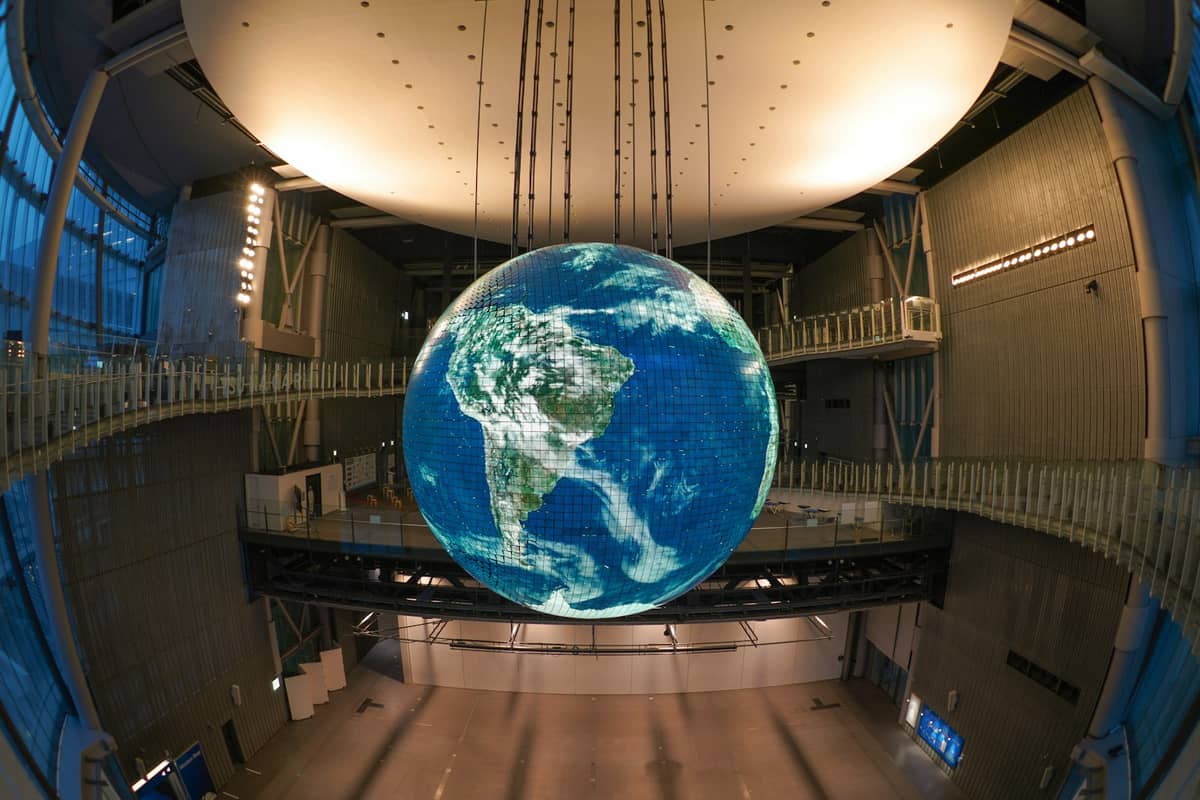
The building itself occupies a prominent plot on Odaiba, the reclaimed waterfront island in Tokyo Bay. The structure is modern and utilitarian from the outside, the kind of architecture that says "government research facility" rather than "landmark." Inside, though, the sense of scale surprises: exhibits spread across multiple floors connected by open atria, and the centrepiece of the permanent collection, the Geo-Cosmos globe, hangs from the ceiling in that central space like a slowly rotating proof of concept.
⚠️ What to skip
Miraikan will be closed for full refurbishment from October 1, 2026 to April 22, 2027. If you are planning a trip that falls in this window, verify the current status on the official website before visiting, as dates may be subject to change.
The Permanent Exhibition: Floor by Floor
The permanent collection is organized around three broad zones: the world we live in (Earth systems, biodiversity, climate), the frontier being pushed right now (robotics, AI, space science, neuroscience), and the connections between humanity and technology. These zones bleed into one another, and the experience feels less like a linear tour and more like a landscape you can wander.
The Geo-Cosmos is the exhibit most photographs fail to capture accurately. It is a sphere roughly six meters in diameter, covered in 10 million organic LED panels displaying real-time satellite imagery of Earth's cloud cover and surface. Visitors watch it from above on an upper-floor walkway or from below in the atrium. In the morning, when the museum first opens and crowds are thin, the sphere dominates a nearly empty space, and the effect is genuinely arresting. Later in the day, with school groups filing past, the atmosphere is noisier but no less impressive.
The robotics section draws the longest queues. ASIMO, Honda's humanoid robot, has appeared in demonstrations here, and the floor includes interactive stations where visitors can explore how machines perceive environments and process decisions. Adjacent exhibits cover AI and the Internet, framed through Japan's specific perspective on how these technologies interact with an aging society, high-density urban living, and decades of industrial automation.
The space science area covers JAXA missions, including the Hayabusa asteroid sample-return program. Physical models of spacecraft are displayed at close range, and the exhibit explanations are detailed enough to satisfy adults without overwhelming younger visitors. English language support is solid throughout the permanent collection, with bilingual labels on most major exhibits.
Tickets & tours
Hand-picked options from our booking partner. Prices are indicative; availability and final rates are confirmed when you complete your booking.
Tsukiji Fish Market Walking Food Tour
From 40 €Instant confirmationFree cancellationMt.Fuji,Owakudani, Hakone Cruise & Ropeway, Oshino Hakkai 1-Day Trip
From 54 €Instant confirmationFree cancellationTour to Mt. Fuji Area, Oshino Hakkai and Kawaguchi Lake from Tokyo
From 57 €Instant confirmationFree cancellationNikko UNESCO Shrine and Nature View 1-Day Tour from Tokyo
From 78 €Instant confirmationFree cancellation
The Dome Theater
Miraikan operates a Dome Theater inside the building, screening science-themed films on a hemispherical screen. Tickets are sold separately from general admission and programs change periodically. If you are planning to see a show, check the schedule on the official website before visiting, as specific sessions fill quickly on weekends and during school holiday periods. Holders of disability-related certificates and one accompanying caregiver receive free admission to the permanent exhibition, the Dome Theater, and any special exhibitions.
Visiting by Time of Day and Season
Weekday mornings between 10:00 and 11:30 are the quietest period. School group visits tend to arrive mid-morning and occupy the building from roughly 10:30 onward, peaking around lunch. If you are visiting with children of your own, the school group presence is a non-issue and often energizing. If you want focused time with interactive exhibits without waiting, weekday afternoons (after school groups depart around 14:00) or weekend evenings approaching the 16:30 last entry window work well.
Saturdays are worth noting for budget visitors: admission is free for anyone under 18, making it the most family-friendly day financially. The museum is correspondingly busier. Sunday mornings tend to attract a more adult crowd in the early hours. On the museum's anniversary, July 9, all permanent exhibitions are free for everyone.
Weather has almost no effect on the experience since the entire museum is indoors and climate-controlled. This makes it a reliable option on rainy days in Odaiba, particularly during the June to mid-July rainy season when outdoor attractions on the waterfront lose much of their appeal.
💡 Local tip
The museum is closed every Tuesday (unless Tuesday falls on a national holiday). During spring, summer, and winter school vacation periods, Miraikan may open on Tuesdays. Check the official calendar before planning a Tuesday visit, as schedules can vary.
Getting to Miraikan from Central Tokyo
Miraikan sits in the Odaiba area of Koto Ward, reachable by two rail options. The Yurikamome Line, an automated elevated monorail departing from Shimbashi Station, stops at Tokyo International Cruise Terminal Station, a five-minute walk from the museum entrance. This is the most common approach and doubles as a scenic ride over the Rainbow Bridge and across Tokyo Bay. For more on getting around this part of the city, the Odaiba neighborhood guide covers connections in detail.
The Rinkai Line (departing from Osaki, Shinonome, and other stations) stops at Tokyo Teleport Station, a 15-minute walk away. This route is useful if you are combining Miraikan with other Odaiba attractions and arriving from the eastern or southern parts of the city. Both routes involve IC card payments; Suica and Pasmo cards are accepted.
Practical Details and Accessibility
Opening hours are 10:00 to 17:00, with the last admission at 16:30. The museum is closed on Tuesdays and from December 28 to January 1. Adult admission for the permanent exhibition is ¥630, and visitors under 18 pay ¥210. Preschool-age children enter free. Groups of eight or more receive reduced rates: ¥500 for adults and ¥160 for under-18 visitors.
Holders of disability-related certificates and one accompanying caregiver receive free admission to the permanent exhibition, the Dome Theater, and any special exhibitions. Wheelchair access is available throughout the facility. For accessibility-specific queries, the museum can be reached at +81 3 3570 9151 during opening hours.
Photography is permitted in most areas of the permanent collection. Lockers are available near the entrance for bags and coats. The museum has a cafe and a shop selling science-themed merchandise, including items related to JAXA space missions that are genuinely hard to find elsewhere in Tokyo.
ℹ️ Good to know
The museum shop stocks official JAXA merchandise and Geo-Cosmos related products. If you are interested in Japanese space science as a souvenir category, this is one of the better places in the city to browse.
Who Should Manage Their Expectations
Miraikan rewards curiosity but requires patience with text-heavy exhibits. Some interactive stations involve waiting, particularly the robotics demonstrations. Visitors looking for pure spectacle without intellectual engagement may find the pacing slow after the first hour. The museum is also located on Odaiba rather than in central Tokyo, which means the journey itself takes 30 to 40 minutes from Shinjuku or Shibuya. If your Tokyo itinerary is very tight, weigh whether the travel time justifies the visit relative to other options. For science and technology enthusiasts, the combination of Miraikan with the teamLab Borderless digital art space in the same general area makes for a coherent full day in Odaiba.
Young children under eight will find parts of the museum engaging, particularly the globe and hands-on robot exhibits, but the volume of reading required by most displays means the experience skews toward older children and adults. Families with mixed-age groups should plan to split time rather than move as one unit.
Insider Tips
- Book Dome Theater tickets online before you arrive, especially on weekends. The capacity is limited and sessions on popular themes can sell out by mid-morning on busy days.
- The walkway above the Geo-Cosmos, on the upper floor, gives a more immersive view than looking up from the atrium below. Go there first before crowds thicken around 11:00.
- If you are visiting with school-age children, the researchers who staff the interactive zones are often willing to go off-script and explain concepts in more depth if you approach them with a specific question rather than just pressing buttons.
- The museum's anniversary on July 9 offers free admission to all permanent exhibitions. It falls in peak summer, so expect higher-than-normal crowds, but the cost saving is significant for groups.
- Combine your visit with DiverCity Tokyo Plaza or other waterfront spots nearby to make the Odaiba trip worthwhile as a half-day or full-day excursion rather than a standalone journey.
Who Is Miraikan (National Museum of Emerging Science and Innovation) For?
- Science and technology enthusiasts who want to understand Japan's approach to AI, robotics, and space exploration
- Families with children aged 8 and older, especially on free-entry Saturdays for under-18 visitors to the permanent exhibition
- Rainy-day visitors seeking a full indoor activity with several hours of substance
- Travelers following a broader interest in Japanese innovation culture alongside other Odaiba attractions
- Budget-conscious visitors: the permanent collection admission is among the most affordable for any major Tokyo museum
Nearby Attractions
Other things to see while in Odaiba:
- DiverCity Tokyo Plaza
DiverCity Tokyo Plaza is a large shopping and entertainment complex on Tokyo's Odaiba waterfront, best known for the life-size Gundam statue in its outdoor festival plaza. Free to enter, it combines retail floors, a food court, and a lively outdoor plaza that draws both anime fans and casual visitors year-round.
- Rainbow Bridge
Officially known as the Tokyo Port Bridge, Rainbow Bridge connects Shibaura to Odaiba across Tokyo Bay with a free pedestrian promenade of about 1.7 km. Whether you cross at midday for sweeping skyline views or linger at dusk for the illuminations, the bridge offers a rare vantage point that most visitors overlook in favor of the observation decks nearby.