teamLab Borderless Tokyo: The Immersive Art Museum Worth the Hype
teamLab Borderless TOKYO at Azabudai Hills is a borderless digital art museum where dozens of installations flow and interact across an entire building. It rewards slow, exploratory visits and overwhelms first-time visitors in the best possible way.
Quick Facts
- Location
- Azabudai Hills Garden Plaza B B1, 1-2-4 Azabudai, Minato-ku, Tokyo 106-0041
- Getting There
- Kamiyacho Station (Tokyo Metro Hibiya Line) – Exit 5, directly connected to Azabudai Hills. Roppongi-itchome Station (Tokyo Metro Namboku Line) – Exit 2, ~4 min walk.
- Time Needed
- 2–3 hours minimum; allow 3–4 hours if you want to revisit rooms
- Cost
- Adults (18+) approximately ¥3,600–¥5,600 depending on date. Date- and time-slot tickets required; book online in advance.
- Best for
- Art lovers, families with older children, photographers, first-time Tokyo visitors with a cultural appetite
- Official website
- borderless.teamlab.art/
What teamLab Borderless Actually Is
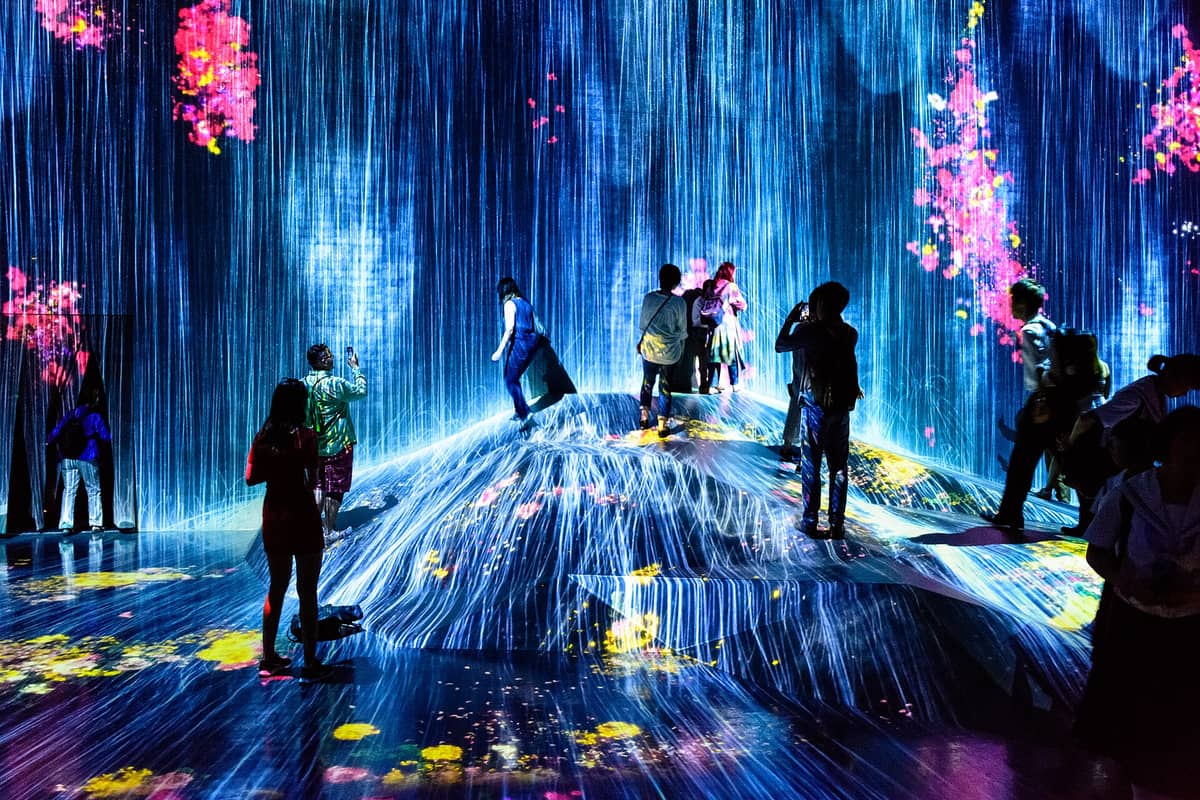
teamLab Borderless TOKYO is not a conventional art museum. There are no labeled rooms, no arrows on the floor, no prescribed route. The concept, developed by the Tokyo-based art collective teamLab, is that the installations themselves are borderless: artworks spill into corridors, react to each other, and respond to visitors in real time. Step into one room and the light patterns underfoot change because of how you moved. Stand still too long and digital flowers bloom around you then fade.
After the closure of its celebrated Odaiba location, teamLab Borderless reopened at Azabudai Hills in early 2024. Azabudai Hills is one of Tokyo's largest recent urban redevelopments, and the museum occupies the basement floor of Garden Plaza B, giving the experience a subterranean, otherworldly quality before you even enter the first room. The address is 1-2-4 Azabudai, Minato-ku, and the venue connects directly to Kamiyacho Station on the Tokyo Metro Hibiya Line.
⚠️ What to skip
Tickets are date- and time-slot specific and should be purchased in advance through the official website. Same-day on-site entry is only possible if time slots are not sold out, and weekends and public holidays often sell out weeks ahead.
For context on how this experience fits into Tokyo's broader art scene, the Tokyo digital art guide covers the main venues and how they compare.
Inside the Museum: What You Will Actually See
The experience unfolds across several dozen interconnected installations spread through a large, intentionally disorienting space. Because there are no maps distributed at the entrance, your first minutes feel genuinely uncertain. The floors are often reflective or mirrored, ceilings can be entirely covered in moving projections, and corridors lead unexpectedly into vast open rooms. Sound design is layered throughout: low ambient tones in some areas, water sounds in others, and occasional silence that makes the next room hit harder.
Signature installations typically include rooms where thousands of digital flowers cascade from ceiling to floor, spaces filled with swirling calligraphic characters that react when you touch the walls, and environments where light appears to turn into solid geometric shapes around you. A children's section, sometimes called the Athletics Forest or similar, features interactive play zones suitable for families. The exact lineup of installations evolves over time, so what you encounter may not precisely match what you saw in a YouTube video from a year ago.
One room that consistently draws crowds is a mirrored space with floating orbs of light that change color when touched. The experience here is tactile and communal in a way that most art museums are not: strangers make eye contact across a room of hovering lights and smile. That social texture is part of what makes this different from a cinema or a theme park.
💡 Local tip
Wear dark, solid-colored clothing. The projections map onto light fabrics in unflattering ways, and many visitors report that wearing white or bright patterns makes you look washed out in photos. Slip-on shoes or socks-only areas appear in some zones, so avoid complicated laces.
Tickets & tours
Hand-picked options from our booking partner. Prices are indicative; availability and final rates are confirmed when you complete your booking.
Tsukiji Fish Market Walking Food Tour
From 40 €Instant confirmationFree cancellationMt.Fuji,Owakudani, Hakone Cruise & Ropeway, Oshino Hakkai 1-Day Trip
From 54 €Instant confirmationFree cancellationTour to Mt. Fuji Area, Oshino Hakkai and Kawaguchi Lake from Tokyo
From 57 €Instant confirmationFree cancellationNikko UNESCO Shrine and Nature View 1-Day Tour from Tokyo
From 78 €Instant confirmationFree cancellation
How the Experience Changes by Time of Day
Opening time (around 10:00, though verify for your specific date) is the least crowded window. The museum is quieter, the sound design feels more intimate, and you can linger in popular rooms without competing for space or photography angles. By midday, especially on weekends, the corridors fill significantly and some rooms feel more like a theme park queue than an art encounter.
Evening time slots, typically from around 18:00 onward, have their own atmosphere. The museum is entirely indoors and has no natural light, so the time of day does not technically change what you see. But arriving in the evening means you leave into Tokyo at night, which pairs well if you are heading to dinner in Roppongi or Azabudai Hills itself, where several restaurants occupy the complex above.
Weekday mornings in non-holiday periods are the practical peak for a calm visit. If your schedule has any flexibility, a Tuesday-to-Friday morning slot will give you a measurably different experience from a Saturday afternoon, even though the content is identical.
ℹ️ Good to know
Hours vary by season (recently often 08:30–21:00, with last admission one hour before closing, but specific dates may differ), and closure days are set on a date-specific basis rather than a fixed weekday pattern. Always confirm your exact date on the official website before booking.
Getting There and Getting In
The most direct route is the Tokyo Metro Hibiya Line to Kamiyacho Station. Exit 5 connects directly into the Azabudai Hills complex, and from there signage leads you underground to Garden Plaza B. The walk from the exit to the museum entrance takes under five minutes and is entirely indoors, which matters during Tokyo's rainy season or summer heat.
From Roppongi-itchome Station on the Tokyo Metro Namboku Line, Exit 4 puts you about four minutes on foot from the venue. Roppongi Station itself (Hibiya and Oedo lines) is roughly a 10-minute walk through the Azabudai Hills development. If you are coming from Shibuya or Shinjuku, the Hibiya Line via Kamiyacho is the cleanest single-transfer option.
For general transit advice across the city, the guide to getting around Tokyo covers IC cards, subway passes, and the practical logic of the rail network.
Entry requires presenting your ticket on a smartphone or printed confirmation. The booking system assigns a time-slot entry window (typically 30 minutes), after which you can stay until the museum closes for that day. There is no fixed exit time once you are inside, though standard tickets do not allow re-entry after leaving the exhibition area.
Accessibility and Practical Realities
Azabudai Hills is a modern complex with elevator access to the basement levels, so wheelchair entry to the museum is feasible. Once inside, however, the museum's design philosophy creates specific challenges. Spaces are intentionally dark, boundaries between surfaces are blurred by projection, and the reflective floors can disorient spatial perception. Visitors with sensory sensitivities, photosensitive epilepsy, or significant mobility limitations should review the FAQ on the official teamLab website and consider contacting the venue directly before booking.
No maps are provided at entry. This is a deliberate choice by teamLab, intended to make the experience feel genuinely exploratory. For most visitors, this is part of the appeal. For anyone who needs structured wayfinding for accessibility reasons, it is worth noting clearly. Staff are present throughout the space and can provide directional guidance on request.
Bag storage lockers are available near the entrance. Large bags are not practical inside the museum, both because of the physical environment and because many rooms require you to move freely. Bringing a small bag or going locker-free is advisable.
Is It Worth It? An Honest Assessment
At ¥3,600–¥5,600 per adult, teamLab Borderless TOKYO is not cheap by Tokyo museum standards. It is also not quite like any other museum in the city. The closest comparison might be the original teamLab Planets in Toyosu, which is smaller and more focused on a handful of intense installations.
The two venues serve different moods. Borderless rewards wandering and repetition. Planets is shorter, more concentrated, and includes the now-famous water-walking room. If you can only do one, consider your tolerance for crowds and your interest in a longer, more open-ended experience. The teamLab Planets guide covers the Toyosu venue in detail for comparison.
For visitors who engage seriously with what they are seeing, spending time in each room rather than moving quickly, this museum is genuinely impressive. For visitors who treat it as a backdrop for social media photography and move through in 45 minutes, the value proposition is less clear. The experience asks something of you: curiosity, patience, and a willingness to feel slightly lost.
If you are building a broader cultural itinerary for Tokyo, the best museums in Tokyo guide helps contextualize teamLab Borderless against more traditional institutions.
Who Should Think Twice Before Booking
Visitors who are uncomfortable in dark, crowded, disorienting environments may find the experience stressful rather than pleasurable. The museum is also not ideal for very young children who cannot manage two to three hours of indoor, projection-heavy exploration, though an interactive children's zone does exist. Anyone expecting a traditional museum format with clear labels, fixed artworks, and logical wayfinding will find this confusing.
Budget travelers should note that this is one of the more expensive standalone attractions in Tokyo. Free or low-cost alternatives with genuine cultural depth exist across the city. That said, there is genuinely nothing else quite like teamLab Borderless in Tokyo or elsewhere.
Insider Tips
- Book the earliest available weekday morning time slot. The difference in crowd density compared to a weekend afternoon is significant enough to change the character of the experience entirely.
- Bring a phone with a fully charged battery. The low light and moving projections require longer exposures even with modern cameras, and you will shoot more than you expect. A small portable charger is worth the bag space.
- Revisit rooms you liked. Because there is no prescribed route, you can loop back. Some installations complete a slow cycle over 20–30 minutes, so returning to a room you saw early in your visit often reveals a different visual state.
- The museum does not provide maps intentionally, but staff stationed throughout can tell you how to find specific zones. If you want to see the children's interactive area or a specific installation type, just ask.
- Azabudai Hills has good food options both above the museum and in the garden plaza level. Building a lunch or dinner around your visit means you do not lose extra transit time, and the complex has enough variety for most budgets.
Who Is teamLab Borderless For?
- Art and technology enthusiasts who engage with the concept rather than just photograph it
- Families with children aged 6 and above who can handle an exploratory, non-linear environment
- First-time Tokyo visitors looking for a cultural experience with no direct equivalent elsewhere
- Photographers and content creators, particularly those who shoot in low-light environments
- Couples or small groups who enjoy sharing a genuinely disorienting and beautiful experience together
Nearby Attractions
Combine your visit with:
- Akasaka Palace (State Guest House)
The State Guest House, Akasaka Palace is Japan's principal diplomatic residence and one of the few Western-style palaces in Asia open to the public. Built in neo-baroque style for the Crown Prince in the early 20th century, it now receives heads of state and, on select days, ordinary visitors. The combination of ornate gilded interiors, formal French gardens, and a Japanese-style annex makes it one of the most architecturally unusual stops in Tokyo.
- Edo-Tokyo Open Air Architectural Museum
Spread across the grounds of Koganei Park, the Edo-Tokyo Open-Air Architectural Museum rescues and reassembles more than 30 historic structures spanning the Edo period through the early 20th century. From a dismantled farmhouse to a reconstruction of a Showa-era Tokyo streetscape, it is one of the most thoughtful and undervisited cultural sites in the metropolitan area.
- Enoshima
A small island off the Shonan coast of Kanagawa Prefecture, Enoshima packs a surprising amount into a short walk: a three-part Shinto shrine, ancient sea caves, a hilltop botanical garden, a lighthouse observation tower, and seafood stalls lining a stone-paved shopping street. It works as a half-day excursion or a full day if you combine it with nearby Kamakura.
- Gotokuji Temple
Gotokuji Temple in Setagaya is a working Soto Zen Buddhist temple that happens to be one of the claimed birthplaces of the maneki-neko, Japan's iconic beckoning cat. Hundreds of white ceramic cats line the shelves of a dedicated shrine, creating one of Tokyo's most quietly striking visual spectacles. Entry is free, crowds are manageable, and the surrounding grounds offer genuine calm.