Rainbow Bridge: Tokyo's Iconic Bay Crossing on Foot
Officially known as the Tokyo Port Bridge, Rainbow Bridge connects Shibaura to Odaiba across Tokyo Bay with a free pedestrian promenade of about 1.7 km. Whether you cross at midday for sweeping skyline views or linger at dusk for the illuminations, the bridge offers a rare vantage point that most visitors overlook in favor of the observation decks nearby.
Quick Facts
- Location
- 3-33-19 Kaigan, Minato-ku, Tokyo 105-0022 (connects Shibaura to Odaiba)
- Getting There
- Yurikamome Line: Shibaura-futo Station (north entrance) or Odaiba-kaihinkoen Station (south entrance)
- Time Needed
- 45–90 minutes for the full promenade crossing and back
- Cost
- Free (pedestrian promenade)
- Best for
- Skyline views, sunset walks, Tokyo Bay panoramas, photography
- Official website
- www.kouwan.metro.tokyo.lg.jp/kanko/road/rainbowbridge
What Rainbow Bridge Actually Is
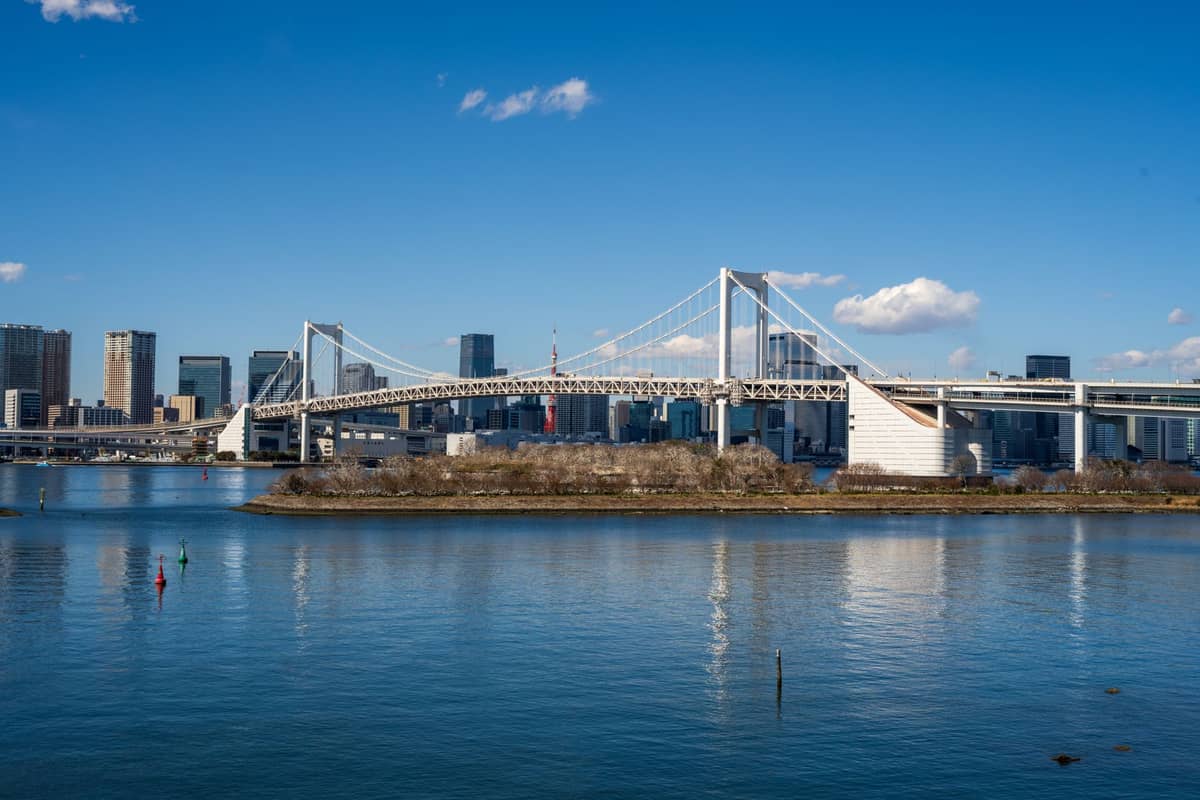
The Rainbow Bridge, whose formal Japanese name is 東京港連絡橋 (Tōkyō Kō Renrakukyō, or Tokyo Port Bridge), opened in 1993 as a dual-level suspension bridge spanning Tokyo Bay between the Shibaura Pier area of Minato Ward and the artificial island of Odaiba. It carries the Yurikamome automated guideway train on its lower deck, along with a general road and the Wangan Expressway on its upper level. What most visitors don't realize is that the lower level also includes a free pedestrian promenade of about 1.7 km in walking distance along the bridge, with one walkway on the north side and one on the south.
The 'Rainbow' name is not just a marketing flourish. After dark, the bridge's cables and towers are lit with sodium and LED lights in white, green, and red sequences that shift with the seasons, giving it a genuinely luminous presence over the water. In daylight the structure is painted in a soft grey-white, which reads cleanly against the bay.
ℹ️ Good to know
Hours change with the seasons. The promenade is open April 1–October 31 from 09:00 to 21:00, and November 1–March 31 from 10:00 to 18:00. Admission to the promenade closes 30 minutes before the listed closing time. The bridge is closed every 3rd Monday of the month (or the following Tuesday if that Monday falls on a public holiday), and may also close for maintenance or severe weather.
The Walk: North Promenade vs. South Promenade
You choose your promenade at the entrance, and the two sides offer genuinely different experiences. The north promenade faces back toward central Tokyo: on a clear day you can see the Tokyo Skytree, the towers of Shinjuku, and in winter the snowcapped cone of Mount Fuji to the west. This is the photographer's side in the morning when the sun is behind you and the city is front-lit. The south promenade looks toward the open bay, Tokyo DisneySea's distant profile, and on clear days the Boso Peninsula across the water.
The promenade surfaces are slightly uneven in places, and the walkway is enclosed by a metal mesh fence rather than open railings, which does limit ultra-wide-angle photography but keeps the experience feeling safe in high winds. Walking the full crossing one way takes roughly 20–30 minutes at a comfortable pace along the approximately 1.7 km promenade, and most visitors choose one side going out and the other returning.
If you want to combine this with the wider Odaiba experience, the Odaiba neighborhood guide covers everything on the island side, from DiverCity to the waterfront parks.
Tickets & tours
Hand-picked options from our booking partner. Prices are indicative; availability and final rates are confirmed when you complete your booking.
Tsukiji Fish Market Walking Food Tour
From 40 €Instant confirmationFree cancellationMt.Fuji,Owakudani, Hakone Cruise & Ropeway, Oshino Hakkai 1-Day Trip
From 54 €Instant confirmationFree cancellationTour to Mt. Fuji Area, Oshino Hakkai and Kawaguchi Lake from Tokyo
From 57 €Instant confirmationFree cancellationNikko UNESCO Shrine and Nature View 1-Day Tour from Tokyo
From 78 €Instant confirmationFree cancellation
How the Experience Changes by Time of Day
Morning visits, roughly 09:00–11:00 in summer, are genuinely calm. The Yurikamome trains rattle past below with a low mechanical hum, the water catches the early light, and you may have long stretches of the promenade entirely to yourself. The air carries a faint salt smell mixed with the mild diesel drift of Tokyo Bay shipping. Temperatures are manageable before the midday heat builds.
Midday is the least rewarding window. Summer heat reflects off the metal decking, there is minimal shade on the promenade, and haze over the bay often reduces visibility to a fraction of what you'd get on a clear winter or spring morning. If you are visiting between June and September, early morning or evening is strongly preferable.
Sunset and early evening transform the bridge entirely. As the city lights come on and the sky moves through orange into deep blue, the bridge's illumination activates, and the reflection on the water below becomes the main event. Summer evenings keep the promenade open until 21:00, which gives you a full hour of night photography time after full dark. Winter hours close at 18:00, which is just after the brief dusk window.
💡 Local tip
For night photography, arrive 30–40 minutes before closing so you have time to reach the midpoint of the bridge before the last entry cut-off. The middle of the span gives the longest sight lines in both directions.
Getting There: Approaching from Both Sides
The north (Shibaura) entrance is accessed from Shibaura-futo Station on the Yurikamome Line, about a 10-minute walk. The station itself is on the elevated Yurikamome track, so you descend to street level and follow the waterfront path to the bridge entrance building, which houses elevators and stairs to the promenade level. The south (Odaiba) entrance is near Odaiba-kaihinkoen Station, again on the Yurikamome, and the walk is slightly shorter at around 5–8 minutes.
The Yurikamome Line runs from Shimbashi Station in central Tokyo, making it the most direct single-train connection to both ends of the bridge. For broader context on moving around the city, the getting around Tokyo guide covers IC card options and day passes that work on the Yurikamome.
You can also reach the Shibaura side by water bus from Hinode Pier, which adds a pleasant approach across the bay and gives you a good look at the bridge from the waterline before you walk it. Check Tokyo Cruise Ship timetables directly, as schedules are seasonal.
Accessibility and Practical Realities
Wheelchair access to the promenade is technically possible via elevators at both entrance buildings, but the Tokyo Metropolitan Port and Harbor Bureau explicitly notes that the promenade has steep inclines and recommends that wheelchair users have assistance with them. The mesh enclosure along the sides and the gradient make this a genuinely challenging walk for anyone with limited mobility, and it is worth considering whether the panoramic views might be better accessed from a nearby observation deck with fewer physical demands.
For comparison, the Tokyo Tower and the observation decks at Tokyo Skytree offer fully accessible skyline views with barrier-free facilities, though they cost significantly more than a walk across Rainbow Bridge.
There are no food stalls or vending machines on the promenade itself. In summer, bring water. The walk is exposed to wind from the bay, which can be considerable in winter, so an extra layer is useful between November and March even on sunny days.
Viewing Rainbow Bridge Without Walking It
If you prefer to look at the bridge rather than walk across it, the best vantage points are from the Odaiba Seaside Park waterfront and from the Yurikamome Line train itself. The elevated railway curves around the bridge on its approach, giving passengers a close-up view of the suspension cables and towers. Sitting on the right side of a Shimbashi-bound train as it departs Odaiba-kaihinkoen gives you a sweeping arc around the north face of the bridge.
The artificial beach and lawn at Odaiba Seaside Park sits almost directly beneath the bridge's south approach, making it one of the better free viewpoints in the area. This park connects easily to the rest of the Odaiba waterfront, where you can also find the teamLab digital art museums a short walk inland.
Weather affects the experience from the ground level more than it does on the bridge. On humid summer days, the bridge can disappear into haze from street level. The clearest views tend to come in winter and early spring, when low humidity and northwesterly winds scrub the sky clean.
Is It Worth It? An Honest Assessment
Rainbow Bridge is genuinely free, genuinely photogenic at the right time of day, and genuinely different from anything else you can do in Tokyo. Walking a major suspension bridge over an active bay, with trains running beneath your feet and tankers moving slowly across the water below, is a specific and memorable experience. It is not, however, a destination that rewards a long detour on its own. The promenade view is excellent but the walk is purely a transit experience: there is nothing to stop and examine, no interpretive content, and no facilities once you're on it.
Visitors who find themselves at Odaiba for another reason (teamLab, DiverCity, the Miraikan science museum) should absolutely fit in the bridge walk. Visitors making a special trip only for the bridge may find the journey time, particularly from central Tokyo via the slow Yurikamome Line, disproportionate to the payoff unless they have a specific interest in the photography or the engineering.
⚠️ What to skip
The Yurikamome Line is a slow, scenic route that takes around 20 minutes from Shimbashi to reach the bridge area. Factor this into your planning if time is tight, particularly for a sunset visit where you want to arrive before the last entry cut-off.
Insider Tips
- The north promenade gives better morning light on the city skyline; the south promenade is quieter and works better for watching bay traffic and distant views toward Chiba. Most visitors default to whichever side the entrance attendant points them toward — ask specifically which you want.
- Winter mornings between December and February offer the best chance of seeing Mount Fuji from the north promenade. The clearest windows are the day or two after a cold front passes through, usually mid-morning before haze rebuilds.
- If you are visiting in summer and want to combine the bridge with teamLab Planets in Toyosu, the water bus from Hinode Pier to Odaiba connects to the bridge walk naturally, and you can then take the Yurikamome back toward Shimbashi and onward to Toyosu in a single logical loop.
- The bridge closes on the 3rd Monday of each month regardless of weather or season. This catches more visitors than you'd expect — check the closure calendar on the official Tokyo Port and Harbor Bureau website before you travel specifically for the walk.
- There are no lockers or bag storage at the promenade entrance. If you are carrying heavy bags from earlier in the day, the walk becomes significantly less comfortable over 1.7 km of gradient changes.
Who Is Rainbow Bridge For?
- Photographers who want city skyline and bay views without paying for an observation deck
- Travelers spending a full day in Odaiba who want a free activity between paid attractions
- Architecture and engineering enthusiasts interested in suspension bridge design
- Couples looking for a free, atmospheric evening walk with city lights reflecting on the water
- Tokyo on a budget travelers who want a memorable experience without an entry fee
Nearby Attractions
Other things to see while in Odaiba:
- DiverCity Tokyo Plaza
DiverCity Tokyo Plaza is a large shopping and entertainment complex on Tokyo's Odaiba waterfront, best known for the life-size Gundam statue in its outdoor festival plaza. Free to enter, it combines retail floors, a food court, and a lively outdoor plaza that draws both anime fans and casual visitors year-round.
- Miraikan (National Museum of Emerging Science and Innovation)
Miraikan, officially the National Museum of Emerging Science and Innovation, sits on the artificial island of Odaiba and takes visitors through Japan's most pressing scientific frontiers: robotics, artificial intelligence, space exploration, and the Internet. The admission price is low, the exhibits are genuinely interactive, and the experience rewards curious adults as much as school groups.