Tokyo Tower: What to Expect at Tokyo's Postwar Icon
Standing 333 meters above the Minato district, Tokyo Tower has been a fixture of the city's skyline since 1958. With two observation decks, sweeping views of the metropolitan sprawl, and an unexpectedly layered history, it rewards visitors who look beyond the obvious photo opportunity.
Quick Facts
- Location
- 4-2-8 Shiba-koen, Minato-ku, Tokyo 105-0011
- Getting There
- Akabanebashi (Toei Oedo Line), Onarimon (Toei Mita Line), or Kamiyacho (Tokyo Metro Hibiya Line) — all 5-7 min walk
- Time Needed
- 1.5 to 2.5 hours for both decks; add 30 min for the foot town floors
- Cost
- Main Deck: from ¥1,500 (adults). Top Deck Tour: from ¥3,300 online / ¥3,500 at ticket counter (adults). Verify current prices at official site.
- Best for
- Skyline photography, first-time visitors to Tokyo, clear-day views of Mt. Fuji, evening ambience
- Official website
- en.tokyotower.co.jp
First Impressions: Arriving at the Tower
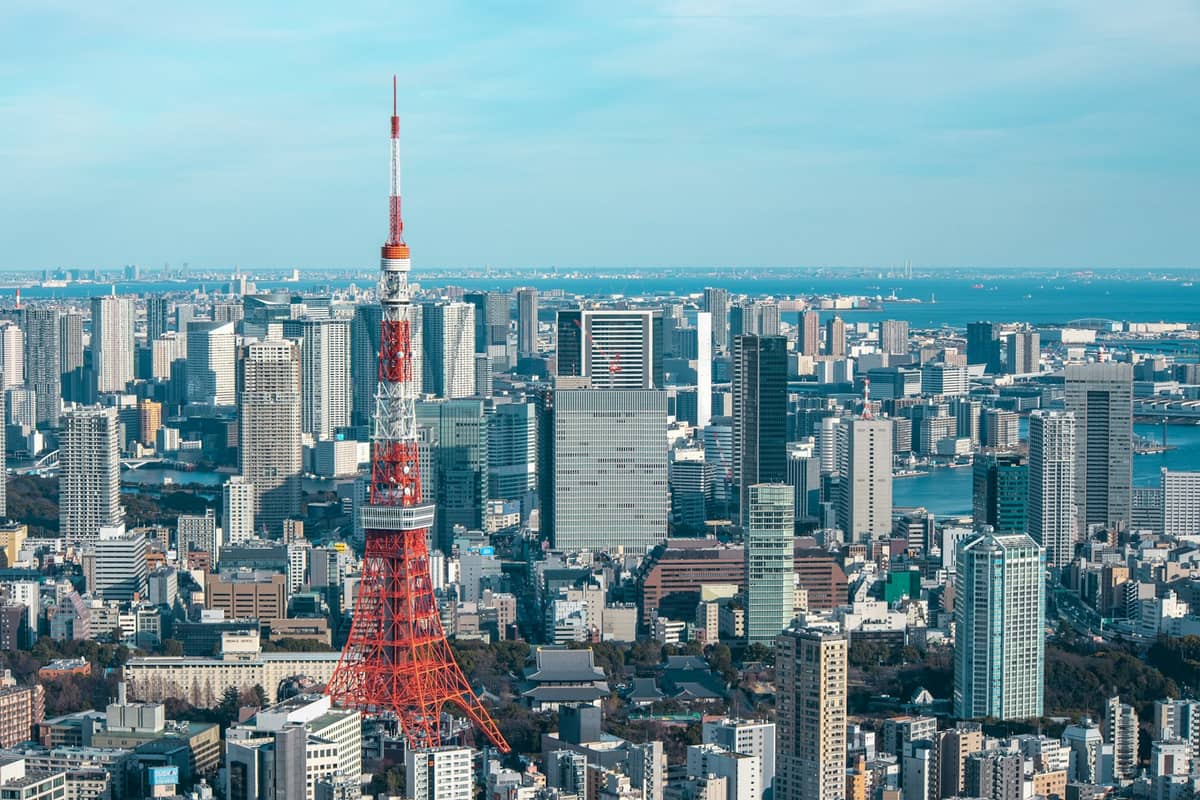
Tokyo Tower announces itself before you expect it. Walking from Akabanebashi Station along Hibiya-dori, you pass quiet residential streets and then, between a gap in the apartment blocks, the orange-and-white lattice frame appears overhead, far larger than photographs suggest. At ground level, the structure is less elegant than it looks from a distance — the base sprawls across a wide footprint, and the surrounding plaza mixes tourist souvenir stalls with a handful of food vendors. But look straight up through the legs of the tower itself, and the geometry is genuinely striking: four tapering columns of steel converging toward a point 333 meters above the pavement.
The main entrance leads into Foot Town, a four-story commercial building built into the tower's base. It houses food outlets and shops selling tower-branded merchandise. It is easy to spend more time here than intended. For most visitors, this floor is best treated as a transition space rather than a destination — pick up tickets and move toward the elevators.
💡 Local tip
Buy Top Deck Tour tickets online in advance. Same-day tickets cost about ¥200 more per adult, and popular time slots — especially sunset windows — sell out on weekends and public holidays.
The Main Deck (150 m): What You Actually See
The Main Deck sits at 150 meters and is where most visitors spend the majority of their time. Floor-to-ceiling glass panels run around the entire perimeter, offering unobstructed 360-degree views of central Tokyo. On a clear day the cityscape extends in every direction without an obvious horizon — just low-rise residential grids giving way to clusters of towers, the dark thread of the Sumida River to the northeast, and the faint blue ridge of mountains to the west.
What surprises many first-time visitors is just how flat Tokyo appears from this height. The vast majority of the city sits close to sea level, and aside from a handful of skyscraper clusters in Shinjuku, Shibuya, and around the Sumida area, the urban fabric rolls out almost uniformly in every direction. The Tokyo Skytree is clearly visible to the northeast, its profile useful for calibrating scale and distance. On exceptionally clear days in late autumn and winter, Mount Fuji appears above the western horizon — a perfectly conical silhouette that looks almost too symmetrical to be real.
The Main Deck also has a glass floor panel set into one corner, allowing you to look straight down 150 meters to the plaza below. It draws a short queue at most hours. For the broadest view without crowding, Tokyo's best viewpoints each have their own character — Tokyo Tower's strength is the warmth of its orange lighting and the Showa-era surroundings, which give it a different atmosphere from the more clinical feel of newer observatories.
Tickets & tours
Hand-picked options from our booking partner. Prices are indicative; availability and final rates are confirmed when you complete your booking.
Tour to Mt. Fuji Area, Oshino Hakkai and Kawaguchi Lake from Tokyo
From 57 €Instant confirmationFree cancellationNikko UNESCO Shrine and Nature View 1-Day Tour from Tokyo
From 78 €Instant confirmationFree cancellationYanaka: historical walking tour in Tokyo's old town
From 40 €Instant confirmationFree cancellationMeiji Shrine, Imperial Palace, Asakusa and Tokyo Skytree Entry
From 34 €Instant confirmationFree cancellation
The Top Deck Tour (250 m): Worth the Premium?
The Top Deck Tour takes visitors from the Main Deck up to 250 meters via a separate elevator. The experience is deliberately curated: the tour runs in timed groups, the lighting shifts as you ascend, and the deck itself is narrower and quieter than the Main Deck below. The views here feel genuinely different — the additional 100 meters of elevation pushes more of the urban sprawl below the horizon of your peripheral vision, and the sensation of height becomes noticeably more pronounced.
Whether the higher ticket price is justified depends on what you want. For serious photographers or anyone who wants to feel the full scale of the city, the Top Deck delivers something the Main Deck cannot. Casual visitors who primarily want a photo from Tokyo Tower's observation level may find the Main Deck perfectly sufficient. Groups with children or anyone affected by heights may prefer the enclosed, slightly less vertiginous feel of the lower deck.
ℹ️ Good to know
Wheelchair access to the Main Deck is available by barrier-free elevator. The Top Deck has size restrictions (maximum wheelchair size 700 mm x 1,200 mm) and limited elevator capacity — contact the tower in advance to confirm arrangements.
How Time of Day Changes Everything
Morning visits — between 9:00 and 11:00 — offer the quietest decks and the best odds of clear visibility before urban haze builds. The light at this hour is soft and directional, useful for photography, and the crowd is usually thin enough to move freely around the full perimeter without waiting for a clear window.
Midday brings school groups, tour buses, and peak crowds, particularly on weekends. The experience becomes more chaotic and the windows more contested. Late afternoon from around 15:00 to 17:00 is a useful middle ground: crowds thin slightly, the light begins to warm, and the transition from late-day sun to early dusk is gradual enough to experience both states in a single visit.
Evening visits are where Tokyo Tower genuinely distinguishes itself. After dark, the tower's exterior illumination reflects in the deck windows, and the city below transforms into a dense grid of light. The orange glow of the tower's own lighting gives nearby buildings a warm cast, and the overall effect is more atmospheric than the colder LED panoramas you get from Shibuya Sky or the upper floors of the Tokyo Metropolitan Government Building. The deck stays open until 23:00, with last entry at 22:30 for the Main Deck and 22:15 for the Top Deck Tour, making it one of the later-running viewpoints in the city.
If your schedule allows only one viewpoint visit, think carefully about what kind of experience you want. For a comprehensive look at how Tokyo's observation options compare, the Shibuya Sky observatory offers a rooftop outdoor deck that some visitors prefer for its open-air feel, while Tokyo Skytree reaches more than double the height. Tokyo Tower's advantage is its location in low-rise Minato, which means less visual obstruction from surrounding towers and a stronger sense of looking out over the city rather than across to it.
Historical and Architectural Context
Tokyo Tower was completed in 1958, just thirteen years after the end of the Second World War. At 333 meters, it was at the time the tallest self-supporting steel structure in the world, surpassing the Eiffel Tower in Paris by about 9 meters. That comparison was deliberate: the tower's designers consciously modeled the form on Eiffel's lattice-frame construction, adapting it with a slightly different profile optimized for typhoon resistance and Japanese engineering standards.
The tower was built primarily as a broadcasting antenna, designed to serve the rapidly expanding television networks of postwar Japan. A centralized broadcast tower for the Kanto region was considered essential infrastructure. The orange-and-white color scheme is not purely aesthetic: aviation regulations require the alternating pattern for visibility to aircraft. The color combination also inadvertently aligned with the early television broadcasts it was built to transmit, giving it an instant recognizability that has only deepened over time.
The area around the tower reflects its origins as a civic monument. Zojo-ji Temple — a 17th-century Buddhist temple with a commanding main gate — stands a short walk south. The combination of Meiji-era temple architecture and postwar steel tower in the same sight line is one of Tokyo's more quietly interesting visual contrasts. For a fuller understanding of the neighborhood's layers, Zojo-ji Temple is worth adding to the same half-day itinerary.
Practical Walkthrough: Navigating the Visit
The tower opens at 09:00 daily and closes at 23:00, with last entry to the observation decks at 22:30. The elevator is the standard route.
From the nearest stations — Akabanebashi on the Toei Oedo Line, Onarimon on the Toei Mita Line, and Kamiyacho on the Tokyo Metro Hibiya Line — the walk is roughly 5 to 7 minutes. Akabanebashi is generally the most direct. IC cards (Suica, Pasmo) work on all three lines. There is no dedicated parking recommendation for visitors arriving by car; given the station proximity, public transit is the practical choice.
Weather affects the experience significantly. Tokyo's humid summers mean haze frequently reduces visibility between June and September, even on days that feel clear at street level. The sharpest views occur between November and February, when low humidity and cold fronts push the atmosphere clear. Spring cherry blossom season brings excellent light and comfortable temperatures but also the highest crowds of the year. If visibility matters to you, check an air quality or visibility forecast before visiting.
⚠️ What to skip
In summer (July-August), afternoon haze often limits long-distance visibility significantly. Morning visits before 10:00 give the best chance of seeing Mount Fuji and the full western horizon clearly.
Tokyo Tower sits within a broader cluster of worthwhile destinations in Minato. The Roppongi area with its concentration of contemporary art institutions is a 15-minute walk north, making it easy to pair a tower visit with a gallery stop at Mori Art Museum or National Art Center Tokyo for a full day in the district.
Insider Tips
- The best angle for photographing the tower from ground level is from the northeast side of Shiba Park in the early evening, when the lit lattice frame contrasts against a deep blue twilight sky. Tripods are permitted in the park.
- If you visit Zojo-ji Temple first, you can frame Tokyo Tower through the temple's large main gate — Sangedatsumon — for a shot that appears in countless travel publications but still requires knowing exactly where to stand.
- The Foot Town aquarium is genuinely good and frequently overlooked. If you are visiting with children and have extra time, it adds a low-cost, uncrowded activity compared to the decks above.
- On very clear winter mornings, the Main Deck's western windows offer a Mount Fuji view without needing the Top Deck premium. Check a Fuji visibility app or forecast the night before to avoid disappointment.
- The tower's exterior lighting changes seasonally for holidays and special events. The Diamond Veil illumination used on certain nights replaces the standard orange with white LED panels — check the official site calendar if lighting is important to your visit.
Who Is Tokyo Tower For?
- First-time visitors to Tokyo wanting an orientation panorama of the city's full scale
- Photographers interested in the contrast between postwar Showa-era architecture and the modern skyline
- Evening visitors who want a viewpoint that stays open late and has warm atmospheric lighting
- Travelers combining the Minato district with Roppongi or Zojo-ji Temple in a single half-day itinerary
- Families with children, given the aquarium, accessible main deck, and relatively manageable scale compared to taller alternatives
Nearby Attractions
Combine your visit with:
- Akasaka Palace (State Guest House)
The State Guest House, Akasaka Palace is Japan's principal diplomatic residence and one of the few Western-style palaces in Asia open to the public. Built in neo-baroque style for the Crown Prince in the early 20th century, it now receives heads of state and, on select days, ordinary visitors. The combination of ornate gilded interiors, formal French gardens, and a Japanese-style annex makes it one of the most architecturally unusual stops in Tokyo.
- Edo-Tokyo Open Air Architectural Museum
Spread across the grounds of Koganei Park, the Edo-Tokyo Open-Air Architectural Museum rescues and reassembles more than 30 historic structures spanning the Edo period through the early 20th century. From a dismantled farmhouse to a reconstruction of a Showa-era Tokyo streetscape, it is one of the most thoughtful and undervisited cultural sites in the metropolitan area.
- Enoshima
A small island off the Shonan coast of Kanagawa Prefecture, Enoshima packs a surprising amount into a short walk: a three-part Shinto shrine, ancient sea caves, a hilltop botanical garden, a lighthouse observation tower, and seafood stalls lining a stone-paved shopping street. It works as a half-day excursion or a full day if you combine it with nearby Kamakura.
- Gotokuji Temple
Gotokuji Temple in Setagaya is a working Soto Zen Buddhist temple that happens to be one of the claimed birthplaces of the maneki-neko, Japan's iconic beckoning cat. Hundreds of white ceramic cats line the shelves of a dedicated shrine, creating one of Tokyo's most quietly striking visual spectacles. Entry is free, crowds are manageable, and the surrounding grounds offer genuine calm.