Zojo-ji Temple: Tokyo's Shogunate Sanctuary Beneath Tokyo Tower
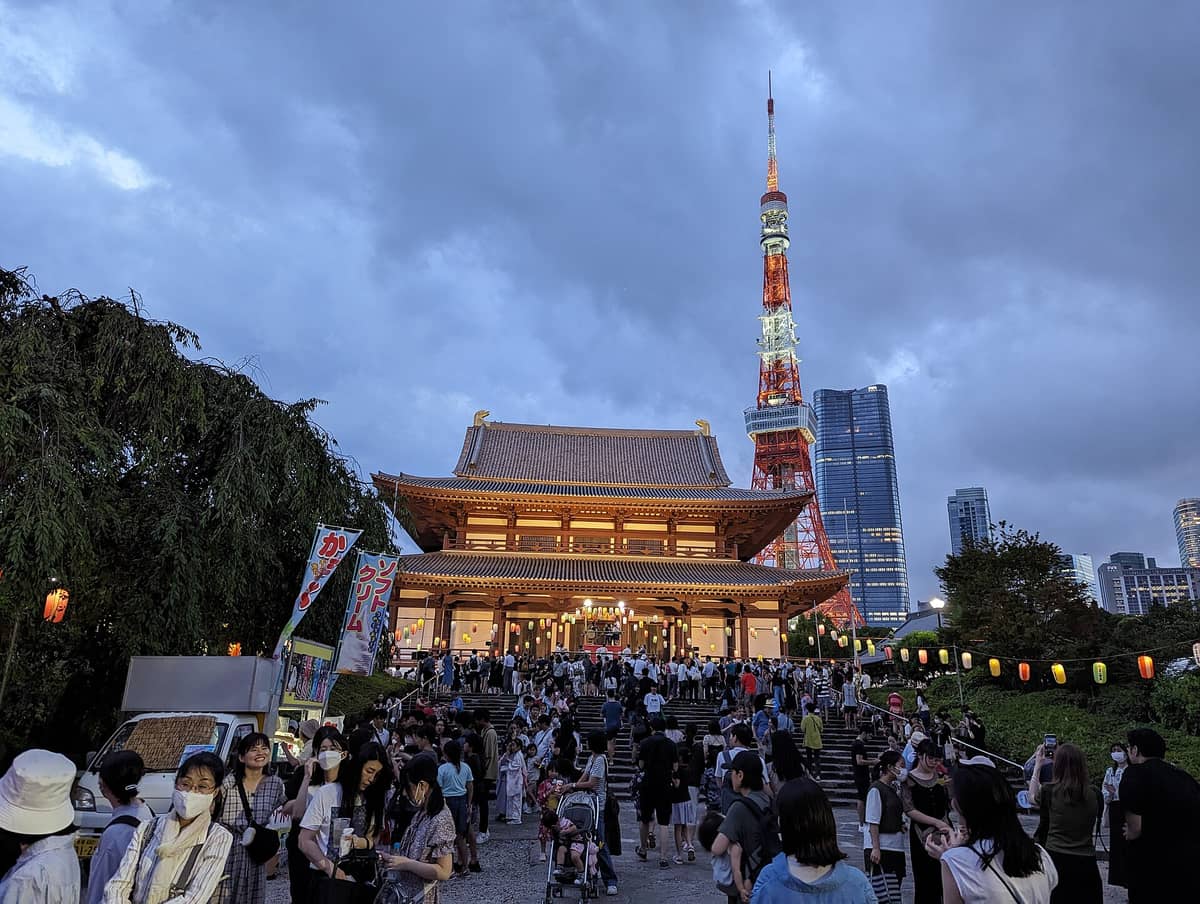
Zojo-ji Temple is one of Tokyo's great Jodo-shu Buddhist temples, founded in 1393 and later chosen as the mortuary temple of the Tokugawa shoguns. Its enormous vermilion gate, rows of Jizo statues, and unobstructed sightline to Tokyo Tower make it one of the most visually arresting sacred sites in the city. Entry to the grounds is free.
Quick Facts
- Location
- 4-7-35 Shibakoen, Minato-ku, Tokyo 105-0011
- Getting There
- Onarimon or Shibakoen Station (Toei Mita Line, 3 min walk); Daimon Station (Toei Asakusa/Oedo Lines, 5 min); Hamamatsucho Station (JR Yamanote Line, 10 min)
- Time Needed
- 45–90 minutes for the grounds; add 30–45 min for the Tokugawa Mausoleum and Treasure Exhibition Room
- Cost
- Temple grounds: free. Tokugawa Shogun Family Graveyard: approx. ¥700. Treasure Exhibition Room: approx. ¥500. Combined ticket: approx. ¥1,000.
- Best for
- History enthusiasts, photographers, early-morning walkers, and anyone wanting a quieter alternative to Senso-ji
- Official website
- www.zojoji.or.jp/en
What Zojo-ji Temple Actually Is
Zojo-ji Temple is a Jodo-shu (Pure Land) Buddhist temple with nearly 630 years of continuous history. Founded in 1393 in a different part of the city, it was relocated to its current site in Shibakoen in 1598 at the direction of Tokugawa Ieyasu, the first Edo shogun. That decision elevated Zojo-ji to an entirely different category: from that point on, it served as the official family temple of the Tokugawa clan, the dynasty that would rule Japan for more than two and a half centuries. Six of the fifteen Tokugawa shoguns are interred here, and their mausoleums remain on the grounds today.
The temple complex you see now is largely a post-war reconstruction. Much of the original Edo-period structure was destroyed in the 1945 air raids, and the current Main Hall was rebuilt in 1974. The one significant survivor of both war and the Meiji-era anti-Buddhist demolitions is the Sangedatsumon, the great triple-arch gate at the temple's south entrance, which dates to 1622 and is designated an Important Cultural Property of Japan. Walk through it and you are passing under one of the oldest surviving wooden structures in Tokyo.
ℹ️ Good to know
Temple grounds are open daily from approximately 06:00 to 17:00 (gate opening at 06:00 and closing at 17:00). The Tokugawa Shogun Family Graveyard and Treasure Exhibition Room have more restricted hours (generally 10:00–16:00 on weekends and holidays, 11:00–15:00 on weekdays), and are closed on Tuesdays except national holidays. Always confirm current hours before visiting.
The Sangedatsumon Gate: Start Here
Approaching from the south along the main avenue, the Sangedatsumon gate stops you before you even reach the temple. It is large enough that first-time visitors often mistake it for the main hall itself. The gate's name translates roughly as 'the gate through which the three obstacles are overcome,' referring to the Buddhist concept of releasing the afflictions of greed, anger, and ignorance. Whether or not the theology resonates, the architectural impact is immediate: raw timber beams, deep-red lacquer on the columns, and the weight of four centuries visible in the wood grain.
The gate frames a direct sightline to Tokyo Tower, which rises immediately to the north above the Main Hall. This is one of the most photographed juxtapositions in Tokyo: a 17th-century Buddhist gate in the foreground, a steel communications tower built in 1958 in the background. It is not subtle, but it is genuinely striking, and it captures something true about Tokyo's relationship with its own past.
💡 Local tip
For the tower-and-gate photograph that travels well, position yourself in the central passage of the Sangedatsumon and shoot north toward the Main Hall with Tokyo Tower visible above. Early morning light hits the gate facade well. By mid-morning the angle flattens and the crowds accumulate around the same spot.
Tickets & tours
Hand-picked options from our booking partner. Prices are indicative; availability and final rates are confirmed when you complete your booking.
Tsukiji Fish Market Walking Food Tour
From 40 €Instant confirmationFree cancellationMt.Fuji,Owakudani, Hakone Cruise & Ropeway, Oshino Hakkai 1-Day Trip
From 54 €Instant confirmationFree cancellationTour to Mt. Fuji Area, Oshino Hakkai and Kawaguchi Lake from Tokyo
From 57 €Instant confirmationFree cancellationNikko UNESCO Shrine and Nature View 1-Day Tour from Tokyo
From 78 €Instant confirmationFree cancellation
The Grounds at Different Times of Day
Zojo-ji opens early, and the difference between arriving at 06:30 and arriving at 10:30 is substantial. In the first two hours of opening, the grounds feel like they belong to the neighborhood. Local residents walk through on their way to work. A monk or two can be seen near the Main Hall. The air smells of incense from the offering area, and the low morning light catches the lacquerwork on the gate columns. The flagstones are clean and quiet underfoot.
By late morning, tour groups begin arriving and the atmosphere shifts. The space is large enough that it never feels genuinely overwhelmed in the way that Senso-ji can on busy weekends, but the contemplative quality dissipates. Midday visitors tend to move quickly, photograph the gate and the Tokyo Tower backdrop, and continue on. If your schedule allows, the early morning window is significantly better for both photographs and atmosphere.
One section of the grounds rewards slower attention at any hour: the rows of small Jizo statues known as Unborn Children's Jizo, or Mizuko Jizo. Hundreds of small stone figures stand in neat rows, each dressed in a red knitted cap and bib, many accompanied by pinwheels left by grieving families. The pinwheels turn in the wind with a soft plastic clicking sound. This is one of the more quietly affecting places in central Tokyo, and it is easy to walk past it quickly if you do not know to stop.
The Tokugawa Mausoleum and Treasure Exhibition Room
Access to the Tokugawa Shogun Family Graveyard costs around ¥700 during specific opening hours. The mausoleum houses the remains of six shoguns, including the second shogun Tokugawa Hidetada and the sixth shogun Tokugawa Ienobu, along with members of their families. The original mausoleums, like much of the temple, were largely destroyed in the 1945 raids; what remains today is a partial reconstruction alongside surviving stone and bronze elements.
The Treasure Exhibition Room holds a collection of artifacts related to the temple and the Tokugawa period, including lacquerware, religious objects, and historical documents. Admission is around ¥500, with a combined ticket for both areas available for around ¥1,000. These spaces are closed on Tuesdays (except national holidays), so plan accordingly. Neither space is extensive, but for anyone with a serious interest in Edo-period history, both warrant the additional fee.
For broader context on how Zojo-ji fits into Tokyo's temple landscape, see the guide to Tokyo's best temples and shrines.
Getting There and Practical Logistics
The most direct approach is via Onarimon Station or Shibakoen Station, both on the Toei Mita Line, each about a three-minute walk from the main gate. Daimon Station (Toei Asakusa Line and Toei Oedo Line) adds a couple of minutes and is a useful option if you are coming from Shiodome, Asakusa, or Shinjuku. From Hamamatsucho Station on the JR Yamanote Line, the walk is around ten minutes and passes through Shiba Park, which is pleasant in autumn and spring.
If you are combining Zojo-ji with Tokyo Tower, the tower entrance is literally adjacent to the temple grounds, less than five minutes on foot from the Main Hall. The two work naturally as a half-day pairing. Shiba Park surrounds the temple and provides a green buffer that makes the whole area more walkable than most of central Tokyo's temple districts.
Wheelchair access is generally good across the main grounds, which are largely flat and paved. The Tokugawa Mausoleum area involves steps and may not be fully accessible; if this is a concern, contact the temple in advance. The Sangedatsumon gate itself is step-free through its central passage.
💡 Local tip
Wear shoes you can slip on and off easily if you plan to enter any of the interior spaces. The Main Hall allows visitors inside for prayer and quiet observation. Remove footwear at the entrance step, as at most Japanese temples.
Seasonal Visits: When Weather Changes Everything
Zojo-ji works in most seasons, but the experience varies considerably. In spring, the cherry trees in adjacent Shiba Park bloom around late March to early April, and the combination of blossoms, the vermilion gate, and Tokyo Tower is one of the more reliable spring photography spots in central Tokyo without fighting enormous crowds. The park itself fills with picnickers but the temple grounds remain calmer than Ueno or Chidorigafuchi.
Autumn brings ginkgo and maple color to Shiba Park from late October into November, complementing the temple's stone and timber palette. Summer is workable in the early morning but genuinely uncomfortable by midday due to Tokyo's humidity and heat. For more on seasonal timing, the best time to visit Tokyo guide has full seasonal breakdowns.
New Year (Oshogatsu) is the one period when the temple is genuinely and deliberately crowded. Zojo-ji hosts a large New Year's Eve countdown event with lantern releases, and the first days of January draw worshippers for Hatsumode, the traditional first shrine or temple visit of the year. If you visit during this period, expect dense crowds around the main gate area but also a festive atmosphere unlike any other time of year.
⚠️ What to skip
In summer, the paved temple grounds absorb heat and radiate it back intensely by midday. Bring water, a hat, and sunscreen if you are visiting between June and September outside of the early morning hours.
Honesty About the Experience
Zojo-ji is a working religious site, not a museum or a theme park. The Main Hall's 1974 reconstruction is functional rather than architecturally distinguished, and visitors expecting the intricate Edo-period woodwork of Nikko's Tosho-gu or the moss-garden serenity of Kyoto's Tenryu-ji will find this temple more austere. The power of the site comes from its history and setting rather than from ornate decoration.
Those looking for a more intimate and less-visited temple experience might find places like Gotokuji Temple or Nezu Shrine more rewarding. But Zojo-ji occupies a specific category: a major urban temple that rewards visitors who bring some knowledge of Edo-period history and who time their visit thoughtfully.
Anyone who is uncomfortable with overtly religious spaces, or who is expecting a well-curated museum-style interpretation of Japanese history, may find the experience thin. The temple provides minimal English-language interpretive signage on the grounds, though the official English website covers the basics. For visitors who take the time to learn a little about Jodo-shu Buddhism and the Tokugawa legacy before arriving, Zojo-ji becomes considerably more than a backdrop for a Tokyo Tower photograph.
Insider Tips
- The best Tokyo Tower reflection photograph from the temple grounds is taken from just inside the Sangedatsumon gate looking north, ideally on a clear morning when the tower catches direct light. Arrive before 08:00 to have the foreground largely to yourself.
- The Mizuko Jizo statues (the rows of small figures in red caps) are behind the Main Hall, slightly to one side. Most visitors on short tours miss them entirely. Give yourself five minutes here even if the religious context is not your focus; the visual effect of hundreds of figures with their spinning pinwheels is unlike anything else at the temple.
- If you are visiting in late December, check the temple's New Year's Eve event in advance. Zojo-ji releases thousands of illuminated balloons at midnight and the event has a genuine community atmosphere, but it draws large crowds and the area around Daimon and Onarimon stations becomes congested.
- Combine the visit with a walk through Shiba Park, which borders the temple to the east and west. The park has some of the least-congested green space in this part of central Tokyo and connects naturally to the Hamamatsucho Station exit route.
- The Tokugawa Mausoleum closes on Tuesdays (except when Tuesday is a national holiday) and has limited weekday hours (11:00–15:00). If seeing the shogun graves is a priority for your visit, plan specifically around weekend or holiday hours to give yourself more time, and check the official website for any seasonal closures.
Who Is Zojo-ji Temple For?
- Travelers with an interest in Edo-period history or the Tokugawa shogunate
- Photographers looking for the gate-and-Tokyo-Tower composition at different times of day
- Early risers who want a calm temple experience within easy walking distance of central Tokyo
- Visitors combining the temple with Tokyo Tower or a walk through Shiba Park
- Anyone who found Senso-ji too crowded and wants a major Tokyo temple without the sustained tourist intensity
Nearby Attractions
Combine your visit with:
- Akasaka Palace (State Guest House)
The State Guest House, Akasaka Palace is Japan's principal diplomatic residence and one of the few Western-style palaces in Asia open to the public. Built in neo-baroque style for the Crown Prince in the early 20th century, it now receives heads of state and, on select days, ordinary visitors. The combination of ornate gilded interiors, formal French gardens, and a Japanese-style annex makes it one of the most architecturally unusual stops in Tokyo.
- Edo-Tokyo Open Air Architectural Museum
Spread across the grounds of Koganei Park, the Edo-Tokyo Open-Air Architectural Museum rescues and reassembles more than 30 historic structures spanning the Edo period through the early 20th century. From a dismantled farmhouse to a reconstruction of a Showa-era Tokyo streetscape, it is one of the most thoughtful and undervisited cultural sites in the metropolitan area.
- Enoshima
A small island off the Shonan coast of Kanagawa Prefecture, Enoshima packs a surprising amount into a short walk: a three-part Shinto shrine, ancient sea caves, a hilltop botanical garden, a lighthouse observation tower, and seafood stalls lining a stone-paved shopping street. It works as a half-day excursion or a full day if you combine it with nearby Kamakura.
- Gotokuji Temple
Gotokuji Temple in Setagaya is a working Soto Zen Buddhist temple that happens to be one of the claimed birthplaces of the maneki-neko, Japan's iconic beckoning cat. Hundreds of white ceramic cats line the shelves of a dedicated shrine, creating one of Tokyo's most quietly striking visual spectacles. Entry is free, crowds are manageable, and the surrounding grounds offer genuine calm.