Ginza Shopping District: Tokyo's Luxury Quarter Worth Exploring on Foot
Ginza is Tokyo's most storied commercial district, where Meiji-era brick boulevards gave way to gleaming flagship stores, world-class galleries, and some of the city's finest restaurants. Walking its grid of avenues costs nothing, and even window-shopping here is a refined experience in itself.
Quick Facts
- Location
- Ginza, Chuo City, Tokyo 104-0061
- Getting There
- Ginza Station (Ginza, Marunouchi, Hibiya Lines); Higashi-Ginza Station (Hibiya, Toei Asakusa Lines); JR Yurakucho Station (5-min walk)
- Time Needed
- 2–4 hours for a walkthrough; a full day if shopping seriously
- Cost
- Free to enter and walk; shops and dining are upscale
- Best for
- Luxury shoppers, architecture lovers, Sunday afternoon strolls, people-watching
- Official website
- www.ginza.jp/en
What Ginza Actually Is
The Ginza Shopping District is not a mall or a theme park. It is a real urban neighborhood, roughly twelve city blocks anchored by Chuo-dori avenue, where Tokyo's appetite for design, craft, and commerce has concentrated for more than 150 years. The name itself encodes that history: 'Ginza' translates as 'silver mint,' a reference to the Tokugawa-era coin mint once located here. After the mint closed in 1869, the district officially adopted the nickname as its formal name, and it spent the following decades reinventing itself as the address for Western-style modernization in Japan.
Today the district functions simultaneously as a luxury retail corridor, a gallery district, a fine-dining destination, and one of central Tokyo's more pleasant places to simply walk. The sidewalks are wide, the architecture rewards close attention, and unlike many of Tokyo's denser commercial zones, there is enough visual breathing room to actually look up. Admission to walk around is free, and the public streets are accessible around the clock.
💡 Local tip
The quickest way in from Tokyo Station is the Tokyo Metro Marunouchi Line: one stop, roughly five minutes, and you surface directly in the heart of the district. From Shibuya, the Ginza Line takes about 15 minutes.
A District Built on Aspiration: The Historical Layer
Ginza's character was largely fixed in the 1870s, when the Meiji government commissioned a grid of brick buildings along Chuo-dori following a catastrophic fire in 1872. The resulting streetscape, modeled loosely on European commercial streets, became a shorthand for modernity in a country undergoing radical transformation. Gas lamps, brick facades, and Western-style shop fronts attracted curious crowds who came to gaze as much as to buy.
None of those original brick buildings survive, but the aspiration embedded in that project has never really left. Ginza became the place where Japanese department store culture reached its most elaborate expression, where galleries championed both Western and contemporary Japanese art, and where flagship stores treated retail as a form of architecture. The district you walk through today is the result of more than a century of careful self-curation.
For a broader sense of how Tokyo's neighborhoods developed across different eras, the Tokyo neighborhoods guide puts Ginza's evolution in useful context alongside districts like Asakusa and Yanaka.
Tickets & tours
Hand-picked options from our booking partner. Prices are indicative; availability and final rates are confirmed when you complete your booking.
Ginza Wagyu and Sake Tour in Tokyo
From 150 €Instant confirmationFree cancellationKaiten Sushi Ginza Onodera in Kyoto
From 21 €Instant confirmationFree cancellationHalf-Day Imperial Palace, Ginza and Japanese Tea Ceremony Guided Tour
From 190 €Instant confirmationFree cancellationTsukiji Fish Market Walking Food Tour
From 40 €Instant confirmationFree cancellation
Walking Chuo-dori: The Main Boulevard
Chuo-dori is Ginza's spine and the logical place to begin any visit. Running north-south through the district, it carries the big names: Chanel, Louis Vuitton, Cartier, Hermes, and a cluster of Japanese flagships that are architecturally significant in their own right. The Hermes building, designed by Renzo Piano and completed in 2001, is worth stopping in front of: its glass-brick facade shifts in appearance depending on the angle and the light, moving from translucent to luminous as the day progresses.
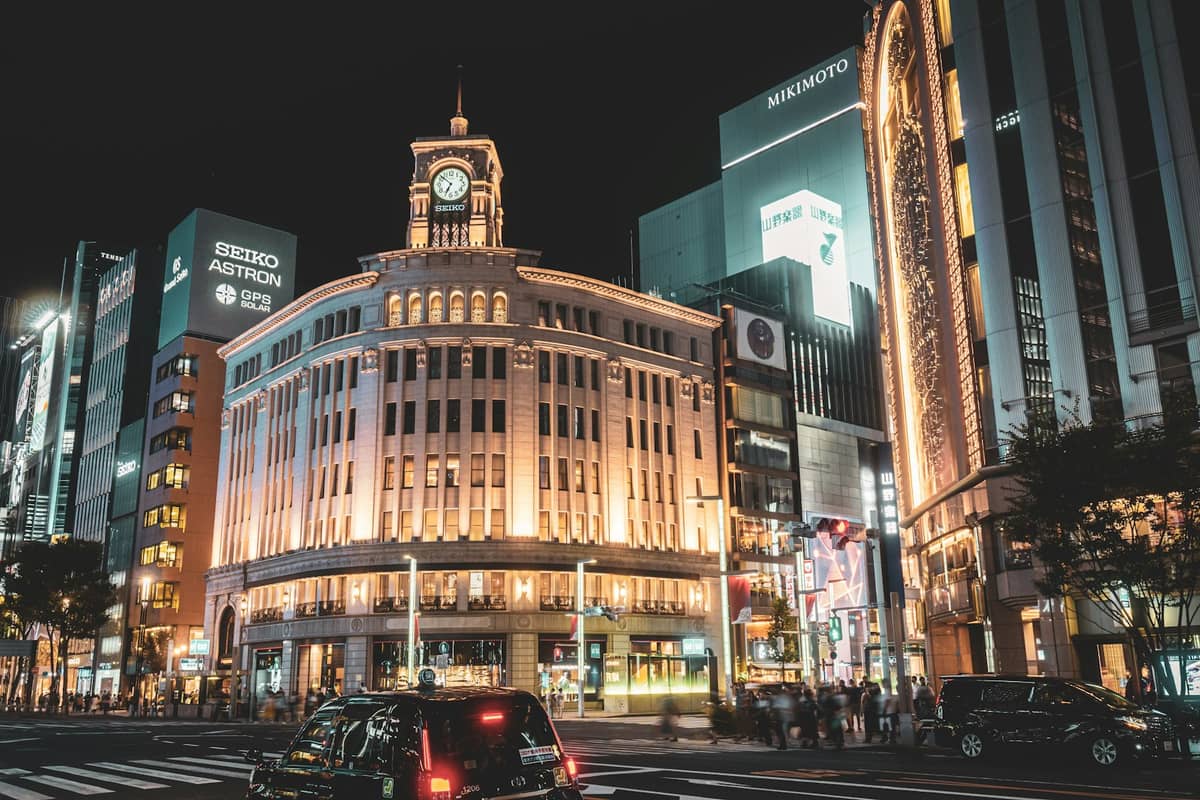
Running parallel to Chuo-dori are Harumi-dori and a series of smaller cross streets numbered by block, locally called 'chome.' The blocks between 4-chome and 7-chome are the commercial core, and the 4-chome intersection, marked by the historic Wako department store with its distinctive clock tower, serves as an informal center of gravity. Wako has occupied the corner since 1952, its neoclassical facade representing one of postwar Ginza's first significant rebuilds.
The side streets ('Ginza-dori' lanes running east-west) carry smaller galleries, specialist shops, and restaurants that tend to be quieter and more interesting than the main avenue. Some of Japan's oldest and most specialized businesses operate from low-rise buildings tucked between the towers, selling everything from handmade brushes to antique lacquerware.
The Pedestrian Paradise: Sundays and Public Holidays
The single best time to experience Ginza on foot is during the 'Hokōsha Tengoku,' or Pedestrian Paradise, when the central stretch of Chuo-dori is closed to vehicles. This operates on Saturdays, Sundays, and public holidays: noon to 18:00 from April through September, and noon to 17:00 from October through March. During these hours, the boulevard transforms from a busy traffic artery into a wide promenade where families spread out, cyclists occasionally drift through, and the scale of the architecture becomes properly appreciable.
Department stores and flagships set up tables and temporary displays along the curb. Street musicians sometimes perform near the 4-chome intersection. The mood is calm rather than carnival, which fits Ginza's character. If you have to pick one afternoon to visit and the weather holds, Sunday during these hours is the right call.
⚠️ What to skip
The Pedestrian Paradise operates weather permitting. On rainy weekends, Chuo-dori returns to normal traffic. Check conditions before planning your visit around it.
How Ginza Changes Through the Day
Mornings before 10:00 are genuinely quiet, especially on weekdays. Shop staff are cleaning windows and arranging window displays, delivery trucks occupy the curb lanes, and the few people on the street are mostly office workers cutting through toward Marunouchi. The light is sharp and the shadows long. This is the best time for architecture photography, because the crowds that gather later are absent and the reflections in glass facades are cleaner.
By mid-morning the department stores open and Chuo-dori starts filling. The lunch hours between noon and 14:00 bring a surge of workers from the surrounding office blocks. Restaurants in the area, particularly the sub-street-level dining floors in department store basements (called 'depachika'), become genuinely crowded. If you want to explore the food halls, 11:00 or late afternoon is more comfortable than the lunch peak.
Evening is Ginza's most cinematic hour. After 18:00, the illuminated signage reflects off the polished stone pavements, and the galleries and restaurants that define the district's more intimate side come into focus. Many shops begin closing around 20:00, but the streets stay lively until later. The atmosphere in the small bars and restaurants tucked into Ginza's upper floors has a particular Tokyo quality: precise, unhurried, expensive.
For dining context beyond the luxury tier, the guide to what to eat in Tokyo covers where Ginza fits into the city's broader food landscape.
Department Stores, Flagships, and the Depachika
Ginza's department stores deserve separate attention because they are not simply shops. Matsuya Ginza, Mitsukoshi Ginza, and Itoya (the famous stationery store) each function more like curated institutions than retail outlets. Mitsukoshi has operated in some form on this block since the early 20th century. Its rooftop garden and food hall represent the full vertical range of the Japanese department store model, from basement grocery theater to rooftop quiet.
The depachika, or department store basement food hall, is worth visiting even if you have no intention of buying anything. The sensory experience is distinctive: the smell of fresh pastry and packaged dashi overlapping, the precision of the displays, the murmured greetings from staff at each counter. Items range from ¥200 rice balls to ¥5,000 wagashi confections. Arriving before noon on a weekday gives you space to actually look around.
Tokyu Plaza Ginza, a newer addition to the district, takes a different architectural approach, with a faceted glass exterior based on traditional Edo kiriko cut-glass patterns. It offers a free rooftop terrace that provides a mid-range view over the surrounding blocks without requiring a paid observation deck ticket.
If high-end retail is a significant part of your Tokyo plans, the Tokyo shopping guide covers Ginza alongside other major retail districts including Omotesando and Shibuya.
Galleries and Culture Between the Flagships
Ginza hosts a concentration of small private galleries that most visitors walk past without noticing. The district has nurtured Tokyo's commercial art scene since the postwar period, and dozens of galleries, many operating from upper floors of otherwise ordinary-looking buildings, show work that ranges from established mid-century Japanese painters to emerging contemporary artists. Entry is typically free, and the galleries are genuinely open to walk-in visitors during business hours.
The Sony Building site, undergoing long-term redevelopment, and the GINZA SIX complex (opened 2017) both gesture at Ginza's ambition to layer culture into commerce. GINZA SIX includes a rooftop garden and a Noh theater in its basement, an unusual combination that reflects the district's self-conscious seriousness about not being merely a shopping street.
Ginza sits within Tokyo's broader architecture story. The Tokyo architecture guide places the district's flagship buildings in the wider context of the city's design landscape.
Getting There, Getting Around, and Practical Notes
Ginza Station is served by three Tokyo Metro lines: the Ginza Line, the Marunouchi Line, and the Hibiya Line, making it one of the better-connected intersections in the city. From Tokyo Station, the Marunouchi Line gets you here in a single stop. JR Yurakucho Station, on the Yamanote and Keihin-Tohoku lines, is a short walk to the district's northern edge and convenient if you are coming from Ueno, Akihabara, or Shinjuku.
The district's main streets are paved and flat, making Ginza one of Tokyo's more accessible neighborhoods for visitors with mobility considerations. The pedestrianized weekend hours reduce the obstacle of traffic further. Individual buildings, including Tokyu Plaza Ginza and the major department stores, have elevators and accessible entrances; confirm barrier-free details with each venue before visiting.
Shops in Ginza typically open around 10:00 and close between 20:00 and 21:00. Most department stores close at 20:00 on weekdays and slightly later on weekends. Galleries tend to open around 11:00 and close by 19:00. Many restaurants do not open for dinner until 17:30 or 18:00. The district itself, as a public neighborhood, has no closing time.
ℹ️ Good to know
Japan has no tipping culture. Service in Ginza's shops and restaurants is attentive and professional; leaving a tip is unnecessary and sometimes causes awkward confusion. Simply a clear 'arigato gozaimasu' is appropriate.
Who Should Think Twice
Ginza is genuinely rewarding if you appreciate architecture, food culture, or retail as theater. It is less compelling if you are looking for budget shopping, streetwear culture, or the kind of chaotic density that defines Shibuya or Akihabara. The district is polished and relatively quiet by Tokyo standards. Prices in most restaurants and shops are high, and the atmosphere can feel formal compared to neighborhoods like Koenji or Nakameguro.
Travelers primarily interested in fashion at more accessible price points may find Omotesando a better fit, where the architectural quality is similarly high but the retail range is broader.
Insider Tips
- The upper floors of Ginza's buildings often contain excellent, quiet restaurants with far less foot traffic than ground-floor spots. Elevators in buildings along Chuo-dori frequently lead to multi-floor dining clusters that locals use regularly.
- Itoya, the stationery institution on Chuo-dori, has a basement floor dedicated to paper and a top-floor cafe. It is worth the full vertical exploration, not just the ground floor that most tourists see.
- If you want to photograph Ginza's architecture without people in the frame, arrive before 9:30 on a weekday morning. The streets are quiet enough to shoot unobstructed, and the light before the high-rise shadows settle is soft and even.
- The blocks east of Chuo-dori, toward Higashi-Ginza and the Tsukiji direction, contain older low-rise buildings with specialist shops that have operated for decades. These streets feel markedly different from the flagship boulevard and are less visited.
- Ginza's galleries are genuinely free and genuinely open to casual visitors. If you see a sign in a building elevator listing gallery names by floor, take it seriously and go up.
Who Is Ginza Shopping District For?
- Architecture and design enthusiasts who want to see flagship retail as serious building
- Food lovers willing to spend time exploring depachika basement food halls
- Travelers who prefer low-density, walkable neighborhoods over crowded retail districts
- Sunday afternoon walkers during the car-free Pedestrian Paradise hours
- Anyone combining a visit to the nearby Tsukiji Outer Market or Imperial Palace gardens into a half-day circuit
Nearby Attractions
Other things to see while in Ginza & Tsukiji:
- Hamarikyu Gardens
Hamarikyu Gardens (浜離宮恩賜庭園) is a roughly 250,000 sqm tidal garden in Chuo Ward that once belonged to the Tokugawa shoguns and later served as an imperial retreat. Today, its seawater ponds, flowering plum and rapeseed fields, and framing views of the Shiodome skyscrapers make it one of the most visually striking public parks in central Tokyo.
- Kabukiza Theatre
Kabukiza Theatre is Tokyo's most celebrated kabuki venue, a grand neo-baroque building in Ginza where centuries-old theatrical tradition plays out on stage daily. Whether you want a full program or just a single act, this guide tells you exactly how to visit, what to see, and what to expect.
- Tsukiji Outer Market
Tsukiji Outer Market (築地場外市場) is Tokyo's most concentrated stretch of seafood stalls, tamagoyaki shops, and counter sushi bars. Free to enter and open most mornings, it rewards early risers with fresh uni, grilled skewers, and some of the best street-level food in Japan.