Cycling Sa Calobra and the Serra de Tramuntana: Mallorca's Greatest Rides
The Sa Calobra climb is the centerpiece of road cycling in Mallorca, winding 9.5 km through 26 hairpin bends into the heart of the UNESCO-listed Serra de Tramuntana. Whether you're a seasoned climber chasing Strava times or a touring cyclist exploring one of Europe's most dramatic mountain landscapes, these routes deliver scenery and challenge in equal measure.
Quick Facts
- Location
- Serra de Tramuntana, northwest Mallorca (Sa Calobra, Escorca)
- Getting There
- By road via MA-10 from Sóller or Pollença; shuttle services available from Palma and resort areas
- Time Needed
- Sa Calobra climb alone: 1–3 hours. Full Tramuntana loop from Palma or Inca: 5–8 hours
- Cost
- Free (public roads). Bike rental and shuttle services vary by provider
- Best for
- Road cyclists, endurance athletes, mountain landscape photography
Why Mallorca Is Europe's Premier Cycling Island
Throughout winter and early spring, particularly February through March, the roads of northwest Mallorca host professional cycling teams running pre-season training camps. The island's combination of quiet tarmac, reliable winter sunshine, and genuinely difficult climbs has made it a fixture on the European road cycling calendar for decades. But you do not need a team car following you to understand the appeal. The Serra de Tramuntana, the mountain spine that runs along Mallorca's northwestern edge, offers a concentration of categorized climbs within a relatively compact area that you will struggle to match anywhere else in the Mediterranean.
The range was designated a UNESCO World Heritage Cultural Landscape in 2011, recognized for its centuries-old terraced agricultural systems and its dramatic relationship between human settlement and steep terrain. For cyclists, that terrain translates into roads that twist through olive groves, past limestone cliffs, and alongside reservoirs edged by pine forest. The Serra de Tramuntana is not a single route. It is a network, and Sa Calobra sits at its dramatic heart.
💡 Local tip
Spring (March to May) and autumn (September to October) are the optimal cycling windows. Summer heat above 1,000 m is manageable, but the descent into Sa Calobra becomes extremely hot by midday in July and August. Start any major climb by 8:00 am in summer.
Sa Calobra: The Climb That Defines Mallorcan Cycling
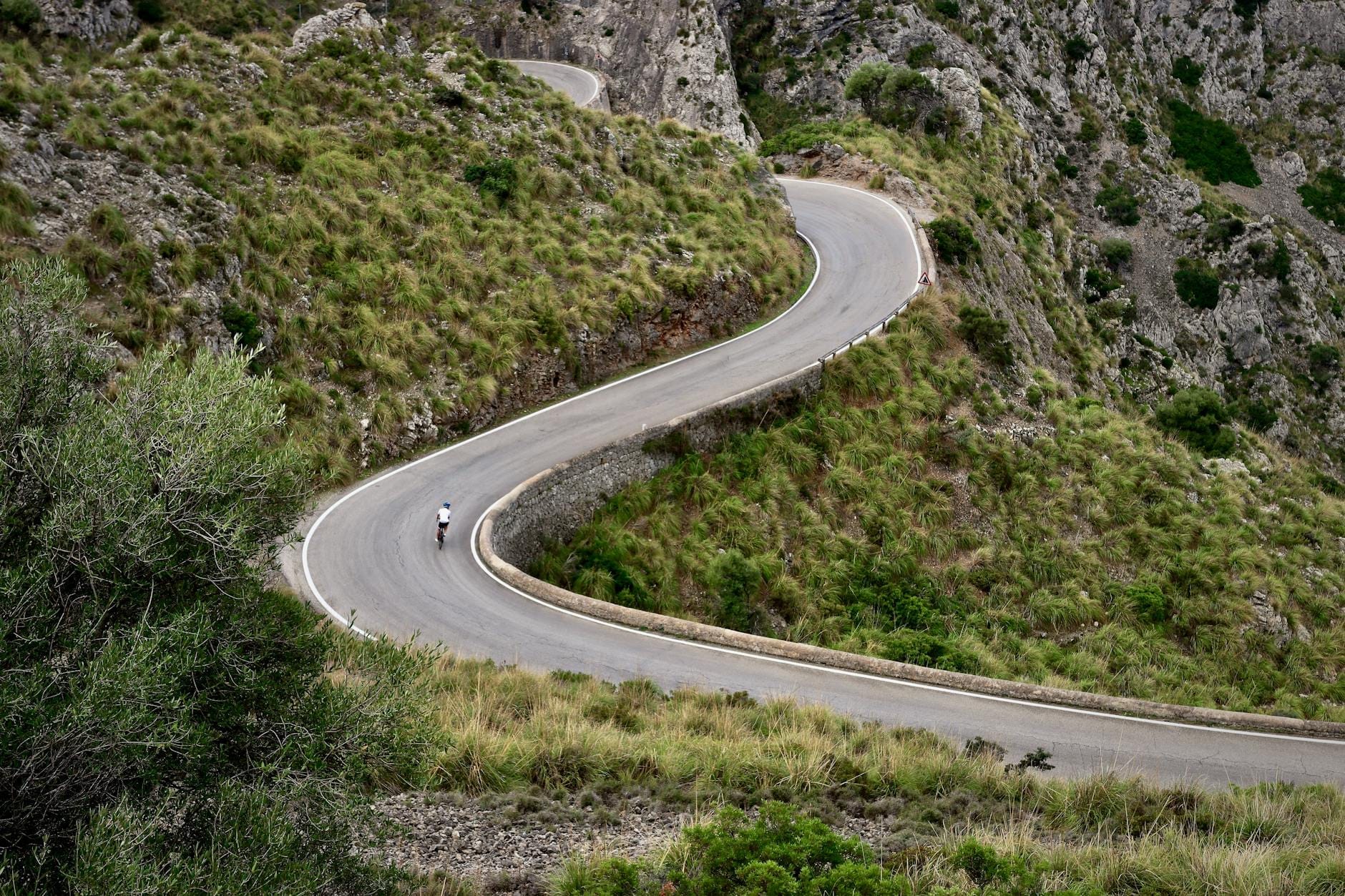
The Sa Calobra road, known locally as the Coll dels Reis and locally known as the Coll dels Reis (Pass of the Kings), was constructed in 1933 by engineer Antoni Parietti. It is 9.5 km long, rises approximately 682 m from near sea level to 682 m, and averages a 7% gradient across its full length. Those numbers alone suggest a serious climb, but they understate the experience considerably.
The road's signature feature is the spiral bridge section, locally called the 'tie knot', where the road loops under itself in a tight 270-degree spiral before continuing upward. Seen from above, it looks structurally implausible. Ridden from below, it creates a brief moment of genuine disorientation as you emerge from the tunnel already pointing in the opposite direction. The 26 hairpin bends are not evenly spaced. Some sections relent to 5-6%, offering a chance to recover; others push through 10% and above on the outer sweeps of tighter corners.
The climb is conventionally ridden from the top down: most cyclists descend from the Coll dels Reis summit (682 m) to the small port at the base, then turn around and climb back up. The Strava KOM segment starts at a car park sign near the bottom. Strava records indicate the current men's record is below 25 minutes. For a fit amateur cyclist, 35 to 50 minutes is a realistic target. For those just enjoying the experience, an hour or more is perfectly reasonable.
⚠️ What to skip
The descent to Sa Calobra port is shared with tourist coaches and transfer vehicles, particularly between 10:00 am and 3:00 pm. On narrow hairpins, give large vehicles as much space as possible. Descend with caution and controlled speed, especially on the lower switchbacks where road surface can be damp from sea spray.
Tickets & tours
Hand-picked options from our booking partner. Prices are indicative; availability and final rates are confirmed when you complete your booking.
3-hour Es Trenc Boat Tour in Mallorca
From 39 €Instant confirmationFree cancellationMallorca Eastern Coast Roundtrip Boat Trip from Porto Cristo
From 25 €Instant confirmationFree cancellationBanana Boat Experience in Mallorca
From 14 €Instant confirmationFree cancellationBoat Tour with BBQ Lunch and Snorkelling in Mallorca
From 59 €Instant confirmationFree cancellation
Getting to the Start: The Access Climbs
Sa Calobra does not exist in isolation. Reaching it by bike from any direction requires a significant climb in its own right, which is part of what makes a full day out here so demanding and so rewarding. The most common approaches are from Inca in the interior (a roughly 70 km ride with approximately 2,000 m of total elevation gain for the full loop), from Sóller to the south, or from Pollença and the north via the Coll de Femenia.
The northern approach via Coll de Femenia is 7.2 km at an average 6% gradient and is a genuinely beautiful road in its own right, passing through shaded pine forest before opening onto views toward the Bay of Pollença. From the south, the Puig Major approach is 14.8 km at approximately 5.8% average gradient, skirting the edge of the Gorg Blau reservoir. Both routes converge at the MA-10 mountain road, which is the spine of all Tramuntana cycling.
If you prefer to skip the access climbs and focus solely on Sa Calobra, shuttle services operate from Palma and several resort areas, transporting riders and bikes to the Coll dels Reis summit or to the Sa Calobra port. This is a practical option for less experienced riders or those combining cycling with other activities. For a broader look at how to plan movement around the island, the getting around Mallorca guide covers transport options in useful detail.
The MA-10: Mallorca's Greatest Road
While Sa Calobra is the headline, the MA-10 mountain road that runs along the crest of the Tramuntana from Andratx in the southwest to Pollença in the northeast is arguably the more complete cycling experience. Riding its full length covers roughly 90 km with over 2,500 m of elevation gain. It passes through the villages of Banyalbufar, Estellencs, Esporles, and Valldemossa before reaching Sóller, then continues through Fornalutx toward the Sa Calobra junction and on to Pollença.
The section between Sóller and the Sa Calobra junction is consistently rated among the most scenic cycling roads in Europe. The road narrows, traffic thins, and the views across the western coast become genuinely spectacular. The village of Fornalutx sits just above Sóller and makes an excellent coffee stop before or after the main climbs. At roughly 100 m altitude with stone-terraced citrus groves on every slope, it represents the Tramuntana at its most photogenic.
For context on the wider mountain region and its villages, the village of Deià sits directly on the MA-10 and is a natural stopping point. The road through Deià is frequently used for the classic Palma-Sóller-Deià loop, which totals around 100 km and is one of the most popular full-day rides on the island.
What It Actually Feels Like: Time of Day and Conditions
Arriving at the Coll dels Reis summit in the early morning, before 9:00 am, is a genuinely different experience from arriving at midday. The light is cooler and more directional, cutting across the limestone faces at an angle that shows the rock's texture clearly. The road is quiet enough that you can hear the wind moving through the scrub pine above the hairpins. By late morning, particularly in peak season, the road takes on more of a shared-use character: rental cyclists, serious club riders, and tourist vehicles all converge.
The descent to the port at the bottom passes through a short tunnel blasted through the cliff, and the air inside is noticeably cooler and damp. Emerging from the tunnel, the sea appears abruptly in the frame of the road ahead, turquoise and close. The port itself is small, with a handful of restaurants and a shingle-and-rock beach hemmed in by vertical cliffs on three sides. In spring, it is calm and accessible. In July and August, it draws large numbers of day-trippers arriving by boat from Port de Sóller, and the contrast with the quiet upper road can feel jarring.
Professional teams have used Sa Calobra and the surrounding roads as a training base for decades. Team Sky's preparation for the 2012 Tour de France, which Bradley Wiggins ultimately won, included extended Tramuntana training blocks. That legacy has made Mallorca a kind of pilgrimage destination for amateur cyclists who want to test themselves on the same gradients. For route ideas beyond cycling, the island also rewards exploration on foot. The hiking in Mallorca guide covers the GR221 long-distance path that traverses many of the same Tramuntana ridges on foot.
Practical Information: Bikes, Kit, and Logistics
Road cycling in Mallorca requires a road or gravel bike with appropriate gearing for steep ascents. A compact chainset (50/34 or smaller) with an 11-28 or 11-32 cassette will cover most riders adequately for Sa Calobra, though riders who struggle on sustained 8-10% sections may prefer a wider ratio. Renting a quality road bike in Palma or in Sóller is straightforward, with numerous specialist hire shops catering to visiting cyclists. Prices vary by season and bike specification; confirm current rates directly with rental providers.
Carry at least two full water bottles for the Sa Calobra climb. There are no reliable water points between the Coll dels Reis descent junction and the port below. In warm weather, the climb generates significant heat, particularly on south-facing sections in the upper third. Sun protection, a light gilet for the descent, and a basic tool kit (inner tube, tyre levers, mini pump or CO2) are standard requirements. The road surface on the MA-2141 is generally well maintained but can have loose gravel on hairpin apexes.
For photography, the best positions on Sa Calobra are from the road itself on the upper switchbacks, looking back down through the hairpins toward the sea. A compact camera or phone on a handlebar mount works well during the climb. For the broader Tramuntana landscape, the Mallorca photography guide covers viewpoint locations and light conditions across the island.
Who Should Skip This Route
Sa Calobra is not appropriate for casual or leisure cyclists. The gradients are sustained, the traffic can be fast-moving on the descent, and the road has no guardrails on several exposed sections. Cyclists who are uncomfortable on steep descents, unfamiliar with road cycling etiquette around motor vehicles, or not physically prepared for 600+ metre climbs should choose flatter routes in the interior plains or along the eastern coast instead. The route is entirely unsuitable for mountain bikes with knobbly tyres (road traction is the priority), wheelchairs, strollers, or non-cyclists.
Insider Tips
- Descend to Sa Calobra port first thing in the morning, before the tourist boats arrive from Port de Sóller. By 11:00 am the small beach and restaurant area can be crowded. Arriving by 9:00 am gives you the cliffs, the turquoise water, and a quiet espresso almost to yourself.
- The Coll de Femenia approach from Pollença is significantly less trafficked than the Puig Major approach from the south. If you want to experience the mountain roads without competing with coaches and rental cars, start from Pollença.
- Strava segments on Sa Calobra are heavily tracked, which means the road can attract riders pushing hard on both the climb and the descent. If you are riding at a steady pace, stay predictably to the right to allow faster riders to pass cleanly.
- The tunnel near the bottom of the Sa Calobra descent is unlit and dark enough that a front light is useful even on a bright day. This is not optional safety advice; it is visibility in black-out conditions for about 10 seconds.
- Most Mallorcan cycling cafes in Sóller, Pollença, and along the MA-10 open by 8:00 am and are well accustomed to cyclists in cleats ordering large breakfasts. Carrying cash is advisable at smaller roadside stops where card readers are not always reliable.
Who Is Mallorca Cycling (Sa Calobra & Tramuntana Routes) For?
- Road cyclists seeking categorized climbs with professional-grade challenge
- Endurance athletes training in winter or spring for the European racing season
- Cycling enthusiasts who want to ride routes associated with Tour de France winners
- Landscape photographers traveling by bike through UNESCO-protected mountain terrain
- Fit touring cyclists comfortable with 100+ km days and 2,000+ m elevation gain
Nearby Attractions
Other things to see while in Serra de Tramuntana:
- Deià
Perched above olive groves on the northwestern cliffs of Mallorca's Serra de Tramuntana, Deià has drawn artists, writers, and travelers for decades. The honey-colored stone houses, the smell of wild rosemary on the lane up to the church, and the long views over the Mediterranean make it genuinely special. But it rewards slow visitors, not quick stop-and-snap day-trippers.
- Fornalutx
Perched in the Serra de Tramuntana above Sóller, Fornalutx is a compact stone village of about 700 people that has won national recognition for how well it has been preserved. The streets are steep, the buildings are honey-coloured, and the orange groves press in close on every side. Entry is free, the walk takes one to two hours, and it pairs naturally with a day in Sóller.
- Jardines de Alfabia
Set against the Serra de Tramuntana mountains, Jardines de Alfabia is a layered estate with roots in 13th-century Moorish Mallorca. Its terraced gardens, vaulted cistern, famous water pergola, and Baroque manor house make it one of the island's most rewarding half-day visits for anyone interested in history, botany, or architecture.
- Sa Calobra & Torrent de Pareis
Sa Calobra and the Torrent de Pareis form one of the most striking natural landscapes in the western Mediterranean: a 300-metre-deep limestone gorge that opens onto a sheltered pebble beach. The journey to reach it, whether by the legendary corkscrew road or by boat from Sóller, is half the experience.