Jardines de Alfabia: Mallorca's Most Atmospheric Historic Garden
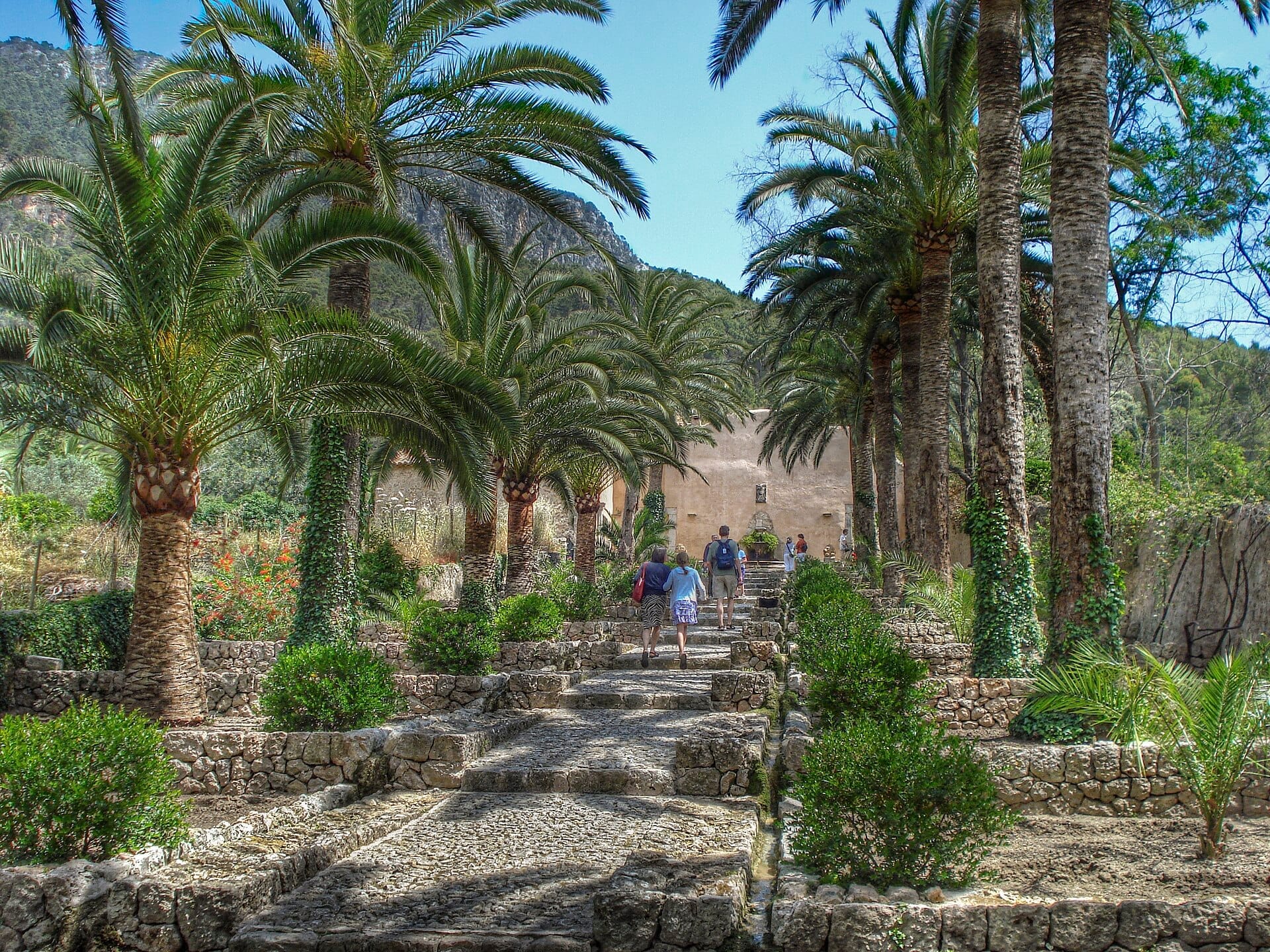
Set against the Serra de Tramuntana mountains, Jardines de Alfabia is a layered estate with roots in 13th-century Moorish Mallorca. Its terraced gardens, vaulted cistern, famous water pergola, and Baroque manor house make it one of the island's most rewarding half-day visits for anyone interested in history, botany, or architecture.
Quick Facts
- Location
- Ctra. Palma–Sóller, Km 17, Bunyola, Tramuntana, Mallorca
- Getting There
- Bus Line 204 (Palma–Sóller); private request-only stop on the Sóller heritage train line
- Time Needed
- 1.5 to 2.5 hours
- Cost
- €10 general; €5 Mallorca residents; free for children under 12
- Best for
- History lovers, garden enthusiasts, architecture fans, photographers
- Official website
- www.jardinesdealfabia.com
What Is Jardines de Alfabia?
Jardines de Alfabia is a historic estate and botanical garden situated at kilometre 17 of the Palma to Sóller road, just as the terrain begins to climb into the Serra de Tramuntana. The property sits within a UNESCO World Heritage landscape and combines a history dating to the 13th century with a remarkably intact physical environment: terraced gardens, a Moorish-era pergola with crossed water spouts, an olive oil mill, potentially a tower or defensive structure, and a Baroque manor house whose current Baroque façade dates to the 18th century.
The estate's name comes from the Arabic word "Alfabia," referencing its historical Moorish origins, a reference to the agricultural identity of the land during Moorish rule. What you visit today is the accumulated result of Moorish, Gothic, and Baroque interventions, each adding a layer without entirely erasing what came before. That accumulated quality is precisely what makes the place feel different from a manicured show garden.
ℹ️ Good to know
Jardines de Alfabia is open daily from 09:30 to 18:30 (14 February–31 October). Last entry is 60 minutes before closing. The estate is closed during winter months.
The Historical Layers You're Walking Through
The estate's origins trace to the Arab occupation of Mallorca during the medieval Moorish period, before the Christian Reconquest in the 13th century. The Moorish administrators who managed this land understood irrigation engineering, and the water systems they built, channels feeding ponds, cisterns, and garden features, still function today. The survival of these hydraulic structures is not incidental: it reflects how successive owners valued and maintained this infrastructure over centuries.
After the Reconquest, the property passed through aristocratic Mallorcan families who overlaid Gothic and later Baroque sensibilities onto the existing Moorish bones. The current house façade dates to the 18th century, giving the entrance a measured, symmetrical dignity that contrasts with the wilder organic quality of the garden behind it. The oil mill on the property speaks to the estate's working agricultural history, not just its ornamental ambitions.
The Serra de Tramuntana was inscribed as a UNESCO World Heritage Site, a designation that recognises the cultural landscape of the mountains, including historic estates like Alfabia, as globally significant. For context on the wider mountain region, the Tramuntana area guide covers the range from Sa Calobra to Andratx, and Alfabia sits near its southeastern boundary.
Its presence feels less like a curatorial statement and more like a quiet acknowledgement of the island's relationship with modern art, one thread in a longer cultural conversation.
Tickets & tours
Hand-picked options from our booking partner. Prices are indicative; availability and final rates are confirmed when you complete your booking.
Dinosaurland and Caves of Hams combined ticket
From 25 €Instant confirmationFree cancellationShuttle Boat from Cala Millor to Cala Ratjada
From 26 €Instant confirmationFree cancellation3-hour Es Trenc Boat Tour in Mallorca
From 39 €Instant confirmationFree cancellationShuttle Boat Roundtrip from Cala Bona to Cala Ratjada
From 29 €Instant confirmationFree cancellation
The Gardens: What You Actually See
The gardens are the main reason most visitors come, and they reward slow exploration. The layout moves through distinct zones: formal areas near the house give way to wilder, shadier sections further in. In early morning, when the light falls at a low angle through the canopy of palms, plane trees, and climbing roses, the temperature drops noticeably compared to the road outside. The air carries a faint mineral smell from the water channels, mixed with earth and the green weight of dense vegetation.
The pergola is the signature feature of the visit. It's a long, vaulted structure with 72 columns and 24 stone hydras with water spouts at intervals, producing a fine mist that cools the air below. On warm spring and summer days, walking through it is one of those simple sensory experiences that tends to stick in memory. The vaulted cistern nearby, mostly underground, gives a sense of how seriously the Moorish designers approached water management.
Ponds with water lilies and reflecting surfaces appear at intervals. The botanical mix is broad: Mediterranean natives alongside species brought over centuries from elsewhere. In spring, flowering climbers cover the pergola structure and sections of wall, adding colour without the artificial intensity of a formal floral display. By midsummer the garden is greener and denser, the shade heavier, and the water features feel even more significant in the heat.
💡 Local tip
Visit on a weekday morning, ideally by 10:00, to have the pergola and ponds largely to yourself. Tour groups from the Sóller train tend to arrive mid-morning and move through quickly, but they can make the space feel crowded during peak season.
Inside the House and Estate Buildings
The main house is included in the general admission. Inside, the rooms hold period furniture, paintings, and decorative objects accumulated across several centuries of occupation. The tone is lived-in rather than museum-sterile, which either appeals to you or doesn't. There are no roped-off displays with explanatory cards on every object; the experience is closer to walking through a private home that happens to be old and interesting.
The oil mill is one of the more underappreciated parts of the visit. Traditional olive pressing equipment, stone wheels, wooden beams, and the mechanical logic of a pre-industrial production process are all present and legible. It contextualises the estate as a working agricultural property rather than purely an aristocratic pleasure ground.
The tower offers elevated views over the garden canopy toward the Tramuntana slopes. It's not a dramatic panorama, but the perspective it provides over the estate's layout is useful for understanding how the whole property fits together.
Getting There: Practical Transport Options
The most practical approach for independent travelers is Bus Line 204, which runs between Palma and Sóller with a stop near the gardens. Check current schedules directly before travel, as frequency varies by season. The bus drops you on the main road; the entrance is clearly signed.
Alfabia also has its own private stop on the historic Sóller train line, which runs from Palma's Plaza de España through the Tramuntana mountains. If you're already planning to take the Sóller train as part of a day trip, you can ask to be let off at Alfabia on the way. Confirm this with staff when boarding, as the stop is request-only.
By car, the gardens are straightforward to reach from Palma via the Ma-11 road toward Sóller. There is parking on site. Driving gives you the flexibility to arrive at opening time and combine the visit with nearby villages. The road passes through increasingly dramatic mountain scenery as it approaches Sóller, so the drive itself has value.
If you're planning a broader day around the northwestern mountains, the Sóller and Port de Sóller guide covers what to do once you continue up the road, and the village of Fornalutx is a short drive further into the mountains.
Photography, Timing, and Honest Caveats
The gardens photograph well in the first hour after opening. The water pergola is the most visually distinctive element, and the light through the mist and vegetation works best before midday. A wide-angle lens helps with the pergola's length and arch structure. The ponds reflect surrounding trees effectively in calm conditions.
Note that professional photoshoots require a separate permit, currently priced at a minimum of €300 plus VAT. For personal travel photography there are no restrictions beyond the standard courtesy rules. The Mallorca photography guide includes wider location suggestions for photographers working across the island.
An honest note on expectations: Jardines de Alfabia is not a spectacularly manicured formal garden in the manner of the great European palace gardens. It's intimate, layered, and atmospheric, but it requires a certain kind of interest to fully appreciate. Visitors expecting a grand floral spectacle may find it understated. Those interested in history, water engineering, or the texture of a genuinely old place will find it absorbing.
⚠️ What to skip
The gardens are closed from 1 November through 28 February. If you're visiting Mallorca in winter, confirm opening before making plans. Weather in the Tramuntana can also be unpredictable in spring; the garden is worth visiting in light rain, but the mountain road to Sóller deserves caution in poor visibility.
Accessibility within the gardens is partially limited by uneven terrain and steps in older sections of the property. The main garden paths are walkable without difficulty, but the estate's historic structure means full wheelchair access is not guaranteed throughout. Contact the estate directly at +34 971 61 31 for specific accessibility queries before visiting.
Combining Alfabia with the Wider Tramuntana
Jardines de Alfabia pairs naturally with a broader Tramuntana day. From the gardens you can continue to Sóller for lunch and walk down to Port de Sóller in the afternoon, or drive north toward Deià and Valldemossa if you're heading back toward Palma via the coastal road. Both villages have their own depth and are worth time rather than a quick stop.
For travelers planning their time in the mountains more broadly, the hiking in Mallorca guide covers Tramuntana trails of varying difficulty, some of which pass through estate landscapes similar to Alfabia's. Spring is the best season for both the gardens and the walking routes, when the mountains are green and the heat is manageable.
Insider Tips
- Request the Alfabia stop when boarding the Sóller train in Palma. It's a request-only halt and staff will let you off at the garden gate, saving a walk from the main road and making the train ride feel purposeful rather than just scenic.
- The garden is at its most atmospheric in the hour after a light rain. The water channels run fuller, the stone darkens, and the scent of wet vegetation and earth is pronounced. If the weather turns overcast, consider it an advantage rather than a reason to postpone.
- The oil mill tends to be overlooked by visitors moving quickly through to the garden. Spend ten minutes in it. The mechanical complexity of a traditional stone press is genuinely impressive, and it's usually quiet.
- Mallorca residents pay half price on admission. If you're staying long-term or have a local address, bring documentation. The discount is applied on presentation of proof of residence.
- The estate is licensed as a wedding and event venue, with capacity up to 350 guests. If you visit on a weekend and find parts of the grounds restricted for a private event, that's the reason. Midweek visits are reliably unaffected.
Who Is Jardines de Alfabia For?
- Travelers interested in Moorish and Baroque architectural history who want something beyond Palma's urban sites
- Garden and botany enthusiasts drawn to Mediterranean plant collections in a working historic context
- Photographers looking for varied compositions: water features, stone architecture, dense vegetation, and sculptural elements
- Families with children old enough to engage with history, or who simply enjoy outdoor exploration with shade and water features
- Tramuntana day-trippers combining the gardens with Sóller, Deià, or the heritage train journey
Nearby Attractions
Other things to see while in Serra de Tramuntana:
- Deià
Perched above olive groves on the northwestern cliffs of Mallorca's Serra de Tramuntana, Deià has drawn artists, writers, and travelers for decades. The honey-colored stone houses, the smell of wild rosemary on the lane up to the church, and the long views over the Mediterranean make it genuinely special. But it rewards slow visitors, not quick stop-and-snap day-trippers.
- Fornalutx
Perched in the Serra de Tramuntana above Sóller, Fornalutx is a compact stone village of about 700 people that has won national recognition for how well it has been preserved. The streets are steep, the buildings are honey-coloured, and the orange groves press in close on every side. Entry is free, the walk takes one to two hours, and it pairs naturally with a day in Sóller.
- Mallorca Cycling (Sa Calobra & Tramuntana Routes)
The Sa Calobra climb is the centerpiece of road cycling in Mallorca, winding 9.5 km through 26 hairpin bends into the heart of the UNESCO-listed Serra de Tramuntana. Whether you're a seasoned climber chasing Strava times or a touring cyclist exploring one of Europe's most dramatic mountain landscapes, these routes deliver scenery and challenge in equal measure.
- Sa Calobra & Torrent de Pareis
Sa Calobra and the Torrent de Pareis form one of the most striking natural landscapes in the western Mediterranean: a 300-metre-deep limestone gorge that opens onto a sheltered pebble beach. The journey to reach it, whether by the legendary corkscrew road or by boat from Sóller, is half the experience.