Sóller Train (Ferrocarril de Sóller): Mallorca's Most Scenic Railway Journey
The Ferrocarril de Sóller is a narrow-gauge wooden train running since 1912 through 13 tunnels and the Serra de Tramuntana mountains, connecting Palma to the orange-grove town of Sóller. It is one of the most atmospheric rail journeys in the western Mediterranean, and a legitimate reason to plan a full day out from Palma.
Quick Facts
- Location
- Plaça d'Espanya, Palma (departs) to Plaça d'Espanya, Sóller — Serra de Tramuntana, Mallorca
- Getting There
- Walk or take any city bus to Plaça d'Espanya, Palma — the train station is on the square's western side
- Time Needed
- 1 hour each way on the train; allow a full day if exploring Sóller and Port de Sóller
- Cost
- Single €23 / Return €30 (Palma–Sóller); add €8 for a return tram ticket to Port de Sóller
- Best for
- History lovers, photographers, families, slow-travel enthusiasts, first-time visitors to Mallorca
- Official website
- trendesoller.com/eng/index
What the Ferrocarril de Sóller Actually Is
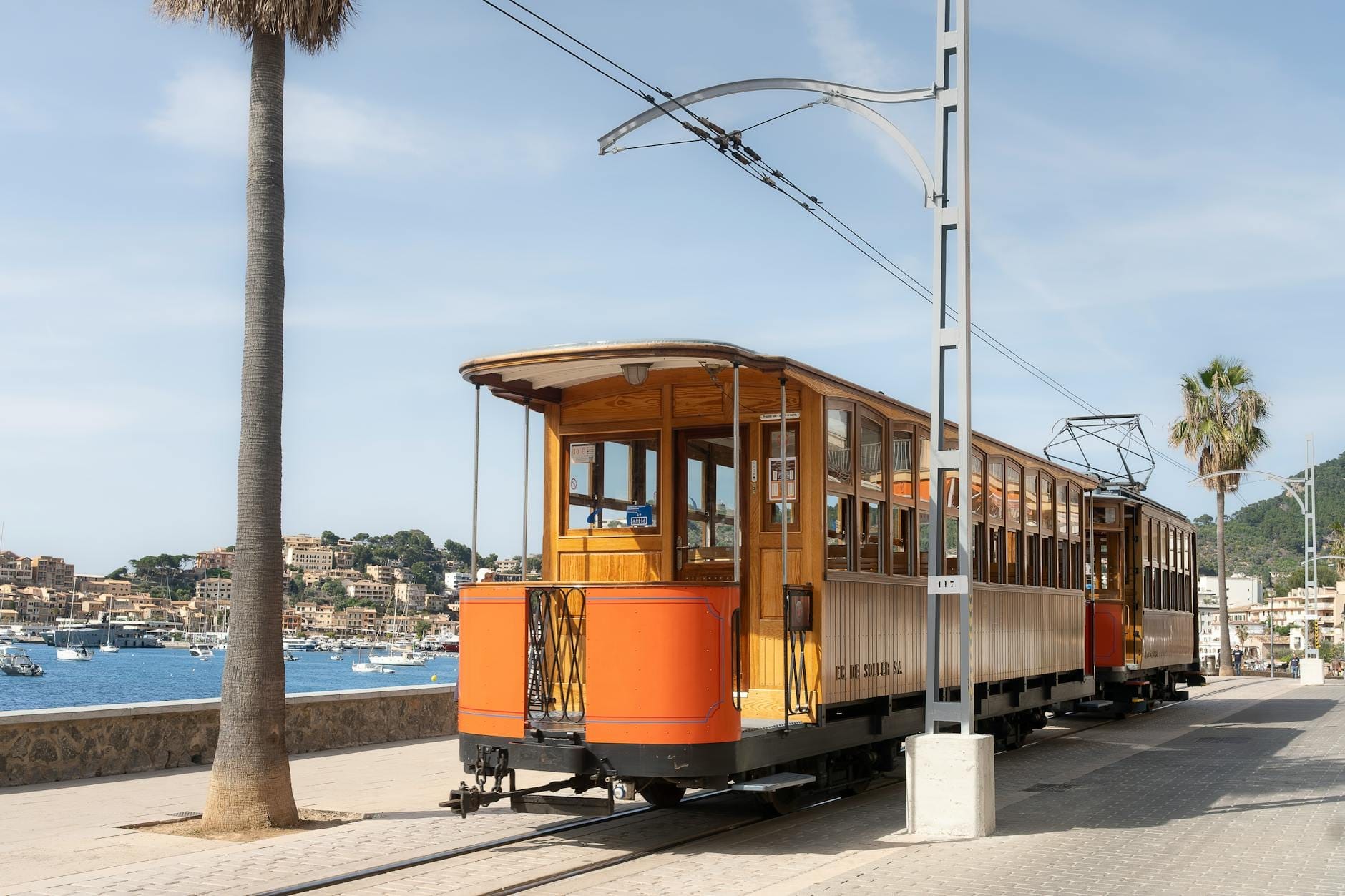
The Ferrocarril de Sóller, known locally as the Tren de Sóller or informally as the Orange Express, is a narrow-gauge electrified railway running 27.3 kilometres from Palma to the mountain town of Sóller. The line was inaugurated on April 16, 1912, funded largely by Sóller's wealthy citrus merchants who needed a reliable route to ship their oranges and lemons to Palma across the Serra de Tramuntana. More than a century later, the wooden carriages from 1912 are still in service, making this one of the oldest continuously operating heritage railways in Europe.
This is not a tourist gimmick retrofitted to look vintage. The carriages, the brass fittings, the leather straps, the slatted wooden seats — all of it is original or period-accurate. The railway was electrified in 1929 and has been running largely unchanged since. What you board in Palma is genuinely the same train that Mallorcan families boarded in the 1920s to travel to the mountains.
💡 Local tip
Book tickets in advance, especially for the popular 10:10 and 10:50 departures from Palma. The train sells out during high season and there is no standing-room option. The official booking site is trendesoller.com.
The Journey: What You See and Feel
The train departs from the lower level of Palma's Plaça d'Espanya station — a different platform from the modern SFM metro lines, and clearly signed. In the first ten minutes, the train moves through Palma's western suburbs at a leisurely pace, crossing streets on surface level and giving an almost tram-like view of the city's ordinary residential blocks. It is not spectacular at first, and some first-time passengers wonder briefly if they have made a mistake.
The transformation happens at Bunyola, the only intermediate stop, where the train swings north and begins its assault on the mountains. The gradient tightens, the carriages rock gently, and the landscape outside the windows shifts from olive groves and dry stone walls to dense pine and increasingly dramatic limestone ridges. The train then enters the first of 13 tunnels — some short enough to pass in seconds, one long enough that the carriage falls into near-complete darkness for a full minute. Between tunnels, the views open suddenly over terraced hillsides and distant glimpses of the Sóller valley floor far below.
The smell inside the wooden carriages is particular: old varnished timber, faint electrical warmth from the overhead lines, and in summer, the dry heat that builds inside even with windows open. Those windows open manually, on leather straps, and the breeze through them as the train climbs is the only air conditioning available. The sound is a steady, rhythmic clack-and-hum, lower in pitch than a modern train, with a horn that echoes off rock faces in the tunnels.
The arrival into Sóller is a descent into a wide, bowl-shaped valley of orange and lemon trees. The train rolls down through orchards and comes to rest at the Sóller station, a handsome early-20th-century building on the town's main square. The whole journey takes approximately one hour.
Tickets & tours
Hand-picked options from our booking partner. Prices are indicative; availability and final rates are confirmed when you complete your booking.
Historic trail of Archduke Ludwig Salvador in Valldemossa
From 76 €Instant confirmationFree cancellationDinosaurland and Caves of Hams combined ticket
From 25 €Instant confirmationFree cancellationShuttle Boat from Cala Millor to Cala Ratjada
From 26 €Instant confirmationFree cancellation3-hour Es Trenc Boat Tour in Mallorca
From 39 €Instant confirmationFree cancellation
Morning vs. Afternoon: How the Experience Changes
The first two departures from Palma at 10:10 and 10:50 carry the heaviest tourist loads. Carriages fill quickly and the atmosphere on board is lively, with multiple languages mixing and cameras appearing at every tunnel entrance. If you want the most social, energetic version of the trip, these are the trains to take. If you want to look out the window without elbows in your field of view, consider the 12:15 or later.
The afternoon return from Sóller, particularly the 17:15 or 18:00 departure, is quieter and carries more locals alongside day-trippers heading back. The light through the western-facing windows on the return leg catches the limestone ridges differently, with a warmer, lower angle. Photographers specifically working the mountain segment should note that the outbound journey (Palma to Sóller) has the best light in the morning, while the return leg has better light in the late afternoon.
ℹ️ Good to know
Sit on the right side of the carriage (facing the direction of travel) on the outbound Palma-to-Sóller journey for the best views of the mountain descent into the Sóller valley. On the return, move to the left side for the same advantage.
Timetable and Ticket Prices
As of 2026, departures from Palma run at 10:10, 10:50, 12:15, 13:30, 15:10, and additional services (with box office confirmation required for some). From Sóller, trains return at 09:00, 10:50, 12:15, 14:00, 17:15, 18:00, 18:30, and 19:30. Schedules are subject to seasonal adjustment, so always verify on the official site before planning your day.
A single ticket from Palma to Sóller costs €23. A return ticket is €30. If you plan to continue to Port de Sóller on the Tranvía de Sóller (a separate narrow-gauge tram that runs 4.9 km from Sóller town down to the port, opened in 1913), a combined return fare adds €8 to your ticket, making it €38 total. The tram is a natural extension of the day and worth including.
⚠️ What to skip
At €23–€30 per person, this is one of Mallorca's more expensive single attractions. Factor in the tram if you plan to reach Port de Sóller. Families of four will spend well over €100 on train tickets alone, before meals or activities in Sóller.
Sóller: What to Do Once You Arrive
The train deposits you directly on Sóller's Plaça d'Espanya, which is also the departure point for the tram to Port de Sóller. The town itself is compact and entirely walkable. The market square, Plaça de la Constitució, is three minutes on foot and lined with café terraces under plane trees. The town has a notably well-preserved modernista architecture, funded by the same citrus wealth that built the railway. From Sóller, the broader Serra de Tramuntana beckons: the villages of Deià and Fornalutx are both reachable by taxi or local bus for those wanting to extend the day into the mountains.
Port de Sóller, reached via the tram in about 25 minutes, is a working fishing harbour that has retained more character than many of Mallorca's coastal towns. It sits inside a near-circular bay with calm, clear water and a pair of 19th-century lighthouses on the headlands. For a broader sense of the Tramuntana coastline, including one of the island's most dramatic road journeys, see the guide to Sóller and Port de Sóller.
History and Cultural Significance
Construction on the Ferrocarril de Sóller began in 1907. Before the railway, the journey from Palma to Sóller required a full day by mule track through the mountains. The citrus-growing families of the Sóller valley financed the project privately, motivated by the need to compete with citrus producers on the Spanish mainland who had easier access to rail transport. When the line opened in 1912, it cut the journey to one hour and transformed the local economy.
The railway runs through the Serra de Tramuntana, the mountain range that forms Mallorca's northwestern spine and has held UNESCO World Heritage status since 2011, recognized for its centuries-old landscape of terraced agriculture, dry stone walls, and water management systems. The train does not stop in the mountains proper, but the views from the carriage windows give a clear sense of the terrain that makes this range significant. For those who want to engage with the Tramuntana more directly, the hiking trails of Mallorca offer several routes departing from Sóller itself.
Practical Details and Accessibility
The station in Palma is at Plaça d'Espanya, the same large square that serves several bus lines and is walkable from the city centre in about 20 minutes, or a short taxi or bus ride. There is paid parking near the square. The Sóller station is directly on the town's main square with no significant walk required on arrival.
Accessibility is limited. The heritage carriages have steps at the doors and narrow aisles without ramps or wheelchair spaces. Passengers with significant mobility impairments or who use wheelchairs will find the train difficult to board without assistance, and the railway does not advertise full wheelchair accessibility. Contact the operator directly if this is a concern.
What to bring: in summer, carry water, as there is no food or drink service on the train. The wooden carriages get warm. Light layers are useful for the mountain section. If you plan to walk in Sóller or hike beyond the town, proper footwear matters. For photography advice covering the broader Tramuntana region, the Mallorca photography guide covers golden-hour locations and seasonal light conditions.
Who Should Think Twice
Travelers on tight budgets should weigh the cost carefully. At €30 return per person, a family or group of friends will spend a meaningful amount on the train alone, and Sóller is also reachable by car via the Ma-11 road (or the toll tunnel) in under 30 minutes at a fraction of the cost. If the journey itself is the point, the train is worth it. If you simply want to reach Sóller, driving or taking a bus is faster and cheaper.
Those who are primarily interested in beaches and coastal scenery rather than mountain landscapes and railway history may find the day less rewarding than a trip to, say, Cap de Formentor or one of the island's southern coves. The train is not a thrill ride; it moves slowly and steadily, and the appeal is atmospheric rather than dramatic.
Insider Tips
- Buy tickets online at trendesoller.com at least a day or two ahead during July and August. The 10:10 departure from Palma is the one that sells out first, often weeks in advance in peak season.
- The 09:00 departure from Sóller to Palma is the quietest train of the day and one of the best for a peaceful return journey with good light on the mountains.
- If you take the combined train-and-tram ticket, you can break the tram journey mid-route at Sóller's botanical garden stop, explore, and board a later tram. The tram ticket allows this flexibility.
- The small café on Sóller's Plaça de la Constitució directly in front of the station is often overlooked in favour of busier spots on the square. It tends to have faster service and a better view of the market activity.
- January and February are almond blossom season in the Sóller valley. The train journey through orchards in bloom is entirely different from the summer experience and far less crowded — a genuinely different trip worth considering.
Who Is Sóller Train (Ferrocarril de Sóller) For?
- First-time visitors to Mallorca wanting a single experience that captures the island's landscape and history
- Families with children who will appreciate the vintage wooden carriages and tunnel sections
- Photographers targeting the Tramuntana mountain light from an unusual angle
- Slow travelers who want a full day built around a single scenic route rather than a tick-box itinerary
- Visitors already based in Palma who want a half-day or full-day excursion without renting a car
Nearby Attractions
Other things to see while in Serra de Tramuntana:
- Deià
Perched above olive groves on the northwestern cliffs of Mallorca's Serra de Tramuntana, Deià has drawn artists, writers, and travelers for decades. The honey-colored stone houses, the smell of wild rosemary on the lane up to the church, and the long views over the Mediterranean make it genuinely special. But it rewards slow visitors, not quick stop-and-snap day-trippers.
- Fornalutx
Perched in the Serra de Tramuntana above Sóller, Fornalutx is a compact stone village of about 700 people that has won national recognition for how well it has been preserved. The streets are steep, the buildings are honey-coloured, and the orange groves press in close on every side. Entry is free, the walk takes one to two hours, and it pairs naturally with a day in Sóller.
- Jardines de Alfabia
Set against the Serra de Tramuntana mountains, Jardines de Alfabia is a layered estate with roots in 13th-century Moorish Mallorca. Its terraced gardens, vaulted cistern, famous water pergola, and Baroque manor house make it one of the island's most rewarding half-day visits for anyone interested in history, botany, or architecture.
- Mallorca Cycling (Sa Calobra & Tramuntana Routes)
The Sa Calobra climb is the centerpiece of road cycling in Mallorca, winding 9.5 km through 26 hairpin bends into the heart of the UNESCO-listed Serra de Tramuntana. Whether you're a seasoned climber chasing Strava times or a touring cyclist exploring one of Europe's most dramatic mountain landscapes, these routes deliver scenery and challenge in equal measure.