Deià: Mallorca's Most Atmospheric Village, Honestly Assessed
Perched above olive groves on the northwestern cliffs of Mallorca's Serra de Tramuntana, Deià has drawn artists, writers, and travelers for decades. The honey-colored stone houses, the smell of wild rosemary on the lane up to the church, and the long views over the Mediterranean make it genuinely special. But it rewards slow visitors, not quick stop-and-snap day-trippers.
Quick Facts
- Location
- Serra de Tramuntana, northwest Mallorca; approx. 45–60 min drive from Palma
- Getting There
- Best by car or rental; TIB bus line 210 (Palma–Sóller) stops at Deià, but service is infrequent
- Time Needed
- 2–4 hours to walk and absorb; a full day if hiking to Cala Deià
- Cost
- Free to enter; an open village with no admission fees
- Best for
- Photographers, literary travelers, walkers, and anyone wanting the 'real Mallorca' mountain-coast feeling
What Deià Actually Is
Deià (pronounced day-YAH, spelled Deya in Castilian Spanish) is a small hill village and municipality in the Serra de Tramuntana, the mountain range that runs along Mallorca's northwestern spine. The Serra de Tramuntana was designated a UNESCO World Heritage Cultural Landscape in 2011, and Deià sits at one of its most dramatic points: high stone terraces of olive and citrus trees drop toward sea cliffs several hundred meters above the Mediterranean.
The village has fewer than 800 permanent residents. Its economy is no longer built on the olive presses and fishing boats that sustained it through the 19th century. Today, Deià is known for its art galleries, a small clutch of upscale hotels and restaurants, and a long association with creative figures who settled here from the mid-20th century onward. That reputation can inflate expectations, but the physical reality of the place holds up: the stone, the views, and the quiet lanes away from the main road are the real draw.
💡 Local tip
Deià is a living village, not a museum. The main road (Ma-10) cuts through with traffic. To find the quieter version, park near the church and walk the upper lanes away from the road entirely.
The Landscape and What You See First
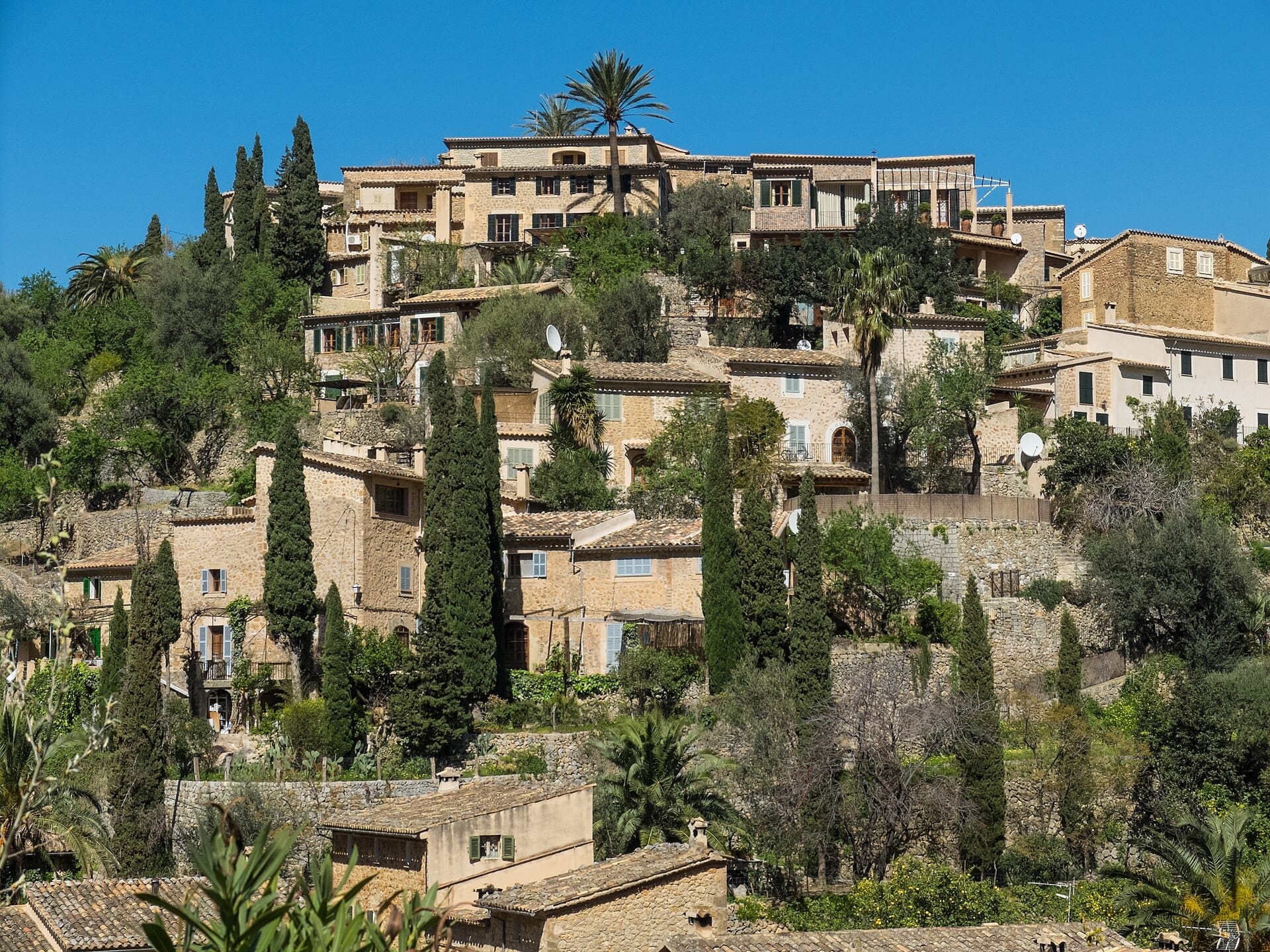
Arriving from Palma on the Ma-10, the road narrows through curves cut into the mountainside before the village appears above you in layers: stone walls, terracotta roofs, a church tower, and tall cypress trees. The first impression is of something built specifically to be part of the landscape rather than placed on top of it. The ochre and grey limestone used in the older buildings blends with the surrounding rock in a way that makes the village look like it grew here organically.
The dominant smell as you walk the upper lanes is olive and wild herb, particularly in warm months when the sun draws out the oils from the low scrub on the hillsides. In the colder months, wood smoke filters through from houses along the narrow stone streets. The terraced olive groves on the slopes below the village are ancient; the Moorish irrigation systems that shaped this agricultural landscape date from the era of Muslim settlement between roughly the 10th and 13th centuries, and many of the terrace walls in this region are still maintained and in agricultural use.
The Serra de Tramuntana context matters here. If you want to understand why this whole northwest coast looks and feels different from the beach resorts of the east and south, the guide to the Tramuntana region explains the geography and what else is worth exploring along this stretch.
Tickets & tours
Hand-picked options from our booking partner. Prices are indicative; availability and final rates are confirmed when you complete your booking.
Dinosaurland and Caves of Hams combined ticket
From 25 €Instant confirmationFree cancellationShuttle Boat from Cala Millor to Cala Ratjada
From 26 €Instant confirmationFree cancellation3-hour Es Trenc Boat Tour in Mallorca
From 39 €Instant confirmationFree cancellationShuttle Boat Roundtrip from Cala Bona to Cala Ratjada
From 29 €Instant confirmationFree cancellation
The Robert Graves Connection
The English poet and novelist Robert Graves arrived in Deià in the 1930s, left during the Spanish Civil War, and returned in 1946. He lived here until his death in 1985. Graves is best known internationally for his historical novels I, Claudius and Claudius the God, though his poetry is what he considered his most serious work. His home, La Casa de Robert Graves, is now a museum dedicated to his life and work.
Graves is buried in the churchyard of Sant Joan Baptista, the 16th-century church that sits at the top of the village. The grave is simple: a flat stone with his name and dates, among other village residents in a small hillside cemetery with long Mediterranean views. It is one of those understated places that rewards a moment of quiet attention. The church itself dates from when Deià became independent from Valldemossa in 1583, though it has been modified over subsequent centuries.
Graves attracted a loose colony of writers, painters, and musicians over the decades. That legacy has given Deià an arts-focused identity, reflected in the small galleries along the main street and the occasional cultural events held in summer. The Deià International Music Festival runs during summer months and draws a serious classical audience, though dates and programming should be verified in advance through current sources.
How the Village Changes by Time of Day
Deià has a pronounced rhythm tied to the day-trip pattern. Tour buses and car convoys tend to arrive from mid-morning onward. By around 11am, the main street through the village can feel congested. From 1pm, many day visitors cluster around the handful of restaurants, and the lanes become quiet again in the late afternoon as people return toward Palma or their hotels along the coast.
The best time to walk the village is early morning, before 9am, or from around 5pm onward. In that window, the light is also more useful for photography: the low sun picks out the texture of the stone and the olive-silver of the groves below. Midday light in summer is harsh and flat for photography and genuinely hot for walking steep lanes.
If you stay in or near Deià overnight (there are several hotels in the village and immediate surroundings, ranging from simple to high-end), the village after dark has a completely different character: quiet, dark, and with clear mountain air that carries the sound of distant waves if you walk toward the upper terraces.
⚠️ What to skip
Parking in Deià is genuinely limited. The small lot near the church fills quickly on weekends and in July and August. Arriving before 9am avoids this entirely. In summer, consider leaving your car at Sóller and taking the bus or taxi the short distance to Deià.
Cala Deià: The Walk Down to the Sea
Deià is not a beach village in the conventional sense, but a rocky cove called Cala Deià sits roughly 1.5 km from the village center, accessible via a paved lane that drops steeply to the sea. This is not a sandy beach; it is a shingle and rock cove hemmed in by cliffs with clear, cold water and a seasonal beach bar-restaurant. The walk down takes around 20–25 minutes at a comfortable pace. The return is a significant uphill effort, and in summer heat it should not be underestimated.
In July and August, the cove is popular and space on the rocks is limited. In May, June, September, or October, it is far more workable and the water is still warm enough to swim. The cove is a known snorkeling spot due to the clarity of the water and the rocky underwater terrain. Bring water and footwear with grip for the rocky entry into the sea.
The northwest coast has several wild coves and dramatic coastal routes worth comparing. The overall context of walking and hiking in Mallorca's mountains includes routes from Deià to Sóller along the coast, which is one of the better half-day walks on the island.
Practical Walkthrough of the Village
The village is small enough that a full exploration on foot takes 45–90 minutes without rushing. The logical route is to park near the bottom of the village, walk up through the main street (Carrer Arxiduc Lluís Salvador), continue to the church and cemetery at the top for the views, then take the smaller lanes back down. These back lanes, particularly those on the northern side of the hill, are where the residential character of Deià is most apparent and where the tourist overlay disappears.
The main street has a few cafes, a small supermarket, some art galleries, and a ceramics shop. Restaurant prices at the village's more established establishments tend to run notably higher than Mallorcan averages, reflecting both the prestige address and the logistics of supplying a mountain village. Budget travelers should note that a simple lunch here will cost more than in Palma or Sóller. If that matters, bring a picnic and eat at the churchyard benches with the view.
Deià's terrain is inherently hilly and the stone streets are uneven. Wheelchair access is limited to the main road through the village; the upper church area and the back lanes are not accessible for most mobility aids. This is an honest limitation of a medieval hill village and not something infrastructure can easily change.
Deià works well as part of a wider northwest loop. The nearby village of Valldemossa is 10–16 km south and is the more touristically developed of the two, while Sóller and its port offer a more complete half-day and are only a short drive northeast.
Who Should Reconsider Visiting
Deià is genuinely overhyped in certain travel media as an exotic or undiscovered place. It is neither. In July and August, the village receives significant tourist traffic for its size, and the experience on the main street can feel like a slow procession rather than a quiet mountain escape. If you are traveling in peak summer and have limited time on the island, a 30-minute stop for a photo from the churchyard and a walk back down is probably enough.
Travelers who cannot manage steep uphill walking will be limited to the main road level. The cove walk is not suitable for anyone with significant mobility challenges. And if you have no interest in landscape, literary history, or walking, Deià offers little that other Mallorcan experiences provide more directly.
Insider Tips
- The churchyard at Sant Joan Baptista has a low stone wall on its western edge with one of the cleanest, least-obstructed views of the olive terraces dropping toward the sea. Most people photograph the church facade and miss it entirely.
- The TIB bus line 210 connects Palma to Deià via Valldemossa and continues to Sóller. It allows a car-free northwest coast day if you plan around the timetable, which is sparse. Check current schedules at tib.org before relying on it.
- La Casa de Robert Graves museum is not large, but it rewards visitors who know something about Graves beforehand. Reading even a short summary of his life before visiting transforms it from a furnished house into a genuinely specific portrait of a working writer's daily life.
- The lane to Cala Deià is signposted but easy to miss if you are on foot in the village. Ask locally or check a map before starting, as there are a couple of private farm tracks that appear similar and do not reach the cove.
- In late January to February, the almond trees on the lower slopes around Deià are in blossom, and the combination of white flowers, grey stone, and winter light is one of the more distinctive seasonal images in this part of Mallorca. Crowds at that time of year are minimal.
Who Is Deià For?
- Photographers working in early morning or late afternoon light
- Travelers interested in 20th-century literary history and Robert Graves
- Walkers using Deià as a base or waypoint on the Tramuntana coastal route toward Sóller
- Couples or small groups looking for a slower, more contemplative half-day away from beach crowds
- Visitors in spring or autumn who want to see the Tramuntana landscape without summer heat or congestion
Nearby Attractions
Other things to see while in Serra de Tramuntana:
- Fornalutx
Perched in the Serra de Tramuntana above Sóller, Fornalutx is a compact stone village of about 700 people that has won national recognition for how well it has been preserved. The streets are steep, the buildings are honey-coloured, and the orange groves press in close on every side. Entry is free, the walk takes one to two hours, and it pairs naturally with a day in Sóller.
- Jardines de Alfabia
Set against the Serra de Tramuntana mountains, Jardines de Alfabia is a layered estate with roots in 13th-century Moorish Mallorca. Its terraced gardens, vaulted cistern, famous water pergola, and Baroque manor house make it one of the island's most rewarding half-day visits for anyone interested in history, botany, or architecture.
- Mallorca Cycling (Sa Calobra & Tramuntana Routes)
The Sa Calobra climb is the centerpiece of road cycling in Mallorca, winding 9.5 km through 26 hairpin bends into the heart of the UNESCO-listed Serra de Tramuntana. Whether you're a seasoned climber chasing Strava times or a touring cyclist exploring one of Europe's most dramatic mountain landscapes, these routes deliver scenery and challenge in equal measure.
- Sa Calobra & Torrent de Pareis
Sa Calobra and the Torrent de Pareis form one of the most striking natural landscapes in the western Mediterranean: a 300-metre-deep limestone gorge that opens onto a sheltered pebble beach. The journey to reach it, whether by the legendary corkscrew road or by boat from Sóller, is half the experience.