Valldemossa: Mallorca's Mountain Village Worth the Drive
Perched at over 400 metres in the Serra de Tramuntana, Valldemossa is one of Mallorca's most photogenic and historically layered villages. Its centrepiece, the Royal Charterhouse, draws visitors for its connection to Frédéric Chopin and George Sand, while the surrounding stone lanes, terraced gardens, and mountain panoramas make even a slow wander rewarding.
Quick Facts
- Location
- Serra de Tramuntana, 17 km northwest of Palma. Postcode: 07170
- Getting There
- Bus 210 from Palma (Estació Intermodal); by car ~20-25 min via Ma-1110. No rail connection.
- Time Needed
- 2–3 hours for the village and Charterhouse; half-day if you linger over lunch
- Cost
- Village streets: free. Real Cartuja (Charterhouse) museum: verify current admission at official site
- Best for
- History buffs, architecture lovers, day-trippers from Palma, Tramuntana road-trippers
- Official website
- www.visitvalldemossa.es/en
What Valldemossa Actually Is
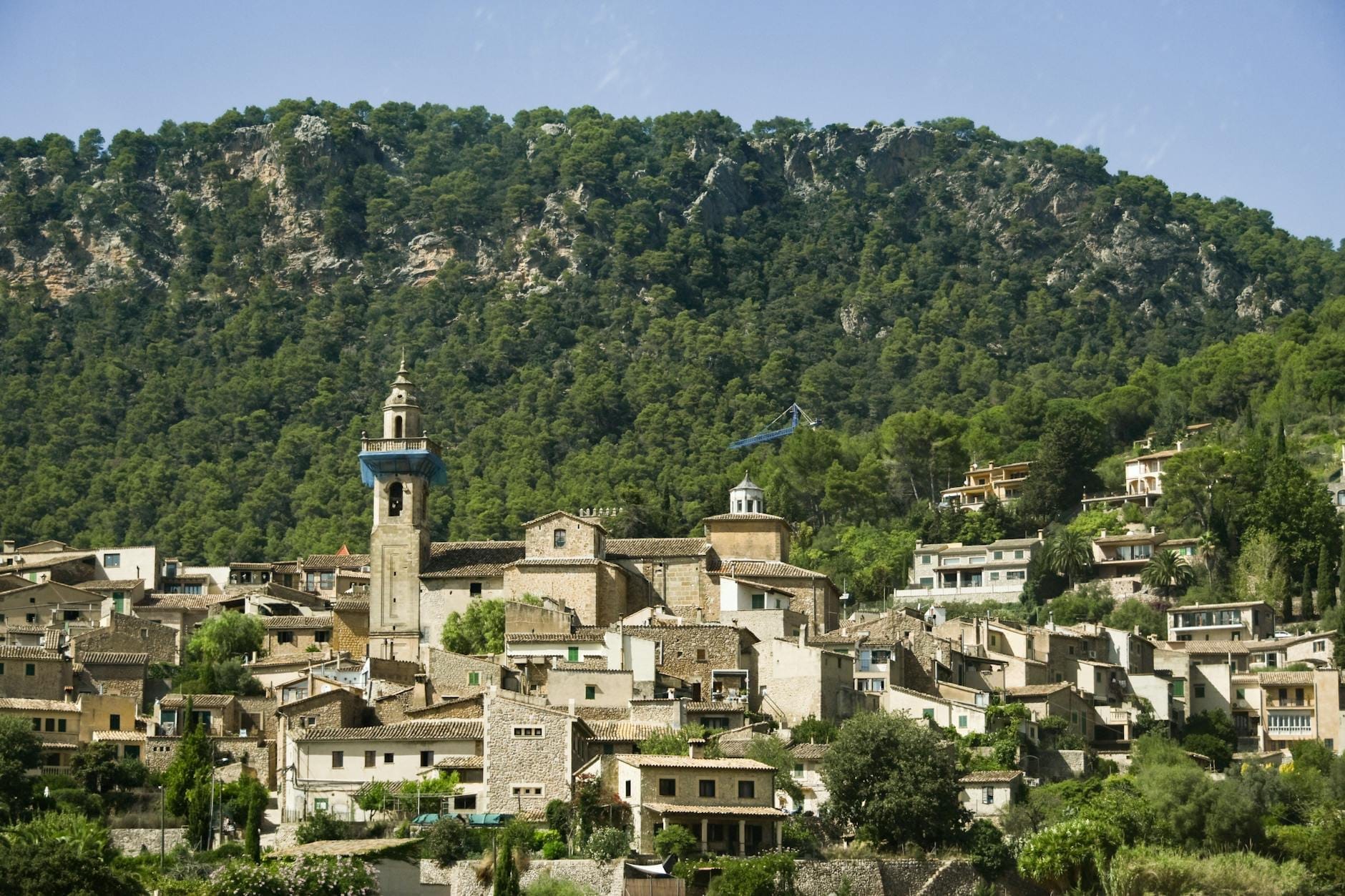
Valldemossa is a small municipality of roughly 2,000 residents sitting at between 413 and 437 metres above sea level, making it the highest town in the Balearic Islands. The name derives from 'Vall de Mossa', the Valley of Mussa, a reference to the Arab nobleman who held the land before the Christian conquest of Mallorca in 1229. That layered past, Moorish origins, a medieval royal palace, a Carthusian monastery, and a famous winter visit by two 19th-century European celebrities, gives the village a cultural density unusual for somewhere so small.
The surrounding landscape is part of the Serra de Tramuntana, designated a UNESCO World Heritage Cultural Landscape in 2011. Arriving by road, the approach through terraced olive groves and steep rock faces gives you a clear sense that this is not a coastal resort village. The architecture is stone-heavy and austere in the Mallorcan highland style: narrow lanes, flower-hung doorways, and the occasional trough fed by mountain spring water.
💡 Local tip
Arriving before 10am or after 4pm keeps you ahead of tour groups. Midday in summer sees the village centre at its most crowded, particularly around the Charterhouse entrance.
The Royal Charterhouse: The Main Event
The Real Cartuja de Valldemossa, or Royal Charterhouse, is the attraction that anchors most visits. Its origins go back to the early 14th century, when King James II of Mallorca had a royal palace built on the site for his son Sancho I. In 1399, the palace was handed to Carthusian monks who converted it into a monastery. The monks were eventually expelled during the liberal reforms of 1835, and the monastic cells were subsequently rented out as accommodation, which is how Frédéric Chopin and writer George Sand came to spend the winter of 1838 to 1839 here.
That winter stay became famous partly because of Sand's account of it in 'A Winter in Majorca', a book that was not especially flattering about the Mallorcan people but did far more than any promotional effort to put Valldemossa on the map. Chopin composed several of his Preludes during those months. Today, cell 2 and cell 4 of the monastery are set up as a museum dedicated to the pair, with period furniture, Chopin's piano, and manuscript pages on display. The wider Charterhouse complex also contains a pharmacy with original 18th-century ceramic jars, a Baroque church, and rooms holding works by the Mallorcan painter Josep Maria Sert.
The Charterhouse is open to visitors as a museum. Admission fees apply and opening hours vary by season, so check the official site or the Palma Cathedral visitor page for current practice on pre-booking, as the pattern is similar for major Mallorcan heritage sites. Photography inside is sometimes restricted in specific rooms.
ℹ️ Good to know
The Charterhouse hosts regular piano recitals in tribute to Chopin, particularly in spring and summer. Schedules are posted on the visitvalldemossa.es official website.
Tickets & tours
Hand-picked options from our booking partner. Prices are indicative; availability and final rates are confirmed when you complete your booking.
Historic trail of Archduke Ludwig Salvador in Valldemossa
From 76 €Instant confirmationFree cancellationDinosaurland and Caves of Hams combined ticket
From 25 €Instant confirmationFree cancellationShuttle Boat from Cala Millor to Cala Ratjada
From 26 €Instant confirmationFree cancellation3-hour Es Trenc Boat Tour in Mallorca
From 39 €Instant confirmationFree cancellation
Walking the Village: Beyond the Charterhouse
The lanes radiating out from the Charterhouse square reward a slow, directionless walk. Stone facades are frequently decorated with terracotta pots planted with geraniums and herbs, a tradition so consistent it feels almost curated, though locals maintain it genuinely. The smell in these lanes shifts depending on season: orange blossom in late winter and early spring, dried lavender and warm stone through summer, woodsmoke from chimneys in November.
At Carrer de la Rectoria 5, a small shrine marks the birthplace of Santa Catalina Thomàs (1531–1574), Mallorca's patron saint. She was born in Valldemossa and later became a nun in Palma, where she was canonised. Locals maintain a devotion to her that is visible in the tiled plaques and small offerings left at the shrine. It is a quiet, unshowy spot that most visitors walk past without noticing.
The upper part of the village opens onto viewpoints looking northwest toward the Tramuntana ridgeline. These require no specific access and are simply reached by following the lanes uphill. In the early morning, before tour groups arrive, the light falls directly onto the stone facades and the terraced gardens below. This is the most photographically rewarding window of the day.
Valldemossa makes a natural anchor point for a Tramuntana road trip, sitting roughly halfway between Palma and the villages of Deià and Sóller to the north.
How the Village Changes Through the Day
Morning arrivals before 9:30am find Valldemossa closest to its everyday self. Locals are out, the bakeries are open, and the ensaimada, Mallorca's spiral pastry dusted in icing sugar, is at its freshest. The village produces its own variant: coca de patata, a soft potato-based roll that is a local speciality. You will find it sold in small shops near the main square, often still warm.
Between 11am and 2pm from April through October, the village absorbs a significant volume of day-trippers and coach tours. The Charterhouse queue can stretch, the souvenir shops do brisk business, and the narrow lane by the entrance becomes difficult to walk against the flow of traffic. This is worth knowing if you find crowds tiring rather than energising.
By late afternoon, the coaches have gone. The light turns gold against the stone, the restaurants fill with a calmer crowd, and the village returns to a more relaxed pace. If you are combining Valldemossa with other Tramuntana stops, consider reversing the usual order and saving it for the late afternoon rather than treating it as a morning tick-box.
⚠️ What to skip
Parking in the village centre is very limited. The main car park sits below the village on the approach road. In peak summer, it fills by 10am. Arriving by bus or very early by car is strongly advisable.
Getting There and Getting Around
From Palma, bus line 210 runs from the Estació Intermodal and takes approximately 30 to 40 minutes depending on traffic. Timetables change seasonally, so check current schedules via the TIB (Transport de les Illes Balears) website before travel. For guidance on navigating Mallorca's broader bus and rail network, the getting around Mallorca guide covers the full picture including the scenic Sóller train, which departs from Palma for the northwest but does not stop at Valldemossa itself.
By car, the drive from Palma takes around 25 minutes via the Ma-1110. The road is well-maintained but includes hairpin bends as you gain altitude. Cyclists frequently use this route as part of the Tramuntana circuit; if you are driving, allow space when passing them. Those planning to continue by bike should look at the cycling in Mallorca guide for route detail and gradient profiles.
Within the village, the historic centre is largely car-free. Wear comfortable shoes with grip: the cobblestones and stepped lanes are uneven and can be slippery when wet. Mobility-limited visitors should be aware that the village terrain is hilly and mostly unpaved, which makes wheelchair access genuinely difficult in the upper lanes, though the area around the Charterhouse entrance is more level.
Honest Assessment: Who Gets the Most From Valldemossa
Valldemossa is genuinely attractive and historically interesting, but the volume of visitors it receives means the experience during peak hours can feel thin relative to the effort of getting there. The Charterhouse is worth the admission for anyone interested in 19th-century European cultural history, Romantic-era music, or Balearic monastic architecture. For those who are not particularly drawn to any of those things, the museum may feel like a series of period rooms without much narrative pull.
The village itself is not overhyped in the way that some Mallorcan spots are. The architecture is authentic, the streets have not been sanitised for tourism, and there are still working residents going about ordinary business. But it is also not a living secret. Expect other tourists, expect souvenir shops selling Chopin-branded olive oil, and plan your timing accordingly.
Travellers with only one or two days on the island should weigh Valldemossa against other Tramuntana destinations. The village of Deià to the north is smaller, quieter, and arguably more dramatically set, though it has fewer organised attractions. The village of Fornalutx near Sóller is similarly well-preserved and significantly less visited. For those with a week or more, all three are worth combining into a single day along the Tramuntana route.
Travellers who struggle with steep terrain, crowded lanes, or coach-group tourism patterns will find midsummer visits frustrating. Those who prefer to spend their time on beaches rather than stone villages will not find Valldemossa rewarding at all, and the nearest beach requires a descent of several kilometres to Port de Valldemossa, which is small and without much infrastructure.
Insider Tips
- The coca de patata (local potato roll) is sold in small bakeries near the main square, not in the souvenir shops. It is the most distinctively local food item in the village and worth seeking out at breakfast.
- The shrine to Santa Catalina Thomàs at Carrer de la Rectoria 5 is easy to miss and worth a few minutes. It gives a sense of the village's devotional character that the Charterhouse, as a museum, cannot quite convey.
- If you plan to visit the Charterhouse, check whether a Chopin recital coincides with your visit. Attending one in the monastery itself is a qualitatively different experience from viewing the rooms in silence.
- The upper lanes of the village, above the Charterhouse, reach open viewpoints toward the northwest Tramuntana ridgeline. They take fewer than ten minutes to walk to and most day-trippers never reach them.
- Coming by bus from Palma gives you a fixed departure point and removes parking stress entirely. The last bus back to Palma is typically in the early evening, so check the timetable before you leave the city.
Who Is Valldemossa For?
- History and architecture enthusiasts drawn to medieval monastic buildings and the Chopin-George Sand connection
- Tramuntana road-trippers using Valldemossa as one stop on a longer mountain circuit
- Photographers who can arrive before 9:30am for the morning light on stone facades and terraced gardens
- Travellers interested in Mallorcan religious and cultural history, including the veneration of Santa Catalina Thomàs
- Day-trippers from Palma looking for a half-day excursion with clear historical content
Nearby Attractions
Other things to see while in Serra de Tramuntana:
- Deià
Perched above olive groves on the northwestern cliffs of Mallorca's Serra de Tramuntana, Deià has drawn artists, writers, and travelers for decades. The honey-colored stone houses, the smell of wild rosemary on the lane up to the church, and the long views over the Mediterranean make it genuinely special. But it rewards slow visitors, not quick stop-and-snap day-trippers.
- Fornalutx
Perched in the Serra de Tramuntana above Sóller, Fornalutx is a compact stone village of about 700 people that has won national recognition for how well it has been preserved. The streets are steep, the buildings are honey-coloured, and the orange groves press in close on every side. Entry is free, the walk takes one to two hours, and it pairs naturally with a day in Sóller.
- Jardines de Alfabia
Set against the Serra de Tramuntana mountains, Jardines de Alfabia is a layered estate with roots in 13th-century Moorish Mallorca. Its terraced gardens, vaulted cistern, famous water pergola, and Baroque manor house make it one of the island's most rewarding half-day visits for anyone interested in history, botany, or architecture.
- Mallorca Cycling (Sa Calobra & Tramuntana Routes)
The Sa Calobra climb is the centerpiece of road cycling in Mallorca, winding 9.5 km through 26 hairpin bends into the heart of the UNESCO-listed Serra de Tramuntana. Whether you're a seasoned climber chasing Strava times or a touring cyclist exploring one of Europe's most dramatic mountain landscapes, these routes deliver scenery and challenge in equal measure.