Cathedral of Santa Maria of Palma (La Seu): What to Know Before You Go
La Seu, Palma's Gothic cathedral, rises from the seafront with astonishing scale: a 44-metre nave, 61 stained-glass windows, and a rose window among the largest ever built. Construction began after the Christian reconquest of 1229–1230 and continued across four centuries, producing one of the Mediterranean's most architecturally ambitious sacred buildings.
Quick Facts
- Location
- Plaça de la Seu, s/n, 07001 Palma — waterfront edge of the old town, beside the Royal Palace of La Almudaina
- Getting There
- 15-minute walk from Plaça d'Espanya; reachable by city bus or taxi; parking available near Parc de la Mar
- Time Needed
- 60–90 minutes for the interior and museum; add 20 minutes if you walk the seafront promenade before or after
- Cost
- Paid admission (check official site for current rates); timed entry slots required
- Best for
- Architecture enthusiasts, history travellers, photography, cultural sightseeing
- Official website
- catedraldemallorca.org
First Impressions: Scale That Earns Its Reputation
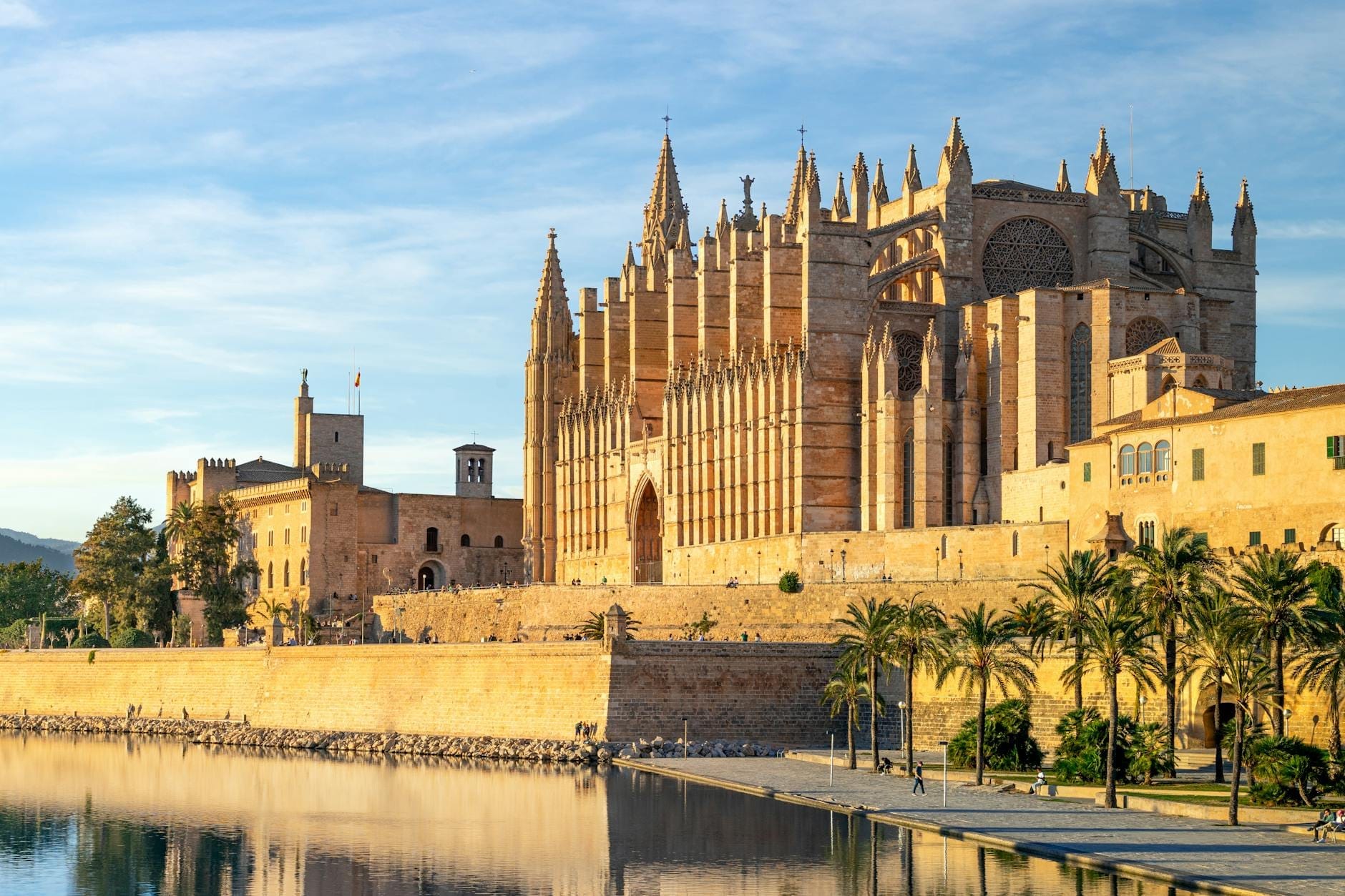
The Cathedral of Santa Maria of Palma, known universally as La Seu, does not ease you in gently. Approaching along the waterfront promenade, the building appears almost improbably large for its setting: golden limestone walls climbing above the old city ramparts, flying buttresses spreading like outstretched arms, and the whole mass reflected in the still water of Parc de la Mar on calm mornings. Palma's skyline is defined by this structure, and that reputation is not overstated.
The dimensions are worth knowing in advance, because they help frame what you are looking at. The interior is 109.5 metres long and 33 metres wide, covering roughly 6,600 square metres. The central nave rises to 44 metres, making it one of the tallest Gothic naves in the world. Narrow pillars, each only one-twelfth as wide as the vault they support, create the impression that the roof is floating unsupported above you. The architects who designed this between the 14th and 17th centuries were pushing the structural limits of stone-and-mortar Gothic engineering.
💡 Local tip
Book timed-entry tickets online before your visit, especially in summer. Walk-up queues can be long, and tourist visiting hours are limited — the cathedral closes at 2:15 PM on Saturdays and typically between 3:15 and 5:15 PM on weekdays depending on the season. Always check the official website, as hours vary between summer and winter.
The Architecture: Gothic Ambition on a Mediterranean Shore
La Seu is classified as Gothic, but that label covers several centuries of decision-making and revision. Construction began following the Christian reconquest of Palma in 1229, when King James I ordered the conversion of the main mosque into a church. The Chapel of the Holy Trinity, the oldest surviving section, was consecrated in 1327. The current form of the cathedral largely dates from 1386 onward, with construction continuing well into the 17th century. The result is a building that speaks several architectural dialects at once while still reading as coherent from the outside.
The light inside is one of the defining experiences. La Seu has 61 stained-glass windows, and the rose window above the altar is approximately 14 metres in diameter, making it one of the two largest Gothic rose windows still intact anywhere in the world. On a clear morning, when sunlight passes through the eastern rose window, the interior fills with shifting rings of colour across the stone floor. This effect lasts roughly an hour and is most dramatic between late February and mid-October, when the sun's angle aligns directly with the window. It draws photographers specifically, and for good reason.
Antoni Gaudí was commissioned to restore parts of the interior between 1904 and 1914, and his interventions are visible if you know where to look: the repositioned altar canopy, the ceramic mosaics, and the ironwork lamp holders suspended from the nave columns. These additions are sometimes controversial among purists, but they give the space an unusual layering of eras that rewards careful observation.
Tickets & tours
Hand-picked options from our booking partner. Prices are indicative; availability and final rates are confirmed when you complete your booking.
Palma de Mallorca 30-minute Jet Ski Tour with Visit to the Cathedral
From 99 €Instant confirmationFree cancellationPalma de Mallorca: Small-Group Tour & Fast-Track Cathedral
From 59 €Instant confirmationFree cancellationCity Sightseeing hop-on hop-off bus tour of Palma de Mallorca
From 0 €Instant confirmationCity Sightseeing hop-on hop-off bus tour of Palma de Mallorca
From 23 €Instant confirmation
Visiting by Time of Day: How the Experience Changes
Morning is the most rewarding time to visit, particularly in the first hour after opening at 10:00 AM. Crowds are thinner, the light through the eastern windows is at its most dramatic, and the air inside retains a coolness from the night that disappears by late morning in summer. The stone floor is smooth and cool underfoot, and the sound inside at this hour is close to silence, which amplifies the spatial quality of the nave considerably.
By midday, tourist groups begin to fill the three parallel naves, and the acoustic character changes completely. The stone amplifies sound efficiently, so a crowded La Seu is a genuinely noisy place. If your interest is contemplative rather than educational, aim for the opening slot. That said, tourist visiting hours end relatively early (2:15 PM on Saturdays, between 3:15 and 5:15 PM on weekdays depending on season), so there is no late afternoon option. The exterior, however, is free to walk around at any hour, and the view from the Parc de la Mar across the water toward the facade is arguably best at dusk, when the stone takes on amber tones.
ℹ️ Good to know
La Seu is a working Catholic cathedral, not only a museum. Religious services take place regularly, and parts of the interior may be closed to tourists during worship hours. Respect is expected: keep voices low and dress appropriately (covered shoulders and knees).
The Museum and Treasury
The cathedral museum occupies rooms adjacent to the nave and contains liturgical objects, historical vestments, altarpieces, and silverwork accumulated across centuries. It is smaller than the main space and often overlooked by visitors focused on the nave, but it contains context that helps explain the cathedral's role in Mallorcan religious and civic life. Several Gothic altarpieces from the medieval period are displayed here and are worth the additional few minutes.
Entry to the museum is typically included with the main cathedral ticket, but confirm this when purchasing. The museum section is cooler and quieter than the nave, and it offers a useful pause if the main space feels overwhelming.
The Setting: La Seu Within Palma's Old Town
La Seu sits at a geographical hinge point in Palma, between the old Arab city walls and the sea. Immediately to the west stands the Palace of La Almudaina, the former royal palace now open to visitors as a museum. To the south, the Parc de la Mar forms a linear park between the cathedral ramparts and the coastal road, with a shallow artificial lake that provides the iconic reflection view most commonly seen in photographs. Walking this promenade before entering the cathedral gives you the full sense of the building's relationship with the waterfront.
The neighbourhood surrounding La Seu is the historic core of Palma's old town, dense with narrow streets, small squares, and historic buildings. The Episcopal Palace is immediately adjacent to the cathedral's north side. Within ten minutes on foot, you can reach the Arab Baths, La Llotja, and the Passeig del Born, which makes La Seu a natural anchor for a morning walking circuit through central Palma.
For a broader sense of what Palma's historic centre contains and how to organise your time, the things to do in Mallorca guide covers the city alongside island-wide attractions.
Photography at La Seu: Practical Notes
Photography is permitted inside the cathedral without flash. The interior lighting is low and the spaces are vast, so a camera or phone that handles low-light conditions well is worth bringing. The rose window requires shooting toward the light source, which means metering carefully or shooting in HDR mode. Tripods are generally not permitted inside.
The exterior offers multiple strong angles. The view from Parc de la Mar, with the reflection in the lake, works best on calm days with no wind. Early morning gives the softest light on the southern facade. Dusk from the water side, looking back toward the city, produces warm stone tones that photographs well. If Palma photography is a priority, the Mallorca photography guide covers the best spots and timing across the island.
⚠️ What to skip
The rose window light effect (sunlight illuminating the nave floor through the eastern window) is weather-dependent and angle-dependent. Overcast skies eliminate it entirely. Do not plan your entire visit around this feature, but treat it as a welcome bonus if conditions align.
Honest Assessment: Is La Seu Worth the Ticket Price?
La Seu is genuinely one of the most architecturally significant Gothic buildings in the western Mediterranean. It is not overhyped in that respect. The sheer scale of the nave interior, the quality of the stained glass, and the Gaudí additions combine to create an experience that goes beyond a standard cathedral visit. For travellers with an interest in architecture, history, or sacred art, this is a serious attraction that rewards the time.
That said, visitors expecting an uncrowded, contemplative experience during peak summer months may find the reality disappointing. Tour groups move through the space in waves, audio guides create overlapping commentary, and the physical conditions inside can become warm and crowded by late morning. If the cathedral context matters more to you than the building itself, or if crowds significantly affect your enjoyment of enclosed spaces, consider visiting in shoulder season (April through May, or September through October) or targeting the first entry slot of the day.
Travellers who want to understand when to visit Palma and Mallorca more broadly to avoid peak crowds should read the best time to visit Mallorca guide, which breaks down conditions month by month.
Insider Tips
- Book the earliest available timed-entry slot online. The 10:00 AM opening sees the fewest visitors and the best morning light through the eastern windows. By 11:30 AM, large tour groups dominate the nave.
- Fridays tend to be the busiest weekday. If possible, visit Monday through Thursday instead for a noticeably quieter experience.
- Walk the Parc de la Mar promenade before entering, not after. Seeing the full scale of the exterior from across the lake reframes everything you see inside. Most visitors do this the wrong way around and miss the spatial context.
- Look up at the pillar bases near the Gaudí-designed altar canopy. The ironwork and ceramic details at mid-height are easy to miss when you are focused on the vault above, but they represent the most concentrated example of Gaudí's intervention in the space.
- The bishop's garden, located behind the Episcopal Palace adjacent to the cathedral, is often overlooked and provides a quiet green space immediately after your visit. It is free to enter and takes about 15 minutes to walk through.
Who Is Cathedral of Santa Maria of Palma (La Seu) For?
- Architecture and design enthusiasts who want to understand how Gothic construction was pushed to its structural limits
- History travellers tracing Mallorca's transition from Islamic to Christian rule after 1229
- Photographers seeking both interior detail shots and the iconic Palma waterfront exterior view
- Travellers building a half-day walking circuit through Palma's old town, using La Seu as the anchor point
- Visitors in shoulder season (spring or autumn) who want a meaningful cultural experience without peak summer crowds
Nearby Attractions
Other things to see while in Palma de Mallorca:
- Arab Baths (Banys Àrabs)
The Banys Àrabs are the only intact remnant of Palma's Islamic past, dating to the 10th or 11th century. Compact but genuinely atmospheric, this ancient hammam in the heart of the old city takes less than an hour to visit and rewards anyone with even a passing interest in history.
- Bellver Castle
Perched on a pine-covered hill 3 km west of Palma's city centre, Bellver Castle is one of Europe's rare circular Gothic fortresses. Built under King Jaume II and completed around 1311, it has served as a royal residence, a prison, and now houses the Palma Municipal History Museum. The views over Palma Bay alone justify the climb.
- Bishop's Garden (Jardí del Bisbe)
Tucked behind the towering walls of Palma Cathedral, the Jardí del Bisbe is a small formal garden on the grounds of the Episcopal Palace. Free to enter and often overlooked by visitors rushing between La Seu and the seafront, it offers citrus groves, herb beds, an ornamental pond, and a rare ground-level view of the cathedral's famous rose window.
- Es Baluard Museum of Modern & Contemporary Art
Es Baluard Museu d'Art Contemporani de Palma occupies a Renaissance bastion on the old city walls, combining 800-plus works of modern and contemporary art with sweeping views over Palma Bay. It is one of the most architecturally striking museum settings in the Balearic Islands, and far less crowded than the cathedral a few minutes' walk away.