Jardí del Bisbe (Bishop's Garden): Palma's Quiet Garden Behind the Cathedral
Tucked behind the towering walls of Palma Cathedral, the Jardí del Bisbe is a small formal garden on the grounds of the Episcopal Palace. Free to enter and often overlooked by visitors rushing between La Seu and the seafront, it offers citrus groves, herb beds, an ornamental pond, and a rare ground-level view of the cathedral's famous rose window.
Quick Facts
- Location
- Carrer de Sant Pere Nolasc, 6, Palma Old Town — behind La Seu Cathedral
- Getting There
- Walkable from Palma city centre; nearest bus stops serve the cathedral area on Avinguda de Gabriel Roca
- Time Needed
- 20 to 40 minutes
- Cost
- Free entry
- Best for
- A calm pause between sightseeing, garden lovers, photography, families with young children
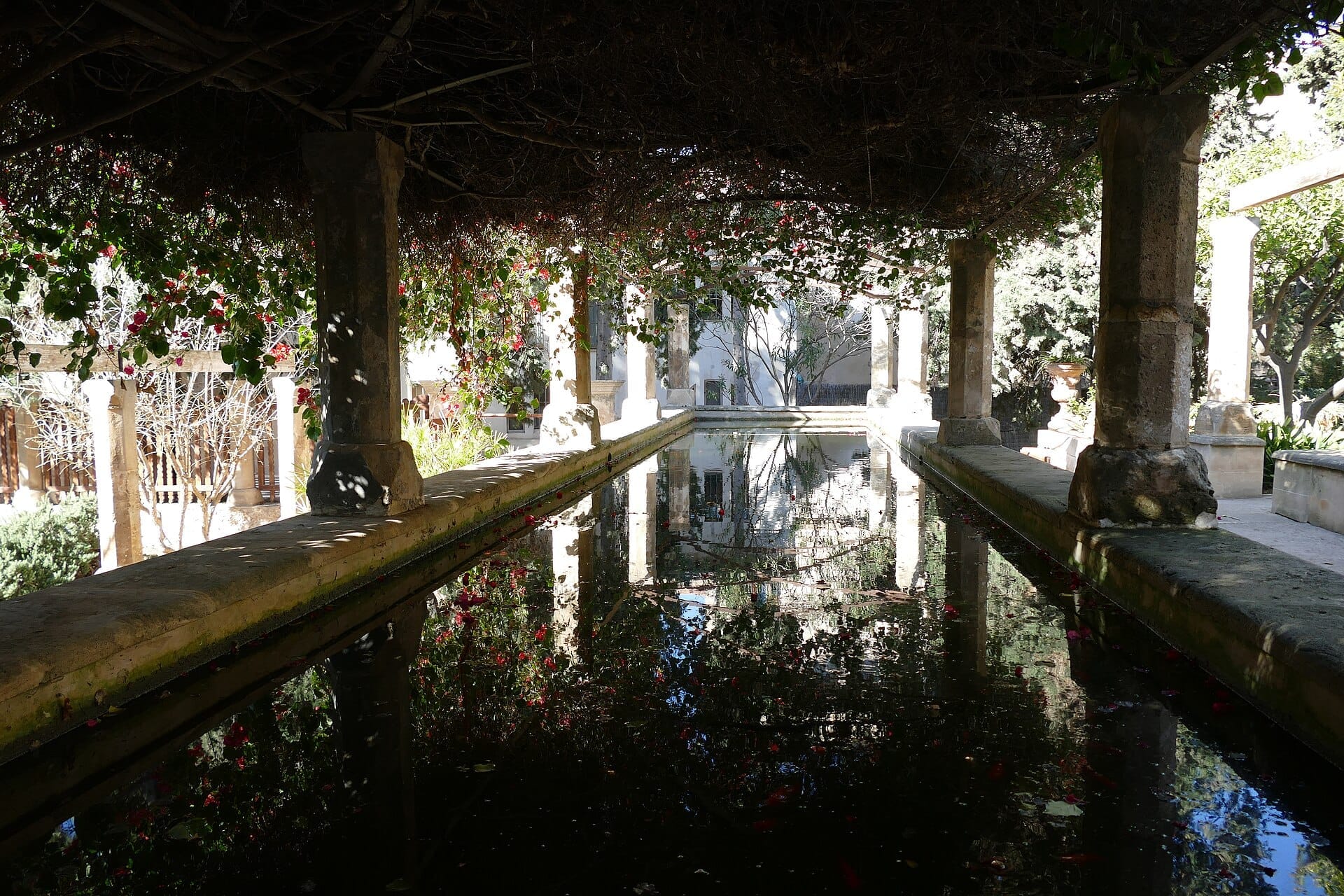
What the Jardí del Bisbe Actually Is
The Jardí del Bisbe is a compact formal garden attached to Palma's Episcopal Palace, sitting in the shadow of La Seu Cathedral in the heart of the old city. Its name translates simply as the Bishop's Garden, reflecting its centuries-long role as a private retreat for the ecclesiastical authorities who occupied the adjacent palace. The garden was restored and opened to the public by Palma Council around 2000, which explains why it remains largely unknown to casual visitors: it only recently became accessible, and it rarely makes the front of tourist maps.
Entrance is through a Mannerist-style stone gate built in 1931, which sets an appropriately quiet, slightly formal tone before you step inside. The garden is small enough to cross in two minutes, but small is not the same as simple. The layout follows a classical cross-shaped Renaissance plan, with a central ornamental pond as its focal point. Around it, citrus trees heavy with oranges and lemons, low herb beds of rosemary, mint, and basil, and a modest vegetable patch give the space a working, lived-in character rather than the manicured sterility of a decorative municipal garden.
💡 Local tip
The gate on Carrer de Sant Pere Nolasc can look locked even when the garden is open. Push it gently — it often swings inward. Verify opening hours locally before visiting, as they are not published on a dedicated official website.
The View That Makes It Worth the Detour
Most people approach Palma Cathedral from the seafront promenade or Parc de la Mar, looking up at its southern façade from below. The Jardí del Bisbe gives you something different: a direct, close-range view of the cathedral's northern side, including its celebrated rose window. From inside the garden, the window sits at roughly eye level with the upper garden terrace, framed by palm fronds and the pale stone of the palace walls. It is one of the better photographic angles of La Seu that most visitors never find.
The rose window itself is a Gothic masterpiece, approximately 11.5 metres in diameter and one of the largest of its kind in the world. Seeing it from the garden at ground level, rather than from a boat or a distant plaza, gives a more accurate sense of its scale. If you want to understand the full architectural ambition of Palma Cathedral, starting your visit here before entering the cathedral adds meaningful context.
Tickets & tours
Hand-picked options from our booking partner. Prices are indicative; availability and final rates are confirmed when you complete your booking.
Banana Boat Experience in Mallorca
From 14 €Instant confirmationFree cancellationPalma de Mallorca 30-minute Jet Ski Tour with Visit to the Cathedral
From 99 €Instant confirmationFree cancellationSnorkel Tour in Mallorca
From 40 €Instant confirmationFree cancellationPalma de Mallorca: Small-Group Tour & Fast-Track Cathedral
From 59 €Instant confirmationFree cancellation
How the Garden Feels at Different Times of Day
In the morning, the garden is at its most atmospheric. The cathedral walls block direct sunlight until later in the day, keeping the air noticeably cooler than the streets outside. The smell of citrus is strongest in the morning hours, particularly near the orange trees, and the ornamental pond is still enough to reflect the stone arches of the palace arcade. Birdsong carries clearly here because the surrounding walls absorb street noise.
By midday in summer, the garden fills with visitors seeking shade rather than sightseeing. The benches along the shaded paths become genuinely useful at this hour, and families with young children often use the space simply to rest between the cathedral and the city walls. The herb beds release their scent more strongly in the midday heat, so the combination of rosemary and warm stone is actually more intense at noon than in the morning.
Late afternoon brings softer light onto the cathedral's stonework and the least foot traffic of the day. This is the most rewarding time for photography. The low angle of the sun catches the texture of the medieval walls, and the ornamental pond picks up the warm tones of the surrounding stone. If you plan to photograph the rose window from this side, a late afternoon visit in spring or autumn is worth planning specifically for.
Historical Context: Why This Garden Exists Here
The Episcopal Palace and its grounds sit on a site with occupation stretching back to Roman times. The garden's position adjacent to the palace reflects the long tradition of European ecclesiastical gardens: spaces designed as much for contemplation and food production as for ornament. The cross-shaped layout common to Renaissance monastery and palace gardens was not decorative whimsy but a deliberate architectural reference to Christian symbolism, dividing the garden into four quadrants representing order and theological meaning.
Palma's old town accumulated layers of this kind of historically encoded space over centuries. The Episcopal Palace complex sits within a neighbourhood dense with medieval and early-modern architecture, and the garden is one of several green courtyards and cloistered spaces scattered through Palma's old town that remain accessible to visitors. The Arab Baths, a short walk away, date to an even earlier period and are another example of how the same streets hold genuinely ancient layers.
The 1931 Mannerist gate is a later addition, but it fits the visual register of the surroundings well enough that most visitors assume it is older. Mannerism was a 16th-century architectural movement that persisted in conservative ecclesiastical contexts long after it fell out of fashion in secular architecture, which partly explains the choice of style for a gate built in the early 20th century on a church property.
Practical Walkthrough: What to Expect Inside
The garden is small, so there is no prescribed route. From the entrance gate, a short path leads toward the central pond, with the cathedral visible immediately to your left. The formal cross-plan paths radiate outward from the pond, bordered by low planting beds. Palm trees provide the main vertical structure, with fruit trees — oranges, lemons — filling the lower canopy. The herb and vegetable section sits toward the far end of the garden, nearer the palace wall.
The surface underfoot is a mix of stone paths and compacted earth. Some sections are uneven, and there are steps between levels. Visitors with pushchairs or mobility limitations should be aware that the historic layout was not designed with modern accessibility in mind, and the terrain is not fully level throughout. Benches are available along the shaded paths, making this a usable resting point regardless of mobility.
ℹ️ Good to know
Entry is free and no ticket or reservation is required. Opening hours are not listed on an official website — the most reliable approach is to check with the Palma tourist office or visit during standard morning hours, typically from around 9am or 10am.
Honest Assessment: Is It Worth the Time?
The Jardí del Bisbe is not a destination garden in the way that larger formal gardens elsewhere in Mallorca might justify a dedicated trip. It will not replace a visit to the grander, more elaborate terraced gardens at Jardines de Alfabia in the Tramuntana foothills, and it lacks the scale to sustain more than 30 to 40 minutes of focused attention. What it does offer is something harder to find in central Palma: genuine quiet, a tactile sense of the old city's layered history, and a specific photographic angle on La Seu that almost no other vantage point provides.
For visitors on a tight schedule covering Palma's main highlights, the garden fits naturally into a walking route that already includes the cathedral, the Arab Baths, and the city walls. It adds perhaps 30 minutes and no cost to that circuit. Visitors who prioritise beaches, nightlife, or the island's more dramatic landscapes will find little reason to seek it out specifically.
Those who should probably skip it: visitors with limited time who have not yet seen the cathedral interior, Parc de la Mar, or the Almudaina Palace. The garden is a complement to those experiences, not a substitute for them. It also offers very little in wet or overcast weather, when the light that makes its stonework glow simply is not there.
Getting There and Combining With Nearby Sights
The garden sits a short walk from La Seu Cathedral and the Palace of La Almudaina. From Parc de la Mar on the seafront, walk uphill through the cathedral precinct and follow Carrer de Sant Pere Nolasc along the northern side of the episcopal complex. The entrance gate is set into the wall and easy to miss — look for the stone Mannerist arch.
Public buses connect the cathedral area to the rest of Palma, but the entire historic centre is compact enough to cover on foot. If you are planning a full day in the old town, the Passeig del Born and the old market at Santa Catalina are both within a 10 to 15 minute walk and pair well with a morning visit to the garden.
Insider Tips
- Visit before 10am in summer for the coolest temperature and the fewest other visitors — the garden empties noticeably after tour groups reach the cathedral.
- Bring a wide-angle lens or use your phone's wide setting to capture the rose window from the garden terrace. The framing with palm fronds in the foreground works best in late afternoon light.
- The herb beds near the palace wall are often untrimmed and fragrant — run your hand lightly across the rosemary and you will carry the scent with you for the rest of your walk through the old town.
- If the main gate looks closed, check the time and try again — the garden is sometimes locked for brief periods during midday. A short wait or a return after lunch usually resolves it.
- The garden is one of the few free, shaded spaces in central Palma where sitting on a bench for 20 minutes does not attract pressure to buy anything. Use it as a genuine rest stop, not just a photo stop.
Who Is Bishop's Garden (Jardí del Bisbe) For?
- Travellers already visiting Palma Cathedral who want to extend the experience with minimal extra cost or time
- Garden and botanical enthusiasts interested in Mediterranean formal garden traditions
- Photographers looking for an unusual, close-range angle on La Seu's Gothic architecture
- Visitors with young children who need a shaded, enclosed outdoor space to decompress mid-morning
- Slow travellers who prioritise atmospheric quiet over headline attractions
Nearby Attractions
Other things to see while in Palma de Mallorca:
- Arab Baths (Banys Àrabs)
The Banys Àrabs are the only intact remnant of Palma's Islamic past, dating to the 10th or 11th century. Compact but genuinely atmospheric, this ancient hammam in the heart of the old city takes less than an hour to visit and rewards anyone with even a passing interest in history.
- Bellver Castle
Perched on a pine-covered hill 3 km west of Palma's city centre, Bellver Castle is one of Europe's rare circular Gothic fortresses. Built under King Jaume II and completed around 1311, it has served as a royal residence, a prison, and now houses the Palma Municipal History Museum. The views over Palma Bay alone justify the climb.
- Es Baluard Museum of Modern & Contemporary Art
Es Baluard Museu d'Art Contemporani de Palma occupies a Renaissance bastion on the old city walls, combining 800-plus works of modern and contemporary art with sweeping views over Palma Bay. It is one of the most architecturally striking museum settings in the Balearic Islands, and far less crowded than the cathedral a few minutes' walk away.
- Fundació Pilar i Joan Miró
The Fundació Pilar i Joan Miró a Mallorca is where Joan Miró actually worked, and that biographical intimacy sets it apart from any conventional gallery visit. Spread across preserved studios, a Rafael Moneo-designed exhibition building, and a sculpture garden in Palma's Cala Major district, the foundation holds around 6,000 works and offers one of the most architecturally considered art spaces in Spain.