Palace of La Almudaina: Palma's Royal Fortress Above the Sea
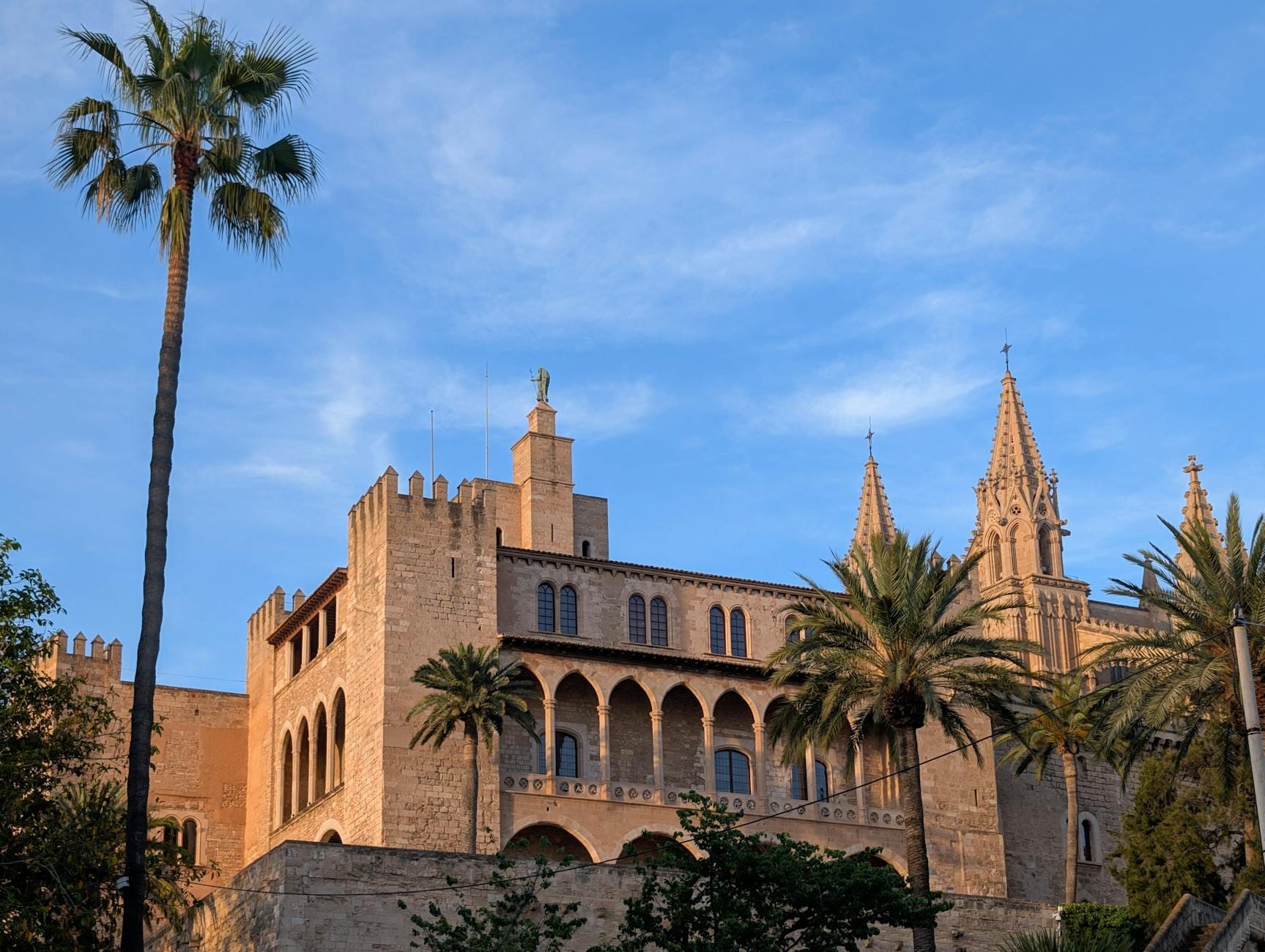
The Palau Reial de l'Almudaina is one of the most historically layered buildings in the western Mediterranean, a structure that began as a Moorish citadel, became a Gothic royal palace, and still serves as an official residence of the Spanish Crown. Standing directly opposite Palma Cathedral, it anchors the old city's waterfront with a quiet authority that rewards closer attention.
Quick Facts
- Location
- Carrer del Palau Reial, s/n, 07001 Palma, Illes Balears — directly opposite Palma Cathedral
- Getting There
- Bus lines 25, 35, or 50 (tourist bus) stop nearby. The palace is walkable from most of Palma's old town within 10–15 minutes.
- Time Needed
- 1 to 2 hours for a thorough visit including the courtyards, state rooms, and gardens
- Cost
- Paid admission; prices vary by season and visitor category. Check Patrimonio Nacional's official site before visiting.
- Best for
- History enthusiasts, architecture lovers, and anyone wanting to understand Palma beyond its beaches
- Official website
- www.patrimonionacional.es/en/visita/royal-palace-la-almudaina
What the Palace of La Almudaina Actually Is
The Palau Reial de l'Almudaina is not a museum dressed up as a palace. It is an active official residence of the Spanish royal family, which means portions of it are periodically closed to the public during state visits and royal functions. That caveat aside, much of the building is open year-round, and what you can access represents over a thousand years of continuous occupation and architectural transformation in a single compact structure.
The name derives from the Arabic 'al-mudayna', meaning citadel or small city. When you walk through the main gate and enter the central courtyard, that etymology starts to make sense. This was not just a building but a self-contained administrative and military complex, first under Moorish governance and then under successive Christian rulers who chose to keep and adapt it rather than tear it down.
The palace shares Palma's most architecturally significant block with Palma Cathedral (La Seu), rising just across a narrow road. The two buildings complement each other visually, but they are very different experiences inside. La Seu is vast and overwhelming. The Almudaina is intimate and layered, more like reading a palimpsest than walking through a single narrative.
ℹ️ Good to know
Opening hours are seasonal. In summer, the palace typically opens Monday to Friday 10:00–18:30 and Saturday 10:00–14:00. Hours contract significantly in winter. Always verify current hours on the Patrimonio Nacional website before planning your visit, as royal functions can affect access without advance notice.
A Building That Has Never Stopped Changing
The site's history predates even its Moorish incarnation. Archaeological evidence points to Roman and Talaiotic (pre-Roman Balearic) occupation beneath the current foundations, though these layers are not publicly accessible. What visitors experience today reflects primarily three architectural moments: the 10th-century Moorish fortress, the Gothic transformation begun under King James II of Aragon from around 1309, and later additions by Charles V in the 16th century.
After the Christian reconquest of Mallorca in 1229 under King James I of Aragon, the fortress was kept intact and repurposed. It was his successor, James II, who began converting it into a proper Gothic royal palace from 1281 onward, adding pointed arches, royal chapels, and the elegant proportions that characterize the building's most distinctive spaces today. The Santa Anna Chapel, embedded within the palace walls, is a particularly fine example of early Mallorcan Gothic and is often overlooked by visitors who rush through the courtyards.
Charles V's 16th-century upper floor additions introduced a more Renaissance sensibility, though they blend surprisingly well with the Gothic bones below. The overall effect is not chaotic but accumulative, each layer of power leaving its mark without entirely erasing the previous one.
Tickets & tours
Hand-picked options from our booking partner. Prices are indicative; availability and final rates are confirmed when you complete your booking.
Dinosaurland and Caves of Hams combined ticket
From 25 €Instant confirmationFree cancellationShuttle Boat from Cala Millor to Cala Ratjada
From 26 €Instant confirmationFree cancellation3-hour Es Trenc Boat Tour in Mallorca
From 39 €Instant confirmationFree cancellationShuttle Boat Roundtrip from Cala Bona to Cala Ratjada
From 29 €Instant confirmationFree cancellation
Moving Through the Palace: What You Will Actually See
Entry is through a fortified gate that opens into the central courtyard, known as the Pati de l'Almudaina. The courtyard is the palace's most photogenic space and its social heart. Stone arches frame the perimeter, and at certain hours in the morning the light falls across the pale limestone in a way that makes the Gothic detailing particularly sharp. If you arrive around 10:00 when doors open, you will often have this space nearly to yourself for the first twenty minutes.
The interior royal apartments contain tapestries, period furniture, and decorative arts accumulated across centuries of royal use. Some rooms feel genuinely inhabited rather than museified, with heavy wooden furniture, gilt-framed portraits, and rugs worn from actual use. The tapestry collection is particularly notable, with Flemish works depicting hunting scenes and mythology. The fabrics are aged but the detail remains extraordinary when viewed at close range.
The gardens on the seaward side of the palace are a quiet reward for those who find them. Small, formally planted, and shaded by mature trees, they offer a view toward the sea and the city ramparts below. At midday in summer, when the interior rooms can feel warm and the tour groups are densest, the gardens provide both a breeze and a moment of proportion. This is where the palace's position above the old port becomes physically apparent.
💡 Local tip
Photography policy inside the royal apartments changes periodically. Flash is never permitted, and tripods are generally prohibited. Natural light in the interior rooms is limited, so a camera or phone that handles low light reasonably well will serve you better than trying to compensate with flash.
Best Time to Visit and How the Experience Changes
Morning visits, particularly on weekdays, are noticeably quieter than afternoon visits. By midday in July and August, the palace courtyard fills with tour groups moving quickly on fixed circuits. If your goal is to linger in the Gothic chapel or study the tapestries at your own pace, arriving at opening time on a Tuesday or Wednesday in shoulder season gives you conditions close to ideal.
Spring and early autumn represent the most balanced visiting conditions overall. Temperatures in April, May, September, and October are comfortable for extended walking on the stone floors and courtyard surfaces, and the palace is open for its fuller summer hours without the August peak crowds. Winter visits are possible but require careful planning around the reduced hours and the higher chance of partial closures.
If you are pairing the palace with other sites in Palma's historic core, allow a full half-day for the Almudaina, the cathedral, and the Parc de la Mar below the city walls. The three form a natural geographic and historical circuit that requires no backtracking.
Getting There and Practical Logistics
The palace is at the southwestern corner of Palma's old city, within walking distance of the central shopping streets, the waterfront promenade, and the Passeig del Born. Bus lines 25, 35, and the tourist-oriented line 50 all serve the area. For visitors staying in the old town or central Palma, walking is often the simplest option.
Parking in central Palma is difficult and expensive. If you are arriving by car, the underground car parks near the waterfront are the most practical option, but walking or using public transport from your accommodation is significantly easier. The getting around Mallorca guide covers public transport options across the island in more detail.
Tickets can be purchased at the entrance, though booking online through Patrimonio Nacional in advance is advisable during peak summer weeks when entry can involve a wait. Free entry is offered on certain days and time windows (for example, Wednesday and Sunday afternoons), and EU and Ibero-American citizens may qualify for additional free hours, but the schedule changes by season — always check the official site before your visit. There are also discounts for students and seniors; bring documentation if you expect to qualify.
⚠️ What to skip
The palace is an active royal residence. Portions of it close without public advance notice during official state functions or royal visits. This is not common, but it does happen. If you have limited time in Palma, check the Patrimonio Nacional website within 48 hours of your planned visit.
Accessibility and Who Should Reconsider
The palace involves a mix of stone-paved courtyards, stairs between levels, and uneven historic flooring throughout. Visitors with significant mobility limitations may find parts of the route inaccessible. There is no detailed accessibility map publicly available at the time of writing; contacting Patrimonio Nacional ahead of your visit is the most reliable way to understand which areas are reachable and which are not.
Travelers who are primarily interested in beaches, outdoor activities, or contemporary culture will likely find the palace underwhelming. The experience is genuinely interior-focused, text-heavy if you use the audio guide, and requires a tolerance for formal historic spaces. If your Mallorca visit is short and you are choosing between this and the cathedral, the cathedral offers more architectural spectacle per square metre. The Almudaina rewards those who want historical depth and a quieter, more contemplative experience.
The Palace in Context: Palma's Historic Core
The Almudaina sits at the centre of a remarkably dense concentration of historical architecture. Within ten minutes on foot you can reach the Arab Baths, one of the few surviving Moorish structures in Palma's old city, which gives useful comparative context for understanding the Almudaina's pre-Christian layers. In the opposite direction, the Es Baluard Museum of Modern and Contemporary Art occupies the old city ramparts and provides a sharp counterpoint to the palace's historical weight.
For a broader picture of Palma's historic centre, including which streets and squares to prioritize, the Palma Old Town guide offers a useful neighbourhood-level orientation. The palace makes most sense when understood as part of that wider fabric, not as a standalone destination.
Insider Tips
- Arrive at opening time on a weekday morning. The central courtyard is at its quietest and most photogenic in the first twenty minutes after doors open, before the first tour groups arrive.
- Don't skip the Santa Anna Chapel inside the palace walls. It is a small, early Gothic space that most visitors pass through quickly, but the carved stonework around the doorway and the proportions of the interior are among the most refined pieces of 14th-century architecture in Palma.
- The gardens on the seaward side are easy to miss if you follow the main circulation route without diverging. Ask at the entrance whether the gardens are included in your ticket and which direction to access them.
- The palace and the cathedral share an architectural and historical conversation that spans centuries. If you are visiting both on the same day, do the Almudaina first. It sets up the context of Palma's medieval power structures in a way that makes the cathedral's scale and ambition more comprehensible.
- EU citizens are entitled to a discounted entry rate on most Patrimonio Nacional sites. Bring a valid national ID or EU passport rather than just assuming the ticket counter will offer the reduction unprompted.
Who Is Palace of La Almudaina For?
- History and architecture enthusiasts who want to understand Palma beyond its waterfront
- Travelers pairing the palace with a cathedral visit as part of a full morning in Palma's old city
- Photography-focused visitors who prioritize natural light and Gothic stonework over crowded viewpoints
- Visitors interested in the intersection of Moorish, Gothic, and Renaissance architecture in a single building
- Travelers looking for a cooler, indoor experience during the hottest part of a summer day
Nearby Attractions
Other things to see while in Palma de Mallorca:
- Arab Baths (Banys Àrabs)
The Banys Àrabs are the only intact remnant of Palma's Islamic past, dating to the 10th or 11th century. Compact but genuinely atmospheric, this ancient hammam in the heart of the old city takes less than an hour to visit and rewards anyone with even a passing interest in history.
- Bellver Castle
Perched on a pine-covered hill 3 km west of Palma's city centre, Bellver Castle is one of Europe's rare circular Gothic fortresses. Built under King Jaume II and completed around 1311, it has served as a royal residence, a prison, and now houses the Palma Municipal History Museum. The views over Palma Bay alone justify the climb.
- Bishop's Garden (Jardí del Bisbe)
Tucked behind the towering walls of Palma Cathedral, the Jardí del Bisbe is a small formal garden on the grounds of the Episcopal Palace. Free to enter and often overlooked by visitors rushing between La Seu and the seafront, it offers citrus groves, herb beds, an ornamental pond, and a rare ground-level view of the cathedral's famous rose window.
- Es Baluard Museum of Modern & Contemporary Art
Es Baluard Museu d'Art Contemporani de Palma occupies a Renaissance bastion on the old city walls, combining 800-plus works of modern and contemporary art with sweeping views over Palma Bay. It is one of the most architecturally striking museum settings in the Balearic Islands, and far less crowded than the cathedral a few minutes' walk away.