Parc de la Mar, Palma: The Cathedral Reflection Park Worth Your Time
Parc de la Mar is a 9-hectare public park at the foot of Palma's medieval city walls, built on land reclaimed from the Bay of Palma. Its artificial lake mirrors the cathedral's golden facade, a Joan Miró mural anchors one end, and old wall vaults host a small gallery. Entry is free, it never closes, and it anchors one of the most cinematic stretches of Palma's waterfront.
Quick Facts
- Location
- Below Palma Cathedral (La Seu), near Plaça de la Reina, 07001 Palma de Mallorca
- Getting There
- 10-min walk from Passeig del Born; bus lines stop on Avinguda d'Antoni Maura nearby
- Time Needed
- 30–60 minutes; longer if events are running
- Cost
- Free — open 24 hours, 7 days a week
- Best for
- Cathedral photography, a shaded midday break, evening strolls, and families with young children
What Parc de la Mar Actually Is
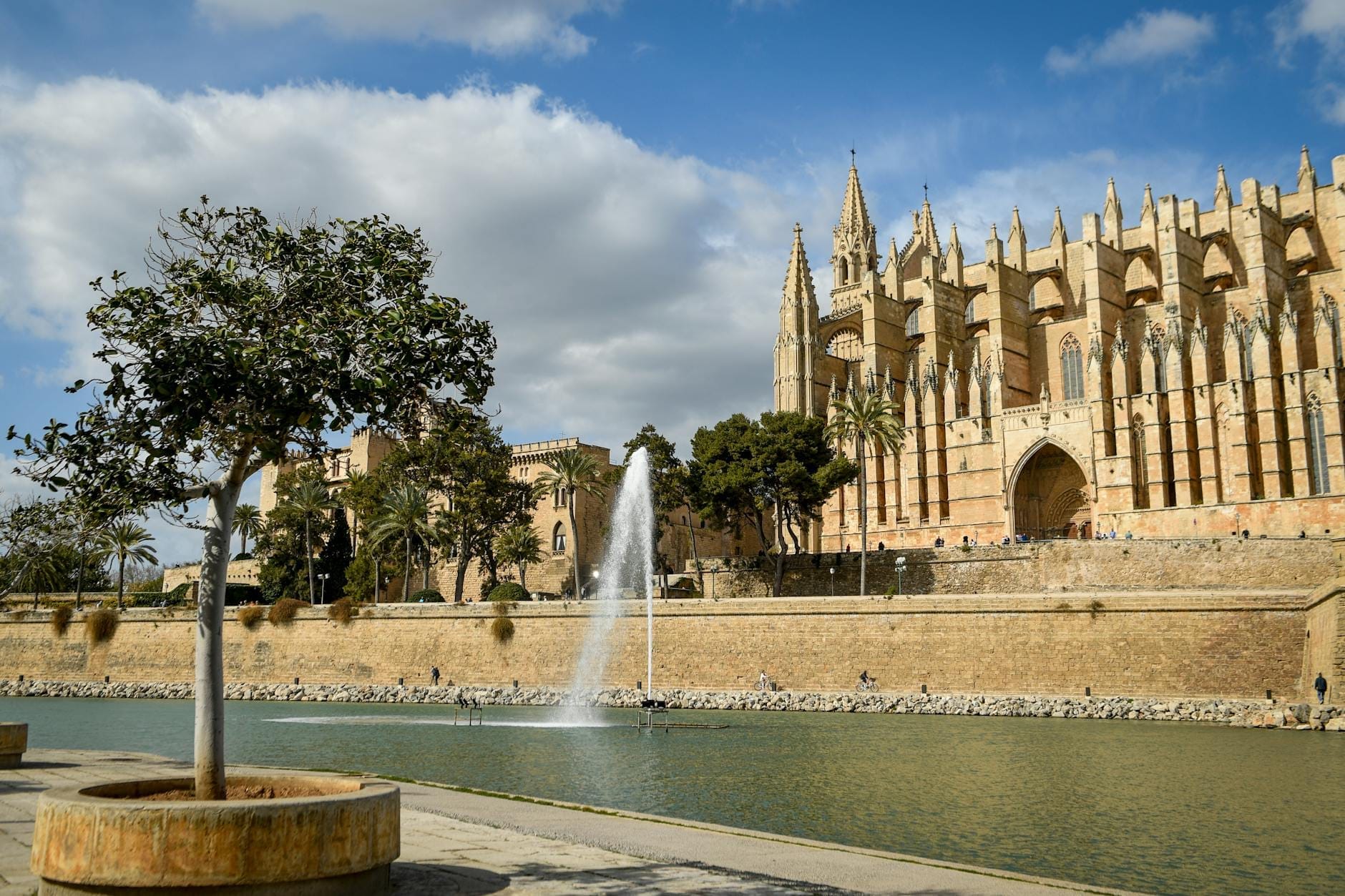
Parc de la Mar is a 9-hectare public park that sits directly below Palma Cathedral (La Seu) and the Almudaina Palace, separated from them by the old city walls, the Dalt Murada. It is not a manicured garden in the traditional sense. It is a wide, open urban space with lawns, a sizable artificial lake, shaded paths, a monumental mural by Joan Miró, and arched vaults cut into the medieval walls that double as gallery and event space.
Before the 1960s, the sea came right up to these city walls. Land reclamation pushed the waterfront south, creating the avenue and park that exist today. The park itself was developed through the 1970s and 1980s, deliberately designed so the artificial lake would capture the cathedral's reflection. That design decision is why this park has appeared in tens of thousands of photographs. It works.
ℹ️ Good to know
The park is open 24 hours a day, every day, with no admission fee. No booking, no tickets, no barriers.
The Cathedral Reflection: What You Actually See
The most-photographed angle is straightforward: stand at the lake's northern edge and look north. The full length of La Seu's southern facade, including its massive Gothic buttresses and rose window, rises above the palm-lined city wall. On calm mornings before the wind picks up, the reflection is near-perfect, the stone turning a warm amber in early sunlight.
By midday, the light moves to the western face of the cathedral and the reflection softens. Late afternoon is less ideal for photography from this angle, though the cathedral glows dramatically at sunset when seen from the marina side. If the reflection is your main reason for coming, early morning — before 9am in summer, around 8am in shoulder season — is the clear choice. The lake surface is calmer, the tourists are scarce, and the quality of light is noticeably better.
💡 Local tip
Photography tip: shoot from the western end of the lake for a wider composition that includes both the cathedral and the palm-lined wall. A polarizing filter cuts glare significantly on bright days.
The cathedral itself is a separate attraction with its own entry and hours. If you plan to go inside, check the Palma Cathedral (La Seu) guide before your visit, as morning time slots sell out during peak summer months.
Tickets & tours
Hand-picked options from our booking partner. Prices are indicative; availability and final rates are confirmed when you complete your booking.
Boat Trip on a Glassbottom Catamaran from Font de Sa Cala
From 35 €Instant confirmationFree cancellationBoat trip to Parc Natural de Llevant and Blue Cave
From 63 €Instant confirmationFree cancellationPalma Bay catamaran with lunch, swim stop and VIP area option
From 85 €Instant confirmationFree cancellationSpeedboat Journey to Palma Marine Reserve with Snorkelling
From 39 €Instant confirmationFree cancellation
The Joan Miró Mural and the Park's Art Layer
At the eastern end of the lake stands a large ceramic mural by Joan Miró, created in 1983. Miró, who spent much of his later life in Mallorca and whose studio-museum is still preserved on the island, donated this work to the city. The mural is bold, primary-colored, and entirely characteristic of his late style: biomorphic forms against a white ground. It does not have a title displayed on-site, and most visitors walk past it without recognizing its significance.
For context on Miró's lasting relationship with Mallorca, the Fundació Pilar i Joan Miró in the Cala Major neighborhood preserves his actual studio and a substantial permanent collection. If the mural sparks genuine interest, that museum is the logical next step.
The arched vaults built into the base of the Dalt Murada, known as Ses Voltes, periodically host exhibitions and cultural events. The programming changes seasonally, so check local listings if you're visiting in summer or around Palma's main festivals. When nothing is showing, the vaults are worth peering into for the sheer scale of the medieval stonework above your head.
How the Park Changes Through the Day
Early morning is the park at its quietest and most atmospheric. A handful of joggers, a few dog walkers, the occasional photographer with a tripod set up at the lake's edge. The cathedral stone catches low golden light. The air still carries a trace of salt from the bay.
By mid-morning, tour groups moving between the cathedral and the palace begin cutting through the park on the upper paths. The grassed areas start filling with people taking short breaks. The cafe terraces that border the park on its southern edge open up, and the whole space takes on a more social character.
Midday in summer can be genuinely uncomfortable. The park has shade along its western paths and around the Ses Voltes vaults, but the main open areas facing the lake are exposed. Families with children tend to gravitate toward the play structures on the western side, which include train-themed equipment referencing the historic Ferrocarril de Sóller railway, which has operated since 1911. If you are visiting with young children, the play area is a practical feature worth knowing about.
Evenings bring the park back to life. Locals use it as a meeting point before heading to restaurants along the waterfront. In summer, outdoor cinema screenings are sometimes held using the lake surface as a backdrop, and the vaults host concerts and events. Check local Palma event listings before your visit if you are hoping to catch something specific.
Getting There and Moving Around
The park sits at the intersection of several walkable Palma landmarks. From Passeig del Born, walk south toward the sea and you will reach the park's western edge in about 10 minutes. From the Palma marina, it is a 5-minute walk north. Several city bus routes stop on Avinguda d'Antoni Maura, the road that runs along the park's southern boundary.
The main paths are wide, paved, and flat enough for wheelchairs and pushchairs on the perimeter level. Access down to the lake itself involves steps in places, which limits full access for some visitors. The lower lawn areas adjacent to the water are reachable via gradual slopes from the eastern entrance.
Parc de la Mar connects naturally into a longer walk through Palma's historic core. The Palace of La Almudaina is directly above on the wall, and the Arab Baths in the old town are a 15-minute walk north through the historic center. For a well-rounded half-day, this stretch covers the densest concentration of Palma's historical layers.
Events, Activities, and Seasonal Features
The park functions as one of Palma's main open-air event venues. Summer programming has historically included open-air cinema projected over the lake, kayaking and model boat sessions on the water, yoga classes on the lawns, and skating in designated areas. The Ses Voltes vaults host exhibitions and small concerts throughout the year.
The almond blossom season in late January and early February does not directly affect the park itself, but it changes the character of Palma significantly. Visiting the park during this period, with fewer tourists and cooler air, gives a completely different impression than a July afternoon.
⚠️ What to skip
If you are visiting specifically for an event (cinema, concerts, kayaking), do not rely on fixed schedules found in older guides. Programming changes yearly and some activities require advance booking through local operators. Check current Palma city event listings before your visit.
Honest Assessment: Is It Worth Your Time?
For most visitors, Parc de la Mar earns its 30 minutes without debate. The cathedral reflection is genuinely striking, it costs nothing, and it sits directly on the route between the historic center and the marina. You would walk past it anyway.
It is not a destination in itself if you are on a very tight schedule. The park has no single overwhelming experience beyond that lake view. Travelers who prioritize beaches, hiking, or Palma's restaurant scene will find little reason to linger. Those with a strong interest in urban photography, Miró's work, or simply want a pause between denser sightseeing will find it genuinely useful.
If your visit to Palma is short, use the one-week Mallorca itinerary to prioritize how Parc de la Mar fits against competing options. For visitors who want to see Palma's best viewpoints systematically, the best views in Mallorca guide covers how this park's cathedral angle compares to Bellver Castle and other elevated spots.
Insider Tips
- The most dramatic reflection occurs on still mornings after overnight rain, when the lake surface is undisturbed and the wet stone of the cathedral appears darker and more contrasty. Check the forecast.
- The vaults of Ses Voltes face north and stay shaded and cool even in August. If you need a midday refuge from the heat that isn't a cafe, this is one of central Palma's better options.
- The train-themed play equipment on the western side of the park is named after stops on the Sóller railway line. It is a small detail, but if you are planning to take the historic narrow-gauge train to Sóller, it makes a good conversation point with children.
- The park hosts a popular outdoor cinema in summer with the lake as a backdrop. Sessions often sell out. If you are in Palma for several nights, this is worth researching early rather than at the last minute.
- Walking the top of the Dalt Murada city walls directly above the park gives a completely different perspective on the park's scale and layout, and a closer view of the cathedral's southern facade. Access points to the wall walkway are at either end of the stretch above the park.
Who Is Parc de la Mar For?
- Photographers targeting the cathedral-lake reflection, especially at dawn
- Families with young children who need a play break between museum visits
- Travelers doing a walking tour of Palma's historic waterfront
- Evening strollers looking for a focal point between the marina and the old town
- Anyone interested in Joan Miró's public work and its Mallorcan context
Nearby Attractions
Other things to see while in Palma de Mallorca:
- Arab Baths (Banys Àrabs)
The Banys Àrabs are the only intact remnant of Palma's Islamic past, dating to the 10th or 11th century. Compact but genuinely atmospheric, this ancient hammam in the heart of the old city takes less than an hour to visit and rewards anyone with even a passing interest in history.
- Bellver Castle
Perched on a pine-covered hill 3 km west of Palma's city centre, Bellver Castle is one of Europe's rare circular Gothic fortresses. Built under King Jaume II and completed around 1311, it has served as a royal residence, a prison, and now houses the Palma Municipal History Museum. The views over Palma Bay alone justify the climb.
- Bishop's Garden (Jardí del Bisbe)
Tucked behind the towering walls of Palma Cathedral, the Jardí del Bisbe is a small formal garden on the grounds of the Episcopal Palace. Free to enter and often overlooked by visitors rushing between La Seu and the seafront, it offers citrus groves, herb beds, an ornamental pond, and a rare ground-level view of the cathedral's famous rose window.
- Es Baluard Museum of Modern & Contemporary Art
Es Baluard Museu d'Art Contemporani de Palma occupies a Renaissance bastion on the old city walls, combining 800-plus works of modern and contemporary art with sweeping views over Palma Bay. It is one of the most architecturally striking museum settings in the Balearic Islands, and far less crowded than the cathedral a few minutes' walk away.