Es Baluard Museum of Modern & Contemporary Art: Where Palma's Old Walls Meet Bold Art
Es Baluard Museu d'Art Contemporani de Palma occupies a Renaissance bastion on the old city walls, combining 800-plus works of modern and contemporary art with sweeping views over Palma Bay. It is one of the most architecturally striking museum settings in the Balearic Islands, and far less crowded than the cathedral a few minutes' walk away.
Quick Facts
- Location
- Plaça de la Porta de Santa Catalina, 10, Palma de Mallorca (on the Bastion of Sant Pere, old city walls)
- Getting There
- Walkable from Palma Cathedral (10-15 min on foot); buses serve central Palma. No direct train stop.
- Time Needed
- 1.5 to 2.5 hours for galleries and terrace; allow extra time if there is a strong temporary exhibition
- Cost
- Free for under-12s, ICOM members, people with certified disabilities (33%+) and one companion; general admission — check esbaluard.org for current prices
- Best for
- Contemporary art lovers, photographers seeking panoramic city views, visitors wanting a quieter cultural alternative to Palma's main monuments
- Official website
- esbaluard.org/en
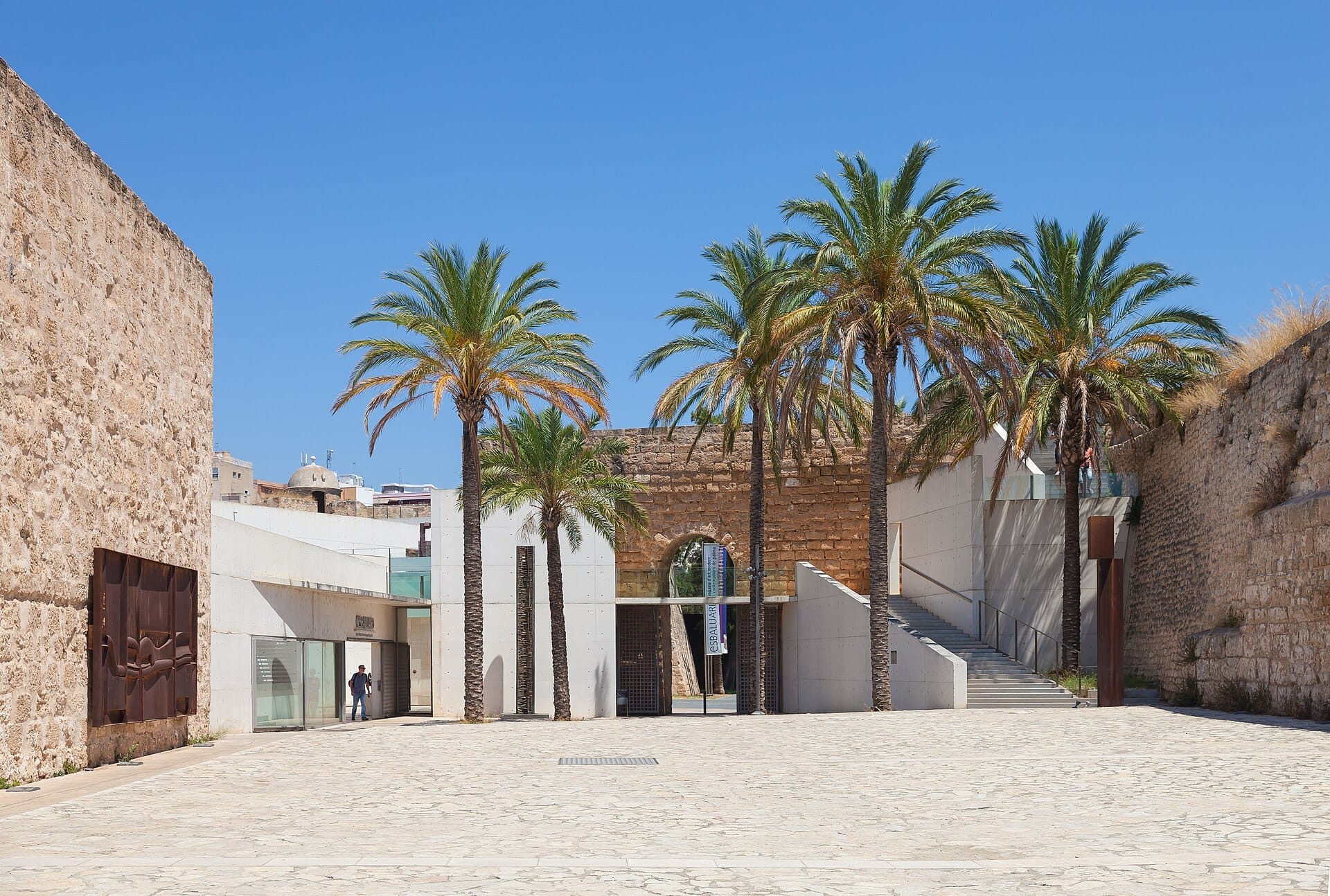
What Es Baluard Actually Is
Es Baluard Museu d'Art Contemporani de Palma opened on 30 January 2004 inside the Bastion of Sant Pere, a section of Palma's 16th-century Renaissance defensive walls. The building is not a conversion of a single historic structure but rather a deliberate dialogue between the surviving stone ramparts and a purpose-built contemporary volume inserted within them. The result is a museum where the architecture itself is as much on display as the collection.
The permanent collection holds over 800 works spanning the late 19th century to the present day, covering painting, sculpture, photography, video, and installation. The core holdings came from donations and deposits by the Fundació d'Art Serra, supplemented by institutional acquisitions. Artists associated with Mallorca and the broader Mediterranean sit alongside figures from the European and international contemporary scene.
ℹ️ Good to know
The ticket office closes 30 minutes before the museum does. On Sundays the museum closes at 3 PM, which catches many visitors off guard. Es Baluard is closed Mondays, 1 January, and 25 December.
The Setting: Why the Building Matters
Before you look at a single painting, spend time outside. The museum sits on the seaward edge of Palma's old walled perimeter, and the Mirador terrace on the upper level offers one of the cleanest panoramic views of Palma Bay available from inside the city. You can see the cathedral's south facade, the Palace of La Almudaina, the harbour, and on clear days the Serra de Tramuntana mountains behind the city skyline.
That view is free to access even without a museum ticket, which makes the terrace a useful stop on any walk along Palma's old town. In the morning, the light off the bay is sharp and the stone glows warm ochre. By late afternoon, the terrace fills with people who have figured out that this is a better place to watch the sunset than the crowded seafront promenade.
The integration of the old bastion walls into the museum's internal circulation is architecturally clever. In several gallery spaces you walk alongside or beneath sections of the original 16th-century stonework. The contrast between rough-hewn medieval masonry and the clean white exhibition volumes creates a tension that the curators lean into rather than smooth over.
Tickets & tours
Hand-picked options from our booking partner. Prices are indicative; availability and final rates are confirmed when you complete your booking.
Dinosaurland and Caves of Hams combined ticket
From 25 €Instant confirmationFree cancellationShuttle Boat from Cala Millor to Cala Ratjada
From 26 €Instant confirmationFree cancellation3-hour Es Trenc Boat Tour in Mallorca
From 39 €Instant confirmationFree cancellationShuttle Boat Roundtrip from Cala Bona to Cala Ratjada
From 29 €Instant confirmationFree cancellation
The Collection: What You Are Actually Looking At
The permanent collection is organized thematically rather than strictly chronologically, which means you will not always find clear historical progression as you move through the rooms. This can be disorienting on a first visit. Pick up the free floor plan at the entrance desk and orient yourself before heading upstairs.
The collection's strength lies in its Spanish and Catalan modernist works from the early 20th century, particularly painters connected to Mallorca or the wider Mediterranean. There are also substantial holdings in post-war European abstraction and more recent multimedia installations. Photography and video art occupy dedicated spaces on the lower levels, where natural light is controlled and the atmosphere shifts noticeably quieter.
Temporary exhibitions run throughout the year and often become the primary reason to visit. The 2026 season opened with Fiona Rae: Vista (30 January to 23 August 2026), showcasing the British abstract painter's large-scale canvases. If you are planning a visit around a specific show, check the current schedule at Palma's other major contemporary art space, the Fundació Pilar i Joan Miró, which also runs a complementary program and is worth combining on the same day if you have the energy.
Visiting by Time of Day: What Changes
Es Baluard is open Tuesday to Saturday from 10 AM to 8 PM and Sunday from 10 AM to 3 PM. Mornings on weekdays are the quietest period. If you arrive close to opening on a Tuesday or Wednesday, you may have entire gallery rooms to yourself for the first hour, which is rare for any museum in a city that draws as many visitors as Palma.
Midday sees a moderate uptick in visitors, particularly from cruise ship passengers doing a rapid cultural circuit of central Palma. The galleries rarely become overcrowded in the way that the cathedral can, but the terrace and ground-floor café get busier between noon and 2 PM. If you plan to have coffee on the terrace with a view of the bay, aim to arrive before 11:30 AM or after 3 PM.
Late afternoons on Fridays and Saturdays draw a younger local crowd. The light in the upper galleries changes significantly in the final two hours before closing, as the western sun comes through the narrow apertures in the old bastion stonework and casts long diagonal shadows across the floors. This is the most atmospheric time to be in the permanent collection rooms, and the terrace view at this hour is exceptional.
💡 Local tip
Photography is generally permitted in the permanent collection without flash. Always check signage in temporary exhibition rooms, as some shows restrict photography entirely. The terrace has no restrictions and is worth bringing a wide-angle lens for the bay panorama.
Getting There and Practical Logistics
The museum is on Plaça de la Porta de Santa Catalina, 10, a short walk from the Palma Cathedral and the Parc de la Mar. From the cathedral, walk west along the old wall promenade for about 10 to 15 minutes. The walk itself is pleasant and passes several of the original wall sections.
Palma's city bus network covers the central area, and several lines stop near the Santa Catalina neighbourhood, which borders the museum on the landward side. If you are combining the museum with lunch or an afternoon in Santa Catalina's food market, the Mercat de Santa Catalina is a five-minute walk uphill from the museum entrance.
Parking near the museum is limited and the surrounding streets are narrow. If you are arriving by car, use one of the paid parking areas near the port or Avenida Argentina and walk the final stretch. The museum itself has no dedicated parking facility.
Accessibility is taken seriously here. People with a certified disability rating of 33 percent or higher enter free, as does one companion if that is noted on their documentation. The building has lift access between levels. Contact the museum in advance if you have specific mobility requirements, as some sections of the old bastion walls involve uneven stone surfaces.
Honest Assessment: Is It Worth Your Time?
Es Baluard rewards visitors who are genuinely interested in modern and contemporary art, or who want a slower, more reflective counterpoint to Palma's more heavily trafficked monuments. The permanent collection is solid rather than exceptional at an international level, but the setting lifts it considerably. Very few museums in Europe put contemporary art inside functioning 16th-century military architecture this successfully.
The quality of any given visit depends significantly on what temporary exhibition is running. When the programming is strong, Es Baluard punches well above its size. When the temporary spaces are between shows or running a less compelling selection, the permanent collection alone may feel thin for visitors expecting something on the scale of Madrid or Barcelona institutions.
Visitors who are not interested in art but are looking for the best free city views in Palma can still get significant value from the terrace without paying admission. For context on how the museum fits into a broader Palma itinerary, the complete Mallorca activities guide covers how to balance cultural sites with the island's outdoor attractions.
⚠️ What to skip
If you are traveling with young children under about age 8, the museum offers little to engage them directly. There are no interactive children's areas in the main galleries. The terrace is safe and enjoyable for families, but a full visit to the collection is unlikely to hold their attention.
Photography, Light, and Practical Tips for Photographers
The terrace is the single best photography subject in the museum complex. Arrive in the first 90 minutes of opening for soft morning light on the cathedral and bay, with minimal people in the frame. The contrast between the ochre bastion stonework in the foreground and the Mediterranean blue behind makes for a strong composition even with a phone camera. For context on other high-altitude viewpoints in Palma and across the island, see the best views in Mallorca guide.
Inside the galleries, the lighting is calibrated for conservation rather than photography, so expect relatively low-contrast artificial light in most rooms. The permanent collection spaces with natural light coming through the bastion apertures offer the most interesting interior shots, particularly in the late afternoon when the angle of the sun creates visible shafts of light through the stonework.
Insider Tips
- The Mirador terrace is accessible without a museum ticket. Even if you decide not to visit the galleries, walk up to the terrace for one of the cleanest panoramic views of Palma Bay and the cathedral's south face — it costs nothing and takes five minutes.
- Sunday hours are 10 AM to 3 PM only. This catches a disproportionate number of visitors who assume the museum keeps full hours on weekends. If Sunday is your only option, arrive by 11 AM to allow a proper visit before the 2:30 PM last entry cutoff.
- Check the temporary exhibition schedule before visiting. The quality and scale of what is showing in the temporary rooms significantly affects the overall experience. A major international artist showing at Es Baluard can make this a highlight of any Palma trip; an in-between period is a more modest visit.
- The museum café on the lower terrace level is a good option for a mid-morning coffee with a harbour view. It is less crowded than the cafés on Passeig del Born and the tables outside have direct sightlines over the bay wall.
- Free admission categories are broad. Beyond the under-12 rule, ICOM and CIMAM cardholders, MACBA members, and those with disabilities (33%+ rating) all enter free. If you hold any of these, bring the relevant documentation.
Who Is Es Baluard Museum of Modern & Contemporary Art For?
- Contemporary art enthusiasts wanting a serious museum experience without the crowds of Barcelona or Madrid
- Photographers looking for an elevated viewpoint over Palma Bay and the cathedral that is off the main tourist circuit
- Travelers on a cultural day in Palma who want to combine the old town monuments with a modern counterpoint
- Architecture-minded visitors interested in how contemporary design integrates with 16th-century military structures
- Repeat Mallorca visitors who have covered the main beach and nature highlights and want a slower urban experience
Nearby Attractions
Other things to see while in Palma de Mallorca:
- Arab Baths (Banys Àrabs)
The Banys Àrabs are the only intact remnant of Palma's Islamic past, dating to the 10th or 11th century. Compact but genuinely atmospheric, this ancient hammam in the heart of the old city takes less than an hour to visit and rewards anyone with even a passing interest in history.
- Bellver Castle
Perched on a pine-covered hill 3 km west of Palma's city centre, Bellver Castle is one of Europe's rare circular Gothic fortresses. Built under King Jaume II and completed around 1311, it has served as a royal residence, a prison, and now houses the Palma Municipal History Museum. The views over Palma Bay alone justify the climb.
- Bishop's Garden (Jardí del Bisbe)
Tucked behind the towering walls of Palma Cathedral, the Jardí del Bisbe is a small formal garden on the grounds of the Episcopal Palace. Free to enter and often overlooked by visitors rushing between La Seu and the seafront, it offers citrus groves, herb beds, an ornamental pond, and a rare ground-level view of the cathedral's famous rose window.
- Fundació Pilar i Joan Miró
The Fundació Pilar i Joan Miró a Mallorca is where Joan Miró actually worked, and that biographical intimacy sets it apart from any conventional gallery visit. Spread across preserved studios, a Rafael Moneo-designed exhibition building, and a sculpture garden in Palma's Cala Major district, the foundation holds around 6,000 works and offers one of the most architecturally considered art spaces in Spain.