Bellver Castle: Palma's Circular Gothic Fortress Above the Bay
Perched on a pine-covered hill 3 km west of Palma's city centre, Bellver Castle is one of Europe's rare circular Gothic fortresses. Built under King Jaume II and completed around 1311, it has served as a royal residence, a prison, and now houses the Palma Municipal History Museum. The views over Palma Bay alone justify the climb.
Quick Facts
- Location
- Puig de Bellver, ~3 km west of Palma city centre
- Getting There
- Bus lines 4, 20, or 47 to Plaça Gomila, then ~500-step uphill walk through pine woods
- Time Needed
- 1.5 to 2.5 hours including walk, castle, and museum
- Cost
- €4 adults · €2 reduced (pensioners, ages 14–18) · Free under 14 and all day Sundays
- Best for
- History enthusiasts, photographers, families on a budget, and anyone wanting panoramic views of Palma Bay
- Official website
- museucastellbellver.palma.cat/en/
What Is Bellver Castle?
Castell de Bellver ("beautiful view" in Catalan) is a 14th-century Gothic castle and one of Europe's rarest circular medieval fortresses. Construction began in 1300 under the order of King Jaume II of Majorca and was completed around 1311, making it more than 700 years old. The castle sits atop Puig de Sa Mesquida at roughly 112 metres above sea level, surrounded by the fragrant Palma pine forest and overlooking the full sweep of Palma Bay.
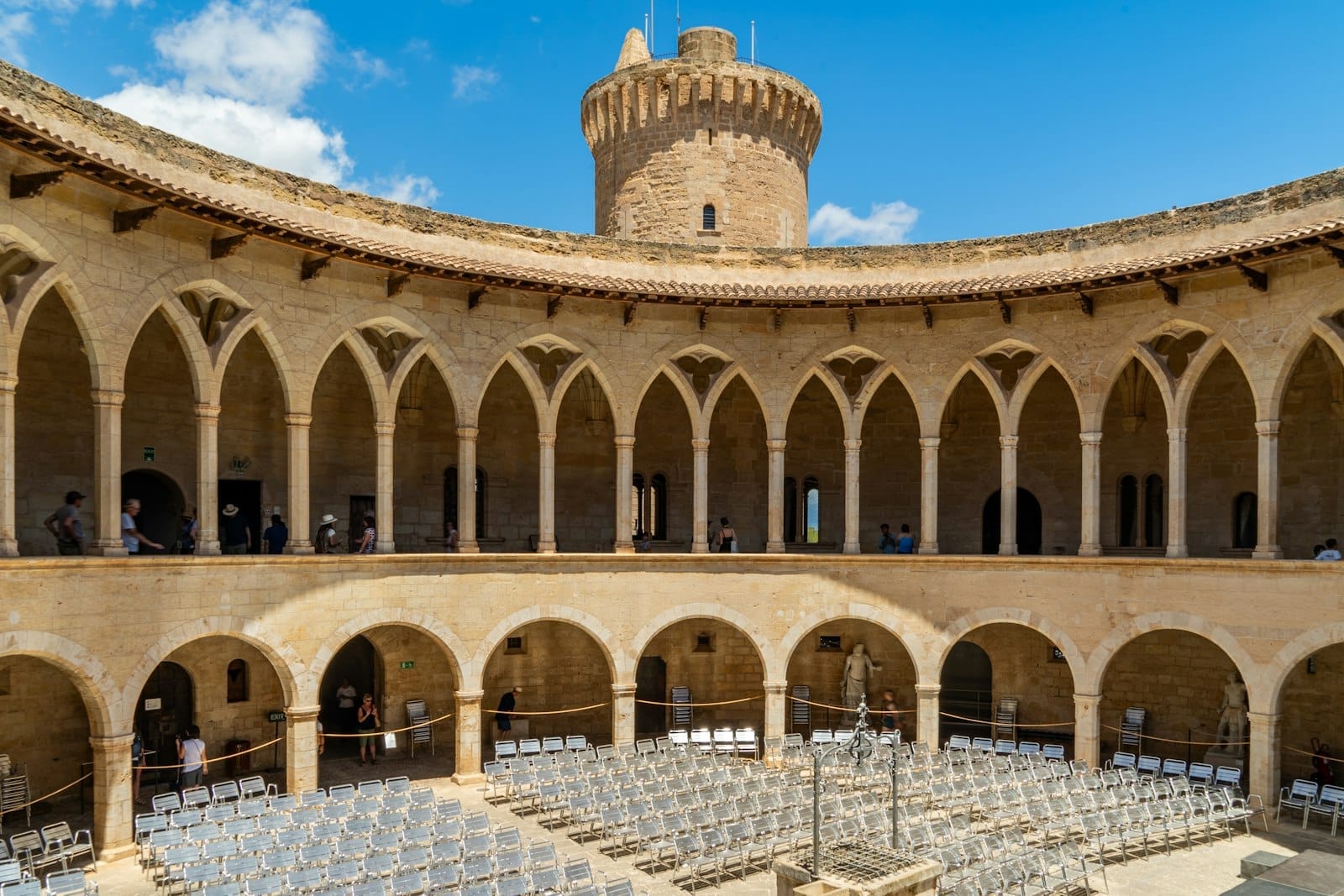
What makes it architecturally unusual is the floor plan: a nearly perfect circle, with three cylindrical towers set around an open circular courtyard and a separate cylindrical keep connected by a raised arch. Most European castles of this era are rectangular or polygonal. The circular design was not just decorative — it was a deliberate defensive and aesthetic choice by the Mallorcan Gothic architects working under the Crown of Majorca.
ℹ️ Good to know
Sunday is free entry all day. If you're flexible with timing, this is the single easiest way to save €4 per person and still access the full museum and rooftop terraces.
The Approach: Pine Woods and the Uphill Walk
Getting to Bellver Castle is part of the experience, though not everyone finds it straightforward. From Plaça Gomila (served by bus lines 4, 20, and 47), a well-marked path winds upward through shaded pine woodland. The ascent involves roughly 500 steps in total, spread across a winding trail rather than a single staircase. On hot summer days, the pine canopy provides welcome shade, and the air carries the dry, resinous scent of Mediterranean pines mixed with wild rosemary.
The walk takes 15 to 20 minutes at a comfortable pace. Early morning arrivals, before 9:30am in summer, will find the path nearly empty and pleasantly cool. By midday in July and August, the climb becomes noticeably warm even in shade. Visitors with limited mobility should be aware that the approach paths and the castle's internal stairways are not suitable for wheelchairs or pushchairs. Driving and parking near the castle is an alternative worth considering if the walk presents difficulties.
⚠️ What to skip
The path up to the castle includes uneven stone surfaces and steep sections. Wear shoes with grip. In wet weather, the stone can be slippery.
Tickets & tours
Hand-picked options from our booking partner. Prices are indicative; availability and final rates are confirmed when you complete your booking.
Dinosaurland and Caves of Hams combined ticket
From 25 €Instant confirmationFree cancellationShuttle Boat from Cala Millor to Cala Ratjada
From 26 €Instant confirmationFree cancellation3-hour Es Trenc Boat Tour in Mallorca
From 39 €Instant confirmationFree cancellationShuttle Boat Roundtrip from Cala Bona to Cala Ratjada
From 29 €Instant confirmationFree cancellation
Inside the Castle: Architecture and Atmosphere
Stepping through the castle gate, the circular courtyard opens in front of you. Two-storey Gothic arcades run along the inner walls, with pointed arches and carved stone columns. The proportions feel surprisingly intimate for a fortress — more like a cloister than a military stronghold. In the early morning, the courtyard is quiet enough to hear pigeons and the wind moving through the upper arches. By 11am in peak season, school groups and tour parties arrive, and the acoustic character of the space shifts completely.
The separate circular keep, or torre de l'homenatge, is connected to the main building by a single-arch bridge at the second level. From the rooftop terraces, the panorama stretches across the entire Bay of Palma, from the cathedral of La Seu on the eastern waterfront to the distant headlands in the west. On a clear morning, the light is sharp and photographic conditions are excellent before 10am. By midday, the southern exposure creates strong overhead light that flattens the view considerably.
The castle is one of the most recognisable silhouettes on the Palma de Mallorca horizon, and photographers who want a shot of the castle itself (rather than the view from it) should look for vantage points from the waterfront near Parc de la Mar to the east, where the hilltop silhouette appears cleanly against the sky in the late afternoon.
History: Royal Residence, State Prison, and Museum
The castle's biography is long and uneven. It served as a royal residence for the kings of Majorca, including King Sanc in 1314 and King Joan I in 1395. After the Kingdom of Majorca was absorbed by the Crown of Aragon, the castle lost its status as a primary royal seat and spent long periods as a military garrison.
From 1717 onwards, following the Wars of Spanish Succession, Bellver Castle became a political prison. It held prisoners during the Napoleonic Wars and the Spanish Civil War, among others. The philosopher Gaspar Melchor de Jovellanos, a key Enlightenment figure in Spain, was imprisoned here from 1801 to 1808, and he wrote about the castle's history during his confinement. This layer of the building's past gives the place a quietly sombre undercurrent that the pleasant views can obscure.
Today the castle houses the Palma Municipal History Museum, which traces the island's human story from the Talaiotic Bronze Age settlements through Roman occupation, Arab rule, and into the Spanish period. If you want context for the prehistoric sites scattered across Mallorca, this museum pairs well with a later visit to sites like Ses Paisses in Artà, one of the island's best-preserved Talaiotic settlements.
The Museum Collection: What to Expect
The museum occupies the castle's interior rooms across two floors, with collections organised chronologically. Exhibits include pottery, tools, and funeral objects from the Talaiotic period (roughly 1300 to 123 BC), Roman sculptures and coins, and fragments of carved stonework from the Arab period of Medina Mayurqa. There are also medieval documents and royal artifacts from the period of the Crown of Majorca.
The collection is well-curated but not exhaustive. Labels are in Catalan, Spanish, and English. Allow 45 to 60 minutes to move through it properly without rushing. The museum is worth it at €4, though visitors who have no particular interest in local archaeology or medieval history may find the views from the terraces more rewarding than the indoor galleries.
💡 Local tip
The rooftop terrace is free to access as part of the castle admission. Don't skip it — the 360-degree view is the reason most people leave satisfied even if the museum underwhelms them.
Opening Hours, Pricing, and Getting Here
Bellver Castle is open year-round with seasonal hours. From April through September, Tuesday to Saturday hours are 08:30 to 20:00, Sunday and public holidays 10:00 to 20:00, and Monday limited to 08:30 to 13:00. From October through March, Tuesday to Saturday 10:00 to 18:00, and Sunday and public holidays 10:00 to 15:00. The castle is closed Mondays during the October to March period. Always verify current hours before visiting, as seasonal adjustments can occur.
Admission is €4 for adults, €2 for pensioners and visitors aged 14 to 18, and free for children under 14. Entry is also free for everyone on Sundays. No advance booking is required under normal circumstances.
By public transport, take bus lines 4, 20, or 47 to Plaça Gomila, then follow the signed path uphill through the pine forest. If you're combining this with a morning in the old town, the Palma Cathedral La Seu and Bellver Castle make a logical pairing — the cathedral first, then the castle in the early afternoon when the crowds thin. By car, parking is available near the castle entrance, which is the most practical option for families with young children.
Who Will and Won't Enjoy This
Bellver Castle works well for travellers who enjoy history, architecture, or simply want an elevated view of Palma that requires a bit of effort to reach. Families with older children tend to find the space engaging — the circular layout is unusual enough to provoke genuine curiosity, and the wide terraces give children room to move. On Sundays, when entry is free, it attracts a mix of locals and tourists, which gives it a more relaxed, less commercial feel than paid heritage sites typically have.
Visitors whose primary interest is beach time or nightlife will likely find it less relevant — it asks for 2 hours and moderate physical effort in exchange for medieval architecture and local history. Those who prefer grand, highly theatrical castle experiences may find the scale modest compared to destinations like a major mainland Spanish fortress. And anyone with significant mobility limitations should be aware that the walk up and the castle's own internal stairs are genuinely steep. For a flatter, equally rewarding Palma experience, the Es Baluard Museum on the seafront offers art, architecture, and views with far easier access.
If you're planning your time carefully across the island, the one week in Mallorca itinerary covers how to slot Bellver into a broader schedule alongside other Palma highlights and day trips.
Insider Tips
- Go on a Sunday for free admission — and aim for before 11am when the terraces are quiet enough to enjoy the view without crowds pressing around you.
- The pine forest walk from Plaça Gomila smells extraordinary in late spring (April to May) when the trees are warmed by sun and the undergrowth is still green. It's a genuinely pleasant 20-minute approach rather than just a transit inconvenience.
- Photographers wanting the castle in the frame (not just the view from it) should position themselves along the Passeig Marítim seafront in the late afternoon, when the hilltop silhouette catches warm westward light.
- Bring a bottle of water. There are no cafes or vending machines inside the castle, and the walk up in summer heat is dehydrating.
- If you're visiting in winter (October to March), note that Monday closures apply and Sunday hours end at 15:00. Arriving after 14:00 on a Sunday in winter leaves very little time inside.
Who Is Bellver Castle For?
- History and architecture enthusiasts who want medieval context beyond the cathedral
- Budget travellers: free on Sundays and cheap every other day
- Families with children aged 8 and up who can manage the uphill walk
- Photographers targeting panoramic views of Palma Bay from above
- Visitors who want to escape the old town crowds for a couple of hours in pine-scented quiet
Nearby Attractions
Other things to see while in Palma de Mallorca:
- Arab Baths (Banys Àrabs)
The Banys Àrabs are the only intact remnant of Palma's Islamic past, dating to the 10th or 11th century. Compact but genuinely atmospheric, this ancient hammam in the heart of the old city takes less than an hour to visit and rewards anyone with even a passing interest in history.
- Bishop's Garden (Jardí del Bisbe)
Tucked behind the towering walls of Palma Cathedral, the Jardí del Bisbe is a small formal garden on the grounds of the Episcopal Palace. Free to enter and often overlooked by visitors rushing between La Seu and the seafront, it offers citrus groves, herb beds, an ornamental pond, and a rare ground-level view of the cathedral's famous rose window.
- Es Baluard Museum of Modern & Contemporary Art
Es Baluard Museu d'Art Contemporani de Palma occupies a Renaissance bastion on the old city walls, combining 800-plus works of modern and contemporary art with sweeping views over Palma Bay. It is one of the most architecturally striking museum settings in the Balearic Islands, and far less crowded than the cathedral a few minutes' walk away.
- Fundació Pilar i Joan Miró
The Fundació Pilar i Joan Miró a Mallorca is where Joan Miró actually worked, and that biographical intimacy sets it apart from any conventional gallery visit. Spread across preserved studios, a Rafael Moneo-designed exhibition building, and a sculpture garden in Palma's Cala Major district, the foundation holds around 6,000 works and offers one of the most architecturally considered art spaces in Spain.