Ses Païsses (Artà): Walking Inside a 3,000-Year-Old Mallorcan Village
Ses Païsses is Mallorca's finest Talayotic archaeological site, a Bronze Age settlement on the outskirts of Artà enclosed by a 374-metre cyclopean wall. Shaded by ancient holm oaks and largely crowd-free, it offers a rare encounter with pre-Roman island civilization that takes under two hours to explore.
Quick Facts
- Location
- Camí de sa Corbaia s/n, 07570 Artà — southeastern outskirts of Artà town
- Getting There
- Buses from Palma and other towns stop in Artà; 15-min walk from the bus stop. Ample parking on site for drivers.
- Time Needed
- 45–90 minutes
- Cost
- Approx. €2 entry (verify current price before visiting)
- Best for
- History enthusiasts, archaeology lovers, families with older children, off-the-beaten-track explorers
What Ses Païsses Actually Is
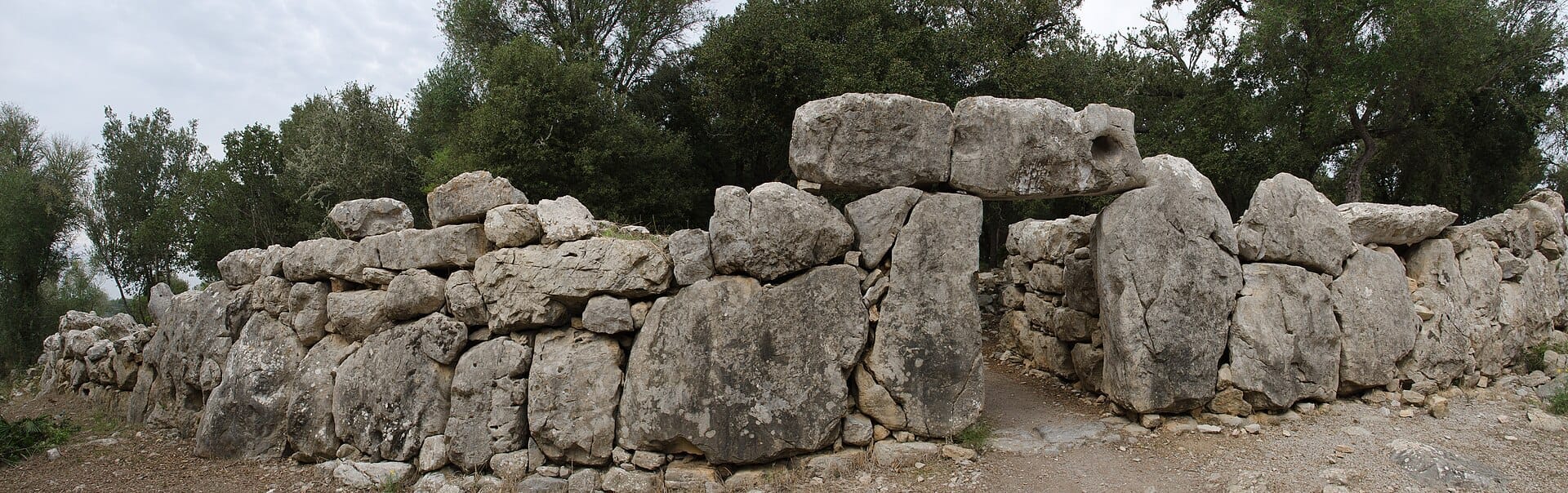
The Poblat Talaiòtic de Ses Païsses is an elliptical Bronze Age settlement on the southeastern edge of Artà that was continuously inhabited from roughly 1300 BC until around 100 BC, possibly later. It covers approximately 13,500 square metres and is surrounded by one of the most complete defensive perimeters surviving anywhere in the Balearic Islands: a 374-metre wall built from massive, uncut limestone blocks stacked without mortar — a construction technique known as cyclopean masonry.
At the heart of the site stands a talayot, a solid stone tower characteristic of this culture. Talayots gave the Talayotic period its name, and Ses Païsses preserves not only its central tower but also the foundations of domestic structures, a colonnaded peristyle hall, and several secondary chambers arranged around the interior. The site was declared a Historic-Artistic Monument in 1946 and excavated systematically between 1959 and 1963 by Italian archaeologist Giovanni Lilliu, whose work transformed understanding of Bronze Age Balearic culture.
ℹ️ Good to know
Opening hours and ticket prices listed here are based on available reference data and may have changed. Always confirm current hours and entry fees via the Artà tourist office (oit@arta.cat) or the Consell de Mallorca before making the trip.
The Gateway: Approaching the Cyclopean Portal
The approach from the parking area leads through a stand of mature holm oaks, Quercus ilex, whose broad canopy keeps the path cool even in summer. The air here smells of dry earth and bark, a contrast to the coastal pine-and-salt combination found across much of the island's east. Within a minute of leaving the entrance gate, the outer wall emerges through the trees: a belt of limestone slabs, some weighing several tonnes, assembled with a precision that still surprises visitors expecting something rougher.
The monumental southeast entrance is the architectural centrepiece. Three enormous upright stones support a single horizontal lintel to form a doorway roughly two metres high. Standing beneath it, you feel the weight of the construction above you in a way photographs simply do not convey. The stones are not dressed or polished — they are raw, grey, and slightly lichened — which makes the engineering achievement more striking. This gateway is among the best-preserved Talayotic entrances in Mallorca, and most visitors instinctively pause here for photographs before entering.
Tickets & tours
Hand-picked options from our booking partner. Prices are indicative; availability and final rates are confirmed when you complete your booking.
Jet ski adventure from Cala Bona to the Caves of Arta
From 165 €Instant confirmationFree cancellationDinosaurland and Caves of Hams combined ticket
From 25 €Instant confirmationFree cancellationShuttle Boat from Cala Millor to Cala Ratjada
From 26 €Instant confirmationFree cancellation3-hour Es Trenc Boat Tour in Mallorca
From 39 €Instant confirmationFree cancellation
Inside the Settlement: The Talayot, Houses, and Peristyle
Once through the portal, a dirt path winds through the interior with low wooden signage in Catalan, Spanish, and English marking key structures. The central talayot is solid rather than hollow, a truncated conical tower approximately six metres tall that would originally have been taller. Its function remains debated: watchtower, ritual platform, or symbol of communal authority. Whatever its purpose, it is the landmark you orient yourself by throughout the visit.
The domestic structures flanking the main path are low-walled foundations, but with some imagination and the interpretive boards provided, the layout of individual households becomes readable. One of the most interesting features is the peristyle room, a large colonnaded chamber whose stone columns still stand to knee or waist height. This architectural form suggests contact with or influence from Mediterranean cultures, particularly during the later occupation period when the Balearics entered the orbit of Carthaginian and then Roman power.
Holm oak roots have pushed between and under many of the stones across centuries, creating a blurred boundary between archaeology and woodland. In some areas the trees have toppled wall sections; in others their shade has actually protected stones from erosion. The interplay gives the site a slightly wild quality that more manicured classical sites lack.
How the Experience Changes Through the Day
In the morning, particularly between 9 and 11am, the oak canopy filters low-angle light across the stone surfaces, creating long shadows that emphasise texture and depth. This is the best light for photography: the grey limestone reads as warm gold, and the wall's irregular surfaces become highly three-dimensional. Temperatures are also cooler at this hour, which matters in July and August when the site offers limited shade outside the tree corridor.
By midday in summer, the interior of the settlement is largely open to the sky, and the exposed stone reflects heat noticeably. Bring water regardless of the season. The site is quiet almost regardless of when you visit — this is not a destination that draws coachloads of tourists, and even in peak season it is common to walk through for stretches without encountering another visitor. That quiet, combined with the age of the place, creates an atmosphere that is genuinely unusual in a region saturated with beach tourism.
💡 Local tip
Visit on a weekday morning when the light is best and the site is at its emptiest. Wear closed shoes — the terrain is uneven, and there are stone steps at the main portal. The site is not fully accessible for wheelchair users due to the rough ground and threshold steps.
Historical and Cultural Context
The Talayotic period in the Balearic Islands spans roughly from 1300 BC to the Roman conquest, with Ses Païsses occupied across most of that span. The people who built it were not a literate culture, so what we know comes entirely from material remains: pottery, bronze tools, animal bones, and architectural evidence. The scale of the defensive wall at Ses Païsses implies a population large enough to construct and maintain it, and a society organised enough to coordinate that labour. Estimates suggest the settlement could have housed between 100 and 300 people at various points in its occupation.
Giovanni Lilliu's excavations in the early 1960s were methodical by the standards of the era and produced artefacts now held in the Museu Regional d'Artà in the town centre. That small municipal museum is worth visiting before or after Ses Païsses: it provides the finds and interpretive context that the open-air site itself cannot fully supply.
Ses Païsses sits within the broader landscape of the southeast Mallorca interior, a part of the island that sees far fewer visitors than the coastal resorts. Combining it with nearby Capdepera Castle makes for a coherent day of Mallorcan history, from prehistoric Bronze Age through medieval Christian occupation.
Practical Walkthrough: What to Expect on the Ground
The site is compact enough to cover thoroughly in 45 minutes at a relaxed pace. A short loop path covers the main gateway, the perimeter wall, the central talayot, and the principal interior structures. There is no café, no gift shop, and no audio guide. The interpretive panels are informative but brief; visitors with a deeper interest in Talayotic archaeology will find them a starting point rather than a full education.
Entry is through a small booth at the parking area where a ticket is purchased. Reported admission has been approximately €2, though this figure dates from earlier published references and should be confirmed directly. The site operates on limited hours, reportedly weekday mornings and early afternoons only, with closure on weekends and public holidays. This is the most important practical constraint: if you arrive on a Saturday, the site will almost certainly be closed.
Artà itself is worth time beyond the archaeological site. The hilltop Santuari de Sant Salvador and the medieval walls above the town offer sweeping views over the surrounding farmland and, on clear days, toward the coast. For context on the wider region, our Alcúdia Old Town guide covers another layered historical site within reasonable driving distance. If you are building a full-day itinerary, check our Mallorca attraction overview for additional stops in the area.
Who Should Reconsider This Visit
Ses Païsses is not for everyone. If you are travelling with very young children who will not engage with low stone foundations and archaeological signage, the site offers little to hold their attention for more than fifteen minutes. Visitors who require step-free access will find the uneven terrain and the steps at the main portal genuinely difficult. And if your schedule is tight or you are arriving on a weekend without having confirmed opening hours, there is a real risk of making a 30-minute detour for a closed gate.
Those primarily interested in natural scenery rather than history would be better served by spending the same time at the Mondragó Natural Park or along the Formentor Peninsula. Ses Païsses rewards curiosity about the deep past. For casual sightseers, it may feel too sparse.
Insider Tips
- Confirm opening days and hours directly with the Artà tourist office (oit@arta.cat) before visiting. The site is reportedly closed on weekends and public holidays, which catches many visitors off-guard.
- Visit the Museu Regional d'Artà in town before or after the site. It holds artefacts excavated from Ses Païsses and provides the interpretive context that makes the ruins significantly more legible.
- The holm oaks create the most atmospheric light in the hour after opening. If you are there for photography, arriving at 9am gives you strong low-angle light and an empty site.
- Wear closed walking shoes with grip. The path is uneven, there are loose stones throughout the interior, and the main portal has a raised stone threshold that is easy to trip over if you are focused on looking up.
- Combine with the hilltop Santuari de Sant Salvador in Artà town for a half-day of history. The views from the sanctuary walls over the inland plain are excellent and require no entry fee.
Who Is Ses Païsses (Artà) For?
- History and archaeology enthusiasts wanting to understand pre-Roman Mallorca
- Photographers seeking textured stone subjects and dappled woodland light
- Travellers building a half-day inland itinerary away from the coast
- Couples or solo travellers who value quiet, unhurried exploration
- Road-trippers crossing the east of the island with a few flexible hours
Nearby Attractions
Other things to see while in Southeast Mallorca:
- Cabrera National Park
The Cabrera Archipelago Maritime-Terrestrial National Park is one of the most strictly protected natural areas in the western Mediterranean. Nineteen uninhabited islands, near-pristine seabed, and a 14th-century castle make it a world apart from mainstream Mallorca tourism. Access is limited and must be booked in advance.
- Cala Agulla
Cala Agulla is a 550-metre natural beach in northeast Mallorca, declared a protected natural area in 1991. Backed by dunes and pine forest, with shallow turquoise water and no major development, it's one of the cleanest and most unspoiled stretches of coastline on the island.
- Cala d'Or
Cala d'Or is a planned resort village on Mallorca's southeast coast, designed in the 1930s by an Ibizan architect and built around several sheltered sandy coves. With calm, clear water, low-rise whitewashed buildings, and a relaxed marina atmosphere, it draws families and couples looking for beach days without the noise of larger resorts.
- Cala Figuera
Cala Figuera is a working fishing village on the southeastern coast of Mallorca, set inside a narrow, fjord-like inlet that splits into two quiet arms. With no sandy beach, no resort hotels, and a harbor still active with traditional wooden boats, it offers something genuinely rare on this island: calm, character, and a sense of place.