Cala Figuera: The Fishing Village That Tourism Forgot
Cala Figuera is a working fishing village on the southeastern coast of Mallorca, set inside a narrow, fjord-like inlet that splits into two quiet arms. With no sandy beach, no resort hotels, and a harbor still active with traditional wooden boats, it offers something genuinely rare on this island: calm, character, and a sense of place.
Quick Facts
- Location
- Santanyí municipality, southeastern Mallorca, almost 60 km from Palma
- Getting There
- By car is the most practical option; no direct public bus service to the village itself
- Time Needed
- 1.5 to 3 hours for a relaxed visit; longer if dining
- Cost
- Free to visit; no admission fee
- Best for
- Photographers, slow travelers, couples, anyone wanting to see real Mallorcan village life
What Makes Cala Figuera Different
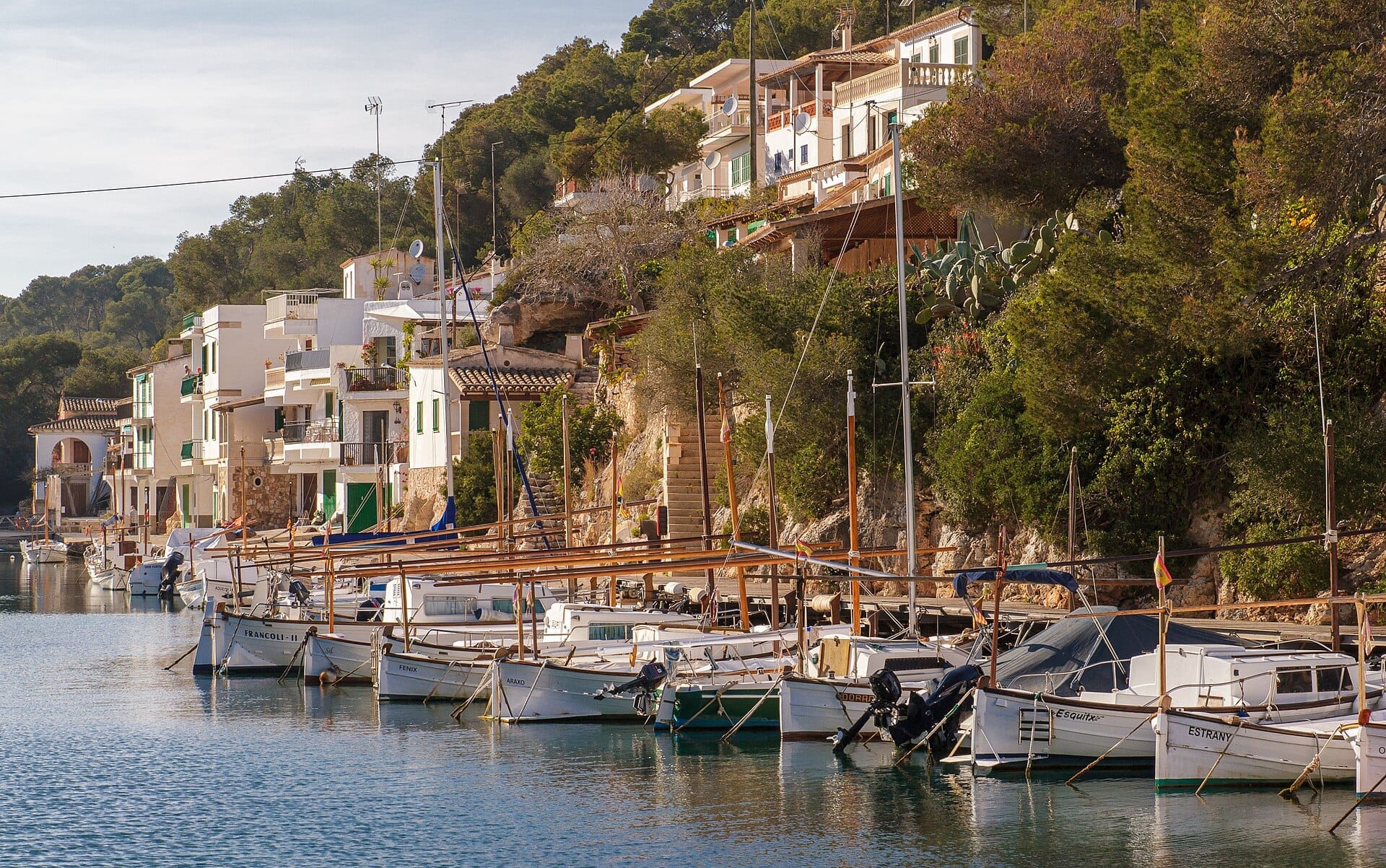
Most of Mallorca's coastal villages were reshaped by tourism decades ago. Cala Figuera was not. The reason is simple: there is no sandy beach here. Without that single amenity, the package-holiday infrastructure never arrived. No waterslide bars, no sunlounger rental stands, no strip of souvenir shops. What remains is a village that looks and functions much as it did a century ago.
The village sits inside a deep, narrow inlet carved into the limestone cliffs of the Santanyí coastline. The geography is unusual for Mallorca: the inlet forks into two arms, Caló d'en Boira and Caló d'en Busques, giving the harbor a sheltered, almost enclosed quality. Whitewashed houses with terracotta rooftops line the water's edge on both sides. The effect from the path above is striking, particularly in the flat morning light.
⚠️ What to skip
There is a second Cala Figuera on the island, located near Cap Formentor in the north. They share the name but are completely different places. If you are driving from Palma, confirm you are heading to the one in Santanyí municipality in the southeast.
The Harbor: Boathouses, Llauts, and Living Tradition
The heart of Cala Figuera is its working harbor. Along both arms of the inlet, you will find escars: traditional boathouses built directly into the rock face or tucked beneath the houses. These low-arched structures, painted in faded pastels, are still used to store fishing equipment and haul boats out of the water. They are not a decorative feature preserved for tourists. Families use them, repair nets in front of them, and tie their boats to the stone quays beside them.
The fishing boats you see here are traditional llauts, flat-bottomed wooden vessels that have worked these waters for generations. Early mornings, particularly in summer, you may see fishermen returning with their catch. The smell of the sea and engine oil mixes with whatever coffee is being made in the cafe nearest the water. It is one of the more honest sensory experiences you will have in coastal Mallorca.
The harbor path is flat and easy to walk in both directions. Most visitors do a loop: down one side of the inlet, across the small area at the water's end, and back along the other. The whole circuit takes under 30 minutes at an easy pace. Benches are placed at intervals, and there are a few cafes and restaurants with terrace seating overlooking the water.
Tickets & tours
Hand-picked options from our booking partner. Prices are indicative; availability and final rates are confirmed when you complete your booking.
Shuttle Boat from Cala Millor to Cala Ratjada
From 26 €Instant confirmationFree cancellationShuttle Boat Roundtrip from Cala Bona to Cala Ratjada
From 29 €Instant confirmationFree cancellationBoat Trip on a Glassbottom Catamaran from Font de Sa Cala
From 35 €Instant confirmationFree cancellationShuttle Boat Roundtrip from Font de Sa Cala to Cala Millor
From 29 €Instant confirmationFree cancellation
Time of Day and How the Village Changes
Morning is the best time to visit, and by some margin. Between 8am and 10am, the village belongs to its residents. The fishing boats may still be going out or coming back. Cats sit on the warm stone walls. The light comes in low over the eastern cliffs and hits the water at an angle that turns the inlet a deep blue-green. Photographers who arrive early will have the harbor almost entirely to themselves.
By midday in peak summer, day-trippers arrive in numbers. The village is never overwhelmed the way somewhere like Cala d'Or can be, but the harbor path does fill up and the restaurant terraces require patience for a table. The afternoon heat bounces off the limestone walls and the walk feels less pleasant. If you are visiting in July or August and cannot come in the morning, late afternoon, after 5pm, is the next best option as temperatures drop and the light becomes golden.
In spring and autumn, the timing matters less. October visits in particular feel like a different place: the air is clear, the crowds are thin, and the village operates on a quieter rhythm that matches its character far better.
💡 Local tip
Park at the upper car park near the village entrance and walk down. Parking close to the water is very limited and the narrow lanes make turning difficult in high season.
History and Settlement
Cala Figuera was first mentioned in records in 1306, though the village as it looks today is much more recent. The first houses were built at the end of the 19th century, gradually accumulating around the natural shelter of the inlet. The settlement has a permanent population of around 577 residences, a number that swells seasonally as holiday villa owners return.
The architecture reflects that organic growth rather than any planned development. Houses are built at different heights, connected by narrow stone steps and paths that run between the water's edge and the cliff above. There is no grand promenade, no uniform facade. The village reads like something that was added to incrementally, each generation building where space and rock allowed.
This part of southeastern Mallorca, centered on the Santanyí municipality, has a character quite distinct from the resort-heavy east coast. The nearby Mondragó Natural Park preserves a wider stretch of this coastline in much the same spirit, and a combined visit to both makes for one of the best half-days in the southeast of the island.
What There Is to Do
To be direct: Cala Figuera is not an activity destination. There is no beach, no water sports rental, no snorkeling pier. What it offers is the experience of walking through a coherent, low-key village and watching life proceed at its own pace near the water.
Walking the harbor path is the primary draw. The two arms of the inlet each have their own character: one tends to be slightly more residential and quieter, the other has more cafes and restaurant activity. A circuit of both, with stops to watch the boats and look into the escars, takes most visitors 45 minutes to an hour at a comfortable pace.
Swimming is possible from the flat rocks at the edge of the inlet. The water is clear and calm, and locals do use these spots, but do not expect a beach experience. Bring water shoes, as the rock entry is uneven.
For a sandy beach within easy reach, Mondragó Natural Park is a short drive and offers two genuinely good beaches in a protected natural setting. It pairs well with a morning at Cala Figuera.
Photography at Cala Figuera
This is one of the more photographed villages in Mallorca, and with reason. The inlet's geometry, with its symmetrical white houses reflected in the still water, produces compositions that are hard to get wrong. The challenge is producing an image that feels like your own rather than a replica of the thousands taken before.
The path above the inlet gives an elevated perspective that shows both arms at once. This is the classic shot, but it requires early morning to avoid other visitors appearing in frame. Alternatively, focus on the detail: the texture of an ecar door, the paint flaking off a wooden hull, the cats that lounge without concern on the stone walls. These closer images often capture the place more truthfully than the wide establishing shot.
For a broader look at photography opportunities across the island, the Mallorca photography guide covers the best vantage points and times of day across multiple locations.
💡 Local tip
The golden hour before sunset lights the western-facing houses on one arm of the inlet in warm tones while the other remains in shade. This contrast is more interesting than the flat midday light and worth timing your visit around.
Getting There and Practical Notes
Cala Figuera is almost 60 km southeast of Palma. By car, the drive takes around 50 to 60 minutes via the Ma-19 and connecting roads through Santanyí town. The roads narrow noticeably on the final approach to the village, and in peak season the last stretch can be slow with parking turnover.
Public transport to Cala Figuera itself is limited. Regular buses connect Palma to Santanyí town, from where a taxi or hired car would be needed for the remaining distance to the village. For this reason, a rental car is the practical choice for most visitors. The village makes a natural stop on a broader southeastern loop.
If you are planning to drive through this part of the island, the Mallorca road trip guide has a southeast route that includes Cala Figuera alongside other less-visited points on this coastline.
There is no formal visitor infrastructure at Cala Figuera: no tourist office, no ticket booth, no guided tours. The village is simply open. Accommodation options are limited to small family-run places; anyone looking for resort facilities will need to stay elsewhere and visit as a day trip.
Who Should Skip This
Cala Figuera will frustrate visitors expecting a beach. The absence of sand is the defining feature of this place, and no framing makes it otherwise. If your priority is a swimming cove with facilities and a sunlounger, this is the wrong stop. Similarly, anyone hoping for nightlife, shopping, or a full day of organized activities will find it thin.
Families with young children who need a beach base will do better at nearby Mondragó or heading further along the coast. Visitors who have limited time in Mallorca and are choosing between highlights should weigh whether a quiet fishing village fits what they are looking for, or whether somewhere like the Drach Caves or Palma's old town would deliver more.
If you are deciding how to allocate your days across the island, one week in Mallorca offers a practical framework for balancing different types of experiences.
Insider Tips
- Arrive before 9am in summer and you will often see the fishing boats still active and have the harbor path almost entirely to yourself. The difference in atmosphere compared to a 10am arrival is significant.
- The cafe tables closest to the water fill fastest. If you want a harbourside seat for coffee, go early or be prepared to wait. The quality difference between restaurants here is modest, so location matters more than reputation.
- Rock swimming spots are used by locals but are not marked. The flatter ledges toward the end of the Caló d'en Busques arm offer the most straightforward water entry. Water shoes are worth it.
- Combine Cala Figuera with Santanyí town, about 5 km inland. The town has a good weekly market and a quieter old quarter that complements the coastal stop without adding much driving time.
- In October and November, the village is noticeably quieter but still fully open. The light is excellent, the water remains warm enough to swim from rocks, and prices at the few restaurants are not inflated by summer demand.
Who Is Cala Figuera For?
- Photographers seeking harbour reflections and traditional boat detail in the early morning light
- Couples wanting a quiet coastal stop with good coffee and no resort noise
- Slow travelers on a southeast Mallorca road trip who want a genuine village experience
- Anyone who has already done the beaches and wants something with more character
- Visitors interested in traditional Mallorcan fishing culture and vernacular architecture
Nearby Attractions
Other things to see while in Southeast Mallorca:
- Cabrera National Park
The Cabrera Archipelago Maritime-Terrestrial National Park is one of the most strictly protected natural areas in the western Mediterranean. Nineteen uninhabited islands, near-pristine seabed, and a 14th-century castle make it a world apart from mainstream Mallorca tourism. Access is limited and must be booked in advance.
- Cala Agulla
Cala Agulla is a 550-metre natural beach in northeast Mallorca, declared a protected natural area in 1991. Backed by dunes and pine forest, with shallow turquoise water and no major development, it's one of the cleanest and most unspoiled stretches of coastline on the island.
- Cala d'Or
Cala d'Or is a planned resort village on Mallorca's southeast coast, designed in the 1930s by an Ibizan architect and built around several sheltered sandy coves. With calm, clear water, low-rise whitewashed buildings, and a relaxed marina atmosphere, it draws families and couples looking for beach days without the noise of larger resorts.
- Cala Llombards
Cala Llombards is a compact white-sand bay on Mallorca's southeast coast, framed by limestone cliffs and pine woodland. At roughly 55 metres wide, it fills quickly in summer, but its clear shallow water, cliff-side ladders for swimming, and relative quiet compared to more marketed beaches make it one of the more rewarding stops in the Santanyí area.