Cala Llombards: The Southeast Cove Worth the Winding Road
Cala Llombards is a compact white-sand bay on Mallorca's southeast coast, framed by limestone cliffs and pine woodland. At roughly 55 metres wide, it fills quickly in summer, but its clear shallow water, cliff-side ladders for swimming, and relative quiet compared to more marketed beaches make it one of the more rewarding stops in the Santanyí area.
Quick Facts
- Location
- Santanyí municipality, southeast Mallorca, near Es Llombards village
- Getting There
- ~50 min by car from Palma via MA-19; ~1h 40min by public bus from Palma to Santanyí, then local transfer
- Time Needed
- 2 to 4 hours
- Cost
- Free entry; beach open 24/7
- Best for
- Snorkeling, cliff jumping, families, photographers, off-peak beach days
What Cala Llombards Actually Is
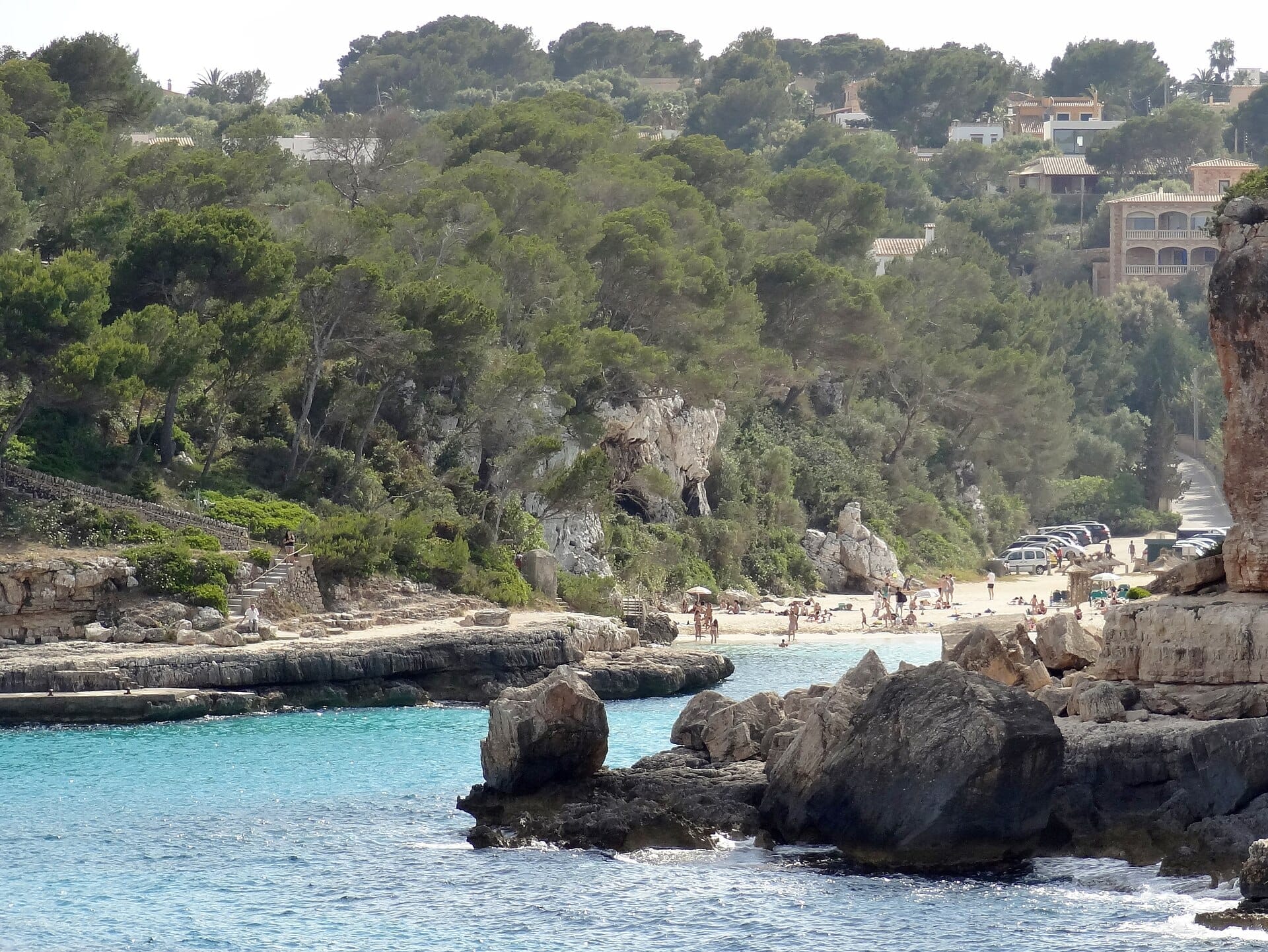
Cala Llombards is a small coastal inlet on Mallorca's southeast coast, sitting within the Santanyí municipality about 7 kilometres from Santanyí town and just a short walk from the quiet hamlet of Es Llombards. The beach itself measures roughly 55 metres across at its widest point and extends perhaps 150 metres inland in a narrow cone shape, where the mouth of the Son Amer torrent meets the sea. Fine white sand gives way to shallow, vigorously clear water in shades that shift from pale turquoise at the shore to deep blue-green further out.
The cove is flanked on both sides by steep limestone cliffs that catch afternoon light beautifully and provide natural shade along the edges by late morning. A fringe of Aleppo pines backs the sand, and the overall scale is genuinely small. On a busy July afternoon, this beach fills up quickly. On a Tuesday in late May or early October, it can feel almost private.
💡 Local tip
Parking near Cala Llombards is limited to a small roadside area. Arrive before 9:30 AM in July and August to secure a spot, or park near Es Llombards village and walk down in under 10 minutes.
The Experience by Time of Day
Early morning at Cala Llombards is the most atmospheric window. By 8 AM, the light hits the eastern cliff face at a low angle, turning the limestone a warm amber while the water below is glassy and undisturbed. The pine trees hold a faint resinous scent in the still air, and the only sounds are waves and the occasional call of an Eleonora's falcon, which nest in the sea cliffs of this coastline during summer months.
By mid-morning, families start arriving in numbers. Sunbed and parasol rentals are available at the beach, though most visitors also bring their own gear. The shallow entry makes this a practical choice for young children, and the rocky edges of the cove create natural pools where smaller kids explore. Snorkelers begin to spread across the bay as the sun climbs higher and visibility through the water increases.
Midday in peak summer is the most congested window. The cove's small footprint means towels end up closer together than most visitors would prefer. Those sensitive to crowds should target late afternoon instead, when tour groups and day-trippers begin to leave. Between 5 PM and sunset, the quality of light improves sharply and the crowd thins considerably. The western cliff throws a long shadow across the sand by about 6 PM, which actually lowers the temperature enough to make it pleasant for a final swim.
Tickets & tours
Hand-picked options from our booking partner. Prices are indicative; availability and final rates are confirmed when you complete your booking.
Shuttle Boat from Cala Millor to Cala Ratjada
From 26 €Instant confirmationFree cancellationShuttle Boat Roundtrip from Cala Bona to Cala Ratjada
From 29 €Instant confirmationFree cancellationBoat Trip on a Glassbottom Catamaran from Font de Sa Cala
From 35 €Instant confirmationFree cancellationShuttle Boat Roundtrip from Font de Sa Cala to Cala Millor
From 29 €Instant confirmationFree cancellation
Swimming, Snorkeling, and Cliff Jumping
The water at Cala Llombards is the main draw, and it earns the attention. The sandy bottom is gently shelving, making the first 20 metres safe for non-swimmers and children. Beyond that, the depth increases gradually and rocky outcrops on both sides of the cove create underwater topography worth exploring. Posidonia seagrass meadows are visible in sections, which accounts for the water clarity and also supports the small fish populations that make snorkeling rewarding here.
Metal ladders are fixed into the cliff rock on the cove walls, and these serve two purposes: they allow swimmers to access the deeper water along the cliff base without wading through the shallows, and they are the launch point for cliff jumping. The jumps are not extreme in height, but they are popular with teenagers and younger adults. If you are visiting with children who might be tempted, observe the entry point before allowing unsupervised jumping.
⚠️ What to skip
Cliff jumping always carries risk, regardless of how experienced other visitors appear. Check for rocks below the entry point before each jump, as sea conditions and water levels vary.
For snorkeling, bring your own equipment as there are no rental facilities at the beach. The best beaches in Mallorca for marine life tend to be those with seagrass beds and rocky margins, and Cala Llombards qualifies on both counts. Visibility is typically excellent from May through October.
Context: Santanyí's Coastline and Why This Cove Stands Out
Cala Llombards sits within the Migjorn, the southern coastal zone of Mallorca characterised by alternating cliffs and sandy inlets. The broader southeast Mallorca coastline is known for some of the island's most photographed beaches, including the dramatic Caló des Moro and the longer crescent of Es Trenc. Cala Llombards occupies the middle ground: more accessible and family-friendly than Caló des Moro, but far less developed than the resort-heavy northern coast.
The geology here is typical of the Santanyí sandstone, a golden-buff limestone that has been quarried on the island for centuries and used in many of Mallorca's historic buildings. The cliffs are soft enough to have been carved into arched forms by wave action, which creates the enclosed, sheltered quality that distinguishes coves like this one from open beaches further north. The Son Amer torrent, which historically deposited sand into the bay, is now dry for most of the year but its course is still visible as a slight depression through the pine woodland behind the beach.
If you are spending more than a day in this area, the nearby town of Santanyí has a weekly Saturday market and a well-preserved old quarter worth an hour of wandering. The Caló des Moro is a 20-minute drive along the coast and provides a striking contrast: narrower, deeper, and with a more dramatic cliff approach, but also stricter in terms of visitor numbers during peak season.
Getting There and Practical Planning
The most practical way to reach Cala Llombards is by rental car. From Palma, the drive takes approximately 50 minutes via the MA-19 motorway toward Campos/Santanyí, continuing south through Ses Salines and Santanyí. Renting a car in Mallorca gives you the flexibility to combine this stop with other southern coves on the same day, which is how most visitors approach this part of the island.
Public transport is possible but slow. Buses from Palma reach Santanyí in roughly 1 hour 40 minutes, and from there you would need a taxi or a 7-kilometre walk or cycle into Es Llombards. There is no direct bus service to the beach itself. Check current schedules with the Serveis Ferroviaris de Mallorca network before relying on this option.
Cala Llombards is not wheelchair accessible. The path from the parking area to the beach involves an uneven descent over compacted earth and some loose stone steps. The beach surface is soft sand, and there are no adapted facilities. Facilities at the beach are minimal: no permanent bars or restaurants directly on the sand, though small seasonal vendors sometimes operate at the access point. Bring water, food, and sun protection. Shade is available under the pines at the back of the beach but disappears from the main sand area by mid-morning.
ℹ️ Good to know
Cala Llombards is walkable from Cala Santanyí in roughly 20 minutes along a coastal path. Combining both beaches in a single morning visit is practical and gives you a good sense of how varied the Santanyí coastline is over a short distance.
Photography and Conditions
This is one of the more photogenic coves in the south, though it is not as widely circulated as Caló des Moro. The cliff-water-pine composition works best in the golden hours. Morning light illuminates the eastern cliff face directly; late afternoon light catches the western side. For drone photography, check current regulations in Spain before flying, as restrictions apply to some coastal and natural areas. The Mallorca photography guide covers the island's best shooting locations with seasonal timing advice.
Water colour photography is best on calm days with high sun, typically between 10 AM and 2 PM when the light penetrates deeply enough to show the gradations from sand to rock to open sea. Overcast days flatten the colour significantly. Wind from the south occasionally brings swell into this cove, which eliminates the turquoise-glass effect entirely and makes the water murky for 24 to 48 hours afterward.
Honest Assessment: What This Beach Is and Isn't
Cala Llombards is a genuinely good beach within its category: a small, scenic, free cove with clear water and a relaxed atmosphere outside of peak summer. It is not undiscovered, and in July and August it can feel overcrowded given its size. Visitors expecting vast stretches of sand or beach clubs will be disappointed. Those who want a beautiful, relatively natural swimming spot in the southeast will find it delivers.
If your priority is long stretches of sand, Es Trenc beach sits about 20 kilometres to the northwest and offers a completely different scale and character. If you prefer maximum drama with fewer facilities, Caló des Moro is closer and more intense. Cala Llombards sits between those two extremes, which is precisely why it suits families and swimmers who want beauty without the commitment of a difficult cliff trail.
People who will not enjoy this beach: those who need sunbeds and bar service, anyone with limited mobility, visitors arriving in peak season without an early start, and travellers who find small enclosed spaces with many people stressful. The cove's enclosed geometry means noise carries and the sense of crowding is amplified when it fills up.
Insider Tips
- Arrive before 9:30 AM in July and August. The parking area fills completely by 10 AM on clear summer days and there is no overflow option nearby.
- Walk the coastal path southwest toward Cala Santanyí for a 20-minute trail that gives elevated views back over Cala Llombards from the cliff top. It is one of the better vantage points in the area and very few visitors take the time to do it.
- Bring snorkeling gear from your accommodation. There is nowhere to rent equipment at the beach, and the rocky cliff margins hold more marine life than the central sandy area.
- The shaded pine area at the back of the beach is small but genuinely cool even on hot days. It fills up early. If shade is a priority for your group, this is another reason to arrive in the first hour of the morning.
- Late September and early October offer the best balance here: sea temperatures are still warm from summer (above 20°C), the crowds have dropped sharply, and the light has the quality of autumn without the water being cold.
Who Is Cala Llombards For?
- Families with young children who need shallow, calm entry water
- Snorkelers looking for clear water with rocky margins and seagrass
- Photographers working the southeast coastline who want cliff-and-cove compositions
- Travellers combining multiple southern coves in a single day drive
- Off-season visitors in May, June, September, or October who want a classic Mallorcan cove without summer crowds
Nearby Attractions
Other things to see while in Southeast Mallorca:
- Cabrera National Park
The Cabrera Archipelago Maritime-Terrestrial National Park is one of the most strictly protected natural areas in the western Mediterranean. Nineteen uninhabited islands, near-pristine seabed, and a 14th-century castle make it a world apart from mainstream Mallorca tourism. Access is limited and must be booked in advance.
- Cala Agulla
Cala Agulla is a 550-metre natural beach in northeast Mallorca, declared a protected natural area in 1991. Backed by dunes and pine forest, with shallow turquoise water and no major development, it's one of the cleanest and most unspoiled stretches of coastline on the island.
- Cala d'Or
Cala d'Or is a planned resort village on Mallorca's southeast coast, designed in the 1930s by an Ibizan architect and built around several sheltered sandy coves. With calm, clear water, low-rise whitewashed buildings, and a relaxed marina atmosphere, it draws families and couples looking for beach days without the noise of larger resorts.
- Cala Figuera
Cala Figuera is a working fishing village on the southeastern coast of Mallorca, set inside a narrow, fjord-like inlet that splits into two quiet arms. With no sandy beach, no resort hotels, and a harbor still active with traditional wooden boats, it offers something genuinely rare on this island: calm, character, and a sense of place.