Es Trenc Beach: Mallorca's Last Great Wild Shoreline
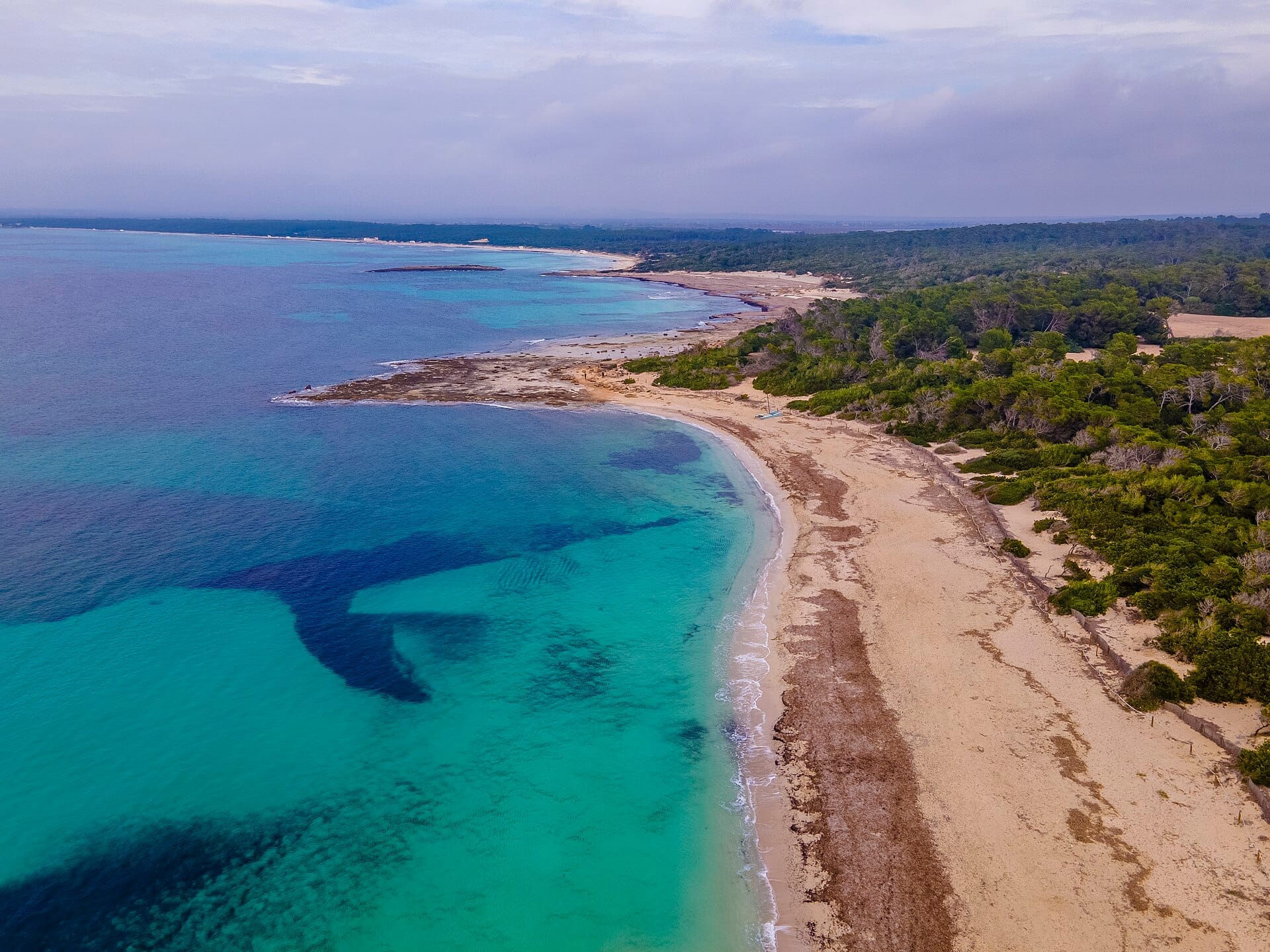
Platja d'es Trenc stretches for roughly 2 kilometres along the southeast coast of Mallorca, protected by law from the hotel development that has consumed most of the island's finest sand. The water is shallow and startlingly clear, the dunes are intact, and the surrounding wetlands shelter over 170 bird species. It is as close to a Caribbean-style beach as you will find in the western Mediterranean, and it remains free to enter.
Quick Facts
- Location
- Campos municipality, southeast Mallorca — approx. 50 km from Palma
- Getting There
- Car recommended: ~50 min from Palma via MA-19 toward Llucmajor, follow signs to Campos and Es Trenc. Infrequent seasonal buses from Palma exist but schedules vary — check TIB (Transport de les Illes Balears) for current timetables
- Time Needed
- Half day minimum; a full day is realistic if you walk the whole beach
- Cost
- Free entry. Sunbed and parasol hire available seasonally (approx. €10–15/day, verify on-site)
- Best for
- Beach lovers wanting undeveloped coastline, nature walkers, birdwatchers, nudist-friendly areas
What Makes Es Trenc Different from Every Other Beach in Mallorca
Platja d'es Trenc occupies a stretch of the Migjorn coast that somehow escaped the resort development that defines much of Mallorca's shoreline. Roughly 2 kilometres long and in places no more than 20 metres wide at high season, the beach sits inside a protected natural area of nearly 1,500 hectares, designated to preserve both the dune system and the adjacent Salobrar de Campos wetlands. What that means in practice: no hotels loom over the water, no apartment blocks interrupt the view west, and the sand is fine white calcium carbonate that squeaks faintly underfoot.
The water colour here genuinely surprises first-time visitors. The combination of a white sandy seabed, extremely shallow gradient, and the clarity of the western Mediterranean produces shades that shift from pale turquoise near the shore to a deeper cobalt at the outer edge of the swimming zone. On a calm morning with the sun behind you, the effect is almost theatrical.
💡 Local tip
Arrive before 10am in July and August. Parking fills to capacity by mid-morning and the experience changes significantly once the beach is crowded. The early light is also better for photography.
The Beach from End to End
The western access point at Ses Covetes is the busiest end of the beach, closest to the main car parks and the small cluster of beach bars and kiosk stalls that operate during summer. This section gets the earliest foot traffic and the densest crowds. If you walk east from here, the beach gradually quiets. Facilities thin out, the sand gets wider, and by the time you reach the middle stretch you are sharing space with a noticeably smaller number of people.
Continuing east, the beach transitions into the officially designated nudist zone, which has existed here since before the end of the Franco era, making Es Trenc one of the longest-established naturist stretches in Spain. There are no hard boundaries marked on the sand, but the conventions are well understood by regular visitors. Families with children tend to stay toward the Ses Covetes end; couples and independent travellers spread across the middle; the eastern sections are predominantly used by naturists.
The far eastern end approaches Colonia de Sant Jordi, a small resort town. Walking the full length and back takes a solid two to three hours, and it is worth doing once if you have the time. The dune vegetation changes as you go, and the horizon remains uninterrupted throughout. Bring water: there are no facilities at the eastern end.
Tickets & tours
Hand-picked options from our booking partner. Prices are indicative; availability and final rates are confirmed when you complete your booking.
3-hour Es Trenc Boat Tour in Mallorca
From 39 €Instant confirmationFree cancellation4-hour Es Trenc Boat Day trip in Mallorca
From 55 €Instant confirmationFree cancellationEs Trenc beach catamaran tour with barbecue
From 56 €Instant confirmationFree cancellationDinosaurland and Caves of Hams combined ticket
From 25 €Instant confirmationFree cancellation
The Protected Natural Area and Its Ecology
The beach cannot be separated from what lies behind it. The Salobrar de Campos, a coastal saltmarsh and wetland system that backs the dunes, is one of the most ecologically significant sites in the Balearic Islands. Over 170 bird species have been recorded here, including flamingos, black-winged stilts, and various wading birds that use the saline shallows as feeding grounds during migration. In autumn and early spring, the birdwatching quality rivals anything in mainland Spain.
The dune system itself is fragile. Visitors are asked to use marked access paths rather than crossing the dunes directly, and the signage explaining why is unusually detailed for a public beach. The plant communities binding the dunes include several endemic Balearic species. Trampling these is both illegal under Balearic environmental regulations and ecologically damaging in ways that take decades to repair.
If the ecology of the south interests you, the nearby Mondragó Natural Park on the southeast coast offers a complementary experience: rocky coves enclosed by protected scrubland, with its own coastal wetlands and walking trails.
Practical Walkthrough: Getting Here and Settling In
There is no train or tram to Es Trenc. The most reliable approach is by car. From Palma, take the MA-19 motorway toward Llucmajor, then follow signs for Campos and eventually Es Trenc or Ses Covetes. The drive takes around 50 minutes without summer traffic; allow 60 to 70 minutes in peak July or August. Parking areas exist near Ses Covetes and at several points along the access road, but capacity is genuinely limited. Arriving after 11am on a Saturday in August often means parking a kilometre or more from the sand and walking in on a dusty track in full sun.
Seasonal bus services from Palma do connect to the area, operated through the TIB network, but schedules are infrequent and not always timed conveniently for a day at the beach. Check the TIB website for current timetables before relying on this option. Cycling from nearby towns like Colonia de Sant Jordi or Sa Rapita is a genuine possibility for fit riders.
⚠️ What to skip
There is almost no shade on Es Trenc. The dune vegetation provides none, and the beach bars only cover a fraction of the area. Bring a parasol, high-SPF sunscreen, and more water than you think you need. Heatstroke is a real risk for visitors who underestimate the southern Mallorca sun in summer.
Facilities at the Ses Covetes end include public toilets, outdoor showers, a handful of chiringuito-style beach bars serving cold drinks and basic food, and sunbed hire. Lifeguards are posted seasonally. Disabled access ramps are available. The water gradient is shallow enough that children can wade considerable distances without reaching significant depth, which makes the western end particularly suitable for families with young kids.
Es Trenc fits naturally into a broader exploration of southeast Mallorca. The fishing village of Cala Figuera is under 30 minutes by car and makes an excellent contrast: a quiet working harbour with no beach at all, just limestone cliffs and bobbing boats.
How the Experience Changes Through the Day
The hour before 9am at Es Trenc is qualitatively different from what comes after. The light comes from the east, flat and warm, and it catches the dune grasses at a low angle. The water is still, almost always glassy before the coastal breeze picks up. The only sounds are the occasional gull and the soft collapse of small waves on the sand. Dog walkers from Ses Covetes tend to appear early, along with a handful of serious swimmers who do long parallel laps before the beach fills.
Between 10am and 1pm, the character shifts. Families stake out territory near the facilities end, beach bars begin serving, and the volume of conversation rises. The water temperature is warmest in August, typically above 26°C at the surface. By early afternoon in high summer, the main sections near Ses Covetes resemble any popular Mediterranean beach: towels close together, sunscreen in the air, queue for the showers.
Late afternoon is often underrated. Crowds thin considerably from about 5pm onward as families leave. The angle of the sun softens the colours across the water and the dunes turn amber. For photography, this window is significantly better than midday, when the sun directly overhead flattens everything. Sunset from the western end of Es Trenc faces roughly northwest and can produce excellent sky colour over the sea.
If you are planning a visit to Mallorca specifically around its beaches and want context on the full range of options across the island, the best beaches in Mallorca guide provides comparisons with the north and east coasts, including spots that suit different priorities.
Who This Beach Is Not Right For
Es Trenc is not the right choice for everyone. Visitors who want beach bars at regular intervals, watersports hire, organised activities, or nearby restaurants will find the facilities sparse compared to resort beaches like Playa de Muro or Cala d'Or. The distance from Palma means it is not a casual half-hour detour. If you are travelling without a car and are not willing to navigate infrequent buses or cycle, getting here is genuinely inconvenient.
In high season, the idea that Es Trenc is an unspoiled secret is not entirely accurate. The main western section can be very crowded from late morning to mid-afternoon in July and August. What is preserved is the landscape behind the beach, not the solitude of the beach itself on peak summer days. Visitors expecting Caribbean-level tranquillity on a Tuesday in August may find the reality requires adjustment.
Timing your visit to Mallorca affects everything. The best time to visit Mallorca covers the tradeoffs between shoulder-season weather, crowd levels, and which beaches are worth the trip at different points in the year.
Photography at Es Trenc
The beach photographs well under specific conditions. The hour after sunrise and the two hours before sunset are the most productive windows. Aerial drone photography requires prior authorisation in protected natural areas in the Balearic Islands; check current regulations with the Govern Balear before bringing a drone. At ground level, a polarising filter dramatically improves water colour saturation.
The most distinctive compositions here combine the white sand with the dune vegetation: dried sedge, low-growing sea holly, and the skeletal shapes of driftwood that accumulate at the tide line in autumn and winter. Outside peak season, the beach is sparse enough that human subjects become part of a larger landscape rather than competing with it.
For a broader approach to capturing Mallorca's varied landscapes, the Mallorca photography guide covers locations from the Tramuntana mountains to the southeast coast with practical advice on light conditions and access.
Insider Tips
- The section of beach roughly 1.5 to 2 kilometres east of Ses Covetes is the sweet spot for most independent travellers: far enough from the main facilities to lose the densest crowds, close enough to walk back for a drink without a 40-minute trudge. Aim for this stretch if you arrive before 9.30am and claim space early.
- Bring a beach mat or groundsheet in addition to towels. The fine sand on the western sections is very light and drifts constantly when the coastal breeze picks up, covering everything at low level. Towels alone leave your belongings coated in sand within an hour.
- The small car park accessed via the Sa Rapita road (eastern approach) is less known than the Ses Covetes lots and tends to fill later. It deposits you closer to the quieter middle sections of the beach rather than the crowded western end.
- If the sea is rough, check before making the drive. Es Trenc faces south and southwest, which means it is exposed to the occasional Migjorn wind that can produce choppy surf and poor water visibility. On these days, the sheltered coves on the east coast offer calmer alternatives.
- The Salobrar de Campos wetlands are best visited at dawn or dusk for birdwatching. The access track that runs along the inland edge of the protected area is walkable and gives good views over the saltmarsh without entering the protected core. Binoculars are worth bringing.
Who Is Es Trenc Beach For?
- Beach purists who prioritise sand and water quality over resort amenities
- Families with young children needing very shallow, calm water for safe swimming
- Naturists looking for an established and unselfconscious nudist stretch
- Birdwatchers and nature walkers interested in coastal wetland ecosystems
- Photographers seeking landscape compositions without resort architecture in the background
Nearby Attractions
Other things to see while in Southeast Mallorca:
- Cabrera National Park
The Cabrera Archipelago Maritime-Terrestrial National Park is one of the most strictly protected natural areas in the western Mediterranean. Nineteen uninhabited islands, near-pristine seabed, and a 14th-century castle make it a world apart from mainstream Mallorca tourism. Access is limited and must be booked in advance.
- Cala Agulla
Cala Agulla is a 550-metre natural beach in northeast Mallorca, declared a protected natural area in 1991. Backed by dunes and pine forest, with shallow turquoise water and no major development, it's one of the cleanest and most unspoiled stretches of coastline on the island.
- Cala d'Or
Cala d'Or is a planned resort village on Mallorca's southeast coast, designed in the 1930s by an Ibizan architect and built around several sheltered sandy coves. With calm, clear water, low-rise whitewashed buildings, and a relaxed marina atmosphere, it draws families and couples looking for beach days without the noise of larger resorts.
- Cala Figuera
Cala Figuera is a working fishing village on the southeastern coast of Mallorca, set inside a narrow, fjord-like inlet that splits into two quiet arms. With no sandy beach, no resort hotels, and a harbor still active with traditional wooden boats, it offers something genuinely rare on this island: calm, character, and a sense of place.