Caló des Moro: Mallorca's Most Coveted Cove (And What It Really Takes to Get There)
Caló des Moro is a narrow, cliff-framed cove in southeast Mallorca with turquoise water so clear it barely looks real. Getting there requires a 15-30 minute walk on rocky terrain, and in summer the small beach fills fast. Here's everything you need to know before you go.
Quick Facts
- Location
- Municipality of Santanyí, southeast Mallorca, near Cap de Ses Salines
- Getting There
- Car to limited parking (~1km away, fills by 9am in summer), then 15-30 min walk on rocky trail. No public transit to trailhead.
- Time Needed
- 2-4 hours including walk in and out
- Cost
- Free (open natural site)
- Best for
- Snorkeling, photography, couples, early-morning swimmers
What Is Caló des Moro?
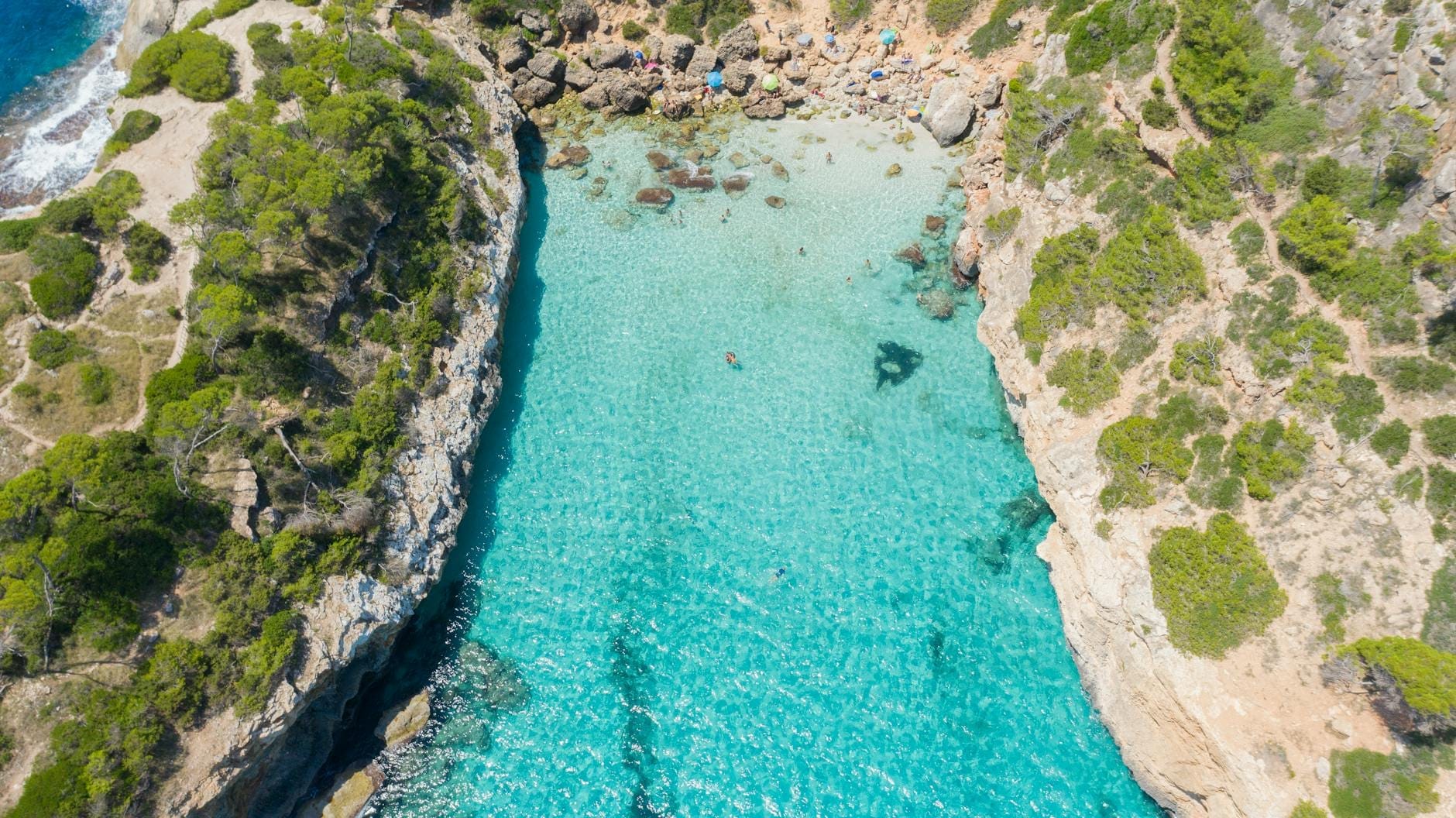
Caló des Moro is a small natural cove in the Santanyí municipality of southeast Mallorca, tucked between limestone cliffs that drop almost vertically into the sea. The name translates roughly from Catalan as 'small Moors' cove', and it is also referred to locally as Cala de Sa Comuna or Cala del Moro. The beach itself is only 30 to 40 metres wide: a sliver of pale sand and flat rock shelves framed by Aleppo pines and bleached stone. What makes it remarkable is the water. The cove's depth, orientation, and white sandy seabed produce shades of blue and green that shift with the light, ranging from near-white in the shallows to deep sapphire at the mouth.
This is not a comfortable, amenity-rich beach. There are no sun loungers to rent, no beach bars, no lifeguards, and no shade structures. What you get instead is one of the most geometrically perfect coves on the island, in a setting that still feels genuinely natural despite the crowds that now arrive every summer morning.
⚠️ What to skip
Caló des Moro has no toilets on the beach itself. There are portable facilities near the parking area, roughly 1km from the cove. Plan accordingly before starting the trail.
The Walk In: What to Expect on the Trail
Access to Caló des Moro is pedestrian only. The main trail begins at the end of Carrer de Caló des Moro, a narrow lane that connects to the road toward Cala S'Almunia and Cala Llombards. A second approach runs from Carrer des Castellet. Both routes take between 15 and 30 minutes depending on your pace, and both involve uneven limestone rock, loose gravel, and sections where the path drops sharply toward the sea. Wearing flip-flops on this trail is a genuine mistake: the rocks are sharp and slippery near the waterline.
There is minimal signage. The general navigation tip is to follow the road from Santanyí toward Cala Llombards, then look for the sign to Cala S'Almunia. From there, the trail is informal but well-worn. In peak summer, you will simply be able to follow the other visitors.
The walk itself is part of the experience. The path moves through low coastal scrub, with views of the cliffs opening up as you descend. If you are already planning a drive along southeast Mallorca's coastline, this fits naturally into a half-day combining two or three coves in the area.
💡 Local tip
Wear closed-toe shoes or sturdy sandals with grip. Bring water, sunscreen, and anything you need for the beach — you cannot buy anything once you leave the parking area.
Tickets & tours
Hand-picked options from our booking partner. Prices are indicative; availability and final rates are confirmed when you complete your booking.
Dinosaurland and Caves of Hams combined ticket
From 25 €Instant confirmationFree cancellationShuttle Boat from Cala Millor to Cala Ratjada
From 26 €Instant confirmationFree cancellation3-hour Es Trenc Boat Tour in Mallorca
From 39 €Instant confirmationFree cancellationShuttle Boat Roundtrip from Cala Bona to Cala Ratjada
From 29 €Instant confirmationFree cancellation
Parking: The Practical Problem You Need to Solve First
Parking is the main logistical challenge at Caló des Moro, and it has been with road restrictions in place by the municipality of Santanyí. You cannot drive to the cove itself. Vehicles must be left roughly one kilometre away, in a small informal parking area that fills completely by 9am on summer mornings and sometimes earlier in July and August. Arriving after 10am in high season and expecting to park easily is optimistic.
There is no public bus service that brings you directly to the trailhead. Renting a car remains the most practical option for reaching this part of the island. If you want to avoid the parking problem entirely, arriving before 8:30am is the most reliable solution. Some visitors park in Cala Llombards village and walk an extended trail to the cove, which adds time but sidesteps the congestion.
For more on moving around the island independently, the getting around Mallorca guide covers car hire, buses, and local transport options in detail.
The Cove Itself: Atmosphere by Time of Day
In the early morning, before 9am, Caló des Moro is as close to serene as a popular Mallorcan beach gets in summer. The light falls low across the cliffs, casting the water in cool, deep greens. The sand is undisturbed. The only sounds are water moving through the rock channels at the cove's edges and occasional birdsong from the pines above. This is the hour for photography and for understanding why the place developed such a strong reputation.
By 11am, the dynamic has changed substantially. The small beach fills with towels and bodies, and the flat rocks on either side become improvised sunbathing platforms. The water stays beautiful regardless, and snorkeling along the cliff walls reveals sea grass, rock formations, and occasionally octopus or sea bream in the clear depths. The afternoon brings the strongest sun directly into the cove, which makes the colours of the water most intense for photography but also means there is no shade anywhere on the beach.
Evenings bring a second quieter window. After 6pm, the crowds thin noticeably, and the low afternoon sun turns the limestone cliffs amber. Swimming at this hour, with the cove nearly empty again, is a different experience from the midday rush. The walk back to the parking area in fading light requires a torch or phone light if you stay too late.
💡 Local tip
For photography, arrive before 9am or return after 6pm. Midday light is harsh on the cliffs, and the beach is too crowded for clean wide shots between 11am and 4pm.
Swimming and Snorkeling: The Water Itself
The water at Caló des Moro is the main reason people make the effort. It is shallow enough near the beach that you can see the sandy bottom clearly from a standing position in the first few metres, then deepens gradually as the cove opens toward the sea. The clarity is exceptional, a product of the protected cove shape and the clean Mediterranean currents that push through the southeast coast.
Snorkeling is best done along the rocky walls to the left and right of the beach, where the flat sandy bottom gives way to irregular limestone formations covered in sea grass and posidonia. The posidonia oceanica meadows that exist along this stretch of coast are a protected marine habitat and a key reason the water is so clear: they filter sediment and oxygenate the water. Treat them accordingly and do not stand on or anchor into them.
There are no lifeguards. Entry into the water is from sand or flat rock shelves. The sea floor drops away more sharply at the mouth of the cove, so weaker swimmers should stay in the inner shallows. The water temperature reaches above 24°C in July and August, cooling to the high teens by October.
Context: Caló des Moro in the Southeast Coast
Caló des Moro sits within a stretch of Mallorcan coastline that contains several of the island's most striking natural beaches. It is close to Cala Llombards, a larger and slightly more accessible cove a short drive north, and near Cala Figuera, a traditional fishing village with a dramatically narrow harbour. Together these spots make a coherent day on the southeast coast without requiring large distances between stops.
Further afield but still within the same region, Es Trenc beach offers a completely different experience: a long, flat, natural stretch of sand backed by dunes and accessible without a difficult walk, making it a better option for families or anyone who needs easier access.
The southeast of Mallorca receives fewer visitors than the northeast or the Tramuntana mountains, which keeps a certain quietness to the overall area even as individual spots like Caló des Moro attract serious summer crowds. The landscape here is flat coastal scrubland and limestone plateau: less dramatic in terms of elevation than the northwest, but austere in its own way.
Who Should Think Twice Before Visiting
Caló des Moro is not suitable for visitors with limited mobility. The trail from the parking area involves significant rocky terrain, uneven surfaces, and in places requires careful foot placement. It cannot be navigated by wheelchair, and strollers are not practical. Bringing young children who cannot walk the trail independently adds complication, as the path is not forgiving and there is nothing to do on the beach itself except swim or sit.
Visitors who need beach facilities should look elsewhere. There are no showers, no beach bars, no equipment rentals, and no shade. If your ideal beach day involves an umbrella, a cold drink delivered to your towel, and a lifeguard in view, Caló des Moro will disappoint. Go to Cala Llombards or the resort beaches near Cala d'Or instead.
For a broader sense of which beaches across the island suit different travel styles, the best beaches in Mallorca guide compares natural, resort, and family-friendly options side by side.
Insider Tips
- Arrive before 8:30am in July and August if you want a parking space and a quiet beach. By 10am the cove is often shoulder to shoulder with towels.
- The flat rock shelves to the right of the beach are more comfortable for sitting than the sand, and give a slightly elevated view across the water. They also dry fast after swimming.
- Bring your own snorkel and mask. The water clarity makes snorkeling genuinely worthwhile here, but there is nowhere nearby to buy or rent equipment.
- The approach from Cala S'Almunia (the adjacent cove) is slightly less steep than the main trail and gives you a view of both coves on the way in. Worth considering if you want to combine both stops.
- Mobile signal is weak or absent at the cove. Download offline maps before you leave town, or at minimum screenshot the trail route — the path is not officially marked and branches in places.
Who Is Caló des Moro For?
- Early-morning swimmers who can secure parking and want the cove to themselves
- Photographers after natural seascape shots with minimal crowds
- Snorkelers comfortable in open water without lifeguard supervision
- Couples or independent travellers who enjoy an active approach to beach days
- Visitors building a self-drive day along the southeast coast
Nearby Attractions
Other things to see while in Southeast Mallorca:
- Cabrera National Park
The Cabrera Archipelago Maritime-Terrestrial National Park is one of the most strictly protected natural areas in the western Mediterranean. Nineteen uninhabited islands, near-pristine seabed, and a 14th-century castle make it a world apart from mainstream Mallorca tourism. Access is limited and must be booked in advance.
- Cala Agulla
Cala Agulla is a 550-metre natural beach in northeast Mallorca, declared a protected natural area in 1991. Backed by dunes and pine forest, with shallow turquoise water and no major development, it's one of the cleanest and most unspoiled stretches of coastline on the island.
- Cala d'Or
Cala d'Or is a planned resort village on Mallorca's southeast coast, designed in the 1930s by an Ibizan architect and built around several sheltered sandy coves. With calm, clear water, low-rise whitewashed buildings, and a relaxed marina atmosphere, it draws families and couples looking for beach days without the noise of larger resorts.
- Cala Figuera
Cala Figuera is a working fishing village on the southeastern coast of Mallorca, set inside a narrow, fjord-like inlet that splits into two quiet arms. With no sandy beach, no resort hotels, and a harbor still active with traditional wooden boats, it offers something genuinely rare on this island: calm, character, and a sense of place.